When Company Names Collide: Challenging Trade Names Through the Company Names Tribunal
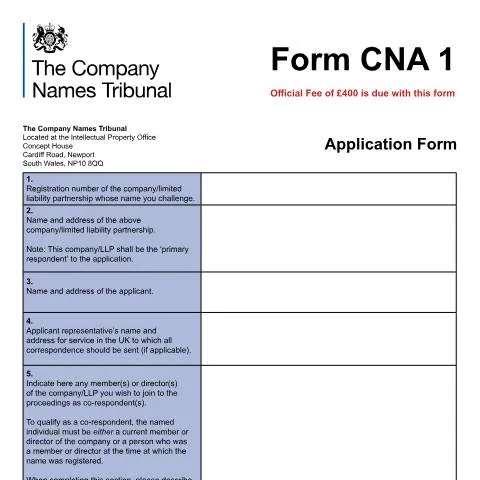
The CNA1 application form represents one of the most decisive legal instruments available to UK businesses facing name disputes with registered companies. This specialised tribunal procedure, overseen by the Intellectual Property Office, offers an alternative route to expensive High Court litigation when a company's registered name appears to infringe upon established trading rights or reputation.
Unlike straightforward company name changes or trademark disputes, the Company Names Tribunal process specifically addresses situations where a company has registered a name that conflicts with another party's pre-existing goodwill in that name. The £400 official fee reflects the serious nature of these proceedings, which can ultimately force a company to change its registered name or face having a new name imposed by the Adjudicator.
The Strategic Landscape: Where CNA1 Fits in Commercial Name Protection
The Company Names Tribunal operates within a complex ecosystem of business name protection mechanisms. While Companies House prevents identical names being registered simultaneously, it cannot assess whether a proposed name infringes upon existing trading rights or causes confusion in the marketplace.
This creates a registration gap where companies can legitimately register names that nevertheless harm established businesses. The CNA1 process fills this void by providing a relatively swift adjudication mechanism compared to full trademark litigation or passing off claims in the courts.
Distinguishing Tribunal Proceedings from Alternative Remedies
The Company Names Tribunal differs fundamentally from other dispute resolution mechanisms:
- Speed advantage: Tribunal proceedings typically conclude within months rather than the years often required for High Court litigation
- Cost efficiency: The £400 fee plus legal costs remain substantially lower than full commercial litigation
- Specialist expertise: Adjudicators possess specific knowledge of company law and commercial naming practices
- Limited scope: The Tribunal cannot award damages, only order name changes and costs
Applicant Profiles: Who Can Challenge Company Names
The CNA1 process serves various categories of commercial actors, each with distinct strategic considerations and evidentiary requirements.
Established Trading Businesses
The most common applicants are businesses that have operated under a particular name for substantial periods before a company registered a similar or identical name. These applicants must demonstrate goodwill through evidence such as:
- Trading accounts showing revenue under the challenged name
- Marketing materials and customer communications
- Supplier contracts and business correspondence
- Evidence of geographic trading area and customer base
Professional Service Providers
Solicitors, accountants, consultants and other professional practitioners frequently use CNA1 applications when companies register names incorporating their professional identity. The challenge often centres on demonstrating personal reputation rather than traditional business goodwill.
Charitable and Non-Commercial Organisations
Charities and community organisations can apply through CNA1 when their established name becomes compromised by company registrations. These cases often involve demonstrating public recognition rather than commercial trading patterns.
| Applicant Type | Key Evidence Required | Common Challenges |
|---|---|---|
| Trading Companies | Financial records, customer base evidence | Proving geographic overlap with respondent |
| Sole Traders | Business registration, trading history | Demonstrating sufficient scale of operation |
| Professional Partnerships | Client relationships, professional recognition | Establishing personal vs business reputation |
| Charitable Bodies | Public awareness, donor relationships | Quantifying non-commercial goodwill |
Dissecting the CNA1 Structure: Critical Form Sections
The CNA1 form's seventeen sections create a comprehensive framework for presenting tribunal applications, with each section serving specific legal and procedural purposes.
Company Identification Requirements (Sections 1-2)
These opening sections demand precise identification of the respondent company. The registration number must match Companies House records exactly, as any discrepancy can delay proceedings. Applicants should verify current company details through the Companies House online service, as addresses and director information frequently change.
Strategic Respondent Selection (Section 5)
Section 5 enables applicants to join individual directors or members as co-respondents, creating joint and several liability for costs and compliance obligations. This tactical decision can significantly impact case dynamics:
Co-respondents face personal legal duties under Section 73 of the Companies Act 2006 to facilitate name changes and prevent future registrations of offending names. This personal liability often encourages swift resolution.
The form limits co-respondents to three individuals who must be current or former directors/members at the time of name registration. Strategic selection typically focuses on active decision-makers rather than passive shareholders.
Prior Warning Requirements (Section 7)
This section addresses whether applicants provided advance notice to the company before commencing tribunal proceedings. While not legally mandatory, demonstrating attempts at informal resolution can influence cost awards and strengthen the applicant's position on reasonableness.
Evidentiary Framework: Building Compelling Applications
Sections 10-16 constitute the substantive heart of CNA1 applications, requiring detailed evidence presentation across multiple legal criteria.
Establishing Name Rights (Sections 10-12)
These interconnected sections require applicants to demonstrate their legitimate interest in the challenged name. Section 10 identifies the specific name element causing concern, while sections 11-12 detail the goodwill or reputation associated with that name.
Successful applications typically provide:
- Temporal evidence: Documentation showing use of the name before the company's registration date
- Commercial evidence: Financial records, customer testimonials, market recognition
- Geographic evidence: Trading area overlap with the respondent company
- Sectoral evidence: Business field similarities creating confusion potential
Objection Grounds (Section 13)
This critical section must articulate why the company's name registration harms the applicant's interests. Common grounds include:
- Consumer confusion: Likelihood of customers mistaking one business for another
- Reputation dilution: Damage to established brand recognition
- Commercial interference: Disruption to existing business relationships
- Passing off elements: Misrepresentation in the commercial marketplace
Remedial Requests (Section 15)
Applicants must specify their desired outcome, typically requesting that the Tribunal direct the company to change its name to one that does not infringe upon the applicant's rights. The Tribunal cannot award monetary damages but can order cost payments.
Procedural Mechanics: Filing and Processing Requirements
The CNA1 submission process involves multiple components requiring careful coordination to avoid processing delays or rejection.
Payment Methods and Processing
The £400 official fee accompanies every application, with the Intellectual Property Office offering several payment mechanisms. Online card payment through the secure IPO portal provides the fastest processing, generating a 16-digit reference number that must be recorded on the form.
Alternative payment methods include:
- IPO deposit accounts: Pre-funded accounts for regular users
- Bank transfers: Using specific IPO account details with appropriate references
- Cheques: Made payable to 'Intellectual Property Office' but causing processing delays
Electronic Submission Protocols
The IPO strongly encourages PDF submission via email to [email protected]. Electronic filing enables faster processing and reduces postal delays that can affect case timelines. The form should be saved as a searchable PDF with all sections completed and legible.
Supporting Documentation Strategy
While the form itself captures essential information, supporting evidence often determines case outcomes. Applicants should compile comprehensive evidence bundles including:
| Evidence Category | Recommended Documents | Strategic Value |
|---|---|---|
| Trading History | VAT returns, business accounts, customer invoices | Proves commercial use of name |
| Market Recognition | Press coverage, industry awards, customer testimonials | Demonstrates reputation strength |
| Geographic Scope | Delivery records, service area maps, regional advertising | Shows potential confusion zones |
| Prior Correspondence | Cease and desist letters, settlement negotiations | Evidences reasonable approach |
Post-Application Dynamics: What Happens Next
Once submitted, CNA1 applications trigger a structured adjudication process involving multiple parties and potential outcomes.
Respondent Notification and Response
The Tribunal serves the application on the respondent company and any named co-respondents, who then have 28 days to file their response. This response period often sees intensive settlement negotiations as companies assess the strength of challenges and potential cost implications.
Respondents may:
- Defend the application: Challenging the applicant's evidence or legal grounds
- Seek voluntary name change: Avoiding adverse tribunal findings
- Negotiate settlement: Agreeing terms for name modification or coexistence
- Default: Failing to respond, risking automatic adverse decisions
Adjudication Process and Outcomes
The appointed Adjudicator reviews all submissions and evidence before issuing a reasoned decision. Successful applications typically result in:
- An order directing the company to change its name within a specified timeframe
- Cost awards reflecting the applicant's reasonable expenses
- Ongoing obligations on co-respondents to prevent future infringements
If companies fail to comply with name change orders, the Adjudicator possesses powers to impose a new name directly, typically a generic designation based on the company registration number.
Strategic Considerations for Maximum Effectiveness
Successful CNA1 applications require careful strategic planning beyond mere form completion. The most effective applications demonstrate clear commercial harm while presenting compelling evidence of established rights.
Timing Considerations
Applications should be filed promptly after discovering problematic company registrations. Delays can suggest that any harm is minimal or that the applicant acquiesced to the company's name use. However, applicants should also ensure they have gathered comprehensive evidence before filing.
Cost-Benefit Analysis
While the £400 official fee appears modest, total costs including legal representation, evidence gathering, and potential adverse cost awards can exceed £5,000-£10,000 for contested cases. Applicants should weigh these expenses against the commercial value of name protection and alternative resolution mechanisms.
The CNA1 process ultimately provides an essential mechanism for protecting established business names from company registration conflicts. Its effectiveness depends upon thorough preparation, compelling evidence presentation, and strategic decision-making throughout the application process. For businesses facing name disputes, the Tribunal offers a proportionate alternative to expensive High Court litigation while maintaining the legal authority to enforce meaningful remedies.
Common Mistakes That Can Delay Your CNA 1 Application
The CNA 1 application process, whilst straightforward in principle, contains several potential pitfalls that can significantly delay processing times or result in outright rejection. Understanding these common errors before submission can save considerable time and frustration.
Documentation Discrepancies
One of the most frequent issues arises from inconsistencies between supporting documents and the information provided on the CNA 1 form itself. For instance, if your passport shows a middle name that you've omitted from the application, or if there are variations in how your name appears across different documents (perhaps due to marriage or deed poll changes), this can trigger additional verification requirements.
Similarly, address histories often cause complications. The form requires a comprehensive residential history, typically covering the past five years. Applicants frequently underestimate the importance of including short-term addresses, such as temporary accommodation during house moves or extended stays with family. Each gap or inconsistency may require additional explanation and supporting evidence.
Employment and Self-Employment Records
Employment history sections demand particular attention to detail. Self-employed applicants must be especially careful when describing their business activities, as vague descriptions like "consultant" or "freelancer" may prompt requests for additional clarification. The authorities need to understand the nature of your work, your client base, and your income sources.
For employees, ensure that company names match exactly with those shown on P60s or employment contracts. If a company has undergone name changes, mergers, or restructuring during your employment, provide clear explanations and supporting documentation where possible.
Financial Information Accuracy
Financial declarations on CNA 1 forms must align precisely with official records held by HMRC. This includes not only current income but also historical tax obligations. If you've had periods of unemployment, career changes, or gaps in National Insurance contributions, these should be clearly explained rather than glossed over.
Fill in your form directly online
No printing: type your details into the boxes of the official form, tick, then download the PDF ready to send.
- 1Type into the form boxes
- 2Tick in one click
- 3Save and download the PDF
Particularly problematic are situations involving overseas income or assets, which must be declared even if not subject to UK taxation. The interaction between UK tax obligations and foreign tax treaties can be complex, and incomplete disclosure may raise questions about your understanding of UK fiscal responsibilities.
Special Circumstances and Exceptional Cases
Whilst standard CNA 1 applications follow a relatively predictable path, certain circumstances require additional consideration and may affect both the application process and processing times. Understanding how these special situations are handled can help applicants prepare more effectively.
Military Service and Crown Dependencies
Applicants with military service backgrounds, whether in UK armed forces or foreign militaries, face unique documentation requirements. Service records, deployment histories, and security clearance information may all be relevant to the application. Former military personnel should be prepared to provide detailed service records and may find that certain overseas postings require additional explanation.
Similarly, individuals with connections to Crown Dependencies (Jersey, Guernsey, Isle of Man) or British Overseas Territories encounter specific considerations. Whilst these jurisdictions maintain their own legal systems, their relationship with the UK creates particular documentation requirements that standard applications may not fully address.
Dual Nationality Considerations
Dual nationals face particularly complex requirements when completing CNA 1 applications. The form must accurately reflect all nationalities held, including those that may have been acquired automatically through birth, descent, or marriage. Some countries do not recognise dual nationality, which can create complications in how applicants describe their status.
Travel document issues are especially relevant for dual nationals. If you hold multiple passports, you must declare all of them, including expired documents that may still be relevant to your application. The authorities need to understand your complete travel history and legal status in all relevant jurisdictions.
Previous Immigration History
Applicants with complex UK immigration histories require careful attention to detail when completing CNA 1 forms. This includes individuals who have previously held different visa categories, those who have experienced visa refusals or immigration enforcement action, and people whose status has changed multiple times.
Even seemingly minor immigration issues from years past can be relevant to current applications. Previous overstaying, even if subsequently regularised, working without proper authorisation, or failing to comply with visa conditions must all be declared accurately. The key is complete transparency rather than attempting to minimise or omit potentially problematic history.
Post-Submission Process and Follow-Up Procedures
The period following CNA 1 submission can be challenging for applicants, particularly given the limited visibility into processing status and the potential for unexpected delays or additional requirements. Understanding what happens after submission helps manage expectations and ensures appropriate responses to any follow-up requests.
Initial Processing and Acknowledgment
Following submission, applications enter an initial assessment phase where basic completeness checks are conducted. This typically involves verifying that all required sections have been completed, that supporting documents match the declared list, and that fees have been correctly calculated and paid.
During this phase, obvious errors or omissions may be identified, potentially resulting in requests for additional information or documentation. Response times for such requests are typically strictly enforced, and failure to provide requested materials within specified timeframes can result in application refusal.
Background Verification Procedures
The substantive assessment phase involves comprehensive background checks across multiple government databases and potentially international information-sharing arrangements. This process can reveal discrepancies between declared information and official records, triggering additional investigation.
Applicants should be aware that this verification process extends beyond information directly provided on the CNA 1 form. Cross-referencing with HMRC records, DVLA databases, electoral registers, and other government systems is standard practice. Any inconsistencies discovered during this process may result in requests for explanation or additional evidence.
Interview and Additional Assessment
In certain cases, applicants may be invited for interview as part of the CNA 1 assessment process. These interviews are typically conducted when written documentation raises questions that require clarification, when there are concerns about the authenticity of provided information, or when the application involves complex circumstances that benefit from face-to-face discussion.
Interview preparation should focus on thorough familiarity with all information provided in the original application, as well as readiness to provide additional detail about any aspect of your circumstances. Inconsistencies between interview responses and written submissions can significantly impact application outcomes.
The interview process also provides an opportunity to address any concerns that may have arisen during the initial assessment. Applicants who receive interview invitations should view this as an opportunity to clarify their circumstances rather than necessarily indicating problems with their application.
Decision Communication and Next Steps
Final decisions on CNA 1 applications are typically communicated in writing, with successful applications receiving official documentation confirming the outcome. However, the specific nature of this documentation varies depending on the type of application and the particular circumstances involved.
Unsuccessful applications receive detailed explanation of the reasons for refusal, including information about appeal rights where applicable. Understanding these refusal reasons is crucial for anyone considering reapplication, as addressing the specific concerns raised in the original decision significantly improves prospects for subsequent attempts.
Even successful applications may come with conditions or requirements for ongoing compliance. These might include obligations for periodic reporting, restrictions on certain activities, or requirements to notify authorities of specific changes in circumstances. Failure to comply with such conditions can have serious consequences for future applications or legal status.