Understanding the ADM4 Form: Context and Importance
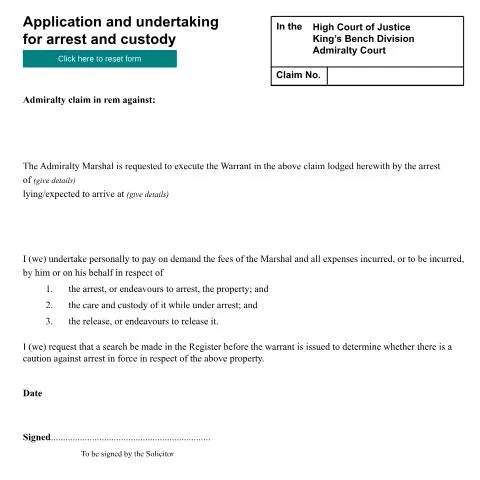
The Application and undertaking for arrest and custody: Form ADM4 is integral to the legal processes concerning maritime law under the jurisdiction of the High Court of Justice. When a claim is made against a ship or another property in the Admiralty Court, this document serves as a formal request for the arrest and subsequent custody of that asset. The form facilitates the enforcement of claims in rem, which is vital in scenarios where parties seek to secure a maritime lien or a debt owed by the vessel's owner.
Historical Framework: The Admiralty Court's Role
Established to handle disputes related to maritime activities, the Admiralty Court has a rich history that reflects the evolution of maritime law. The court is a division of the High Court that deals specifically with such matters, including claims for salvage, ship collisions, and contractual issues arising in marine commerce.
The legal foundation for the ADM4 form is rooted in various Acts and regulations governing maritime law, including the Admiralty Jurisdiction Act 1861 and subsequent amendments. These pieces of legislation outline the court’s authority to arrest vessels and the procedures to be followed.
Chronology of the Process: From Application to Decision
- Initial Claim Submission: The claimant files an admiralty claim in rem against a vessel or property. This is the starting point for the process.
- Completion of Form ADM4: The claimant, or their solicitor, must accurately complete the ADM4 form, providing necessary details about the vessel or property in question.
- Submission to the Court: Once completed, the form is submitted to the High Court of Justice, accompanied by the claim particulars.
- Issuance of Warrant: Upon satisfaction of requirements, the court issues a warrant for arrest based on the information provided in the ADM4.
- Execution by Admiralty Marshal: The Admiralty Marshal is tasked with executing the warrant and taking custody of the property.
- Notification and Fees: The undertaking included in the ADM4 requires the claimant to cover the Marshal's fees and any associated costs.
- Subsequent Court Hearings: The case is then scheduled for hearings, where parties present their arguments concerning the claim.
Who Should Submit the ADM4 Form?
The ADM4 form is typically submitted by claimants or their legal representatives in cases where a claimant seeks to arrest a vessel or maritime property. Understanding who is eligible to submit this form is critical:
- Individual Claimants: Individuals with a valid maritime claim may file the form.
- Corporates: Companies involved in shipping, trading, or related maritime activities may also submit the form on behalf of their interests.
- Solicitors: Legal representatives acting on behalf of claimants are often the ones who complete and submit the ADM4, ensuring all legal requirements are met.
Moreover, understanding specific situations, such as claims arising from contracts, torts, or statutory provisions, can influence who needs to submit the form.
Steps to Complete the ADM4: A Detailed Guide
Completing the ADM4 form requires careful attention to detail. Below are the specific sections of the form and guidance on how to fill them out:
Claim Details Section
In this section, you are required to provide:
- The claim number assigned by the court.
- A detailed description of the property subject to arrest, including the name, type (e.g., ship, cargo), and anticipated location.
Undertaking Section
Here, the claimant must undertake to pay necessary fees and expenses. Clarity in this section is paramount:
- Specify the fees of the Marshal associated with the arrest and custody of the property.
- Ensure to indicate any anticipated additional costs related to the custody.
This undertaking is a legally binding commitment that carries significant weight in court proceedings.
Preparing Supporting Documentation
Alongside the ADM4, relevant documentation should be prepared to support your application:
- Evidence of Claim: This might include contracts, invoices, or any correspondence evidencing the debt or liability.
- Identification Details: Provide proof of identity for claimants, such as passports or company registration documents for corporate entities.
- Witness Statements: Testimonies may aid in establishing the validity of the claim.
Gathering these documents prior to submission can streamline the process and bolster your case.
The Administrative Processing of the ADM4
Once submitted, the form follows a specific administrative path:
- Initial Review: Court clerks examine the ADM4 for completeness and accuracy. If any information is missing, the claimant may be contacted for rectification.
- Court Decision: A judge reviews the application and decides whether to grant the request for arrest based on the merits of the claim.
- Issuance of Warrant: If approved, a warrant for arrest is issued, and the claimant is notified.
- Execution and Custody: The Admiralty Marshal executes the warrant, taking custody of the property, and the claimant is responsible for costs incurred during this process.
Tracking Your Application: Following Up with the Court
After submitting the ADM4, staying informed about your application’s status is crucial. Here are some practical steps to follow:
- Contact the Court: Reach out to the relevant court office to inquire about your application. This can often be done via phone or email.
- Check Payment Status: Ensure that all fees associated with the application and subsequent proceedings have been settled, as this may delay processing.
- Monitor Court Listings: Regularly check scheduled court hearings to stay informed of any developments related to your case.
Understanding the Outcomes: What Happens Next?
The outcome of the ADM4 submission can significantly affect the claimant's position. Here’s a breakdown of possible scenarios:
| Outcome | Description | Next Steps |
|---|---|---|
| Warrant Issued | The court grants the arrest, and the property is seized by the Marshal. | Prepare for court hearings where evidence will be presented. |
| Warrant Refused | The court denies the request due to insufficient evidence. | Consider revising the application or providing additional evidence. |
| Settlement Reached | Parties may settle before formal court proceedings. | Document the settlement and notify the court. |
Each outcome carries implications for ongoing legal strategy and potential costs, making it essential for claimants to remain engaged throughout the process.
Final Thoughts: Navigating the Legal Waters
Filing the ADM4 form is a critical step in asserting a maritime claim. Understanding its function, the process involved, and the importance of supporting documentation can greatly enhance the likelihood of a successful outcome. As maritime law continues to evolve, staying informed and prepared will be invaluable for any claimant looking to navigate the complexities of the Admiralty Court.
Understanding the Legal Framework for Arrest and Custody Applications
The application and undertaking for arrest and custody is governed by a specific legal framework that ensures the rights of the individual while balancing the needs of law enforcement. In the UK, the process is primarily guided by the Police and Criminal Evidence Act 1984 (PACE) and its subsequent amendments. Understanding the implications of these laws is crucial for both the applicants seeking to arrest and custody of an individual, as well as the individuals subject to such actions.
The key provisions under PACE outline the conditions that must be met for a lawful arrest. Notably, officers must have reasonable grounds to suspect that an individual is committing, has committed, or is about to commit an offence. Moreover, the necessity test must also be satisfied, meaning that arrest should be the only option to achieve specific objectives, such as enabling the prompt and effective investigation of the offence or preventing harm to the individual or others.
In addition, the Human Rights Act 1998 plays a pivotal role in ensuring that individuals' rights are respected during the arrest process. It establishes that everyone has the right to liberty and security, and any deprivation of liberty must be lawful, necessary, and proportionate to the circumstances. Consequently, it is imperative that law enforcement officials adhere to these legal standards when applying for arrest and custody through Form ADM4.
Crucially, the legal framework also outlines the process for individuals to challenge arrests that they believe to be unlawful. This can be done through judicial review or by lodging a complaint with the Independent Office for Police Conduct (IOPC). Understanding these rights can significantly empower individuals who find themselves at the centre of an arrest and custody application.
The Role of Form ADM4 in the Judicial Process
Form ADM4 is a critical component of the judicial process concerning arrest and custody applications. When completed properly, it serves as a formal request for the court to consider the conditions under which an arrest warrant is sought. The form consists of several key sections that require detailed information, including the nature of the offence, the identity of the suspect, and the reasons for the arrest.
Applicants must ensure that they provide comprehensive evidence to substantiate their claims, as the court will scrutinize the information presented. It's essential to attach any supporting documents, such as witness statements or previous police reports, to strengthen the application. Failure to provide adequate evidence can result in the court denying the application, thereby prolonging the process of law enforcement action.
Moreover, Form ADM4 is designed to ensure transparency and accountability in the judicial process. Once submitted, the application is subject to review by a magistrate, who will decide whether to grant the request based on the merits of the case. This oversight is crucial in maintaining public trust in the legal system, as it serves as a check against potential abuses of power by law enforcement agencies.
The processing of Form ADM4 also includes the requirement for the applicant to appear before the court to explain the circumstances surrounding the case. This judicial oversight is vital for ensuring that all procedural requirements are met before an individual is detained. Applicants must be well-prepared to defend their application, as magistrates will consider not only the evidence presented but also the implications of granting an arrest warrant for the individual concerned.
Post-Arrest Procedures and Implications Following Form ADM4 Submission
Once Form ADM4 has been successfully submitted and the arrest warrant granted, various procedures and implications follow that are critical for both law enforcement and the arrested individual. Upon arrest, the person must be informed of the reasons for their detention and their rights, including the right to legal representation. This immediate communication is essential to ensure compliance with legal standards and protect the rights of the arrested individual.
The arrested individual will be taken into custody, where they will be booked and processed. This includes the recording of personal information, fingerprints, and photographs. The police are required to conduct a risk assessment to determine the individual's needs and ensure their safety while in custody. This assessment can include considerations around mental health, any potential vulnerabilities, and the need for medical attention.
During the custody period, the individual has the right to contact a solicitor, and police must provide access to legal counsel. This aspect of the process is crucial, as it ensures that the individual can receive guidance on their rights and how to navigate the subsequent legal proceedings. Police are also obligated to inform the arrested individual of their rights to have someone informed of their arrest.
Additionally, following the initial arrest, there are important timelines that must be adhered to. The arrested person must be brought before a magistrate as soon as practicable, which is typically within 24 hours of arrest for most offences. Delays beyond this period could potentially lead to legal challenges against the validity of the arrest.
Finally, the outcome of the court's decision will dictate the next steps in the legal process. If the court decides to remand the individual in custody, a subsequent hearing will be scheduled to address the charges against them. Conversely, if the individual is released on bail, specific conditions may be imposed that must be adhered to before further court proceedings occur. These post-arrest implications highlight the complexity of the legal landscape surrounding arrest and custody and underscore the importance of understanding one's rights and obligations throughout the process.