When Maritime Property Must Return to Open Waters: The ADM12 Release Process
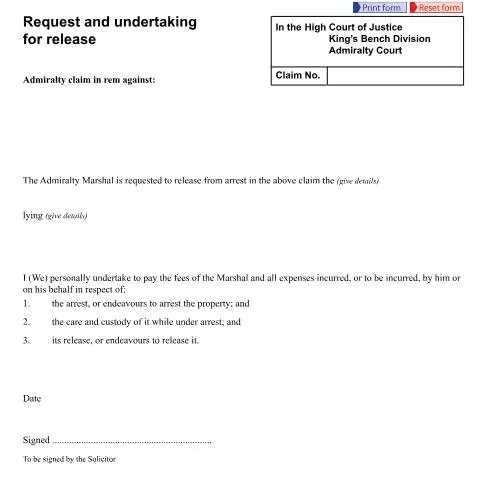
In the specialised world of admiralty law, ships and maritime assets can find themselves legally detained through court-ordered arrest—a powerful remedy that physically prevents vessels from leaving port while legal disputes unfold. The ADM12 Request and undertaking for release represents the formal pathway back to freedom for these arrested maritime properties, establishing the critical bridge between legal detention and operational liberty.
This High Court document serves as both a formal request to the Admiralty Marshal and a binding financial commitment from the requesting party. Unlike standard civil court procedures, admiralty cases involve unique considerations around vessel movements, international waters, and the practical challenges of maintaining expensive maritime assets while legal proceedings continue.
The form's dual nature—combining an immediate release request with a comprehensive financial undertaking—reflects the distinctive character of admiralty law, where physical control of valuable maritime property serves as security for potential claims, but where prolonged detention can rapidly become economically devastating for all parties involved.
The Admiralty Marshal's Authority and Release Procedures
The Admiralty Marshal operates as a specialist officer of the High Court's Admiralty Court, wielding unique powers over maritime property within UK territorial waters. When vessels or maritime assets face arrest under admiralty jurisdiction, they fall under the Marshal's direct custody and control, creating a distinctive legal framework that differs markedly from standard asset seizure procedures.
Form ADM12 specifically addresses the Marshal's dual responsibilities: maintaining secure custody of arrested property while facilitating legitimate release requests. The Marshal's role extends beyond simple detention—encompassing vessel security, crew welfare considerations, environmental protection measures, and the complex logistics of maintaining seaworthy vessels during extended legal proceedings.
Release procedures require careful coordination between multiple parties. The requesting solicitor must demonstrate clear authority to act, while the Marshal must verify that no additional cautions or legal impediments prevent release. This verification process, documented in the form's "Office use only" section, represents a critical safeguard against premature or unauthorised vessel release.
Timing Considerations for Release Applications
Maritime commerce operates on tight schedules, making timing crucial for ADM12 submissions. Vessels generate significant daily operating costs while under arrest—including crew wages, port fees, insurance premiums, and maintenance requirements. These mounting expenses create powerful incentives for swift resolution, but hasty applications can face rejection if procedural requirements aren't met.
The Marshal's office typically processes release requests during standard court hours, though urgent applications may receive expedited handling in exceptional circumstances. Factors influencing processing speed include the complexity of underlying claims, the presence of multiple interested parties, and any environmental or safety concerns surrounding the arrested property.
Financial Undertakings: Understanding Your Binding Commitments
The ADM12's undertaking provisions create comprehensive financial liability extending far beyond simple release fees. Signatories accept personal responsibility for three distinct categories of Marshal-related expenses, each carrying potentially substantial financial implications that continue accumulating until final release completion.
| Expense Category | Coverage Scope | Typical Components |
|---|---|---|
| Arrest Procedures | All costs related to initial detention | Marshal attendance fees, court documentation, vessel boarding, security measures |
| Custody and Care | Ongoing maintenance during detention | Security services, essential repairs, crew welfare, port charges, insurance |
| Release Operations | Final liberation process | Documentation completion, physical handover, final inspections, clearance procedures |
The personal nature of this undertaking means individual solicitors assume direct financial liability, regardless of their client's ability or willingness to reimburse costs. This creates significant professional risk, explaining why many solicitors require substantial client deposits or additional security before signing ADM12 forms.
Cost Escalation Factors in Maritime Detention
Several factors can dramatically increase Marshal-related expenses during vessel detention. Large commercial vessels require specialised security arrangements, potentially including 24-hour guard services and sophisticated monitoring systems. Vessels carrying hazardous cargoes face additional environmental compliance costs, while passenger vessels create crew welfare obligations that can prove extremely expensive over extended periods.
Weather conditions, port congestion, and seasonal variations all influence detention costs. Winter conditions may require additional heating and maintenance, while summer periods can increase crew comfort requirements. Port authorities may impose escalating daily rates for extended stays, creating mounting pressure for swift resolution.
Completing the ADM12: Critical Details and Common Complications
The form's deceptively simple appearance masks several critical completion requirements that can determine success or failure. The vessel identification section demands precise details that match official registration documents—minor discrepancies in vessel names, registration numbers, or technical specifications can delay processing or trigger rejection.
Location details require equal precision, specifying exact berth numbers, port facilities, or anchorage coordinates where applicable. Generic descriptions like "Portsmouth Harbour" prove insufficient—the Marshal needs specific location information enabling immediate vessel identification and access.
The claim number reference must correspond exactly to existing High Court admiralty proceedings. This seemingly obvious requirement creates complications when multiple related claims exist, when claim numbers have been amended during proceedings, or when preliminary applications precede formal claim filing.
Solicitor Authority and Professional Obligations
Only qualified solicitors may sign ADM12 forms, reflecting the significant professional and financial responsibilities involved. The signature creates immediate personal liability for all specified undertakings, making this one of the most financially consequential documents in routine solicitor practice.
Professional indemnity considerations become crucial, as Marshal-related costs can easily exceed standard policy limits for expensive vessel detentions. Some solicitors require enhanced insurance coverage or client indemnities before accepting ADM12 liability, particularly for large commercial vessels or complex international cases.
The solicitor's authority to act requires clear documentation, particularly in international cases where multiple legal representatives may be involved. Questions of authority can delay release processing, making advance clarification essential for time-sensitive applications.
Marshal Verification Processes and Caution Searches
The Marshal's verification obligations, documented in the form's official section, represent crucial safeguards preventing inappropriate vessel release. This process involves comprehensive searches for outstanding cautions, additional arrest warrants, or other legal impediments that might prevent legitimate release.
Caution searches extend beyond the immediate admiralty claim, encompassing related proceedings, sister ship arrests, and potential claims from other interested parties. International vessels may face additional complications where foreign court orders or regulatory restrictions apply, requiring careful coordination between multiple jurisdictions.
The timing notation—requiring specific confirmation that no cautions exist at the precise moment of verification—reflects the dynamic nature of admiralty proceedings. New cautions can be filed at any time, potentially invalidating earlier clearances and necessitating fresh verification procedures.
Multiple Party Scenarios and Competing Interests
Complex admiralty cases often involve multiple claimants, creating competing interests around vessel release. Cargo owners, charterers, fuel suppliers, crew members, and financial institutions may all hold legitimate claims against the same vessel, complicating release procedures significantly.
The Marshal must balance these competing interests while maintaining vessel security and ensuring appropriate legal protections remain in place. This may require multiple ADM12 submissions, coordinated release arrangements, or alternative security provisions satisfying all interested parties.
International Vessels and Cross-Border Complications
Foreign-flagged vessels create additional complexity for ADM12 procedures, particularly where international treaties, flag state regulations, or diplomatic considerations apply. The Marshal's authority extends throughout UK territorial waters, but practical complications can arise when vessels hold multiple nationalities or operate under complex international arrangements.
Crew repatriation obligations may prevent vessel release until appropriate arrangements are confirmed, particularly for vessels from countries with limited consular representation. Environmental regulations can impose additional restrictions, especially for older vessels or those carrying potentially hazardous cargoes.
Currency considerations affect cost calculations, as Marshal fees are typically denominated in sterling while vessel operating expenses may accumulate in multiple currencies. Exchange rate fluctuations can significantly impact total liability calculations, particularly for extended detention periods.
Diplomatic and Consular Involvement
State-owned vessels or those operated by government entities may trigger diplomatic protocols requiring consular notification or involvement. These procedures can significantly extend release timelines, as diplomatic channels operate according to different schedules and priorities than standard commercial proceedings.
Military vessels or those with potential security implications face additional scrutiny from relevant government departments, potentially requiring clearances beyond standard Marshal procedures. Such cases may involve coordination with the Ministry of Defence, Border Force, or other security agencies.
Post-Release Obligations and Ongoing Responsibilities
ADM12 undertakings don't automatically terminate upon vessel release—financial obligations continue until all Marshal-related expenses are finally settled. This can extend weeks or months beyond physical release, particularly where complex cost calculations or disputed charges require resolution.
Final accounting procedures involve detailed expense breakdowns covering the entire detention period. These accounts require careful verification, as errors or disputes can create ongoing liability issues. Professional relationships with the Marshal's office often depend on prompt and accurate settlement of these final accounts.
The released vessel may face ongoing restrictions or monitoring requirements, particularly where environmental concerns existed during detention or where partial security arrangements replace full arrest procedures. Understanding these continuing obligations helps prevent inadvertent violations that could trigger renewed arrest procedures.
Record-keeping requirements extend beyond simple payment documentation, encompassing vessel condition reports, crew welfare records, and environmental compliance documentation that may prove relevant to ongoing legal proceedings or future disputes involving the same vessel or related parties.
Understanding the Legal Framework Behind ADM12 Undertakings
The ADM12 form operates within a complex legal framework that balances individual rights with administrative efficiency. Under the Data Protection Act 2018 and UK GDPR, any personal information processed through this undertaking must comply with strict data protection principles. The requesting party must demonstrate a lawful basis for processing, typically legitimate interest or legal obligation, depending on the specific circumstances of the release request.
The concept of "undertaking" in this context carries significant legal weight. Unlike a simple promise or agreement, an undertaking creates a binding obligation that can be enforced through various legal mechanisms. When you sign Form ADM12, you're essentially entering into a quasi-contractual arrangement with the relevant government department or agency. This means that any breach of the terms specified in the undertaking could result in legal consequences, including potential civil liability or administrative sanctions.
Fill in your form directly online
No printing: type your details into the boxes of the official form, tick, then download the PDF ready to send.
- 1Type into the form boxes
- 2Tick in one click
- 3Save and download the PDF
The statutory authority for such undertakings often derives from sector-specific legislation. For instance, if the form relates to tax matters, HMRC's powers would stem from the Taxes Management Act 1970 and subsequent regulations. For immigration-related releases, the Immigration Act 2014 and related statutory instruments provide the necessary framework. Understanding which specific legislation underpins your ADM12 request is crucial, as it determines both the scope of information that can be released and the conditions that may be imposed.
Data subjects retain certain rights even after providing an undertaking. Under UK GDPR, you maintain the right to be informed about how your data is being processed, though this right may be limited where disclosure would undermine the purpose of the undertaking. The right of access (subject access requests) remains available, though responses may be redacted to protect third-party information or ongoing investigations. Importantly, the right to rectification applies if any information released under the undertaking is subsequently found to be inaccurate.
Third-party rights present particular complexities in ADM12 scenarios. Where the requested information relates to multiple individuals, each person's privacy rights must be considered. The releasing authority must conduct a careful balancing exercise, weighing your legitimate need for the information against potential harm to third parties. This often results in heavily redacted releases or additional conditions being imposed on how you may use the information received.
Sector-Specific Variations and Special Circumstances
Different government departments and agencies apply varying standards when processing ADM12 requests, reflecting the diverse nature of information held across the public sector. HMRC, for example, maintains particularly strict protocols when releasing tax-related information, even with a valid undertaking. The department's internal guidance distinguishes between different categories of requesters: taxpayers seeking their own information, authorised representatives acting under valid powers of attorney, and third parties with legitimate interests such as executors or trustees.
In tax contexts, the timing of your ADM12 submission can significantly impact processing. Requests made during peak periods—particularly between January and April when Self Assessment deadlines approach—may experience longer processing times. HMRC prioritises urgent cases, such as those relating to ongoing tribunal proceedings or time-sensitive commercial transactions. If your request falls into this category, clearly indicating the urgency and providing supporting documentation can expedite processing.
Immigration-related ADM12 requests present unique challenges due to the sensitive nature of the information involved. The Home Office applies heightened scrutiny to such requests, particularly where they involve asylum cases, deportation proceedings, or national security considerations. Standard processing times may be extended significantly, and additional security checks are often required before any release is authorised. The department may also impose specific conditions on information use, such as restrictions on sharing with certain countries or organisations.
Local authority variations add another layer of complexity. While central government departments follow relatively standardised procedures, local councils may have their own interpretations of ADM12 requirements. Some authorities require additional local forms or supplementary documentation. For instance, requests relating to social services records may require approval from designated safeguarding officers, whilst planning-related information might need clearance from legal departments due to potential commercial sensitivities.
Healthcare information requests through NHS bodies require particularly careful handling due to medical confidentiality obligations. Even with a properly completed ADM12, NHS trusts and clinical commissioning groups must ensure compliance with professional regulatory requirements. Medical professionals have ongoing duties to their patients that may override administrative undertakings in certain circumstances. This can result in partial releases or requirements for additional clinical oversight of the information sharing process.
Financial services regulation adds further complexity where ADM12 requests intersect with FCA-regulated activities. If the information you're seeking relates to authorised financial services firms or their activities, the releasing authority must consider whether disclosure might conflict with regulatory confidentiality requirements. This is particularly relevant for requests relating to ongoing enforcement actions or regulatory investigations.
Strategic Considerations for Complex Multi-Party Scenarios
When multiple parties are involved in an ADM12 request—whether as joint requesters, affected third parties, or competing claimants—the strategic approach becomes crucial for successful outcomes. Corporate scenarios often involve complex ownership structures where subsidiary companies, parent entities, or associated firms may all have legitimate interests in the same information. In such cases, determining who has the strongest claim to make the request requires careful analysis of corporate relationships, contractual obligations, and statutory rights.
Timing coordination becomes critical in multi-party situations. Where several entities might potentially submit ADM12 requests for related information, a coordinated approach often proves more effective than separate applications. Government departments generally prefer to handle related requests together to ensure consistency and avoid potential conflicts in the conditions imposed. However, this requires careful negotiation between the parties to agree on lead requesters, shared conditions, and information distribution arrangements.
Conflicting interests between potential requesters can create significant complications. For example, in commercial disputes where both parties seek access to the same government-held information, departments must carefully balance competing claims while avoiding any appearance of favouring one side over another. The undertaking conditions may include specific restrictions on how information can be used in relation to the other party, such as limitations on its use in litigation or commercial negotiations.
International dimensions add substantial complexity to ADM12 procedures. Where requesters are based overseas, or where the information might be shared internationally, additional legal considerations apply. The UK's adequacy decisions regarding third countries, international treaties, and mutual legal assistance agreements all influence how requests are processed. Brexit has created additional complications for EU-related requests, with new frameworks still evolving for information sharing with European institutions and member state authorities.
Cross-border data transfer restrictions may require additional safeguards beyond standard ADM12 undertakings. Standard contractual clauses, binding corporate rules, or adequacy decisions under UK GDPR may need to be in place before information can be released to overseas requesters. These requirements can significantly extend processing times and may require legal advice to ensure compliance.
Professional privilege considerations become particularly complex in multi-party scenarios involving legal representatives. Where solicitors or barristers are acting for different parties with potentially conflicting interests, careful consideration must be given to privilege waiver and confidentiality obligations. The undertaking may need to include specific provisions addressing how privileged information will be handled and whether separate disclosure regimes are required for different categories of information.
Regulatory oversight adds another layer of complexity where professional bodies or regulatory authorities have interests in the information being requested. For instance, if the ADM12 request relates to information that might be relevant to ongoing professional disciplinary proceedings, the releasing authority must consider whether disclosure could prejudice regulatory processes. This might result in delayed processing pending completion of regulatory investigations or additional conditions protecting the integrity of ongoing proceedings.