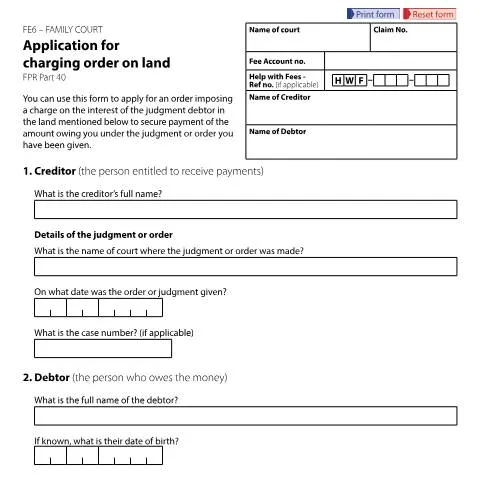
Navigating the FE6: Unpacking the Application for Charging Order on Land or Property
When creditors find themselves in a position where a debtor has failed to comply with a court order for payment, the Form FE6 becomes a crucial tool. This particular application allows creditors to seek a charging order against the debtor's interest in specific land or property, thus securing the amount owed. This process is especially pertinent for those engaged in civil disputes or debt recovery procedures. The charging order facilitates a legal claim over a property, ensuring that the debt is settled from any potential future sale of that asset.
The Importance of the FE6 in Legal Proceedings
The FE6 form operates within the framework of the Family Procedure Rules (FPR) Part 40 and is a central document in the enforcement of judgments. Unlike other legal forms, the FE6 specifically targets the assets of a debtor rather than merely demanding payment. This means that creditors can secure their interests against land or property, which provides an added layer of protection and potential recovery in case of default.
It is vital to differentiate the FE6 from similar forms, such as those used for general enforcement applications. The FE6 specifically imposes a charge on land, making it essential for creditors aiming at securing debts linked to real estate. Other forms may simply establish payment plans or garnishment orders without attaching a claim to physical property.
Who Initiates the FE6 Application?
Typical Scenarios for FE6 Applications
The initiation of the FE6 application generally falls to creditors who have previously obtained a judgment against a debtor. This includes:
- Individual Creditors: Individuals seeking repayment for loans or services rendered.
- Businesses: Companies that may extend credit or have contractual agreements with consumers or other businesses.
- Debt Recovery Agencies: Agencies acting on behalf of creditors to recover outstanding debts through legal means.
Exclusions from the Application Process
It's important to note that not all creditors qualify for this application. For example, if the debtor has no interest in land or property, or if the debt is not enforceable through a judgment, the FE6 would not be the appropriate route. Additionally, debts below a certain threshold may make this form less viable.
Breaking Down the FE6: Essential Sections
The FE6 form consists of several sections that must be completed meticulously. Failing to properly fill out any part could result in delays or rejection of the application. Here’s a detailed look at each critical section:
1. Creditor Information
The application begins with the creditor's details, including:
- Full name of the creditor.
- Details of the court that issued the judgment.
- Date of judgment and case number.
Accurate information is crucial as it ties the application to the correct legal case.
2. Debtor Details
Next, detail the debtor's information:
- Full name and address, including postcode.
- Date of birth (if known) to verify identity.
- Email and phone contact.
Providing complete and accurate debtor information not only aids processing but also ensures that the application can be served appropriately.
3. Judgment Debt
This section outlines the specifics of the judgment debt:
- Amount owed (including any costs and interest).
- Indications whether the judgment stipulated payment by installments.
- Current amount owed and any unpaid installments.
Be mindful of how these amounts are presented; discrepancies may lead to complications.
4. Identification of the Land
Creditor must specify the land or property against which the charge is sought:
- Address of the land and postcode.
- Evidence of debtor’s interest in the property (registered or unregistered).
This is a pivotal part of the application, as failure to provide adequate evidence may result in rejection.
5. Nature of the Debtor’s Interest
Understanding the debtor’s relationship to the property is vital:
- Is the debtor a sole owner, joint owner, or a beneficiary under a trust?
- Details of any partnership interests.
The nature of ownership directly impacts the legal enforceability of the charging order.
6. Other Creditors
Creditor must disclose whether they are aware of any other creditors who may have a claim against the same debtor:
- If known, list the names and addresses of other creditors.
This transparency is important for the court’s understanding of the debtor's financial situation.
7. Additional Information
In this section, creditors can provide any further evidence or context that may support their application. This could include documentation of previous communication attempts with the debtor or evidence of their financial status.
8. Statement of Truth
The application concludes with a formal declaration that all information provided is accurate. This must be signed by the creditor or their legal representative. Misrepresentation can lead to serious legal consequences.
Step-by-Step Process: From Application to Enforcement
Once the FE6 application is completed, it should be sent to the appropriate court. For judgments made in England or Wales, if the debtor resides in one of these jurisdictions, the following must occur:
- Prepare Supporting Documentation: Gather all relevant documents, including copies of the judgment, evidence of the debt, and any additional information required by the court.
- Submission of the Application: Submit the completed FE6 form along with the supporting documents to the designated Family Court or Maintenance Enforcement Business Centre, as applicable.
- Payment of Fees: Ensure the application fee is paid. If financial hardship is present, consider applying for fee remission.
Upon receipt, the court will review the application. If all criteria are met and the documentation is satisfactory, the court may grant the charging order. This is a legal acknowledgment that the creditor has a stake in the property, which can be enforced upon sale or re-mortgage.
Post-Application: Understanding the Judicial Process
After submission, creditors may wonder what to expect:
- The court may schedule a hearing if the debtor contests the application.
- If granted, the charging order will be registered with the Land Registry, providing formal notice of the creditor’s interest.
- Creditors should monitor the debtor's financial situation, as this can affect the ability to recover the debt.
Understanding this journey is essential for creditors to effectively navigate the legal landscape of debt recovery.
Who Will Benefit from the FE6 Application?
Various profiles of creditors will find the FE6 application beneficial:
1. Individual Lenders
Those who have loaned money to friends or family may find the FE6 particularly useful when dealing with substantial amounts that remain unpaid.
2. Small Business Owners
Businesses that extend credit to clients or engage in service agreements often require a means to enforce payment. Using the FE6 application can secure financial interests tied to real estate.
3. Debt Recovery Professionals
Agencies dedicated to recovery of outstanding debts benefit from the FE6 as it empowers them to leverage assets for payment enforcement.
Common Pitfalls and Considerations
As with any legal document, careful attention is necessary to avoid common mistakes:
Fill in your form directly online
No printing: type your details into the boxes of the official form, tick, then download the PDF ready to send.
- 1Type into the form boxes
- 2Tick in one click
- 3Save and download the PDF
- Incomplete forms often lead to rejection; ensure all sections are filled out entirely.
- Make sure to provide all supporting documentation; missing evidence can derail the application.
- Cleary articulate the relationship between the debtor and the property to avoid confusion.
These precautions are crucial for ensuring the success of the FE6 application.
Final Steps After Obtaining a Charging Order
If the charging order is successfully granted, it is essential for creditors to follow through:
- Regularly check the status of the debtor’s financial situation and any potential property sales.
- Consider further legal action if the debtor continues to default or if the property changes hands.
- Maintain records of all communications and transactions related to the debt for future reference.
By doing so, creditors can enhance their chances of successful debt recovery while also adhering to legal protocols.
Understanding the Purpose of Form FE6
Form FE6 is a critical document used in the UK when a creditor seeks to secure a debt by applying for a charging order against a debtor's land or property. This process is often employed when the debtor has failed to repay an outstanding judgment debt. By placing a charge on the property, the creditor can ensure that they receive payment when the property is sold or, under certain circumstances, may be able to enforce the charge through the court. The form needs to be filled accurately, reflecting the details of the debt and the property in question, and must be submitted to the relevant county court.
The application can be initiated against various types of property, including residential and commercial properties. It is essential for applicants to understand that not all debts are eligible for a charging order. Generally, an unsecured debt, which has been ordered by the court, can lead to this application. Before proceeding, individuals should confirm that a county court judgment (CCJ) has been obtained against the debtor, as this is a prerequisite for applying for a charging order.
In filling out Form FE6, the applicant must provide detailed information regarding both the creditor and debtor, as well as a clear indication of the debt owed. Supporting documents, such as a copy of the judgment and proof of the debt, must accompany the application. This ensures the court has sufficient information to consider the request thoroughly.
Eligibility Criteria for Applying for a Charging Order
Before applying for a charging order using Form FE6, it is crucial to assess eligibility based on certain criteria. The applicant must hold a valid county court judgment (CCJ) against the debtor. An application for a charging order can only be made if the CCJ has not been satisfied, meaning the debt remains unpaid. Moreover, the creditor must have a legitimate interest in the property in question, which typically means they need to have a recognized claim against the property.
One critical aspect to consider is the type of debt involved. Only certain debts can lead to a charging order, such as loans, credit card debts, or unpaid bills where a CCJ has been issued. However, debts arising from family law or certain public debts (like council tax arrears) may not qualify. In the case of multiple debts, the creditor may need to consider prioritizing which debts to address with a charging order, as other creditors may also seek similar actions.
Furthermore, it’s essential to note that the property must be registered with the Land Registry to apply for a charging order. If the property is unregistered, the applicant may have to undertake additional steps to secure their interest in the property. This could involve lengthy legal processes, including obtaining a land charge registration. It is also advisable for the applicant to seek legal advice if unsure about any aspect of the eligibility criteria or the application process itself.
The Impact of Charging Orders on Property Ownership and Rights
Understanding the implications of a charging order on property ownership is paramount for both creditors and debtors. Once a charging order is granted, it creates a legal claim against the property. This can significantly affect the debtor’s ability to sell or remortgage the property, as the charge must be settled before any transfer of ownership can take place. Consequently, should the debtor wish to sell the property, they will need to pay the debt in order for the sale to proceed, which can be an added pressure.
Additionally, charging orders can lead to further legal action if the debt remains unpaid. Creditors may choose to apply for an order for sale, allowing them to enforce the charge and potentially sell the property to recover the owed amount. This can lead to serious consequences for the debtor, including loss of their home. It is vital for debtors to comprehend that the presence of a charging order might not only impact their current financial situation but could also affect their credit rating significantly, complicating future borrowing opportunities.
On the other hand, creditors benefit from the security provided by a charging order, as it gives them a priority claim on the property. This means that in the event of a sale, they can recoup the debt before other unsecured creditors. It is an essential tool for creditors looking to safeguard their interests in cases where debtors may not be forthcoming with payments.
In summary, while Form FE6 serves as an important mechanism for creditors to secure debts, it is essential to navigate the application process thoughtfully, considering all legal implications for both parties involved.