Understanding the Appeal Process Against Decisions Made by Social Care Wales
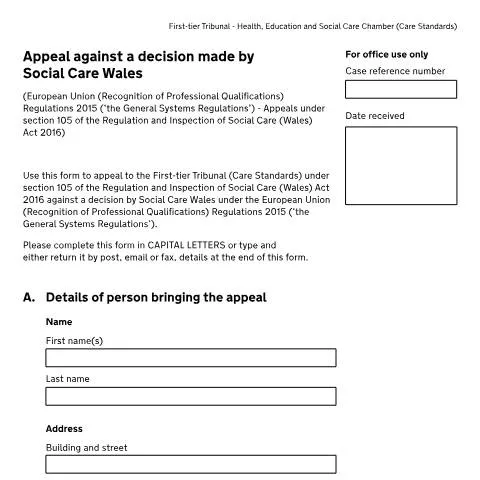
The Form CSW6 serves as an official document issued by the HM Courts & Tribunals Service that provides guidance for individuals wishing to challenge decisions made by Social Care Wales under the European Union (Recognition of Professional Qualifications) Regulations 2015. This form is specifically used within the context of the First-tier Tribunal (Care Standards) – Health, Education and Social Care Chamber, which handles appeals related to social care professionals in Wales.
Scope and Purpose of the Form
The primary purpose of the Form CSW6 is to facilitate a formal appeal by a person or their representative against a decision issued by Social Care Wales. This decision could relate to various aspects such as the recognition of professional qualifications, eligibility to work as a social worker or social care manager in the UK, or specific alerts related to professional conduct or qualifications. The appeal process is governed by section 105 of the Regulation and Inspection of Social Care (Wales) Act 2016, which establishes the legal framework for such appeals.
Who Is Eligible to Use This Form?
This form is intended for individuals directly affected by decisions made by Social Care Wales concerning their professional recognition or status. This includes:
- Social care professionals seeking recognition or validation of their qualifications.
- Individuals subject to alerts or restrictions issued by Social Care Wales.
- Representatives acting on behalf of the concerned individual, such as legal advisors or advocacy groups.
It is crucial that the appellant completes the form accurately, providing all necessary personal and professional details, along with any relevant documentation supporting their case.
Key Sections and Their Significance
Details of the Appellant and Their Representation
The form requires comprehensive personal information, including full name, address, contact details, and, if applicable, details of a representative. This ensures clear identification and facilitates communication throughout the appeal process.
Respondent’s Details and Decision Date
The appellant must specify the organization involved (Social Care Wales) and provide the date when the original decision was communicated. Accurate details are essential for the tribunal to locate and review the relevant decision record.
Timeliness of the Appeal
Appeals must be lodged within 28 days of notification of the decision. If the appeal is late, the appellant must provide a valid reason and may request an extension. The tribunal considers such requests on a case-by-case basis, assessing whether there is a good cause for the delay.
Grounds for the Appeal
The appellant must clearly state the reasons why they believe the decision was incorrect. This could involve challenging the interpretation of regulations, the assessment of qualifications, or the application of rules concerning professional conduct.
Fill in your form directly online
No printing: type your details into the boxes of the official form, tick, then download the PDF ready to send.
- 1Type into the form boxes
- 2Tick in one click
- 3Save and download the PDF
Submitting the Appeal
Once completed, the form should be accompanied by a copy of the decision notice from Social Care Wales. It can be submitted via email, post, or fax to the designated addresses provided by the HM Courts & Tribunals Service. The contact details include:
- Email: [email protected]
- Post: HM Courts & Tribunals Service, Care Standards, 1st Floor, Darlington Magistrates’ Court, Parkgate, Darlington DL1 1RU
- Phone: 01325 289350
- Fax: 01264 785013
References and Further Guidance
For additional information about the appeal process or to access detailed guidance, individuals are encouraged to consult the official Care Standards website, which provides comprehensive resources regarding tribunal procedures and requirements.
Conclusion
The Form CSW6 is a formal mechanism designed to ensure that individuals affected by decisions of Social Care Wales have an accessible route to challenge and seek review of those decisions. Understanding the structure of the form and the legal framework underpinning the appeal process is essential for ensuring a timely and effective challenge within the established legal parameters.