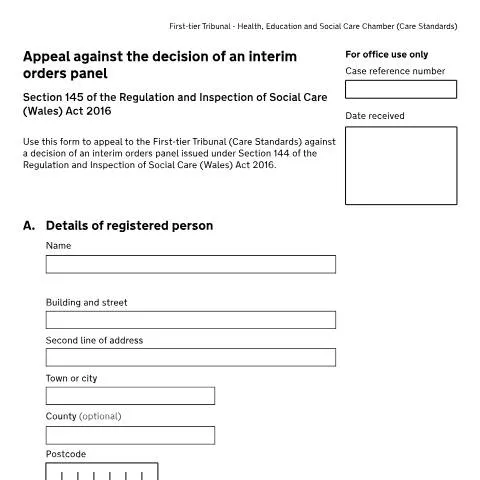
Understanding the Official Guidance on Form CSW1: Appeal Against Decisions of an Interim Orders Panel under Section 145 of the Regulation and Inspection of Social Care (Wales) Act 2016
Introduction to the Appeal Process
The Form CSW1 is an official document used within the framework of social care regulation in Wales. It provides a structured process for individuals or entities to formally challenge decisions made by an interim orders panel under Section 144 of the Regulation and Inspection of Social Care (Wales) Act 2016. These decisions typically relate to urgent restrictions or suspensions placed on social care providers or registered persons, aiming to protect vulnerable service users.
Scope and Purpose of the Form
This form is designed for use by registered persons or their representatives who wish to appeal a decision concerning an interim suspension order or a conditional registration order issued by Care Standards Wales (CSW). The appeal is heard by the First-tier Tribunal (Care Standards), which functions as an independent adjudicator in social care disputes. The primary goal is to ensure that decisions affecting social care providers are subject to fair review and that the rights of the registered persons are upheld.
Who Can Use This Form?
- Registered persons: Individuals or organisations registered under the Regulation and Inspection of Social Care (Wales) Act 2016 who have received notice of an interim order.
- Representatives: Legal or professional representatives acting on behalf of the registered persons can also submit the appeal, provided they complete the relevant sections of the form.
It is important that the appellant is aware of the strict time limits for submitting an appeal, which is generally within 28 days from the date the notice of decision was issued.
Key Sections of the Form
A. Details of the Registered Person
This section requires basic contact information, including name, address, and contact details. Accurate information is essential for processing the appeal and for correspondence purposes.
B. Details of the Representative (if any)
If a representative is acting on behalf of the appellant, their details must be provided here, including contact information and address.
C. Details of the Interim Order
This section captures specifics about the order being challenged, including the type of order (either suspension or conditional registration) and the date when notice was given. Accurate details are vital for the tribunal to identify the case correctly.
D. Is the Appeal Timely?
The form prompts the appellant to confirm whether the appeal is submitted within the statutory timeframe. If not, the appellant must provide reasons for the delay and may need to request an extension of time.
E. Grounds for Appeal
This is a critical part of the process. The appellant must clearly state why they believe the decision of CSW is incorrect. They should include supporting evidence and specify the outcome they are seeking, such as the overturning of the interim order or variation of its terms.
Note that the appeal must be accompanied by copies of the original notice of decision and any relevant statements or records from Care Standards Wales.
F. Hearing Preferences
The appellant can indicate whether they prefer a hearing based solely on written evidence or an oral hearing with both parties present. The tribunal will consider these preferences when scheduling the case.
Submission and Contact Details
Once completed, the form must be sent to the Care Standards Tribunal via postal mail, email, or fax, along with copies of the relevant documents. The address and contact details are as follows:
Fill in your form directly online
No printing: type your details into the boxes of the official form, tick, then download the PDF ready to send.
- 1Type into the form boxes
- 2Tick in one click
- 3Save and download the PDF
- Post: HM Courts & Tribunals Service, Care Standards, 1st Floor, Darlington Magistrates’ Court, Parkgate, Darlington DL1 1RU
- Email: [email protected]
- Phone: 01325 289350
- Fax: 01264 785013
For further guidance on the appeal process, individuals are advised to consult the official Care Standards Tribunal guidance available on the UK government’s justice website.
Legal and Procedural Considerations
The appeal process is governed by the statutory framework set out in the Regulation and Inspection of Social Care (Wales) Act 2016. It is essential that appellants adhere to the prescribed timelines and include all necessary supporting documentation to ensure their appeal is considered valid.
Decisions made by the tribunal can result in the modification, suspension, or upholding of the original order, depending on the evidence and legal arguments presented.
Conclusion
The CSW1 form provides a formal mechanism for challenging interim orders issued under social care regulation in Wales. It ensures that registered persons have a fair opportunity to contest urgent restrictions affecting their practice, safeguarding both their interests and the well-being of service users. Understanding the correct procedure and adhering to the legal requirements is crucial for a successful appeal.