When Local Authorities Say No: Understanding Your Right to Challenge Assessment Refusals
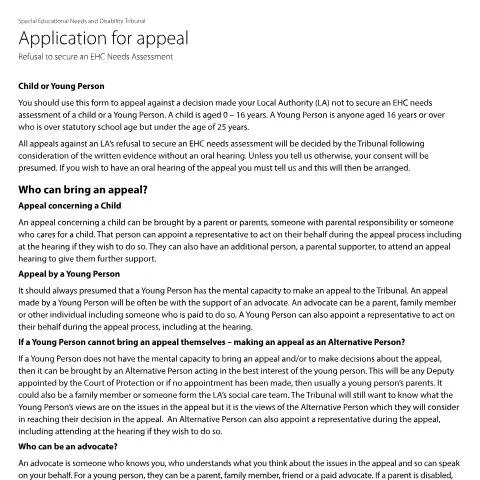
The moment a local authority decides not to conduct an Education, Health and Care (EHC) needs assessment can feel like hitting a brick wall for families and young people seeking support. Yet this decision marks not an end, but potentially the beginning of a formal challenge process. Form SEND35A serves as the gateway to the Special Educational Needs and Disability Tribunal, where parents, young people, and their advocates can contest these refusal decisions through a structured legal framework.
Unlike many administrative processes, appeals against assessment refusals operate under a presumption of written determination—the Tribunal typically decides cases based on documentary evidence alone, unless parties specifically request an oral hearing. This approach reflects both the volume of such cases and the nature of the legal test being applied, which focuses primarily on whether statutory thresholds for assessment have been met rather than complex factual disputes requiring witness testimony.
Navigating the Complex Landscape of Who Can Appeal
The question of standing—who has the legal right to bring an appeal—reveals the nuanced approach UK law takes to recognising different relationships and capacities within the special educational needs system. Form SEND35A accommodates three distinct categories of appellants, each with specific requirements and procedural considerations.
Parents and Those with Parental Responsibility
For children under 16, appeals typically originate from parents or individuals holding parental responsibility. This extends beyond biological parents to include adoptive parents, step-parents with formal parental responsibility, and local authority designated carers in certain circumstances. The form recognises that modern family structures often involve multiple individuals sharing parental responsibility, allowing joint appeals where appropriate.
Significantly, someone who cares for a child may also initiate proceedings, even without formal parental responsibility. This provision acknowledges situations where grandparents, extended family members, or long-term carers have assumed primary responsibility for a child's welfare and educational needs, though they must demonstrate their caring role and legitimate interest in the child's educational provision.
Young People Acting Independently
The legislation presumes that young people aged 16 and over possess the mental capacity to make their own appeals, reflecting the principle of growing autonomy as individuals transition toward adulthood. This presumption carries significant weight—local authorities and the Tribunal must treat young people as capable decision-makers unless clear evidence suggests otherwise.
Young people frequently engage advocates to support their appeals, and the form explicitly recognises various advocacy arrangements. An advocate might be a family member who understands the young person's views and can articulate them effectively, a friend with relevant experience, or a professional advocate with specialised knowledge of the SEND system. Crucially, advocates differ from representatives in that they speak for the young person rather than about the legal issues involved.
Alternative Person Arrangements
When a young person lacks the mental capacity to conduct their own appeal, the system provides for "Alternative Person" arrangements. This typically involves a Deputy appointed by the Court of Protection, though in practice, parents often assume this role where no formal appointment exists. The Tribunal retains discretion to determine appropriate Alternative Person status, considering factors such as the young person's best interests, existing relationships, and practical considerations about who can effectively pursue the appeal.
| Appellant Type | Age Range | Capacity Requirement | Support Options |
|---|---|---|---|
| Parent/Carer | Child 0-16 | Standard adult capacity | Representative, parental supporter |
| Young Person | 16-25 | Presumed capable | Advocate, representative |
| Alternative Person | 16-25 | Young person lacks capacity | Representative, advocate consultation |
Dissecting the Two-Pronged Legal Framework
Form SEND35A structures the appeal around the specific legal test established in Section 36(8) of the Children and Families Act 2014, which creates a two-stage inquiry that appellants must navigate strategically. Understanding this framework proves crucial for presenting effective appeals that address the Tribunal's decision-making criteria.
Question One: Establishing Special Educational Needs
The first prong requires demonstrating that the child or young person "has or may have" special educational needs. This deliberately broad formulation recognises that assessment refusals often occur precisely because needs have not been fully identified or quantified. The "may have" element allows appellants to present emerging concerns, developmental patterns, or professional observations that suggest underlying difficulties requiring investigation.
Effective responses to this section typically combine current evidence of educational difficulties with indicators suggesting deeper underlying needs. This might include teacher observations of persistent struggles despite appropriate differentiation, discrepancies between cognitive ability and academic achievement, or behavioural patterns that interfere with learning progress. The form specifically asks appellants to describe both identified needs and those "which have not yet been fully identified," encouraging a forward-looking approach that anticipates what comprehensive assessment might reveal.
Question Two: The EHC Plan Threshold
The second question addresses whether the child or young person "may require" an EHC plan, introducing a higher threshold that considers not just the existence of special educational needs, but their likely severity and complexity. This stage requires appellants to articulate why mainstream provision, even with SEN support, would be insufficient to meet the individual's needs.
Successful responses often reference the statutory criteria for EHC plans: needs that require provision beyond what schools can reasonably be expected to provide from their own resources, or needs requiring coordination across education, health, and social care sectors. Appellants might highlight the intensity of support required, the specialist nature of interventions needed, or the long-term planning necessary to ensure successful transitions between educational phases.
Timing Constraints and the Mediation Maze
The temporal framework governing SEND35A appeals creates a complex web of deadlines that can trap unwary appellants. The standard two-month deadline from the local authority's decision letter appears straightforward, but the mediation certificate requirement introduces additional complications that require careful navigation.
Under the Children and Families Act 2014, parents and young people must generally engage with mediation before appealing, though specific exemptions apply. The mediation certificate—issued either after mediation concludes or when mediation is declined—resets the appeal deadline to one month from the certificate date, potentially extending the overall timeframe but creating new pressure points for appellants who delay mediation engagement.
Late Appeal Considerations
When appeals arrive outside statutory deadlines, Form SEND35A requires detailed explanations for the delay and arguments about why the appeal would succeed if time extensions were granted. The Tribunal applies a multi-factor test considering the length and reasons for delay, prejudice to the local authority, the strength of the proposed appeal, and the broader public interest in maintaining procedural deadlines.
Common reasons for late appeals include delayed access to advocacy support, family crises affecting the appellant's ability to engage with legal processes, or late discovery of crucial evidence that strengthens the case for assessment. However, simple unfamiliarity with deadlines or administrative oversight rarely suffices to justify extensions, emphasising the importance of prompt action following adverse decisions.
Documentary Evidence Strategy and Supporting Materials
The written determination process places exceptional weight on documentary evidence, making the preparation and presentation of supporting materials crucial to appeal success. Unlike oral hearings where witnesses can clarify points or respond to questions, written appeals must anticipate Tribunal concerns and present comprehensive evidence packages that speak for themselves.
Educational Evidence Portfolio
Strong appeals typically include recent school reports demonstrating persistent difficulties despite intervention attempts, assessment reports from educational psychologists or specialist teachers, and evidence of the child or young person's views about their educational experience. Particularly powerful evidence includes documentation showing that schools have exhausted their SEN support strategies or are requesting additional resources beyond their capacity to provide.
Independent assessments, while not mandatory, often carry significant weight as they provide objective professional opinions about needs and appropriate provision. However, appellants should ensure such assessments address the specific legal criteria rather than simply documenting difficulties, as the Tribunal's role involves applying statutory tests rather than making general judgements about need.
Health and Social Care Documentation
Where needs span multiple sectors, evidence from health professionals, social workers, or therapeutic specialists can demonstrate the complexity requiring coordinated planning through an EHC plan. This might include speech and language therapy reports identifying communication needs affecting educational access, occupational therapy assessments revealing sensory processing difficulties, or mental health assessments documenting emotional barriers to learning.
The key lies in connecting such evidence to educational outcomes—showing how health or social care needs directly impact learning progress or school participation rather than existing in isolation from educational considerations.
Fill in your form directly online
No printing: type your details into the boxes of the official form, tick, then download the PDF ready to send.
- 1Type into the form boxes
- 2Tick in one click
- 3Save and download the PDF
Local Authority Decision Analysis and Response Preparation
Form SEND35A requires appellants to identify the specific local authority and decision date, but effective appeals go far beyond these basic requirements to engage substantively with the reasoning behind refusal decisions. Understanding common patterns in local authority decision-making helps appellants construct targeted responses that address the specific concerns raised.
Deconstructing Refusal Rationales
Local authorities typically refuse assessments based on arguments that current provision is meeting needs adequately, that difficulties stem from factors other than special educational needs, or that the child or young person is making sufficient progress without additional support. Each rationale requires different response strategies, making careful analysis of the decision letter essential.
Where authorities argue that current provision is adequate, appellants might present evidence of ongoing struggles despite intervention, teacher concerns about sustainability of current arrangements, or gaps between provision and identified needs. Progress-based refusals often require more nuanced responses showing that apparent progress masks underlying difficulties or occurs only with unsustainable levels of support.
Addressing Threshold Arguments
Many refusals invoke threshold arguments—suggesting that while needs exist, they fall below the level requiring statutory assessment. Effective appeals respond by demonstrating either that needs are more significant than initially apparent or that their complexity requires the coordinated planning that only EHC assessment can provide.
This might involve showing how seemingly separate difficulties actually represent different manifestations of underlying conditions, how needs interact across domains to create compound effects, or how future educational transitions will require advance planning impossible without formal assessment processes.
Procedural Safeguards and Representation Dynamics
The Tribunal system recognises that most SEND appeals involve unrepresented parties navigating complex legal processes, leading to various procedural accommodations designed to ensure fair hearings regardless of representation status. Form SEND35A reflects this philosophy by providing clear guidance while maintaining flexibility for different support arrangements.
Representatives—whether solicitors, barristers, or specialist advocates—can provide crucial legal expertise in interpreting statutory criteria and presenting compelling arguments. However, the form emphasises that most appeals proceed without formal representation, with the Tribunal providing procedural support to ensure fair determination regardless of parties' legal sophistication.
The distinction between representatives and advocates reflects different support models: representatives provide legal advice and formal advocacy, while advocates focus on ensuring the appellant's voice is heard and understood. Both serve important functions, and the form accommodates various combinations of support arrangements to match individual circumstances and preferences.
Communication preferences warrant particular attention, as the Tribunal's emphasis on email, phone, and text contact reflects both efficiency considerations and accessibility needs. Maintaining current contact information proves crucial, as procedural delays often result from communication breakdowns rather than substantive legal issues.
For families embarking on this challenging process, Form SEND35A represents more than administrative paperwork—it embodies a statutory right to challenge decisions affecting children and young people's educational futures. Success requires not just completing the form accurately, but understanding the legal framework it serves and preparing evidence that addresses the specific criteria the Tribunal must apply.