Navigating the N464: A Roadmap for Applicants
Imagine finding yourself in the intricate web of the UK's legal system, needing clarity on where your case should be heard. This is precisely the scenario addressed by the Application for Directions as to Venue for Administration and Determination, commonly referred to as Form N464. This official document plays a pivotal role in determining the most appropriate court venue for your legal proceedings, ensuring that the administration of your case is handled efficiently and effectively.
The Purpose Behind the N464: A Closer Look
The essence of completing Form N464 extends beyond mere administrative duty; it embodies the pursuit of justice within the right jurisdiction. For claimants or appellants, this form is crucial when there is a dispute regarding where the case should be heard. It allows the court to establish the venue that connects most closely with the circumstances of the claim.
- Jurisdictional Relevance: The form helps define the most pertinent location based on where the claimant resides and where the defendant's relevant office or department is situated.
- Efficiency in Proceedings: Proper venue selection can lead to a smoother legal process, minimizing delays and reducing the costs associated with travel and representation.
- Public Interest Considerations: In some instances, the nature of the claim may warrant proceedings to be held in a particular locality, reflecting the community’s interest.
Who Needs to File Form N464?
Determining the necessity of submitting Form N464 largely depends on the nature of your claim. Generally, this form is applicable for parties involved in legal proceedings that seek direction regarding the appropriate court venue. Here are some key players who might need to file this application:
- Claimants: Individuals or entities initiating the claim that require clarity on the venue.
- Appellants: Those challenging a previous decision who believe that the venue is incorrectly designated.
- Legal Representatives: Solicitors acting on behalf of their clients who seek to streamline the administrative process for their cases.
Completing Form N464: Step-by-Step Guidance
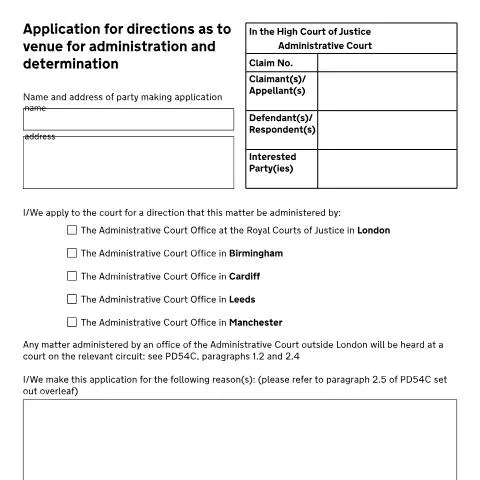
Completing Form N464 requires careful attention to detail to ensure that your application is comprehensive and accurate. Below is a detailed breakdown of the key sections within the form and their significance:
1. Basic Information
The initial section requires you to provide fundamental details:
- Claim Number: Essential for the court's reference.
- Parties Involved: Accurately list the claimants, defendants, and any interested parties, as this establishes the context of your application.
- Name and Address: Provide your details or the details of your legal representative, ensuring they are up to date.
2. Venue Preference
Indicate which court office you believe should administer the claim. The options include:
- Royal Courts of Justice in London
- Administrative Court Office in Birmingham
- Administrative Court Office in Cardiff
- Administrative Court Office in Leeds
- Administrative Court Office in Manchester
Choosing the right venue is crucial; it determines where hearings will take place and can significantly influence the proceedings.
3. Reasons for Application
Arguably, this section is one of the most critical parts of Form N464. You need to articulate your reasons for preferring a specific venue. Referencing the relevant paragraphs from Practice Direction 54C (PD54C), particularly paragraph 2.5, is essential. Factors to consider include:
- The geographical proximity of the claimants and defendants to the proposed venue.
- Public interest that might favour a particular locality.
- Historical cases or similar claims that have been addressed in a particular court.
Submission Process: From Form Completion to Court Acknowledgement
Once you have meticulously completed Form N464, the subsequent steps for submitting your application are crucial and must be adhered to strictly:
1. Timing of Submission
It is imperative to submit your completed form to the Administrative Court Office currently handling your case within 21 days of being served with the proceedings. Failure to comply with this timeline could jeopardize your application.
2. Serving Other Parties
After submitting your form, you must ensure that copies of your completed application are served to all other parties involved in the proceedings. This step is necessary to maintain transparency and fairness in the legal process.
Understanding the Broader Context: Legal Implications and Rights
Filing Form N464 is not merely a procedural task; it opens the door to several implications and rights relevant to the parties involved:
- Right to Fair Hearing: Choosing the correct venue enhances your right to a fair hearing and ensures that justice is served in a manner that is accessible.
- Legal Representation Considerations: If legal representatives are based far from the proposed venue, this might influence the costs and logistics of your case.
- Potential Delays: An improper or poorly justified venue application could lead to delays, which may adversely affect the resolution of the case.
Supporting Documents: Preparing for Your Application
In addition to completing Form N464, you may need to prepare various supporting documents that can bolster your application. Depending on your circumstances, these documents may include:
| Document Type | Purpose | Examples |
|---|---|---|
| Letter of Instruction | Clarifies the legal basis for your claim and venue preference. | Documentation from your solicitor explaining the case. |
| Evidence of Residence | Supports claims regarding the proximity of the claimant and defendant to the venue. | Utility bills, rental agreements, or government correspondence. |
| Previous Judgements | Contextualizes your case within historical precedents. | Case summaries that highlight similar venue decisions. |
Why N464 Stands Apart from Similar Forms
It's essential to recognize how Form N464 differs from other official documents commonly utilized in the legal domain. Here’s how it stands out:
- Specificity of Venue: While other forms may relate to case initiation or response, N464 uniquely addresses the venue determination, a critical step in the legal process.
- Application Context: N464 is not a standalone document; it is contingent on the existence of ongoing proceedings, whereas many forms may serve independent purposes.
- Procedural Focus: The N464 is specifically designed to manage the logistics of court operations, a detail often overlooked in other forms that may focus more on substantive legal claims.
Final Thoughts: The Importance of Compliance and Diligence
Successfully navigating the complexities of the UK legal system is no small feat, and completing the N464 is a vital step in ensuring that your case is administered appropriately. By understanding the form’s purpose, the required details, and the importance of venue selection, you can position your application for the best possible outcome. Always keep in mind the strict deadlines and the importance of notifying all parties involved, as these are critical components of maintaining your rights throughout the legal process.
Understanding the Context of Form N464
Form N464 is integral to the judicial system in the UK, specifically when dealing with the administration of estates. This form serves a crucial role when a party seeks the court's direction regarding the venue for administration and determination of a particular case. Generally, situations arise when multiple jurisdictions are involved or when there is ambiguity about the suitable location for a hearing.
Applications for directions are often necessary in claims where the estate includes assets in different parts of the UK; for instance, properties located in both England and Wales, or where executors are situated in varying locations. In such instances, Form N464 facilitates the clarification process, enabling the court to provide guidance on the appropriate venue to hear the matter.
The necessity to complete Form N464 arises from the inherent complexities of cross-jurisdictional legal matters. Different regions may adhere to distinct procedural rules, which complicates the administration of estates. By submitting Form N464, an applicant can ensure that the case is adjudicated in a way that is efficient and conforms to the legal framework governing the respective jurisdictions.
The completion of this form requires a comprehensive understanding of the involved parties, the nature of the assets, and relevant laws that might dictate jurisdiction. This understanding is vital as it directly impacts where a case will be heard, potentially influencing timelines, procedural rules, and even the outcomes depending on the regional laws.
Key Considerations When Submitting Form N464
When preparing to submit Form N464, there are several key considerations that applicants must keep in mind to increase the likelihood of a successful outcome.
Filing Party's Details: The application should accurately represent all relevant parties involved in the administration of the estate. This includes executors, beneficiaries, and any other interested parties. Ensuring clarity about who is involved helps the court understand the context and significance of the application.
Documentation: Supporting documentation is crucial. Applicants should provide all necessary documentation that backs up the need for the application. This could include proof of the assets’ locations, correspondence among parties, and any prior court orders affecting jurisdiction.
Jurisdictional Relevance: It is essential to meticulously outline why the chosen venue is appropriate. This can include demonstrating connections between the estate and the jurisdiction, such as where the deceased lived, where properties are situated, or where the executors reside.
Potential Opposition: Applicants should be aware of any potential objections from other parties. If there are known concerns about the chosen venue from other interested parties, it might be beneficial to address these issues upfront in the application.
Legal Advice: Given the complexities involved in jurisdictional matters, obtaining legal advice can significantly enhance the quality of the application. A solicitor with experience in probate matters will be familiar with the intricacies of such cases and can ensure that the application is comprehensive and aligns with legal standards.
Understanding Court Procedures: Familiarity with court procedures related to N464 is critical. Applicants should review guidelines set forth by HM Courts & Tribunals Service, as they provide insight into what the court will expect from the application and how to navigate subsequent hearings or disputes.
The Process of After Submission: What to Expect Following the Filing of Form N464
Once Form N464 has been submitted to the appropriate court, it initiates a series of proceedings that will lead to the determination of the venue. Understanding what to expect in the subsequent steps can be invaluable for applicants.
Acknowledgment of Receipt: After submission, the court will issue an acknowledgment of receipt, confirming that your application has been filed. This is an essential step; it establishes a formal record of your request.
Review Process: The court will then review the application to ensure it meets the required standards. This includes examining the details provided in Form N464, the accompanying documentation, and the justifications for the selected venue. If the application is complete and adequately substantiated, it will progress to the next stage.
Hearing Scheduling: In cases where the court deems it necessary, a hearing may be scheduled. During this hearing, the applicant will present their case before a judge or magistrate, who will consider the arguments made and the evidence provided. It is crucial for applicants to be prepared to articulate their reasons for the preferred venue.
Court's Decision: After reviewing the evidence and hearing the submissions, the court will issue its directions concerning the venue. This decision will be formalized in a court order, which must be adhered to moving forward in the administration process.
Further Legal Steps: Depending on the outcome, there may be additional steps to follow. If the court grants the application, the case will proceed at the designated venue. If the application is denied, parties may need to consider whether to appeal the decision or adjust their approach to the administration of the estate based on the court's feedback.
Record Keeping: Throughout this process, maintain meticulous records of all correspondence, decisions, and any further applications that may arise. This documentation will be beneficial not only for your case but also for transparency and accountability in the administration of the estate.
Adhering to these guidelines will foster a smoother experience when navigating the complexities associated with Form N464, ensuring that all parties involved are adequately informed and prepared for the judicial process ahead.