Maritime Disputes and the High Court's Specialist Jurisdiction
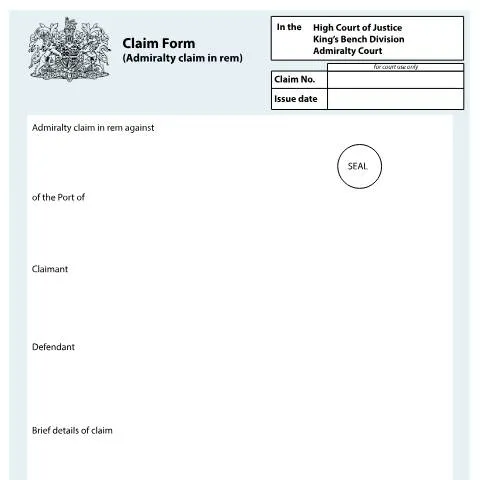
When a shipping company's cargo vessel suffers damage at Portsmouth Harbour, when unpaid crew wages mount up on a bulk carrier moored in Liverpool, or when a collision occurs between commercial vessels in the Thames Estuary, these maritime disputes require specialist legal intervention. The Form ADM1 serves as the gateway to the High Court's Admiralty Court, enabling claimants to initiate in rem proceedings against vessels themselves rather than their owners directly.
This distinctive legal mechanism allows creditors, crew members, cargo owners, and other maritime stakeholders to pursue claims by effectively "arresting" a ship through the court system. The vessel becomes both the subject of the dispute and the security for any eventual judgment, reflecting centuries of maritime law tradition where ships were treated as separate legal entities capable of bearing liability.
The Admiralty Court, sitting within the King's Bench Division of the High Court, handles these specialised cases through procedures that differ markedly from standard commercial litigation. Form ADM1 initiates this process, requiring claimants to identify not just their grievance, but the specific vessel against which they seek remedy.
Understanding In Rem Proceedings: When Ships Become Defendants
The Latin term "in rem" literally means "against the thing" - in this context, the ship itself. This distinguishes admiralty claims from typical in personam actions against individuals or companies. When completing Form ADM1, claimants name the vessel as defendant, specifying its port of registration and current location.
Several categories of maritime claims qualify for in rem proceedings:
- Collision damage between vessels, including cases where negligent navigation causes property damage or personal injury
- Salvage claims where vessels or cargo have been rescued from peril at sea
- Crew wages and maintenance owed to seafarers, including overtime payments and repatriation costs
- Cargo damage or loss during transportation, including contamination or delay claims
- Port charges and pilotage fees remaining unpaid by vessel operators
- Maritime liens for repairs, supplies, or other necessaries provided to the vessel
The vessel's physical presence within English waters typically establishes the Admiralty Court's jurisdiction, though sister ship arrests may also be possible under specific circumstances where the beneficial owner operates multiple vessels.
Statutory Framework and Legal Foundations
The Senior Courts Act 1981 provides the statutory basis for admiralty jurisdiction, while the Civil Procedure Rules Part 61 governs procedural aspects of admiralty claims. Form ADM1 must comply with these rules, particularly regarding the identification of vessels and the nature of claims pursued.
International conventions also influence admiralty practice, including the International Convention on Maritime Liens and Mortgages and various collision liability treaties. Claimants should ensure their claims fall within recognised maritime law categories before initiating proceedings.
Completing the Claim Form: Technical Requirements and Practical Considerations
Form ADM1's structure reflects the unique nature of maritime litigation. The vessel identification section requires precise details: the ship's exact name as registered, its port of registration, and current location. Minor variations in vessel names can create jurisdictional complications, making accuracy essential.
The "Brief details of claim" section should concisely summarise the dispute while indicating the legal basis for the claim. Rather than extensive factual recitation, this section identifies the type of maritime claim and its approximate value. Detailed facts belong in the Particulars of Claim, which may be attached to Form ADM1 or served separately within fourteen days.
| Claim Type | Key Details Required | Supporting Evidence |
|---|---|---|
| Collision Damage | Date, location, vessels involved | Survey reports, witness statements |
| Crew Wages | Employment period, amounts owed | Employment contract, wage records |
| Cargo Claims | Bill of lading details, damage extent | Cargo surveys, delivery receipts |
| Salvage | Rescue circumstances, vessel condition | Lloyd's Open Form, salvage agreement |
The statement of truth carries particular weight in admiralty proceedings, where false claims can result in wrongful arrest liability. Claimants must genuinely believe their facts are accurate, as vessel arrests can cause significant commercial disruption and potential damages claims.
Legal Representation and Professional Requirements
While self-representation remains possible, admiralty law's complexity typically necessitates specialist legal advice. Maritime solicitors understand the intricacies of vessel identification, jurisdictional requirements, and the tactical considerations surrounding ship arrests.
When legal representatives sign Form ADM1, they must be properly authorised and should hold professional indemnity insurance adequate for potential wrongful arrest claims. The form requires clear identification of the representative's firm and their specific authority to act.
Strategic Timing and Procedural Advantages
Admiralty claims often involve urgent circumstances where vessels may depart jurisdiction before creditors can secure their interests. Form ADM1 can be filed without prior notice to defendants, enabling claimants to obtain arrest warrants before vessel owners become aware of pending litigation.
This element of surprise proves crucial in cases where ship operators might otherwise relocate vessels to avoid legal proceedings. However, claimants must act swiftly once they become aware of grounds for claim, as delays may suggest the matter lacks genuine urgency.
The Admiralty Registry operates between 10am and 4.30pm, Monday to Friday, from its location within the Rolls Building on Fetter Lane. Emergency applications outside these hours require special arrangements through the court's out-of-hours service, typically involving duty judges who can authorise urgent arrest warrants.
Security Considerations and Financial Implications
Successful admiralty claimants may need to provide security for potential damages if their arrest proves wrongful. The court can require undertakings covering the vessel owner's losses from detention, including port charges, crew costs, and lost commercial opportunities.
Conversely, defendants may provide security to obtain vessel release, typically through bank guarantees or insurance company bonds. These arrangements allow commercial operations to continue while legal proceedings resolve the underlying dispute.
Filing Procedures and Court Registry Requirements
Form ADM1 must be filed at the Admiralty Registry specifically, rather than general court offices. The Registry's specialist staff understand maritime law requirements and can advise on procedural compliance, though they cannot provide legal advice on claim merits.
Court fees vary depending on claim value, following the standard High Court fee structure with additional charges for arrest applications. Fee remission may be available for eligible claimants demonstrating financial hardship, though this rarely applies in commercial maritime disputes.
The Registry assigns unique claim numbers following the format "ADM-[year]-[number]", which must be quoted in all subsequent correspondence. This numbering system helps track the substantial volume of maritime cases processed annually through London's position as a major shipping centre.
Service Requirements and International Complications
Service of Form ADM1 follows specialised rules for maritime cases. Vessel service typically occurs by affixing documents to the ship's mast or superstructure, though alternative methods may be ordered where vessels have departed jurisdiction.
International service becomes necessary when ship owners are based overseas, requiring compliance with service conventions or diplomatic channels. These procedures can extend litigation timescales significantly, making initial vessel arrest particularly important for securing jurisdiction.
Enforcement Mechanisms and Recovery Prospects
Successful admiralty claimants can enforce judgments against arrested vessels through judicial sale proceedings. The Admiralty Marshal, a court official responsible for vessel custody, arranges sales through specialist maritime auctioneers when settlement negotiations fail.
Sale proceeds are distributed according to maritime lien priorities, with crew wages typically ranking above commercial debts. This priority system reflects international maritime law principles protecting seafarers' interests, though mortgagees and other secured creditors may also have superior rights.
The court can order vessel release upon payment of judgment debts plus costs, providing defendants with incentives to settle claims promptly. Interest continues to accrue during detention periods, increasing pressure for early resolution.
Alternative Dispute Resolution in Maritime Context
Many maritime disputes benefit from arbitration or mediation rather than court proceedings, particularly where ongoing commercial relationships exist between parties. London Maritime Arbitrators Association provides specialist arbitration services, while various mediation schemes offer confidential settlement opportunities.
However, in rem proceedings remain necessary where security is required or where defendants cannot be located for alternative dispute resolution. Form ADM1 therefore serves as both a litigation tool and a negotiation catalyst, encouraging settlement discussions while preserving claimants' legal rights.
Post-Filing Developments and Case Management
Once Form ADM1 is filed and any arrest warrant obtained, cases enter the Admiralty Court's case management system. Directions hearings establish timetables for evidence exchange, expert reports, and trial preparation, following procedures adapted for maritime law's technical complexity.
The court expects parties to engage in settlement discussions throughout proceedings, recognising that maritime disputes often involve continuing commercial relationships. Case management conferences may include specific directions about alternative dispute resolution attempts.
Admiralty judges bring specialist knowledge to these cases, understanding both legal principles and maritime industry practices. Their expertise proves valuable in complex technical disputes involving navigation, cargo handling, or vessel operation standards.
Fill in your form directly online
No printing: type your details into the boxes of the official form, tick, then download the PDF ready to send.
- 1Type into the form boxes
- 2Tick in one click
- 3Save and download the PDF
The Rolls Building's modern facilities accommodate the charts, photographs, and technical exhibits typical of admiralty cases, while video link capabilities enable international witness testimony without extensive travel costs. These practical considerations reflect the international nature of maritime commerce and the need for efficient dispute resolution mechanisms that serve this vital economic sector.
Jurisdictional Requirements and Territorial Waters
The Admiralty Court's jurisdiction over in rem claims extends beyond the territorial waters of England and Wales, but understanding these boundaries is crucial for properly completing Form ADM1. The court exercises jurisdiction over vessels and maritime property within the territorial sea (extending 12 nautical miles from the baseline), as well as in circumstances where the vessel has been within these waters during the relevant period.
When completing section 4 of Form ADM1, you must specify the jurisdictional basis with precision. If your claim relates to a collision or salvage incident occurring in international waters, you'll need to establish that the vessel subsequently entered UK territorial waters or that other jurisdictional grounds apply under the Senior Courts Act 1981. The court may also exercise jurisdiction where the vessel is beneficially owned by persons domiciled in England and Wales, regardless of the vessel's current location.
For claims involving foreign-flagged vessels, additional considerations apply. You must demonstrate that the Admiralty Court has jurisdiction either through the vessel's presence in UK waters, the defendant's submission to jurisdiction, or under relevant international conventions such as the Brussels Regulation (recast) or the Lugano Convention. The jurisdictional statement in your Form ADM1 should reference specific statutory provisions, typically sections 20-24 of the Senior Courts Act 1981.
Port State jurisdiction becomes particularly relevant for claims relating to marine pollution, crew wages, or safety violations. If asserting jurisdiction on these grounds, your Form ADM1 must include details of the vessel's port calls within UK waters and the specific regulatory framework under which the claim arises. Environmental claims may invoke jurisdiction under the Merchant Shipping Act 1995, while employment-related claims often fall under the Maritime Labour Convention as implemented in UK law.
Security and Arrest Procedures
Filing Form ADM1 is frequently the precursor to seeking the arrest of a vessel or other maritime property. The application for arrest warrant (Form ADM2) typically accompanies or closely follows the in rem claim form, but the relationship between these procedures requires careful coordination. Your Form ADM1 must lay the groundwork for any subsequent arrest by clearly establishing the maritime lien or statutory right in rem that supports the security claim.
The court's approach to granting arrest warrants has evolved significantly following the Supreme Court decision in The Owners of the Ship "Renos" v. The Owners of the Ship "Renos", which clarified the standard for "good arguable case" in jurisdictional disputes. When preparing Form ADM1 with a view to seeking arrest, ensure that your statement of case anticipates potential jurisdictional challenges and provides sufficient evidence of the underlying maritime claim.
Sister ship arrests represent a particular complexity in Admiralty practice. If you intend to arrest a vessel other than the one directly involved in the incident giving rise to your claim, Form ADM1 must establish the common ownership or control that justifies this approach under section 21(4) of the Senior Courts Act 1981. The court requires clear evidence of beneficial ownership at the time both of the incident and of the proposed arrest, which may involve corporate searches and ownership tracing through complex vessel ownership structures.
Alternative security arrangements may be negotiated following the filing of Form ADM1 but before proceeding to arrest. The Commercial Court's practice of encouraging parties to agree on alternative security, such as club letters of undertaking or bank guarantees, means that your initial claim form should indicate your willingness to consider such arrangements while preserving your right to seek arrest if negotiations fail.
Cross-Border Enforcement and Recognition
Admiralty judgments obtained through proceedings commenced with Form ADM1 often require enforcement in multiple jurisdictions, given the mobile nature of vessels and maritime assets. The UK's post-Brexit enforcement regime has introduced new complexities that must be considered when structuring your initial claim. While the Brussels Regulation (recast) continues to apply to proceedings commenced before the end of the transition period, new claims must navigate the bilateral enforcement treaties and common law recognition principles.
When completing Form ADM1, consider including alternative defendants where enforcement across multiple jurisdictions is anticipated. The joinder of the vessel owner's parent company or guarantor as an additional defendant may facilitate enforcement in jurisdictions where the judgment debtor has assets but where Admiralty in rem judgments face recognition difficulties. This strategic consideration should inform your pleading of the case in section 6 of the form.
The European Arrest Warrant equivalent for vessels—the ability to arrest sister ships across EU jurisdictions—no longer operates automatically for UK judgments. Your Form ADM1 should therefore consider whether parallel proceedings in EU jurisdictions might be necessary to preserve security rights. The doctrine of forum non conveniens may be invoked by defendants to argue that another jurisdiction is more appropriate, particularly where the incident occurred in foreign waters or involves predominantly foreign elements.
Recognition and enforcement under the Hague Convention on Choice of Court Agreements applies to qualifying Admiralty disputes, but only where there is an exclusive jurisdiction clause. If your maritime contract contains such a clause favouring the English courts, ensure this is prominently featured in Form ADM1 as it significantly strengthens the enforceability of any resulting judgment in Hague Convention states.
The practical implications of cross-border enforcement extend to the preservation of evidence and assets pending trial. Your Form ADM1 may need to be supported by applications for worldwide freezing orders or disclosure orders against third parties, particularly where the vessel ownership structure involves multiple offshore entities. The court's willingness to grant such relief often depends on the strength of the underlying maritime claim as pleaded in your initial form, making the quality of your case statement in section 6 particularly important for subsequent procedural applications.