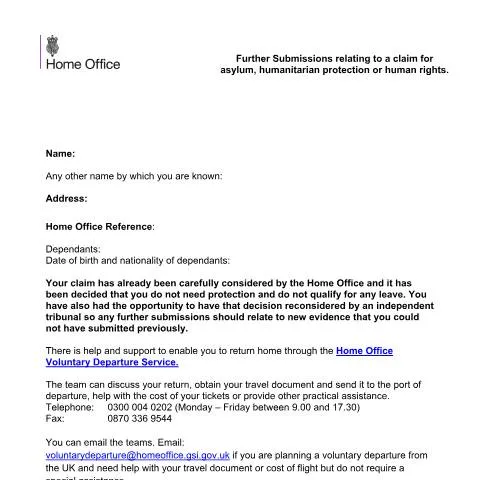
When Previous Asylum Refusals Meet New Circumstances
The immigration landscape for refused asylum seekers in the UK presents a complex challenge: how to navigate the narrow pathway for further submissions when your initial claim has been comprehensively rejected. The Further Submissions form for asylum, humanitarian protection, and discretionary leave represents one of the most stringent processes within UK Visas and Immigration, designed specifically for cases where genuinely new evidence has emerged after exhausting standard appeal routes.
This process sits at the intersection of hope and harsh reality. While the Home Office maintains the Further Submissions Unit in Liverpool precisely to handle such cases, the form itself carries a stark warning: very few further submissions are successful because they fail to meet the exacting standards required. Understanding these standards becomes crucial for anyone considering this route, particularly given the alternative pathways available through family life applications or voluntary departure services.
The timing of further submissions proves critical. Unlike initial asylum applications, this process assumes your case has already undergone thorough scrutiny by both Home Office decision-makers and independent tribunal judges. The bar for success therefore sits considerably higher, demanding evidence that fundamentally alters the assessment of your protection needs rather than simply supplementing your original account.
Distinguishing Further Submissions from Alternative Immigration Routes
The Further Submissions form occupies a specific niche within the broader immigration framework, distinct from several related but separate processes that often cause confusion among applicants and advisers alike.
For those whose circumstances have evolved beyond protection needs, the FLR (FP) and FLR (M) forms provide structured pathways for family and private life applications under the Immigration Rules. These carry application fees but benefit from fee waivers in cases of destitution or exceptional circumstances where human rights grounds apply. The FLR (O) form covers other circumstances falling outside asylum or family considerations.
| Application Type | Purpose | Fee Structure | Processing Location |
|---|---|---|---|
| Further Submissions | New asylum/humanitarian evidence | No fee | FSU Liverpool (in person) |
| FLR (FP) | Family/private life | Fee (waiver available) | Online/postal |
| FLR (M) | Marriage/partnership | Fee required | Online/postal |
| FLR (O) | Other circumstances | Fee (limited waivers) | Online/postal |
The fundamental distinction lies in the legal framework applied. Further submissions engage the Refugee Convention and human rights protection obligations, requiring assessment against persecution and serious harm thresholds. Family life applications operate under Article 8 proportionality tests, weighing private and family ties against immigration control considerations.
Crucially, the Further Submissions process does not require legal representation, though the complexity of demonstrating realistic prospects of success often necessitates expert guidance. The form's structure reflects this tension, providing clear sections for different types of new evidence while maintaining strict requirements for documentation and translation.
The Five Pillars of Successful Further Submissions
The Home Office has crystallised its expectations into five specific criteria that distinguish viable further submissions from unsuccessful attempts. These requirements reflect years of case law development and administrative experience, creating a framework that prioritises genuine developments over repetitive applications.
Novelty forms the cornerstone requirement. New evidence must be significantly different from previous material, not merely expanded or refined versions of earlier submissions. This extends beyond factual developments to include expert reports, country guidance, and supporting documentation that genuinely adds to the protection assessment.
Realistic prospects of success demands that new material could reasonably lead a decision-maker to grant leave to remain. This standard explicitly excludes marginal improvements or speculative arguments, focusing instead on evidence that fundamentally challenges previous negative findings or addresses entirely new protection needs.
The relevance criterion requires clear connections between new evidence and personal circumstances. Country reports or expert opinions must explicitly address how documented conditions or developments affect the individual applicant, rather than providing general background information already considered in country guidance.
Previous unavailability ensures the further submissions process serves its intended purpose of addressing genuinely new developments rather than providing second chances for poorly prepared initial applications. Applicants must demonstrate this represents their first opportunity to submit the specific evidence presented.
Finally, timeliness emphasises the importance of prompt submission once new evidence becomes available. Delays in presenting material can impact both the substantive decision and any subsequent appeal rights, reflecting the system's emphasis on efficient case resolution.
Practical Application of Success Criteria
These criteria operate cumulatively, meaning successful submissions must satisfy all five requirements simultaneously. A common misconception involves treating them as alternative pathways, leading to submissions that excel in one area while failing others.
For instance, country guidance developments might satisfy novelty and timeliness requirements while failing the relevance test if the applicant cannot demonstrate personal connections to documented changes. Similarly, previously unavailable medical evidence might meet four criteria but lack realistic success prospects if it does not address the core reasons for initial refusal.
Evidence Categories and Their Strategic Deployment
The form's structure reflects three primary categories of further submissions, each requiring distinct evidential approaches and strategic considerations. Understanding these categories helps determine the most appropriate framework for presenting new material.
Country condition changes represent the most common basis for further submissions, typically involving deteriorating security situations, new persecution patterns, or altered state protection capabilities. These submissions require current, authoritative country information demonstrating relevant changes since the original decision, coupled with clear explanations of personal impact.
Effective country condition submissions combine objective evidence from recognised sources with detailed personal statements explaining specific vulnerabilities. The Home Office expects applicants to engage with Country Policy and Information Notes, Upper Tribunal country guidance, and recent expert reports while avoiding generic assertions about general deterioration.
Previously unavailable evidence encompasses material that genuinely could not have been obtained during initial proceedings. Medical evidence often falls into this category, particularly where conditions develop or worsen after initial decisions, or where specialist assessments were previously inaccessible.
This category demands careful explanation of unavailability circumstances. Simple assertions that evidence was "difficult to obtain" rarely satisfy Home Office scrutiny. Instead, submissions must demonstrate specific barriers that prevented earlier acquisition, such as ongoing medical investigations, witness safety concerns, or documentary destruction in country of origin.
The third category addresses personal circumstance changes affecting protection needs or human rights considerations. These might include family developments, health deterioration, or new vulnerabilities arising from changed personal circumstances since the original decision.
Documentary Requirements and Translation Standards
All supporting documentation requires English translation where original languages differ, with translations becoming integral parts of the submission rather than supplementary additions. The Home Office will not consider untranslated documents, regardless of their potential significance.
Translation quality affects assessment outcomes, making professional translation services advisable for complex or technical documents. The form requires specific document references including titles, page numbers, and paragraph numbers for each piece of supporting evidence, creating an administrative framework that demands meticulous organisation.
The Liverpool Gateway: FSU Appointment Procedures
The requirement for in-person submission at the Further Submissions Unit in Liverpool represents a significant procedural hurdle, particularly for applicants residing in other parts of the UK. This centralised approach reflects the Home Office's desire to maintain consistent assessment standards while managing resource allocation efficiently.
Booking FSU appointments requires advance planning through the gov.uk website, with availability often limited and requiring flexibility in scheduling. The appointment system operates on a first-come, first-served basis, though urgent cases may receive priority consideration where compelling circumstances exist.
During FSU appointments, officials conduct preliminary assessments to ensure submissions meet basic requirements before formal processing begins. This screening function can result in immediate rejection of clearly inadequate submissions, though it also provides opportunities to address minor technical deficiencies.
The in-person requirement serves multiple purposes beyond administrative convenience. It allows officials to assess credibility through direct interaction, ensures complete documentation submission, and provides opportunities for clarification on complex evidential matters. However, it also creates accessibility challenges for vulnerable applicants or those with limited mobility.
Preparation for FSU Attendance
Successful FSU appointments require comprehensive preparation extending beyond form completion. Applicants should organise supporting documentation according to the form's reference system, prepare clear explanations for any gaps in evidence, and understand the specific legal tests their submissions must satisfy.
The appointment typically involves document verification, preliminary credibility assessment, and clarification of any ambiguous aspects of the submission. Officials may identify additional evidence requirements or suggest alternative application routes where appropriate.
Processing Pathways and Decision Frameworks
Once submitted through the FSU, further submissions enter a distinct processing stream within UK Visas and Immigration, separate from both initial asylum decisions and routine immigration applications. This pathway reflects the complex legal and evidential considerations involved in reassessing previously refused cases.
Fill in your form directly online
No printing: type your details into the boxes of the official form, tick, then download the PDF ready to send.
- 1Type into the form boxes
- 2Tick in one click
- 3Save and download the PDF
Initial screening determines whether submissions meet the five core criteria for consideration. Cases failing this preliminary assessment receive rapid rejection, often within weeks of submission. This screening function prevents clearly inadequate cases from consuming extensive caseworker time while ensuring genuine developments receive proper consideration.
Submissions passing initial screening undergo substantive assessment by specialist caseworkers familiar with protection law and country condition analysis. This process typically takes several months, reflecting the detailed consideration required to evaluate new evidence against previous negative findings.
The decision framework operates on a binary basis: either the further submissions create realistic prospects of success, warranting a new substantive decision on the asylum claim, or they fail to meet this threshold and receive rejection. Unlike initial asylum decisions, further submissions do not result in partial grants or alternative forms of leave unless specifically applied for.
Appeal Rights and Onward Options
Successful further submissions restore full appeal rights equivalent to fresh asylum applications, including First-tier Tribunal hearings and potential Upper Tribunal appeals on points of law. This restoration of appeal rights represents one of the most significant advantages of the further submissions route over alternative application types.
Rejected further submissions carry limited appeal options, typically restricted to judicial review challenges on procedural or legal error grounds. This restriction reflects the assumption that cases reaching this stage have already benefited from independent tribunal scrutiny through initial appeal processes.
The absence of repeat further submission rights means rejection typically exhausts protection-based options within the UK immigration system. Applicants facing this outcome must consider voluntary departure services, family life applications under the Immigration Rules, or exceptional circumstances applications outside standard immigration categories.
Integration with Voluntary Departure Services
The Further Submissions form uniquely incorporates explicit information about voluntary departure options, reflecting the Home Office's policy emphasis on encouraging return rather than prolonged immigration proceedings. This integration serves both informational and strategic purposes within broader immigration enforcement approaches.
The Voluntary Departure Service offers practical assistance including travel document acquisition, flight cost support, and reintegration advice for those choosing to return voluntarily. Contact details provided on the form enable direct engagement with specialist teams handling different aspects of voluntary return processes.
Two distinct email addresses serve different voluntary departure needs: general assistance for straightforward cases, and specialised support for applicants requiring medical assistance or reintegration help. This bifurcation reflects varying complexity levels in voluntary departure cases and resource allocation within the service.
The strategic placement of voluntary departure information within the Further Submissions form serves multiple functions. It provides practical alternatives for applicants recognising limited prospects of immigration success, while also emphasising the Home Office's expectation that most further submissions will ultimately prove unsuccessful.
Voluntary departure remains available throughout the further submissions process, offering exit strategies for applicants whose circumstances change or whose initial optimism about new evidence proves unfounded. The service operates independently of immigration decision-making, ensuring applicants can access return assistance regardless of their further submission outcomes.
Assisted Voluntary Return Programmes
The distinction between standard voluntary departure and Assisted Voluntary Return reflects varying support levels available to different applicant categories. Assisted programmes typically provide enhanced financial support, medical assistance during travel, and reintegration support in destination countries.
Eligibility for assisted return often depends on vulnerability factors, length of UK residence, or specific country conditions affecting safe return. The integration of this information within the Further Submissions form ensures applicants understand the full range of available options before committing to extended immigration proceedings.