When Protection Status Creates New Pathways for Young Relatives
The landscape of UK immigration changes dramatically when a family member receives protection status as a refugee, beneficiary of humanitarian protection, or someone granted limited leave under Article 3 of the European Convention on Human Rights. For children under 18 with close relatives in such circumstances, the FLR(P) application under Appendix Child Relative (Protection) opens a specific route that differs fundamentally from standard family reunion procedures.
This particular application pathway recognises the unique vulnerabilities of children whose close relatives have been granted protection but haven't yet achieved settled status in the UK. Unlike the more straightforward processes for children joining parents with indefinite leave to remain, the FLR(P) route acknowledges the transitional nature of protection status whilst still prioritising family unity and child welfare.
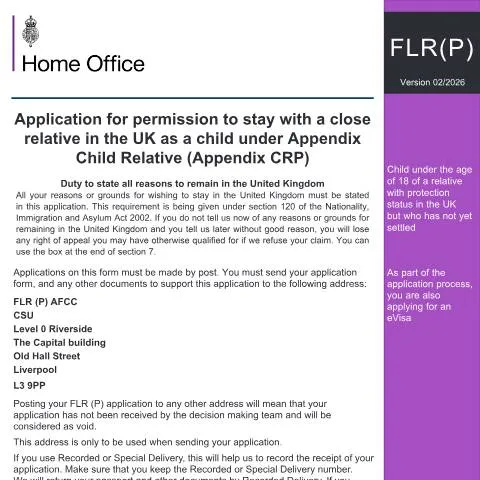
The application must reach the dedicated processing centre in Liverpool by post only—a requirement that reflects the sensitive nature of protection-related cases and ensures proper handling by specialist teams trained in the complexities of refugee family situations. The version 02/2026 validity date indicates recent updates to accommodate evolving protection frameworks and digital visa systems.
Understanding the Specific Qualifying Framework Under Appendix CRP
Appendix Child Relative (Protection) establishes distinct criteria that separate this route from other child-related immigration applications. The sponsoring relative must hold current protection status in the UK but crucially not yet have settled status—a temporal window that creates both opportunity and urgency for qualifying children.
The definition of close relative under this appendix extends beyond immediate family to include grandparents, siblings, aunts, uncles, and other relatives where dependency relationships existed prior to the sponsor's arrival in the UK. This broader scope acknowledges that protection scenarios often involve extended family separations and non-traditional care arrangements.
| Sponsor's Protection Status | Child's Eligibility Window | Key Considerations |
|---|---|---|
| Refugee status (5 years initial) | Until sponsor applies for settlement | Must maintain dependency relationship |
| Humanitarian Protection (5 years) | During protection period only | Evidence of pre-existing relationship required |
| Limited leave under Article 3 | Varies with sponsor's leave duration | Often involves medical or exceptional circumstances |
The child applicant must demonstrate that they were part of the family unit before the sponsor fled their home country and that reasonable alternative care arrangements aren't available in their current location. This requirement prevents the route being used for general family migration whilst protecting genuinely vulnerable children.
Navigating the Financial Requirements and Fee Structure
The £1,321 application fee represents a significant financial barrier for families already dealing with the economic challenges of protection status. However, the fee waiver provisions specifically recognise these circumstances, allowing families to request exemption based on their financial situation.
The Immigration Health Surcharge calculation introduces a unique complexity: rather than being based on the child's proposed leave duration, it aligns with the remaining protection period of the sponsoring relative. If the sponsor has 18 months remaining on their refugee status, the child pays 18 months of IHS at the reduced under-18 rate. This alignment ensures the child's leave doesn't extend beyond their sponsor's current permission.
Fee waiver applications require detailed financial disclosure and are assessed before the main application. Families should prepare comprehensive evidence of their economic circumstances, including:
- Sponsor's employment status and income documentation
- Universal Credit or other benefit award letters
- Bank statements showing financial hardship
- Evidence of exceptional circumstances affecting family finances
The five working day clearance period for cheque payments can create anxiety for families concerned about their child's current legal status, making credit or debit card payments preferable despite potential banking complications with large transaction amounts.
Documentation Strategy for Protection-Related Child Cases
Evidence requirements for FLR(P) applications differ markedly from standard family applications due to the protection context. Many families lack traditional documentation due to the circumstances that led to the sponsor's flight from their home country.
UK Visas and Immigration recognises these evidential challenges and accepts alternative forms of proof. Relationship evidence might include community statements, religious organisation confirmations, or witness testimonies where civil documents are unavailable. The key is demonstrating the pre-existing family relationship and the child's dependency on the UK-based relative.
Sponsor's protection documentation forms the foundation of the application. This includes their grant letter, biometric residence permit, and any correspondence confirming their current immigration status. The sponsor's protection status must be current and valid throughout the child's application process.
For children currently in the UK, evidence of their legal status becomes crucial. Those who entered illegally or overstayed previous permission need careful legal advice about disclosure requirements and potential immigration consequences during the application process.
Managing Documentation Gaps in Crisis Situations
Protection scenarios often involve document destruction, loss, or inaccessibility. UK Visas and Immigration guidance acknowledges these realities but requires applicants to explain gaps thoroughly. Successful applications often include:
- Detailed statements explaining why documents are unavailable
- Alternative evidence sources (school records, medical records, community testimony)
- Professional assessments of the child's circumstances and needs
- Evidence of attempts to obtain documentation from relevant authorities
The Section 120 Disclosure Requirement and Its Strategic Implications
The mandatory disclosure under section 120 of the Nationality, Immigration and Asylum Act 2002 creates both opportunity and risk for FLR(P) applicants. This provision requires stating all reasons for wishing to remain in the UK, not just those related to the child relative route.
Failure to disclose all grounds can eliminate appeal rights if the application is refused, creating a strategic dilemma for families who might have alternative immigration routes. For example, a child who could potentially claim asylum in their own right must decide whether to include this in their FLR(P) application or preserve it as a separate option.
The section 7 space for additional grounds allows applicants to raise multiple arguments simultaneously. Common additional grounds include:
- Best interests of the child considerations under Article 8 ECHR
- Potential asylum claims based on the child's own circumstances
- Medical needs requiring UK treatment
- Educational disruption arguments
- Risk of harm if returned to country of origin
Legal representatives often advise comprehensive disclosure to preserve all options whilst focusing the primary case on the child relative provisions.
Biometric Requirements and the Transition to eVisa Systems
The FLR(P) process incorporates biometric enrolment at Service and Support Centres, but the application notes specifically mention eVisa integration. This reflects the UK's transition away from physical documents towards digital immigration status verification.
Children granted permission under FLR(P) will receive their status digitally rather than through a biometric residence permit. This change affects how they'll prove their immigration status to employers, educational institutions, and service providers in future. Families need to understand the implications for accessing services and maintaining status records.
The biometric appointment scheduling can create logistical challenges, particularly for children living outside major urban centres. Service and Support Centres have limited locations, and appointment availability varies seasonally. Families should factor potential travel costs and accommodation needs into their application planning.
Special Considerations for Vulnerable Children
UK Visas and Immigration recognises that children in protection-related cases often have specific vulnerabilities requiring sensitive handling. Unaccompanied children or those with trauma histories may need additional support during biometric enrolment.
The system allows for reasonable adjustments including:
- Accompanied appointments for nervous or traumatised children
- Interpreter services for non-English speaking applicants
- Medical exemptions from certain biometric requirements
- Priority processing in urgent welfare cases
Timeline Pressures and Status Implications During Processing
FLR(P) applications face unique timing pressures due to the temporary nature of protection status. If the sponsoring relative's protection period expires or they obtain settled status during processing, this can affect the child's application outcome.
Children already in the UK may have section 3C leave—automatic extension of their current status whilst the FLR(P) application is pending. However, children applying from overseas lack this protection and remain vulnerable to changing circumstances in their current location.
Processing times vary significantly based on case complexity and seasonal demand. Simple cases with complete documentation might resolve within 6-8 months, whilst complex cases requiring additional evidence or interviews can extend considerably longer. Families should maintain regular contact with the decision-making team and respond promptly to any requests for additional information.
The Liverpool processing centre's postal-only requirement means communication delays can compound timing issues. Families using recorded delivery services should retain tracking information and follow up if acknowledgment doesn't arrive within reasonable timeframes.
Post-Decision Pathways and Long-Term Family Planning
Successful FLR(P) applicants receive permission aligned with their sponsor's protection status duration. This creates a pathway towards eventual settlement, but families must navigate the transition carefully as circumstances change.
When the sponsoring relative becomes eligible for settled status, the child can typically apply for settlement simultaneously or shortly afterwards. However, the timing requires careful coordination to avoid gaps in permission or complications with residence requirements.
Refused applications trigger different appeal routes depending on the refusal grounds. Protection-related refusals often engage Article 8 family life arguments, whilst procedural refusals might be addressed through administrative review. The loss of appeal rights for undisclosed grounds under section 120 makes initial application quality crucial.
Families should begin planning for the next immigration step early in the FLR(P) period. This includes maintaining evidence of continued relationship, the child's integration into UK life, and the sponsor's progress towards settlement. Educational records, medical registration, and community involvement all contribute to demonstrating the family's establishment in the UK for future applications.
Documentation Requirements and Evidence Gathering
The FLR(P) application demands comprehensive documentation to establish both your identity and your qualifying relationship with the protected relative. Understanding what constitutes acceptable evidence can significantly impact your application's success rate.
For identity verification, you'll need your current passport or travel document, along with any previous UK immigration documents. If you've been living in the UK continuously, gather evidence of your residence such as NHS registration letters, school reports, or local authority correspondence. The Home Office particularly values documents that demonstrate an ongoing presence rather than isolated snapshots of your time here.
Relationship evidence forms the cornerstone of your application. Birth certificates must be official copies, preferably with apostille certification if issued outside the UK. Where birth certificates are unavailable—common in certain countries affected by conflict—DNA evidence may be accepted, though this typically requires advance discussion with UK Visas and Immigration. Alternative documents might include baptismal certificates, family court orders, or sworn affidavits from relatives, though these carry less weight than primary documentation.
Your protected relative's status documentation is equally crucial. This includes their refugee recognition letter, humanitarian protection grant notice, or discretionary leave correspondence from the Home Office. Ensure you have copies of their current biometric residence permit, as the Home Office cross-references applications against their internal records.
Financial evidence requirements vary depending on your circumstances. If you're under 18 and your protected relative is your parent, they must demonstrate adequate maintenance without recourse to public funds. This typically means providing three months of bank statements, employment contracts, and payslips. For those approaching 18 or already adults, additional evidence of your own financial independence or support arrangements may be necessary.
Educational documentation becomes particularly relevant for older children. School enrollment letters, examination certificates, and evidence of ongoing studies can strengthen your case by demonstrating integration and the impact of potential removal on your education.
Language proficiency, while not always explicitly required for FLR(P) applications, can support your case. If you've achieved qualifications in English or can demonstrate proficiency through school reports, include this evidence as it shows integration and commitment to UK society.
Fill in your form directly online
No printing: type your details into the boxes of the official form, tick, then download the PDF ready to send.
- 1Type into the form boxes
- 2Tick in one click
- 3Save and download the PDF
Common Pitfalls and Application Challenges
FLR(P) applications face several recurring issues that can lead to refusal or significant delays. Understanding these pitfalls allows applicants to proactively address potential weaknesses in their cases.
Timing represents one of the most critical factors. Applications submitted after your current leave expires, even by a single day, face additional scrutiny and potential refusal on grounds of overstaying. The Home Office operates strict deadlines, and while Section 3C leave may provide some protection during application processing, this doesn't excuse late submission. If you're approaching your deadline and lack complete documentation, consider seeking legal advice about making a holding application or requesting an extension.
Relationship verification often proves problematic, particularly for applicants from countries with unreliable civil registration systems. Simply stating a family relationship without robust documentation typically results in refusal. Where standard documents are unavailable, the Home Office may accept DNA evidence, but this process requires coordination and can extend processing times significantly. Some applicants attempt to substitute testimonial evidence for documentary proof, but witness statements alone rarely satisfy the evidential threshold.
The "sole responsibility" and "serious and compelling circumstances" tests create another common stumbling block. For children whose protected relative isn't their primary carer, demonstrating why family life should continue in the UK rather than the child joining family abroad requires careful argumentation. Medical evidence, educational disruption assessments, and expert reports on country conditions may be necessary.
Financial maintenance requirements catch many applicants unprepared. The protected relative must show they can support the applicant without accessing public funds, but calculating the required income threshold can be complex. Different rates apply depending on family composition, and the Home Office expects evidence of sustained income rather than temporary financial arrangements. Borrowing money to meet maintenance requirements immediately before application typically won't satisfy the test.
Previous immigration history can complicate applications significantly. Children who've previously been refused entry clearance, overstayed, or breached conditions may face additional hurdles. The Home Office considers whether granting leave would undermine immigration control, particularly if there's evidence of deliberate circumvention of normal entry routes.
Application form errors, while seemingly minor, can have serious consequences. Inconsistent dates, omitted information, or contradictory statements raise credibility concerns. The Home Office may interpret discrepancies as attempts to mislead, even when they result from genuine mistakes or language barriers. Double-checking all entries and ensuring consistency across supporting documents is essential.
Character requirements apply even to child applicants in certain circumstances. Any criminal convictions, cautions, or involvement with local authorities must be declared. Attempting to conceal negative information almost invariably leads to refusal and may impact future applications.
Processing Timeline and What to Expect During Assessment
Understanding the FLR(P) processing journey helps manage expectations and prepare for potential outcomes. The Home Office doesn't guarantee processing times, but typical timelines range from eight to sixteen weeks, though complex cases may take considerably longer.
Initial processing involves administrative checks to ensure your application is complete and fees have been paid. Incomplete applications may be rejected without consideration, requiring resubmission with additional fees. This preliminary stage typically takes one to two weeks, after which you should receive acknowledgment correspondence confirming your reference number and that processing has begun.
Document verification follows, where the Home Office examines your evidence against their requirements and internal databases. They may contact third parties to verify information, such as schools, employers, or medical practitioners. This stage can extend processing times if additional information is requested or if verification proves problematic.
The substantive assessment involves caseworkers evaluating whether you meet the eligibility criteria and considering any discretionary factors. For straightforward cases with clear documentation, this may proceed smoothly. However, complex family situations, disputed relationships, or borderline financial evidence can trigger more detailed investigation.
During processing, you may receive requests for additional information or attendance at interviews. Response deadlines are typically strict—usually ten working days—and failure to comply can result in refusal. If you cannot meet a deadline due to genuine circumstances, contact the Home Office immediately to request an extension, providing supporting evidence for any delay.
Biometric enrollment occurs separately from document submission if you're applying from within the UK. You'll receive an appointment letter specifying when and where to attend. Missing this appointment can significantly delay your application, as the Home Office won't usually proceed without biometric information.
Decision notification arrives by post to your registered address, making it crucial to inform the Home Office of any address changes during processing. Positive decisions include details of your new leave conditions, work restrictions, and validity period. Refusal letters explain the reasons for rejection and outline appeal rights where applicable.
If your application succeeds, you'll typically receive leave for thirty months, aligning with your protected relative's status review cycle. This ensures your cases remain synchronized, though it may result in shorter initial grants than other immigration routes.
Processing delays aren't uncommon, particularly for applications requiring additional verification or those submitted during peak periods. While frustrating, these delays don't necessarily indicate problems with your case. However, if processing extends beyond published timeframes significantly, you may be able to make a complaint or request expedition in exceptional circumstances.
Throughout the process, maintaining accurate contact information and responding promptly to any correspondence is essential. The Home Office may attempt contact multiple times before treating applications as withdrawn, but this varies depending on the specific request and circumstances.