The Critical Gateway: Securing Additional CAS Allocations for UK Educational Institutions
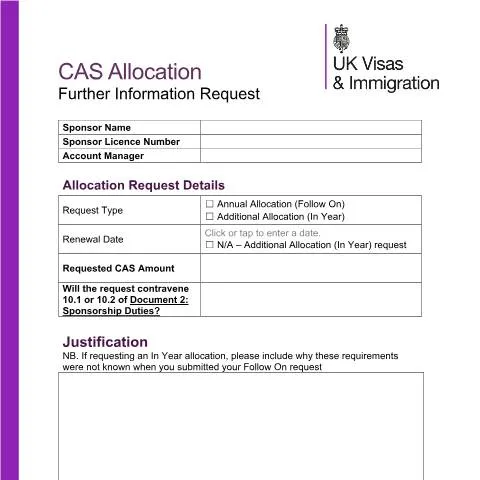
When an established UK educational institution suddenly finds its student recruitment exceeding expectations or faces unexpected demand for specific courses, the need for additional Confirmation of Acceptance for Studies (CAS) certificates becomes urgent. The CAS allocation further information request form represents a pivotal document that can determine whether an institution can capitalise on growth opportunities or must turn away prospective international students.
This comprehensive form, managed by UK Visas and Immigration's Student Sponsor Assessment Unit, serves as the formal mechanism through which licensed educational sponsors request either their annual follow-on allocation or additional in-year CAS certificates. The process involves detailed scrutiny of institutional capacity, compliance history, and strategic planning, making accurate completion essential for maintaining operational flexibility.
Navigating the Dual Pathways: Annual Follow-On versus In-Year Requests
The form accommodates two distinct scenarios, each with markedly different implications for institutional planning and UKVI assessment criteria. Understanding these pathways proves crucial for determining the appropriate request type and tailoring supporting documentation accordingly.
Annual Allocation Follow-On Requests
Annual follow-on requests represent the standard renewal process for institutions approaching their licence renewal date. These applications typically align with established recruitment patterns and demonstrate continuity in educational delivery. Institutions pursuing this route must provide their renewal date and justify their requested CAS amount based on historical usage patterns and projected student intake.
The assessment process for annual requests generally follows established precedent, with UKVI examining year-on-year growth trends, compliance records, and capacity planning. Institutions with consistent track records often find this pathway more straightforward, though significant increases still require substantial justification.
Additional In-Year Allocations
In-year requests present greater complexity, as they indicate circumstances not anticipated during the initial annual planning cycle. These requests demand comprehensive explanation of why additional CAS certificates have become necessary, with particular emphasis on factors beyond the institution's original recruitment strategy.
Common triggers for in-year requests include unexpected market opportunities, successful new partnership arrangements, or changes in competitor landscapes. However, UKVI scrutinises these applications carefully, seeking assurance that increased recruitment won't compromise educational quality or compliance standards.
Dissecting the Justification Framework: Building a Compelling Case
The heart of any successful CAS allocation request lies in the justification section, where institutions must demonstrate both need and capacity. This section requires strategic thinking rather than mere administrative completion, as it directly influences UKVI's assessment of risk and institutional capability.
Market Analysis and Recruitment Strategy
Institutions must provide detailed analysis of their primary recruitment markets, including specific regions experiencing growth and the underlying drivers of increased demand. This extends beyond simple geographical data to encompass recruitment methodologies, whether through agents, in-country staff, or organic growth.
The form specifically requests information about shifts in recruitment patterns, including movement between undergraduate and postgraduate levels, changes in course popularity, and emerging market trends. Institutions should prepare comprehensive data demonstrating how their recruitment aligns with broader educational objectives rather than opportunistic expansion.
Compliance and Risk Mitigation Measures
A critical component addresses how institutions actively reduce the five main reasons for visa refusal, demonstrating proactive engagement with UKVI's priorities. This requires specific examples of interventions, screening processes, and support mechanisms rather than generic policy statements.
Institutions must also detail additional measures for reducing recruitment risks, including due diligence procedures for international partnerships, agent oversight mechanisms, and student support systems designed to maintain engagement and attendance rates.
Infrastructure and Capacity Planning: Proving Operational Readiness
Beyond recruitment justification, the form demands evidence of institutional capacity to accommodate increased student numbers without compromising educational standards. This encompasses both physical infrastructure and academic delivery capabilities.
Physical Infrastructure Assessment
Institutions requesting significant increases must demonstrate adequate teaching facilities, library resources, laboratory capacity, and crucially, accommodation availability. This extends beyond current capacity to include planned expansions, partnership arrangements, and contingency planning for unexpected shortfalls.
The assessment considers not just immediate teaching requirements but also supporting infrastructure including student services, IT systems, and recreational facilities. UKVI examines whether rapid expansion might strain existing resources and impact student experience quality.
Academic Delivery and Monitoring Systems
The form requires detailed explanation of how institutions will maintain effective monitoring of student attendance and engagement despite increased numbers. This includes staffing plans, technology solutions for tracking student progress, and escalation procedures for identifying at-risk students.
Particular attention focuses on how institutions will manage the administrative burden of increased student numbers while maintaining compliance with sponsor duties, including timely reporting of student withdrawals, course changes, and attendance issues.
Remote Delivery Provisions: Navigating Post-Pandemic Educational Models
For Higher Education Providers with established compliance track records, the form includes specific sections addressing remote delivery arrangements, reflecting ongoing adaptation to post-pandemic educational models while maintaining immigration compliance.
Remote Delivery Thresholds and Justifications
Institutions delivering between 21% and 40% of course content remotely must provide comprehensive justification for each affected course. This requirement acknowledges legitimate pedagogical innovations while ensuring that international students receive substantial face-to-face educational experiences justifying their physical presence in the UK.
The form requires separate listing and justification for each remote delivery course, distinguishing between continuing programmes, newly proposed arrangements, and concluded courses. This granular approach enables UKVI to assess whether remote delivery represents strategic educational enhancement or cost-cutting measures potentially compromising student experience.
Ongoing Monitoring and Review Mechanisms
Institutions must demonstrate robust systems for monitoring remote delivery effectiveness, including student feedback mechanisms, academic outcome tracking, and regular review processes. This extends to explaining how remote elements integrate with in-person components to create coherent educational experiences.
| Remote Delivery Category | Reporting Requirement | Assessment Criteria |
|---|---|---|
| Currently Running Courses | List all previously agreed remote delivery courses still active | Continuity and effectiveness demonstration |
| Concluded Programmes | Detail completed remote delivery courses no longer offered | Lessons learned and outcomes achieved |
| New Proposals | Individual course justification with pedagogical rationale | Educational necessity and student benefit analysis |
Strategic Forecasting: The CAS Breakdown Framework
The final section requires detailed breakdown of anticipated CAS usage across different student categories, providing UKVI with granular insight into institutional planning and resource allocation strategies.
Student Category Analysis
Institutions must forecast CAS requirements across multiple categories including doctoral/research students, partnership arrangements, study abroad programmes, medical school placements, and various undergraduate and postgraduate pathways. This breakdown enables assessment of whether growth represents balanced expansion or concentration in specific areas that might indicate compliance risks.
Particular attention focuses on categories historically associated with higher refusal rates or compliance challenges, such as foundation programmes and pre-sessional English courses. Institutions must demonstrate understanding of associated risks and mitigation strategies for each category.
Intake Planning and Seasonal Variations
The form requires detailed explanation of institutional intake patterns, including multiple entry points throughout the academic year and corresponding CAS forecasts for each intake. This information enables UKVI to assess whether institutions maintain consistent standards across different entry periods or whether certain intakes receive reduced attention.
Institutions must also address how they manage varying demand across intakes, including contingency planning for over or under-recruitment and systems for reallocating CAS certificates between different student categories as circumstances change.
Compliance Documentation and Supporting Evidence
Successful CAS allocation requests require comprehensive supporting documentation that substantiates claims made within the form itself. This evidence base often determines whether applications receive approval or face additional scrutiny.
Market Intelligence and Recruitment Data
Institutions should prepare detailed market analysis including competitor benchmarking, regional demand trends, and evidence of sustainable recruitment pipelines. This extends beyond simple application numbers to encompass conversion rates, student satisfaction data, and employment outcomes for graduates.
Documentation should include recruitment strategy documents, agent agreements where applicable, and evidence of marketing activities supporting projected growth. UKVI particularly values evidence demonstrating strategic rather than opportunistic expansion.
Capacity and Infrastructure Evidence
Physical capacity documentation should include facility assessments, accommodation partnerships, and staffing plans demonstrating readiness for increased student numbers. This encompasses both immediate capacity and planned expansions, with clear timelines and contingency arrangements.
Academic capacity evidence includes staff recruitment plans, curriculum development documentation, and systems for maintaining educational quality standards despite increased numbers. Institutions should demonstrate how they will preserve student-to-staff ratios and maintain individual attention levels.
Assessment Timelines and Decision Processes
Understanding UKVI's assessment timeline proves crucial for institutional planning, particularly given the competitive nature of international student recruitment and the need to provide certainty to prospective students.
The Student Sponsor Assessment Unit typically processes requests within established timeframes, though complex applications or those requiring significant increases may face extended assessment periods. Institutions should plan submission timing carefully, considering their recruitment cycles and the need for CAS certificates to support student visa applications.
During assessment, UKVI may request additional information or clarification, particularly regarding capacity planning, compliance measures, or market analysis. Institutions should prepare comprehensive responses promptly, as delays can impact the overall assessment timeline and potentially affect recruitment outcomes.
The final decision encompasses not just approval or refusal but may include conditions or reduced allocations based on UKVI's assessment of institutional capacity and compliance capability. Institutions should prepare for various scenarios and maintain flexibility in their recruitment planning to accommodate potential variations from requested amounts.
Understanding Different Types of Further Information Requests
The Child and Working Tax Credits office may issue various types of further information requests, each requiring specific documentation and responses. Understanding these distinctions helps you provide the most relevant evidence efficiently.
Income verification requests typically arise when there's a discrepancy between your reported earnings and HMRC's records from employers or self-employment returns. You'll need to provide P60 certificates, payslips covering the specified period, or SA302 calculations if self-employed. For those with multiple income sources, include all relevant documentation even if one source seems minor—HMRC needs the complete picture.
When dealing with childcare cost queries, the request often stems from changes in your provider or significant cost variations. Acceptable evidence includes receipts from registered childminders, nursery invoices clearly showing the child's name and period covered, or contracts with after-school clubs. If you've changed providers mid-claim, explain the transition clearly and provide documentation from both old and new arrangements.
Household composition reviews occur when HMRC suspects changes in your living arrangements that could affect your entitlement. These requests require careful handling as they directly impact your award calculation. Provide council tax bills showing who's liable, tenancy agreements listing all occupants, or mortgage statements if you own your home. For separated parents sharing childcare, include any court orders or formal agreements outlining custody arrangements.
Disability-related requests focus on verifying continued eligibility for disability elements within your tax credits claim. You'll typically need current medical certificates, DLA or PIP award letters, or statements from healthcare professionals. If your condition has improved or worsened since your original claim, explain these changes clearly as they may affect your entitlement level.
Some requests combine multiple categories—for instance, asking for both income and childcare evidence simultaneously. In these cases, organise your response by category and clearly label each section of documentation to help processing staff navigate your submission efficiently.
Common Pitfalls and How to Avoid Them
Many claimants inadvertently delay their case by making preventable errors when responding to further information requests. Recognising these common mistakes can save you significant time and stress.
Incomplete date ranges represent one of the most frequent issues. If HMRC requests bank statements for "January to March 2024," ensure you provide complete statements covering those full months, not just selected transactions. Partial statements or screenshots of online banking often lack the official formatting and comprehensive transaction history that processing staff require.
Another critical error involves providing outdated documentation. Always check the issue dates on certificates and letters before submitting them. A P60 from two tax years ago won't satisfy a current income verification request, regardless of how detailed it appears. Similarly, expired medical certificates cannot support ongoing disability element claims.
Unclear photocopies frequently cause unnecessary delays. Modern mobile phone cameras often produce clearer images than traditional photocopiers, but ensure all text remains legible and no crucial details are cut off. If submitting multiple pages, number them clearly and include a cover sheet listing all enclosed documents.
Many claimants struggle with explaining complex circumstances in the limited space provided on standard forms. If your situation involves unusual employment patterns, shared custody arrangements, or multiple benefit claims, consider preparing a separate explanatory letter. Keep this concise but comprehensive, using bullet points to highlight key facts that might not be immediately obvious from the supporting documents alone.
Timing assumptions also cause problems. Don't assume that submitting your response automatically pauses any ongoing investigations or extends deadlines. If you're approaching the response deadline but still gathering documents, contact the Tax Credit Helpline to explain your situation. They may grant extensions in appropriate circumstances, but this isn't guaranteed.
Some claimants make the mistake of over-explaining minor discrepancies while under-explaining significant changes. A brief note about a £10 difference in monthly earnings rarely requires extensive justification, whereas a job change or house move demands clear explanation even if the financial impact seems minimal.
Special Circumstances and Complex Cases
Certain life situations create additional complexity when responding to further information requests, requiring tailored approaches and sometimes specialist documentation.
Military families face unique challenges, particularly those with frequent postings or deployment-related income variations. Service personnel should include posting orders when explaining address changes, and provide detailed breakdowns of allowances versus basic pay. If deployed overseas, explain how this affects your UK tax liability and provide evidence of continued UK residence status for tax credits purposes.
For seasonal workers, HMRC often struggles to understand irregular income patterns that are perfectly normal within certain industries. Agricultural workers, holiday resort staff, or construction workers should provide employment contracts showing seasonal terms, historical payslips demonstrating the pattern over previous years, and employer letters confirming the cyclical nature of the work.
Foster carers and kinship carers encounter specific complications around allowances and payments. Foster care allowances generally don't count as income for tax credits purposes, but you must clearly distinguish between maintenance payments and any additional income from local authorities. Include official fostering agreements and payment breakdowns showing which elements constitute allowances versus income.
Claimants with fluctuating health conditions often find their circumstances don't fit neatly into standard categories. Conditions like multiple sclerosis or mental health issues may vary significantly over time, affecting work capacity unpredictably. Provide medical evidence showing the fluctuating nature of your condition, and explain how this impacts your ability to work consistently.
Students transitioning to work or returning to education mid-claim create particular complexity. Student loan payments, grants, and part-time work interact differently with tax credits depending on your study status and course type. Include university letters confirming enrollment dates, student finance award letters, and clear timelines showing when your status changed.
For carers of disabled adults, distinguishing between informal family care and formal caring roles affects your tax credits entitlement. If you're caring for a disabled partner, parent, or other relative, provide evidence of their care needs and any Carer's Allowance claims you've made. This helps HMRC understand your work limitations and childcare requirements.
Recent immigrants or those with changing immigration status must navigate additional requirements around residency and work authorization. Include Home Office correspondence showing your current immigration status, and explain any restrictions on your right to work or claim benefits. If your status has recently changed, provide clear timelines and official documentation confirming the transition.
Business owners facing company restructuring or partnership changes need to explain how these affect their personal income extraction. Provide company accounts, partnership agreements, and clear explanations of any salary versus dividend arrangements. If you've changed from employed to self-employed status (or vice versa), include documentation showing exactly when this transition occurred and how it affects your ongoing earnings.