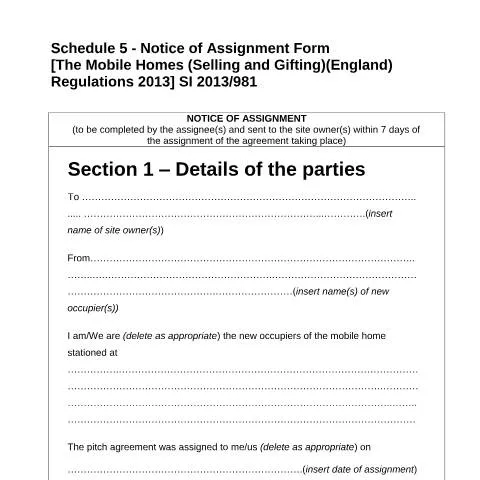
Understanding Park Home Ownership Transfers: The Critical Assignment Notice Process
When purchasing or receiving a park home in England, new occupiers enter a specialised residential sector governed by The Mobile Homes (Selling and Gifting)(England) Regulations 2013. Unlike conventional property transactions, park home ownership involves a unique two-tier system: you own the mobile home structure whilst renting the pitch from a site owner. This arrangement creates specific legal obligations, particularly when ownership changes hands through assignment of the pitch agreement.
The Notice of Assignment form represents a mandatory notification requirement that bridges the gap between private ownership transfer and site management responsibilities. New occupiers must complete and submit this document within seven days of the assignment taking place, establishing their legal standing with the site owner and ensuring compliance with statutory obligations under the Mobile Homes Act 1983.
This process affects thousands of transactions annually across England's estimated 1,800 residential park home sites, where approximately 85,000 households have chosen this distinctive form of homeownership that combines property ownership with tenancy arrangements.
Decoding the Assignment Framework: Legal Foundations and Pitch Agreements
The assignment process fundamentally differs from traditional property conveyancing. When you acquire a park home, you're actually receiving an assignment of a pitch agreement – a legal transfer of the contractual relationship between the previous occupier and the site owner. The Mobile Homes Act 1983 establishes implied terms that automatically govern these agreements, regardless of what express terms might appear in written contracts.
This statutory framework creates several layers of protection and obligation. The implied terms include security of tenure provisions, succession rights, and specific procedures for pitch fee reviews. Crucially, where any express term in a written agreement conflicts with these implied terms, the implied terms take precedence. This principle ensures consistent protection across all park home agreements, regardless of individual site owner preferences or historical contract variations.
Understanding this hierarchy proves essential when completing the Notice of Assignment. The form specifically references "the terms set out in the written statement/agreement and including those implied into the agreement by the Mobile Homes Act 1983," emphasising that your rights and obligations extend beyond any written documentation you might receive from the previous occupier.
Commission Calculations Under Statutory Provisions
The Mobile Homes Act 1983 permits site owners to charge a commission of up to 10% of the sale price when park homes are sold (but not when gifted). This commission system generates considerable complexity, as it applies only to sales transactions and requires careful calculation based on the actual purchase price paid.
| Transaction Type | Commission Due | Payment Timeline |
|---|---|---|
| Sale to new occupier | Up to 10% of purchase price | 7 days after receiving site owner's bank details |
| Gift between family members | No commission payable | N/A |
| Inheritance/succession | No commission payable | N/A |
The commission payment mechanism involves a two-stage process designed to prevent disputes. Site owners must provide bank account details "as soon as practicable" after receiving the Notice of Assignment, and new occupiers then have seven days from receipt of those banking details to transfer the commission payment. This structure prevents indefinite delays whilst protecting both parties' interests.
Navigating the Seven-Day Notification Requirement
The seven-day deadline for submitting the Notice of Assignment begins from "the assignment of the agreement taking place" – typically the completion date when keys change hands and legal ownership transfers. This timeframe is absolute and non-negotiable under the regulations, making prompt action essential for new occupiers.
Failure to meet this deadline can create legal complications and potentially affect your standing with the site owner. While the regulations don't specify penalties for late submission, non-compliance could impact your ability to establish legitimate occupancy rights and may complicate future dealings with site management.
The notice must be sent directly to the site owner(s), whose names and contact details should be available from the previous occupier or site management office. In cases where multiple site owners exist (such as corporate structures or partnerships), the notice should be addressed to all named parties to ensure comprehensive notification.
Essential Documentation Assembly
Section 5 of the Notice requires new occupiers to enclose specific documents received from the previous occupier. These materials serve multiple purposes: they provide the site owner with comprehensive information about the transaction, establish the legal foundation for the new occupancy, and create an audit trail for regulatory compliance.
- Assignment instrument copy: The legal document formally transferring the pitch agreement, often prepared by solicitors or specialist park home conveyancers
- Site rules documentation: Both current rules and any pre-commencement rules that might apply to older agreements
- Agreement and written statement: The formal pitch agreement including all express and implied terms
- Purchase price evidence: Documentation proving the actual amount paid, essential for commission calculations
Not all documents may be available in every transaction, particularly where informal arrangements or family transfers have occurred. However, new occupiers should make reasonable efforts to obtain and submit whatever documentation exists, as incomplete submissions may prompt queries from site owners or delay recognition of occupancy rights.
Residency Declarations and Site Rule Compliance
Park home regulations require occupiers to use their homes as their "only or main residence" – a fundamental requirement that distinguishes residential park homes from holiday or second home arrangements. Section 3 of the Notice requires detailed declaration of all persons who will occupy the mobile home under this criterion.
This residency requirement carries significant implications for occupancy patterns and potential future changes. Holiday use, short-term letting, or maintaining the park home as a secondary residence could breach the fundamental terms of occupancy and potentially trigger site owner intervention.
Age information for residents must be provided only where site rules impose age restrictions – typically in adult-only parks or developments with specific demographic requirements. Many park home sites operate as retirement communities with minimum age requirements (commonly 45, 50, or 55 years), making accurate age declaration crucial for ongoing compliance.
Site Rule Acknowledgment and Ongoing Obligations
Section 4 addresses site rule compliance, but only requires completion where parks maintain rules regarding age restrictions, pets, or vehicles. This conditional requirement reflects the diversity of park home communities, from family-friendly sites to specialist retirement developments with comprehensive lifestyle regulations.
Site rules can cover extensive aspects of daily life, including:
- Vehicle types, numbers, and parking arrangements
- Pet ownership, types, and behaviour requirements
- Noise levels and quiet hours
- External modifications to homes or gardens
- Commercial activities and business use restrictions
The requirement to confirm that rules have been "read and understood" or "had them explained" acknowledges that some new occupiers might need assistance with complex or extensive rule sets. This provision particularly benefits elderly purchasers or those with literacy challenges who might require verbal explanation of their obligations.
Commission Payment Mechanics and Banking Procedures
The commission payment process involves careful coordination between new occupiers and site owners, with specific timelines designed to prevent disputes whilst ensuring prompt settlement. Site owners must provide banking details "as soon as practicable" after receiving the Notice of Assignment – a deliberately flexible timeframe that accounts for varying administrative capabilities across different site operations.
Once banking details are received, new occupiers have exactly seven days to transfer the commission payment. This deadline is calculated from the date of receiving the bank account information, not from the original assignment date or Notice submission. The precision of this timeframe emphasises the importance of maintaining clear communication channels with site owners throughout the process.
Commission calculations must reflect the actual purchase price paid, including any additional payments for fixtures, fittings, or garden improvements that form part of the overall transaction. However, separate payments for items like furniture or personal belongings that don't transfer with the home ownership should not be included in the commission calculation base.
Distinguishing Sales from Gifts in Commission Context
The regulations draw a clear distinction between sales (which attract commission) and gifts (which don't), but real-world transactions sometimes blur these boundaries. Family transfers at nominal consideration, sales to relatives at below-market prices, or arrangements involving future obligations can create classification challenges.
Genuine gifts typically involve transfers between family members or close relationships without monetary consideration. However, where any payment changes hands – regardless of amount – the transaction generally qualifies as a sale for commission purposes. Site owners cannot waive commission payments even where they might prefer to do so, as the statutory framework mandates the charge structure.
Accuracy Requirements and Legal Implications
The Notice of Assignment concludes with a declaration that information provided is "truthful, accurate and up-to-date" to the best of the signatory's knowledge and belief. This declaration carries legal weight and potential consequences for deliberate misrepresentation or negligent inaccuracy.
Particular attention should be paid to purchase price declarations, as incorrect figures directly impact commission calculations. Site owners may request additional evidence if declared prices appear inconsistent with market values or transaction documentation. Similarly, residency declarations must accurately reflect intended occupancy patterns, as subsequent changes might require further notifications or approvals.
The "knowledge and belief" qualification provides some protection for new occupiers who might lack complete information about complex transactions or historical site arrangements. However, this protection doesn't extend to information that should reasonably be known or could easily be verified through available documentation.
Strategic Considerations for New Park Home Occupiers
Successful completion of the Notice of Assignment represents just the beginning of the relationship between new occupiers and site owners. The information provided establishes important precedents for ongoing interactions, particularly regarding site rule compliance, pitch fee obligations, and future modification requests.
New occupiers should retain copies of all submitted documentation, including proof of posting or delivery for the Notice itself. These records may prove valuable for resolving future disputes or demonstrating compliance with regulatory requirements. Additionally, maintaining clear communication channels with site management can facilitate smoother resolution of inevitable questions or concerns that arise during the settlement period.
The commission payment obligation, where applicable, should be budgeted for as part of the overall acquisition cost. Unlike traditional property transactions where all costs are typically settled at completion, the park home commission creates an additional financial obligation that arises after occupancy begins. Planning for this payment helps avoid cashflow difficulties during the critical early weeks of residence.
Understanding the assignment process also provides valuable insight into the broader regulatory framework governing park home occupancy. New occupiers who grasp these fundamental obligations are better positioned to navigate the ongoing responsibilities and opportunities that characterise successful park home ownership in England's distinctive residential communities.
Statutory Requirements and Legal Framework for Assignment Notices
The legal framework governing notice of assignment forms for park homes operates within a complex web of statutory provisions, primarily anchored by the Mobile Homes Act 1983 and subsequent amendments. Under Section 1 of the Act, any assignment of a mobile home agreement must comply with strict procedural requirements, with the notice of assignment serving as a critical legal document that triggers specific obligations for all parties involved.
The statutory definition of "assignment" encompasses not only straightforward sales but also transfers arising from inheritance, divorce settlements, or corporate restructuring where the beneficial ownership of the pitch agreement changes hands. The Courts have established through case law that even arrangements appearing as sub-letting may constitute assignments if they involve a transfer of the substantive rights under the original agreement, thereby requiring formal notice procedures.
Local authorities play a pivotal role in the assignment process, particularly where park homes are situated within their jurisdiction. Many councils maintain registers of licensed mobile home sites under the Caravan Sites and Control of Development Act 1960, and assignment notices often trigger review procedures for site licensing conditions. The assignee may need to demonstrate compliance with local planning requirements, particularly if the assignment involves any modification to the existing use or occupancy arrangements.
The Data Protection Act 2018 and UK GDPR impose additional obligations on site owners processing assignment notices, as these documents typically contain substantial personal data about both assignors and assignees. Site owners must maintain lawful bases for processing this information, implement appropriate security measures, and respect data subject rights throughout the assignment process. This includes ensuring that personal data within assignment notices is not retained longer than necessary and is shared only with parties having legitimate interests in the transaction.
Failure to serve proper notice of assignment can result in the assignment being deemed invalid, potentially leaving the assignee without legal rights to occupy the pitch. The Courts have been particularly strict in enforcing notice requirements, with several cases establishing that substantial compliance is insufficient – the notice must meet all statutory requirements precisely. This includes ensuring that notices are served on all relevant parties, contain all prescribed information, and are delivered within the specified timeframes.
Financial Implications and Cost Structures in Park Home Assignments
The financial landscape surrounding park home assignments extends far beyond the basic purchase price, encompassing a complex array of ongoing obligations, fees, and potential liabilities that assignees must carefully evaluate. Pitch fees represent the most significant ongoing financial commitment, typically ranging from modest weekly amounts in rural locations to substantial monthly payments in premium coastal or metropolitan areas. These fees are subject to annual review procedures governed by the Mobile Homes Act, with site owners required to follow specific consultation processes before implementing increases.
Commission payments to site owners upon assignment vary considerably across the sector, with most agreements stipulating fees between 5% and 15% of the sale price. However, the calculation basis for these commissions can differ significantly – some are based on the total consideration including chattels and improvements, whilst others apply only to the value of the mobile home itself. Assignees should scrutinise the pitch agreement carefully to understand precisely how commission calculations will be applied, as this can represent a substantial cost element in higher-value transactions.
Utility connections and service charges often present unexpected financial obligations for new residents. Many park home sites operate communal utility systems where individual consumption cannot be easily measured, leading to apportionment arrangements based on factors such as home size, occupancy levels, or equal sharing among residents. These arrangements may include contributions to infrastructure maintenance, sewerage system upkeep, and communal area management that are not immediately apparent from basic pitch fee structures.
Insurance requirements for park homes differ markedly from conventional residential properties, with assignees needing to secure appropriate coverage for both the structure and contents whilst ensuring compliance with site-specific requirements. Many sites mandate minimum coverage levels or require policies from approved insurers, potentially limiting assignees' ability to secure competitive rates through independent brokers. The unique risks associated with mobile home construction, including potential for wind damage and structural settling, can result in higher premiums than anticipated.
Local authority charges may apply depending on the specific circumstances of the assignment and the site's planning status. Some park home sites operate under temporary planning permissions that require periodic renewal, potentially exposing residents to future uncertainty about their long-term occupation rights. Additionally, assignees should investigate whether any development contributions or infrastructure levies might become payable if site improvements or expansions are planned, as these costs are sometimes passed through to residents via service charge mechanisms.
Dispute Resolution and Enforcement Mechanisms
The resolution of disputes arising from notice of assignment forms and subsequent assignment processes operates through a multi-tiered system designed to provide accessible and proportionate remedies for different types of conflicts. The First-tier Tribunal (Property Chamber) serves as the primary judicial forum for mobile home disputes, offering a specialist jurisdiction with deep understanding of the unique legal and practical issues affecting park home residents.
Tribunal procedures for assignment-related disputes follow streamlined processes designed to minimise costs and complexity for individual residents. Applications can be submitted online through GOV.UK services, with prescribed forms available for common dispute categories including challenges to assignment refusals, commission payment disputes, and disagreements over pitch agreement interpretations. The Tribunal's approach emphasises early resolution through case management conferences, where parties are encouraged to reach negotiated settlements with judicial guidance.
Alternative dispute resolution mechanisms have gained significant traction in the park homes sector, with several industry bodies offering mediation and arbitration services specifically tailored to mobile home disputes. The National Association of Park Home Residents provides mediation schemes that can address assignment disputes more quickly and cost-effectively than formal tribunal proceedings, whilst maintaining the flexibility to escalate to binding arbitration if mediation proves unsuccessful.
Enforcement of assignment rights presents particular challenges given the unique nature of mobile home ownership, where residents own the structure but not the land beneath it. Where site owners wrongfully refuse assignments or fail to recognise validly completed transfers, remedies may include mandatory injunctions compelling recognition of the assignee's rights, damages for losses incurred during delayed occupancy, and in extreme cases, orders requiring site owners to facilitate alternative accommodation arrangements.
The role of local authority enforcement varies significantly depending on site licensing conditions and planning permissions. Environmental health departments may become involved where assignment disputes relate to site conditions or statutory nuisances, whilst planning enforcement teams can address unauthorised changes to site use or occupancy patterns. Trading Standards departments occasionally investigate assignment-related issues where consumer protection laws may have been breached, particularly in cases involving misleading information about site conditions or future development plans.
Protective measures for vulnerable assignees have evolved considerably, with particular attention paid to elderly residents who may lack familiarity with complex legal procedures. The Tribunal system includes provisions for representative proceedings where residents' associations can bring collective actions, and legal aid may be available in exceptional circumstances where assignment disputes raise fundamental questions about housing rights or involve allegations of serious misconduct by site owners.