The Legal Framework Behind Park Home Assignment in England
When a mobile home resident in England decides to sell or gift their park home, the transaction involves far more than a simple property transfer. The Mobile Homes Act 1983 establishes a unique legal structure where residents hold agreements with site owners for pitch occupation rights, rather than traditional property ownership. This creates a complex assignment process that requires specific documentation to protect all parties involved.
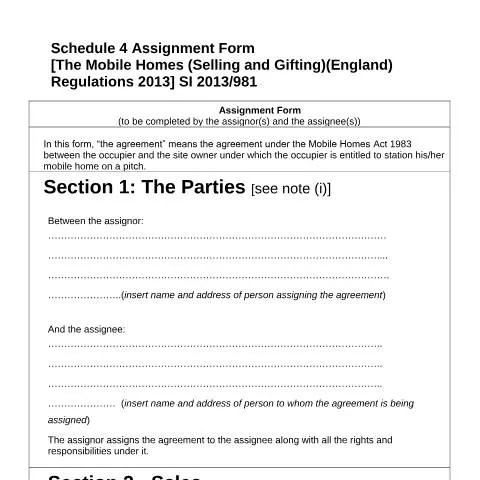
The Assignment Form under Schedule 4 of The Mobile Homes (Selling and Gifting)(England) Regulations 2013 serves as the cornerstone document for these transactions. Unlike standard property sales, park home transfers involve assigning both the physical mobile home and the pitch agreement simultaneously, creating dual obligations that must be carefully documented.
This regulatory framework emerged from decades of disputes between park home residents, purchasers, and site owners. The 2013 regulations specifically addressed gaps in earlier legislation, particularly around commission payments and the timing of various obligations. The assignment form standardises what was previously a patchwork of informal arrangements that often led to costly legal disputes.
Distinguishing Assignment from Standard Property Sales
The assignment process differs fundamentally from conventional property transactions. In standard property sales, ownership transfers directly from seller to buyer through Land Registry processes. Park home assignment, however, involves transferring rights under an existing agreement rather than transferring ownership of land or buildings.
The assignor (seller or gifter) holds a pitch agreement with the site owner under the Mobile Homes Act 1983. This agreement grants rights to station a mobile home on a specific pitch, subject to ongoing obligations including pitch fee payments and compliance with site rules. The assignment form legally transfers these rights and corresponding responsibilities to the assignee (buyer or recipient).
| Standard Property Sale | Park Home Assignment |
|---|---|
| Land Registry transfer | Agreement assignment under Mobile Homes Act |
| Freehold or leasehold ownership | Pitch occupation rights |
| Council tax liability | Pitch fee obligations |
| Property searches required | Site owner commission due |
| Mortgage arrangements | Indemnity provisions |
The assignment form captures these distinctions by requiring specific information about pitch fees, commission payments, and indemnification arrangements that simply don't exist in standard property transactions.
Navigating the Dual Nature of Sales and Gifts
The assignment form accommodates both sales and gifts, but the completion requirements differ significantly between these transaction types. Section 2 of the form applies exclusively to sales, requiring detailed financial information including purchase price and commission calculations.
For gift transactions, the assignor transfers the mobile home and pitch agreement without monetary consideration. Common gift scenarios include transfers between family members, inheritance arrangements before death, or charitable donations. In these cases, Section 2 remains blank, but all other sections require completion.
Sales transactions involve more complex documentation. The purchase price must be clearly stated, as this determines the site owner's commission entitlement. Under the Mobile Homes Act 1983, site owners can charge up to 10% commission on the sale price, making accurate price declaration crucial for all parties.
The commission payment mechanism creates a triangular obligation structure. While the assignee pays the purchase price to the assignor, they separately owe commission to the site owner. The assignment form acknowledges this arrangement, with the assignee agreeing to pay commission within seven days of receiving the site owner's bank account details.
Timing Considerations for Different Transaction Types
Gift assignments often proceed more quickly than sales, as they avoid mortgage arrangements, surveys, and extended negotiations. However, gifts may trigger inheritance tax considerations if the assignor dies within seven years, requiring careful documentation of the transaction date and circumstances.
Sales assignments typically involve longer timescales, particularly where the assignee requires financing. Some lenders specialise in park home mortgages, but others remain reluctant to lend against pitch agreements rather than freehold property. This can extend completion periods significantly beyond standard property transactions.
Critical Obligations and Indemnification Provisions
Section 3 of the assignment form establishes ongoing obligations that extend far beyond the transaction completion date. The assignee accepts responsibility for all future pitch fee payments and compliance with the pitch agreement terms. This includes adherence to site rules, maintenance obligations, and any restrictions on use or occupation.
The indemnification clause represents perhaps the most significant long-term implication for assignors. By signing the assignment form, assignees promise to protect assignors against any future claims arising from the assignee's failure to meet their obligations. This creates a continuing liability link between the parties that can persist for years after completion.
Practical examples of indemnification scenarios include:
- Assignee defaults on pitch fee payments, leading to site owner claims against the assignor
- Assignee breaches site rules, resulting in legal action that names both current and former residents
- Assignee abandons the mobile home, leaving the assignor liable for ongoing site obligations
- Assignee disputes arise over interpretation of the original pitch agreement terms
The indemnification provision attempts to shift these risks to the assignee, but enforcement depends on the assignee's financial capacity and willingness to honour their commitments. Assignors should consider whether additional protections might be appropriate, particularly for high-value transactions or where concerns exist about the assignee's reliability.
Commission Calculations and Payment Mechanics
The 10% maximum commission provision under the Mobile Homes Act 1983 creates specific obligations that the assignment form must address. Site owners cannot charge more than 10% of the purchase price, but they can charge less or waive commission entirely at their discretion.
The commission calculation applies only to the mobile home sale price, not to any separate payments for fixtures, fittings, or furniture. Where transactions include these additional elements, careful price allocation becomes essential to avoid overpaying commission.
Regulation 10 of the 2013 regulations establishes a seven-day payment deadline once the site owner provides bank account details. This creates a potential timing issue where completion occurs before bank details are available. The assignment form acknowledges this by requiring the assignee to agree to future payment rather than demanding immediate settlement.
Commission Disputes and Resolution
Disputes over commission calculations occasionally arise, particularly where the purchase price includes elements beyond the mobile home itself. The assignment form helps prevent such disputes by requiring clear price declarations, but complex transactions may need additional documentation to allocate costs appropriately.
Site owners must provide bank account details within a reasonable timeframe, but the regulations don't specify exact deadlines for this obligation. Where delays occur, assignees should document their readiness to pay and seek written confirmation of account details to avoid potential breach claims.
Pitch Fee Transitions and Review Arrangements
The assignment form captures critical information about ongoing pitch fee obligations, including current fee levels and review dates. This information helps assignees understand their long-term financial commitments and plan for future fee increases.
Pitch fees typically undergo annual reviews, with increases subject to specific procedures under the Mobile Homes Act 1983 and subsequent regulations. The assignment form requires disclosure of the next review date, enabling assignees to anticipate potential changes and budget accordingly.
Different sites operate varying payment frequencies - weekly, monthly, quarterly, or annually. The assignment form accommodates these variations by requiring deletion of inappropriate options, ensuring clarity about payment expectations from completion onwards.
The assignee's agreement to "pay the pitch fee and keep to the terms of the agreement" creates comprehensive obligations extending beyond mere rent payment. These terms typically include:
- Maintenance of the mobile home to specified standards
- Compliance with site rules regarding pets, visitors, and conduct
- Insurance arrangements for the mobile home and contents
- Restrictions on subletting or business use
- Procedures for requesting permission for home improvements
Documentation Requirements and Record Keeping
Proper completion of the assignment form requires careful attention to detail and supporting documentation. Both assignor and assignee sections must be completed fully, with clear signatures and dating. Incomplete forms can delay transactions or create future disputes about the parties' intentions and obligations.
The form requires full names and addresses for both parties. Where multiple assignors or assignees are involved - such as joint owners or married couples - all parties must be named and must sign the form. This ensures that all relevant parties accept the assignment obligations and indemnification provisions.
Supporting documentation typically includes:
- Copy of the original pitch agreement being assigned
- Evidence of current pitch fee levels and payment history
- Site owner's written consent to the assignment (where required)
- Proof of purchase price payment or gift circumstances
- Bank account details for commission payments
Record keeping becomes crucial given the long-term nature of indemnification obligations. Assignors should retain copies of all assignment documentation, correspondence with site owners, and evidence of the assignee's acceptance of obligations. These records may prove essential years later if disputes arise or indemnification claims emerge.
Future Implications and Ongoing Responsibilities
The assignment form creates lasting relationships between assignors, assignees, and site owners that extend well beyond the completion date. Understanding these ongoing implications helps all parties make informed decisions and avoid future complications.
For assignees, the assignment represents the beginning of a long-term relationship with the site owner. Unlike standard property ownership, this relationship involves ongoing negotiations over pitch fee increases, site rule changes, and maintenance obligations. The assignment form establishes the foundation for this relationship by transferring all rights and responsibilities under the original agreement.
Assignors retain potential liability through the indemnification provisions, making careful assignee selection crucial. While legal remedies exist if assignees breach their indemnification promises, practical enforcement can prove challenging and expensive. Prevention through thorough due diligence often provides better protection than post-completion legal action.
Site owners benefit from the assignment form's clarity around commission payments and ongoing obligations. The standardised format reduces administrative burdens and provides clear evidence of the parties' intentions if future disputes arise. However, site owners must still comply with their own obligations under park home legislation, including proper procedures for pitch fee reviews and enforcement actions.
The assignment form thus serves as more than a simple transaction document - it establishes the legal framework for ongoing relationships in England's unique park home sector, balancing the interests of residents, purchasers, and site owners within a comprehensive regulatory structure.
Understanding Your Rights and Obligations During the Assignment Process
The assignment of a park home involves significant legal and financial implications that extend beyond the simple transfer of ownership. Understanding your rights and obligations throughout this process is essential for both assignors and assignees to ensure compliance with the Mobile Homes Act 1983 and subsequent regulations.
As an assignor, you retain certain responsibilities even after completing the assignment. You remain liable for any outstanding pitch fees up to the date of assignment, and you must ensure that all utility accounts are properly transferred or closed. The site owner cannot hold you responsible for debts incurred by the new owner after the assignment date, but any pre-existing obligations remain your responsibility until formally discharged.
Your right to assign the park home is protected under statute, meaning the site owner cannot unreasonably withhold consent to a proposed assignment. However, they can refuse consent on specific grounds outlined in the Mobile Homes Act, such as if the proposed assignee would not be suitable to live in a mobile home, considering factors like age restrictions in retirement parks or if the assignee has a history of breaching site rules at other parks.
The assignee's rights begin from the moment the assignment is completed and they take possession of the home. These include the right to quiet enjoyment of their pitch, protection from harassment by the site owner, and the right to sell the home again in future. However, assignees must also accept the existing pitch agreement terms, including any lawful site rules that were in place at the time of assignment.
Site owners have specific obligations during the assignment process that go beyond simply processing paperwork. They must provide clear information about any planned changes to the site that might affect the new owner, such as development plans or changes to facilities. If the site owner has served any notices on the previous owner regarding breaches of the pitch agreement, these must be disclosed to the prospective assignee before completion.
The timing of when ownership transfers can significantly impact your obligations. Generally, ownership transfers on completion of the assignment, but you should clarify this in your agreement. If there's a delay between signing the assignment form and the assignee taking physical possession, you need to establish who is responsible for pitch fees, insurance, and maintenance during this interim period.
Insurance considerations are particularly important during assignment. Your existing insurance policy will typically cease to cover the home once ownership transfers, so you must arrange for coverage to end on the completion date. The assignee needs to ensure they have appropriate insurance in place from the moment they take ownership, as gaps in coverage could leave the home vulnerable and potentially breach site rules requiring continuous insurance.
If you're assigning a home on a protected site (most residential park home sites), the assignee automatically inherits the security of tenure that comes with the Mobile Homes Act protections. However, if the assignment involves a holiday home or a home on an excluded site, different rules apply, and the level of protection may be significantly reduced.
Dealing with Complex Assignment Scenarios and Common Complications
Park home assignments don't always follow a straightforward path, and various complications can arise that require careful navigation. Understanding these potential issues and how to address them can prevent delays and disputes that might otherwise derail the assignment process.
Joint ownership assignments present unique challenges that require special attention to legal documentation. When a park home is owned by multiple parties—such as married couples, civil partners, or family members—all owners must consent to the assignment. This becomes particularly complex in situations involving relationship breakdowns, where one party may be unwilling to cooperate. In such cases, you may need to seek legal advice about applications to the First-tier Tribunal (Property Chamber) to resolve disputes about the right to assign.
If one joint owner has died, the surviving owner cannot simply assign their share without following proper legal procedures. The deceased owner's interest in the home forms part of their estate, and probate procedures may be necessary before any assignment can proceed. This process can take several months, during which pitch fees continue to accrue, making it essential to maintain communication with the site owner about the situation.
Inheritance situations create another layer of complexity in park home assignments. When you inherit a park home, you don't automatically have the right to live there if you don't meet the site's occupancy criteria. For example, if you inherit a home on an over-55s site but you're only 40, you cannot take up residence. However, you do have the right to assign the home to someone who does meet the criteria, though this must typically be done within a reasonable timeframe.
Financial complications can significantly impact assignment proceedings. If there's an outstanding mortgage or loan secured against the park home, the lender's consent is usually required before assignment can proceed. Some lenders may demand immediate repayment upon assignment, while others may allow the debt to transfer to the new owner. This needs to be clarified early in the process to avoid last-minute complications.
Negative equity situations, where the outstanding loan exceeds the home's value, create particular challenges. You cannot simply walk away from the debt, and the assignment may need to be structured to address the shortfall. This might involve the assignor continuing to service part of the debt or negotiating with the lender for a reduced settlement.
Site-specific complications can also arise, particularly on sites undergoing changes or facing closure. If the site owner has served notice of intention to close the site or change its use, this significantly affects the assignment process. Potential assignees must be fully informed of such notices, as they may affect the long-term viability of their investment. Similarly, if the site is subject to planning applications that might impact residents, this information must be disclosed.
Disputes over the condition of the home or pitch can complicate assignments, particularly if issues are discovered after the assignment form has been signed but before completion. Unlike traditional property sales, park homes don't typically involve detailed structural surveys, so disputes about undisclosed defects are not uncommon. Establishing clear protocols for inspection and acceptance of the home's condition before signing can prevent such complications.
Age-restricted sites present unique challenges for assignment. If the original owner no longer meets the age requirements due to changes in site rules, or if family circumstances mean the home needs to be assigned to someone outside the permitted age range, special procedures may apply. Some sites have provisions for temporary residence while a suitable assignee is found, but these are not universal and must be negotiated with the site owner.
When assignments involve homes that have been significantly modified or extended, additional complications can arise. Any alterations should have been approved by the site owner, and evidence of this approval should be provided to the assignee. Unauthorised modifications can affect the assignment, as the site owner might require remedial work before consenting to the transfer.
Post-Assignment Procedures and Ongoing Responsibilities
The completion of an assignment form marks the beginning rather than the end of important administrative and legal processes. Both parties must attend to various post-assignment procedures to ensure the transfer is properly recognised by all relevant authorities and service providers, while understanding the ongoing responsibilities that continue after ownership has changed hands.
Immediately following assignment completion, the new owner must establish their legal status with the site owner through formal recognition procedures. This typically involves providing identification documents, proof of address, and sometimes references or financial information if required by the site rules. The site owner should update their records to reflect the change of ownership and provide the new owner with a copy of the current pitch agreement and site rules.
Council tax arrangements require immediate attention after assignment. The new owner becomes liable for council tax from the date they take ownership, regardless of when they actually move into the home. You must contact the local council to inform them of the change in ownership and liability. The previous owner should also notify the council that their liability has ended, providing the assignment completion date as evidence.
Utility supply transfers must be arranged carefully to avoid service interruptions or disputes over final bills. Each utility provider (electricity, gas, water, broadband) must be contacted separately to arrange the transfer. Some providers may require sight of the assignment documentation before accepting the change of responsibility. It's advisable to take meter readings on the completion date to establish clear cut-off points for billing purposes.
The new owner must register the change of ownership with their chosen insurance provider or arrange new coverage. Most insurers require notification within a specified period (often 30 days) of any change in ownership or occupancy. Failure to notify insurers promptly could invalidate coverage, leaving the home unprotected and potentially breaching site insurance requirements.
Banking and financial service updates are essential for the new owner, particularly if they're arranging mortgage payments or setting up direct debits for pitch fees and utilities. The site owner may require evidence of the new owner's ability to meet ongoing financial obligations, especially if pitch fees are substantial or if there's a history of payment difficulties on the site.
Vehicle registration updates may be necessary if the assignment includes parking rights or if the site maintains records of residents' vehicles for security purposes. The DVLA should be notified of address changes, and any site-specific vehicle registration or permit systems must be updated with the new owner's details.
Post-assignment maintenance responsibilities transfer immediately to the new owner, but this doesn't absolve the previous owner of responsibility for pre-existing issues. If defects or maintenance problems become apparent after assignment that clearly pre-date the transfer, disputes may arise about responsibility for repairs. Clear documentation of the home's condition at assignment, including photographs and written records, can help resolve such disputes.
The new owner must familiarise themselves with site-specific procedures and community arrangements that may not have been fully apparent during the assignment process. This includes understanding waste collection arrangements, community facility access, emergency procedures, and any resident association or committee structures. Many park home sites have established communities with informal support networks and social arrangements that new residents need to integrate with.
Ongoing compliance with site rules becomes the new owner's responsibility from the assignment date. This includes maintaining the home and pitch to required standards, adhering to occupancy restrictions, and following procedures for any future modifications or improvements. Site rules can be complex and may cover everything from pet ownership to visitor arrangements, making thorough understanding essential.
Future assignment rights must be understood by the new owner, as these may be subject to specific conditions or restrictions that weren't immediately apparent. Some sites have restrictions on how soon after purchase a home can be re-sold, while others may have right of first refusal clauses that give the site owner or other residents priority if the home is offered for sale again.
Record-keeping becomes crucial for the new owner, who should maintain comprehensive documentation of all communications with the site owner, copies of all agreements and notices, and records of any improvements or modifications made to the home. These records will be essential if any disputes arise or if the home is assigned again in future.
The previous owner's responsibilities don't end immediately upon assignment. They remain liable for any outstanding debts or obligations that pre-date the assignment, and they may need to respond to queries from utility companies, local authorities, or other organisations during the transition period. Maintaining accurate records of the assignment date and keeping copies of all transfer documentation is essential for resolving any such queries efficiently.