When a Medical Condition Demands Immediate Declaration to the DVLA
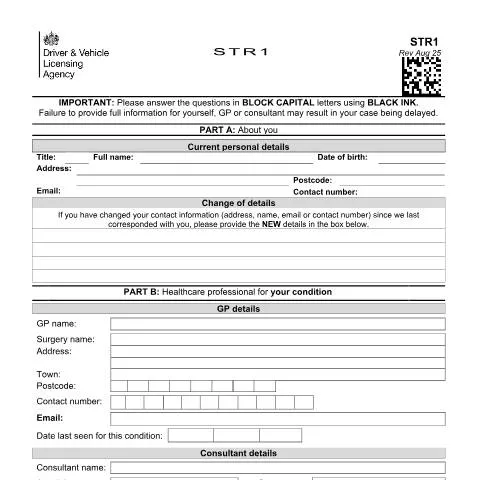
The moment a driver experiences a stroke, transient ischaemic attack (TIA), or related neurological event, their relationship with their driving licence fundamentally changes. Form STR1 serves as the critical bridge between medical diagnosis and legal driving status, requiring immediate completion once the mandatory one-month driving suspension period concludes. This self-declaration process places considerable responsibility on drivers to accurately assess their own capabilities whilst navigating complex medical terminology and strict regulatory requirements.
Unlike routine licence renewals or straightforward medical declarations, the STR1 form addresses conditions that can profoundly affect cognitive function, visual perception, and motor control. The Driver and Vehicle Licensing Agency requires this detailed assessment not merely as bureaucratic procedure, but as a safeguard for both the individual driver and other road users. The form's comprehensive structure reflects the multifaceted nature of stroke-related impairments, from obvious physical limitations to subtle cognitive changes that drivers themselves may not immediately recognise.
The timing of this declaration carries particular weight. Drivers must complete the STR1 after the mandatory one-month suspension period following their stroke or TIA, but the assessment itself requires reflection on symptoms and effects that may still be evolving. This creates a complex scenario where individuals must balance their desire to return to driving with honest evaluation of their current capabilities.
Understanding the Scope: Beyond Simple Strokes
Form STR1 encompasses a broader spectrum of neurological conditions than its common name suggests. Whilst stroke and TIA represent the primary focus, the form also addresses retinal artery occlusion, cerebral venous thrombosis, and amaurosis fugax. Each condition presents distinct challenges for driving assessment, requiring tailored evaluation approaches.
Stroke typically involves permanent brain tissue damage, with effects ranging from barely perceptible to severely debilitating. The form's questions probe for ongoing weakness, coordination problems, and cognitive changes that may persist months after the initial event. Transient Ischaemic Attacks, whilst temporary by definition, often herald future strokes and can leave subtle residual effects that drivers may dismiss as inconsequential.
Retinal artery occlusion primarily affects vision, but the implications for driving safety are profound. Unlike correctable refractive errors, these conditions can create permanent blind spots or visual field defects that significantly compromise road awareness. Cerebral venous thrombosis may cause symptoms similar to stroke but with different recovery patterns and prognoses.
| Condition Type | Primary Impact Area | Key Assessment Focus |
|---|---|---|
| Stroke | Motor/cognitive function | Lasting physical and mental effects |
| TIA | Temporary disruption | Residual symptoms, recurrence risk |
| Retinal artery occlusion | Visual field | Permanent vision loss areas |
| Cerebral venous thrombosis | Variable presentation | Individual symptom pattern |
The form's structure acknowledges that these conditions rarely present in isolation. Many patients experience multiple symptoms simultaneously, requiring careful documentation of each affected area. The interconnected nature of neurological function means that seemingly minor issues in one area may compound to create significant driving impairment.
Navigating the Medical Professional Requirements
Part B of form STR1 demands comprehensive healthcare provider information, reflecting the DVLA's recognition that accurate medical assessment requires professional input. The form distinguishes between GP and consultant involvement, acknowledging the different roles these professionals play in stroke care and recovery.
GP details must include full surgery information, contact methods, and the date of last consultation for the specific condition. This isn't merely administrative convenience – the DVLA may need to contact GPs directly for clarification or additional medical evidence. The "date last seen" field proves particularly important, as it indicates how current the medical oversight is and whether the driver maintains appropriate healthcare engagement.
Consultant information requires specialty specification, which helps the DVLA understand the type of expertise involved in the case. Neurologists, stroke specialists, and ophthalmologists each bring different perspectives to driving capability assessment. The hospital and department details enable direct professional-to-professional communication when complex cases require additional clarification.
The emphasis on email addresses alongside traditional contact methods reflects modern healthcare communication preferences. However, drivers should verify that their healthcare providers consent to email communication about their case, as some maintain strict postal correspondence policies for medical matters.
Incomplete healthcare professional information frequently delays STR1 processing. The DVLA cannot proceed without ability to verify medical details, and missing contact information necessitates return correspondence that extends the assessment timeline. Drivers should contact their healthcare providers before completing the form to ensure all required details are accurate and current.
Decoding the Symptom Assessment Matrix
The heart of form STR1 lies in its detailed symptom evaluation, structured as a logical progression through potential stroke-related impairments. The questionnaire design reflects evidence-based understanding of how neurological conditions affect driving safety, with each question targeting specific risk factors.
Lasting effects assessment begins with the fundamental question of whether symptoms persist one month post-event. This timeline aligns with the mandatory driving suspension period and represents the point where temporary effects should have resolved. Ongoing symptoms at this stage suggest permanent or long-term impairment requiring careful evaluation.
Physical impairment questions probe weakness, coordination, and balance issues that directly affect vehicle control. The form specifically mentions arms, legs, and body, recognising that driving requires integrated physical function. Subtle coordination problems may not prevent walking or daily activities but can critically compromise steering precision or pedal operation during emergency situations.
Cognitive assessment addresses memory, decision-making, orientation, and concentration. These abilities prove essential for safe driving but may be compromised in ways that drivers themselves struggle to recognise. The form's phrasing encourages honest self-evaluation whilst acknowledging that cognitive impairment can affect insight into one's own limitations.
Visual problems receive particular attention, with separate questions addressing general eyesight issues, visual field defects, and visual inattention. The form explicitly excludes routine refractive errors, focusing instead on neurological visual impairments that cannot be corrected with standard glasses or contact lenses.
The Double Vision Complexity
Double vision (diplopia) receives extended treatment within the STR1 framework, reflecting its complex relationship with driving safety. The form distinguishes between controlled and uncontrolled double vision, with additional assessment of stability over time. This nuanced approach recognises that some forms of diplopia can be managed through corrective measures whilst others present ongoing safety risks.
The double vision declaration section requires specific acknowledgement of adaptation requirements for corrective devices. Patches, prisms, frosted glasses, or specialised lenses all affect depth perception and peripheral awareness in ways that demand gradual adjustment. The three-month adaptation period mentioned reflects clinical experience with visual rehabilitation, but individual variation can be substantial.
Drivers must not resume driving until healthcare professionals confirm full adaptation to visual aids. This requirement places responsibility on both the driver to seek appropriate assessment and the healthcare provider to make informed determinations about driving readiness. The signature and date requirement creates a formal record of the driver's acknowledgement of these restrictions.
Epilepsy and Seizure Complications
Form STR1's epilepsy section addresses a critical complication of stroke that many drivers may not anticipate. Post-stroke epilepsy affects approximately 10% of stroke survivors, but the risk varies significantly based on stroke location, severity, and individual factors. The form's detailed seizure history requirements reflect the complex relationship between epileptic activity and driving safety.
The distinction between first-ever seizures and recurrent seizures proves crucial for licensing decisions. A single seizure may result from acute stroke effects and may not recur, whilst multiple seizures suggest established epilepsy requiring ongoing management. The five-year assessment period for recurrent seizures aligns with DVLA epilepsy guidelines and reflects evidence about long-term seizure patterns.
Awake versus sleep seizures receive separate documentation because they carry different implications for driving safety. Sleep-only seizures may not directly threaten driving safety if they remain confined to sleep periods, but the transition to awake seizures significantly changes the risk profile. The form's request for dates of first sleep seizures after awake seizures helps identify pattern changes that affect licensing decisions.
Consciousness level during seizures directly impacts driving capability assessment. Seizures that preserve awareness may be less dangerous than those causing complete unconsciousness, but even subtle awareness changes can compromise reaction times and decision-making during critical driving moments.
Provoked Seizure Documentation
The concept of provoked or acute symptomatic seizures introduces important nuance to epilepsy assessment. These seizures result from specific, identifiable triggers rather than underlying epileptic tendency. Common provoking factors in stroke patients include electrolyte imbalances, medication effects, or acute brain swelling. Proper documentation of provoking circumstances may influence licensing decisions, as addressing the underlying cause might prevent recurrence.
Healthcare professional involvement in seizure classification proves essential. Drivers should not attempt to self-diagnose seizure types or determine whether seizures were provoked. The form's emphasis on professional diagnosis reflects the complexity of seizure evaluation and the importance of expert assessment for licensing decisions.
The Declaration's Legal Weight and Ongoing Obligations
The STR1 applicant's declaration transforms medical information into legal commitment, creating binding obligations that extend far beyond the initial form submission. The criminal offence warning at the declaration's beginning emphasises the serious legal consequences of false information, but the ongoing obligations may prove more significant for day-to-day compliance.
Treatment compliance requires drivers to follow healthcare professional advice regarding their condition. This obligation continues indefinitely and may include medication adherence, therapy participation, and regular medical monitoring. Failure to comply with treatment recommendations could affect future licensing decisions and may constitute breach of the declaration.
Follow-up arrangement compliance mandates participation in ongoing health monitoring as recommended by healthcare providers. This might include regular neurological assessments, imaging studies, or specialised testing. Drivers who fail to attend scheduled appointments or refuse recommended monitoring may face licence restrictions or revocation.
Condition reporting obligations require immediate DVLA notification if health conditions worsen or new symptoms develop. This includes additional strokes, seizures, blackouts, or episodes of altered consciousness. The obligation extends to "sudden attacks of disabling giddiness" or fainting, recognising that various symptoms may indicate neurological deterioration.
The declaration's permanence means that drivers remain bound by these obligations throughout their licensed driving career. Changes in health status, even years after the initial STR1 submission, must be reported promptly. This creates an ongoing relationship between the driver, their healthcare providers, and the DVLA that extends well beyond the initial licensing decision.
Special Controls and Adaptive Driving Solutions
Question 15 of form STR1 opens discussion of special controls or adaptive equipment that may enable safe driving despite ongoing health limitations. This section acknowledges that many stroke survivors can return to driving through appropriate vehicle modifications or driving technique adaptations, rather than permanent licence withdrawal.
Common adaptive solutions for stroke survivors include hand controls for drivers with leg weakness, spinner knobs for one-handed steering, or left-foot accelerator pedals for right-side impairment. More complex adaptations might involve electronic steering assistance, automated transmission requirements, or specialised seating systems to accommodate physical limitations.
The DVLA's approach to special controls reflects evidence-based assessment of individual capabilities rather than blanket restrictions based on diagnosis. Drivers who demonstrate safe operation of appropriately modified vehicles may receive licences with specific restrictions noting required adaptations. These restrictions become legally binding requirements, and driving without prescribed adaptations constitutes a licensing violation.
Professional driving assessments often prove essential for special controls evaluation. Occupational therapy driving assessments or specialist driving instructor evaluations provide objective evidence of driving capability with various adaptive equipment. The STR1 form specifically requests copies of such assessments, recognising their value in licensing decisions.
The timing of special controls assessment requires careful coordination between medical recovery, equipment installation, and licensing processes. Drivers should not assume that adaptive equipment automatically enables legal driving – DVLA approval of specific modifications and restrictions remains essential before returning to the road.
Processing Realities and Timeline Management
STR1 processing involves multiple stages that can extend over several months, particularly for complex cases requiring additional medical evidence or specialist assessment. Understanding these timelines helps drivers plan appropriately and avoid unrealistic expectations about rapid licence restoration.
Initial processing begins with administrative review to ensure form completeness and legibility. The emphasis on block capital letters in black ink reflects scanning and processing requirements that enable efficient handling. Unclear handwriting or incomplete information triggers immediate return for correction, adding weeks to the assessment timeline.
Medical evidence review may require contact with healthcare providers for clarification or additional information. GPs and consultants may need several weeks to respond to DVLA enquiries, particularly during busy periods or when detailed medical reports are required. Complex cases may necessitate multiple rounds of medical correspondence before sufficient information is available for decision-making.
Some STR1 submissions require independent medical examination by DVLA-appointed specialists. These appointments may involve additional waiting periods based on specialist availability and geographic location. The examination process itself may take several hours and could require multiple appointments for comprehensive assessment.
Drivers should maintain alternative transportation arrangements throughout the STR1 process. The mandatory one-month post-stroke suspension represents only the minimum period – actual licensing decisions may require considerably longer depending on individual circumstances and processing complexity.
Regular communication with the DVLA during extended processing periods helps ensure that cases remain active and that any additional requirements are addressed promptly. However, drivers should recognise that frequent enquiries may not accelerate processing and should focus on ensuring that all requested information is provided completely and promptly.