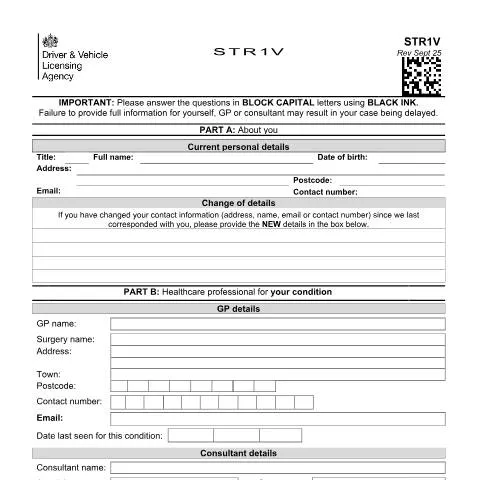
When Your Medical Condition Becomes a Legal Obligation: The STR1V Journey
The moment a stroke strikes or a seizure occurs, drivers across the UK face a stark reality: their legal right to drive may hang in the balance. Form STR1V represents far more than administrative paperwork—it's the critical bridge between medical crisis and driving privilege restoration. This self-declaration document, mandated under Section 94 of the Road Traffic Act 1988, transforms personal health information into legal compliance, determining whether someone can legitimately remain behind the wheel.
Unlike routine renewals or standard applications, STR1V emerges during medical emergencies when the Driver and Vehicle Licensing Agency must assess whether neurological conditions compromise road safety. The form's existence stems from decades of research linking stroke complications, epileptic episodes, and visual disturbances to driving accidents, creating a legal framework where medical transparency becomes essential for public safety.
The Regulatory Framework Behind Neurological Driving Assessments
STR1V operates within a complex web of medical driving standards established through collaboration between the DVLA, Department for Transport, and medical advisory panels. The form's September 2025 revision reflects ongoing updates to neurological assessment criteria, incorporating latest clinical research on stroke recovery patterns and seizure management.
The legal foundation rests on fitness to drive regulations that categorise medical conditions by their impact on driving ability. Stroke-related conditions fall under Group 1 (ordinary driving licences) and Group 2 (lorry and bus licences) standards, with distinctly different thresholds. Where Group 1 drivers might resume driving weeks after a minor stroke, Group 2 licence holders face potential permanent disqualification following multiple episodes.
This regulatory approach emerged from statistical analysis showing that untreated post-stroke visual field defects contribute to approximately 12% more accidents than the general driving population. The form's detailed questioning about visual symptoms, cognitive effects, and physical limitations directly addresses these evidence-based risk factors.
Medical Advisory Panel Influence
The STR1V structure reflects recommendations from the Secretary of State's Honorary Medical Advisory Panel on Driving and Disorders of the Nervous System. This panel, comprising consultant neurologists, ophthalmologists, and rehabilitation specialists, regularly reviews medical driving standards based on emerging clinical evidence and accident data analysis.
Decoding the Multi-Layered Assessment Process
STR1V's seven-page structure follows a sophisticated medical assessment logic that mirrors clinical evaluation protocols. Part A establishes identity verification while capturing contact changes—crucial because stroke patients often relocate during recovery or require family support affecting their registered address.
Part B's healthcare professional requirements serve dual purposes: they provide DVLA medical advisers with direct consultation channels and establish the clinical care network supporting the applicant's recovery. The form distinguishes between GP involvement and specialist consultant care, recognising that stroke management typically involves multiple medical professionals with varying expertise levels.
| Assessment Category | Questions Covered | Decision Impact |
|---|---|---|
| Condition Classification | 1, 1a | Determines applicable medical standards |
| Ongoing Symptoms | 2-9 | Assesses current functional capacity |
| Professional Assessment | 10 | Validates self-reported abilities |
| Physical Capacity | 11 | Emergency response capability |
| Seizure History | 12-15 | Determines seizure-free periods required |
The Visual Field Assessment Complexity
Questions 5 through 8e represent perhaps the most sophisticated section, addressing visual field defects that significantly impact driving safety. The form differentiates between visual field loss (measurable defects in peripheral vision) and visual inattention (neurological inability to process visual information from one side), conditions that require entirely different assessment approaches.
The double vision (diplopia) subsection illustrates medical complexity through its branching question logic. Controlled diplopia through prisms or patches may permit Group 1 driving after adaptation periods, while uncontrolled double vision typically results in licence revocation until resolution.
Strategic Completion for Optimal Outcomes
Successful STR1V completion requires understanding that DVLA medical advisers scrutinise consistency between self-reported symptoms and supporting medical evidence. The form's block capital requirement using black ink ensures optical character recognition accuracy, preventing processing delays that could extend licence suspension periods.
The healthcare professional sections demand complete accuracy because DVLA frequently contacts listed practitioners for clarification. Incomplete GP or consultant details trigger automatic processing delays, while incorrect contact information may result in case closure and licence revocation by default.
Critical Documentation Strategy
Question 10's on-road driving assessment reference creates opportunities for applicants to strengthen their cases through independent evaluation. Occupational therapy driving assessments, conducted through NHS rehabilitation services or private providers, carry significant weight in DVLA decision-making processes.
The brisk walking test (Question 11) assesses emergency response capability—whether applicants could evacuate vehicles quickly during emergencies. This seemingly simple question often determines licence restoration for applicants with residual mobility limitations.
The Seizure Assessment Labyrinth
Questions 12-15 navigate complex epilepsy regulations where timing becomes crucial. The form distinguishes between provoked seizures (triggered by specific medical events) and unprovoked seizures (spontaneous epileptic episodes), categories that carry dramatically different driving implications.
Single unprovoked seizures typically require six-month driving bans, while multiple seizures may mandate one-year seizure-free periods. However, provoked seizures occurring during acute medical phases (such as immediately post-stroke) may not trigger driving restrictions if the provoking factor resolves.
The form's detailed seizure dating requirements (Questions 14a-14e) enable DVLA medical advisers to calculate precise seizure-free periods and determine whether applicants meet legal driving thresholds. Sleep-only seizures carry different implications than awake seizures, with the form capturing these distinctions through separate date recording sections.
Understanding Consciousness Impact Assessment
Question 14f addresses whether seizures affected consciousness levels—a critical factor because altered consciousness during seizures indicates higher driving risks. Simple partial seizures without consciousness impairment may permit continued driving, while complex partial or generalised seizures typically trigger immediate licence suspension.
Processing Pathways and Decision Timelines
Once submitted, STR1V forms enter DVLA's medical review system where trained medical advisers evaluate cases against published medical standards. Processing typically requires 4-6 weeks for straightforward cases, though complex situations involving multiple medical conditions may extend to 12 weeks or more.
The DVLA medical team may request additional information from treating healthcare professionals, particularly when self-reported symptoms suggest ongoing driving impairment. These medical enquiries can significantly extend processing times but often result in more favourable outcomes than decisions based solely on incomplete information.
Appeal and Review Mechanisms
Unfavourable decisions trigger automatic rights of appeal to independent medical panels. These panels, comprising specialist physicians independent of DVLA, review cases based on submitted medical evidence and may request additional assessments or specialist opinions.
The appeal process typically requires 3-6 months but offers genuine opportunities for case reversal, particularly when new medical evidence emerges or initial assessments prove overly restrictive. Successful appeals often result in licence restoration with specific monitoring conditions rather than permanent revocation.
Navigating Complex Medical Scenarios
STR1V handles numerous edge cases that standard medical assessments might overlook. Applicants with multiple TIAs (transient ischaemic attacks) face different evaluation criteria than those with single major strokes, despite potentially similar symptom presentations.
The form accommodates cerebral venous thrombosis and amaurosis fugax under stroke-related conditions, recognising that these less common neurological events carry specific driving implications. Medical advisers apply specialist knowledge to distinguish between conditions requiring temporary driving cessation versus those mandating permanent licence withdrawal.
Professional Driver Considerations
Group 2 licence holders (lorry and bus drivers) face substantially stricter medical standards throughout STR1V assessment. The double vision declaration specifically notes that patches and frosted lenses are prohibited for Group 2 driving, effectively ending professional driving careers for applicants requiring these visual aids.
Multiple strokes or TIAs typically result in permanent Group 2 licence revocation, regardless of recovery levels achieved. This reflects the higher safety standards required for professional drivers responsible for passenger safety and larger vehicle operation.
Long-term Monitoring and Licence Conditions
Successful STR1V completion often results in time-limited licence restoration with mandatory periodic reviews. These conditions might require annual medical declarations, specialist consultant reviews, or driving assessments to maintain licence validity.
The DVLA medical database tracks all STR1V submissions, creating permanent medical histories that influence future licence applications and renewals. This comprehensive record-keeping ensures that medical driving assessments remain consistent across decades of licence holding.
Some applicants receive restricted licences permitting driving within specific geographical areas, during daylight hours only, or excluding motorway use. These tailored restrictions reflect individual medical circumstances while maintaining road safety standards and preserving driving independence where medically appropriate.
The STR1V process ultimately balances individual mobility needs against public safety requirements, creating personalised driving solutions that acknowledge both medical limitations and quality of life considerations. Success depends largely on thorough, honest completion and strong medical support throughout the assessment journey.
Special Circumstances and Complex Medical Scenarios
Certain medical conditions present unique challenges when completing form STR1V, requiring careful consideration of how to accurately represent your circumstances. If you have a fluctuating condition such as multiple sclerosis, rheumatoid arthritis, or chronic fatigue syndrome, you'll need to describe both your worst days and your better periods. The DVLA medical advisers understand that these conditions vary significantly, so focus on providing a realistic picture of your limitations during flare-ups whilst acknowledging periods of remission.
Mental health conditions require particularly thoughtful reporting on form STR1V. Conditions like severe depression, anxiety disorders, bipolar disorder, or schizophrenia can significantly impact driving ability through concentration problems, medication side effects, or episodes of altered mental state. When describing these conditions, be specific about symptoms that could affect your driving rather than simply naming the diagnosis. For instance, mention if you experience panic attacks that could occur whilst driving, or if medication causes drowsiness during certain times of day.
Progressive conditions such as Parkinson's disease, motor neurone disease, or dementia present ongoing challenges as your driving ability may deteriorate over time. The DVLA may issue shorter-duration licences for these conditions, requiring more frequent reviews. When reporting a progressive condition, include information about the current stage and any recent changes in your symptoms. This helps medical advisers make appropriate decisions about licence duration and any necessary restrictions.
If you have multiple medical conditions affecting your driving, list all relevant conditions on form STR1V even if they seem minor compared to your primary diagnosis. Diabetes combined with visual impairment, for example, creates different risks than either condition alone. The cumulative effect of multiple conditions or medications can be significant, and the DVLA needs this complete picture to make informed decisions about your fitness to drive.
Temporary conditions following surgery, injury, or acute illness also require reporting if they affect your driving ability for more than three months. Post-surgical restrictions, recovery from stroke, or healing fractures might temporarily impact your capacity to drive safely. Be honest about your current limitations whilst indicating if you expect improvement as you recover.
Medical Professional Requirements and Documentation
The DVLA may require additional medical information beyond what you provide on form STR1V, particularly for complex or serious conditions. Understanding what medical professionals need to provide can help you prepare for this process and ensure smooth handling of your application. Your GP, consultant, or specialist may need to complete specific DVLA medical forms or provide detailed reports about your condition and its impact on driving ability.
For certain conditions, the DVLA requires reports from specific medical specialists rather than general practitioners. Neurological conditions typically require input from a neurologist or neurosurgeon, whilst cardiac conditions need assessment by a cardiologist. Eye conditions must be evaluated by an ophthalmologist or optometrist, and mental health conditions often require psychiatric assessment. If you're under the care of a relevant specialist, mention this on form STR1V as it may expedite the assessment process.
Medical professionals completing DVLA forms or reports must provide objective clinical information rather than simply stating whether you're fit to drive. They'll need to detail your functional abilities, medication effects, seizure history, visual acuity measurements, or other specific clinical parameters relevant to driving safety. This clinical information helps DVLA medical advisers apply the published medical standards for driving consistently across all cases.
Some medical conditions require ongoing monitoring through regular medical reviews. The DVLA may issue licences valid for shorter periods—perhaps one, two, or three years instead of the standard validity period—requiring you to undergo periodic medical assessments. Your medical professional will need to provide updated reports at each review, so maintaining regular contact with appropriate specialists is crucial for licence renewal.
If your condition is well-controlled and stable, medical professionals may recommend longer review periods or even removal of medical restrictions. Conversely, if your condition deteriorates, they have a professional duty to advise both you and the DVLA about any increased risks. This ongoing professional oversight helps ensure that medical conditions affecting driving are properly monitored throughout your driving career.
Private medical reports requested by the DVLA typically incur costs that you'll need to meet. NHS services don't routinely cover reports for driving licence purposes, as these are considered administrative rather than clinical requirements. Discuss potential costs with your medical professional beforehand, and factor these expenses into your budget if you're reporting a condition that's likely to require specialist assessment.
Appeals Process and Challenging DVLA Decisions
If the DVLA makes a decision about your driving licence that you believe is incorrect following submission of form STR1V, you have specific rights to challenge this decision through formal appeal processes. Understanding these procedures is crucial if you disagree with a licence refusal, revocation, or the imposition of restrictions that you consider inappropriate given your medical condition and actual driving ability.
The first step in challenging a DVLA medical decision is usually to request a review of their determination. This involves writing to the DVLA explaining why you believe their decision is wrong, providing any additional medical evidence that supports your case, and requesting that they reconsider their position. New medical reports, specialist opinions, or evidence of improved condition management might support your review request. The DVLA will reassess your case using this additional information alongside their original medical advice.
If the DVLA maintains their decision after review, you can appeal to the Magistrates' Court in England and Wales, or Sheriff Court in Scotland. This legal appeal must be lodged within six months of receiving the DVLA's decision. The court will consider whether the DVLA's decision was reasonable based on the medical evidence available and the published medical standards for driving. You'll typically need legal representation for court appeals, and you should gather comprehensive medical evidence supporting your fitness to drive.
During the appeals process, you cannot legally drive if your licence has been revoked or refused, unless the court grants you interim driving privileges pending the appeal outcome. This can create significant practical difficulties, particularly if you depend on driving for employment or essential daily activities. Consider alternative transport arrangements and potential impact on work commitments when deciding whether to pursue an appeal.
Independent medical assessments can strengthen your appeal case, particularly if you believe the DVLA's medical advisers have misunderstood your condition or its impact on driving ability. Some medical professionals specialise in fitness-to-drive assessments and can provide detailed reports specifically addressing the DVLA's medical standards. These independent assessments, whilst involving additional cost, may provide different perspectives on your driving capability that support your appeal.
Successful appeals often involve demonstrating that your actual functional ability exceeds what might be expected from your medical diagnosis alone. Practical driving assessments by qualified instructors, occupational therapy evaluations, or specialist driving assessments can provide objective evidence of your real-world driving capability. This functional evidence can be particularly valuable when appealing decisions based primarily on diagnostic criteria rather than individual assessment of driving ability.
Consider seeking advice from disability rights organisations or legal professionals experienced in DVLA appeals before proceeding. They can help you understand the strength of your case, guide you through the appeal process, and advise on gathering appropriate evidence. Some organisations provide free initial advice or may be able to recommend specialists familiar with medical fitness-to-drive cases.