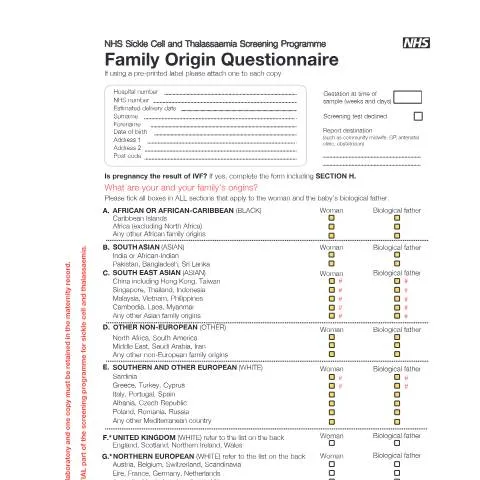
The Critical Role of Genetic Heritage Mapping in NHS Antenatal Care
Every year, thousands of women across the UK undergo routine antenatal screening that extends far beyond standard health checks. The Sickle Cell and Thalassaemia Screening: Family Origin Questionnaire represents one of Public Health England's most sophisticated approaches to preventing serious genetic conditions in newborns. This detailed assessment tool maps family heritage across multiple generations, creating a genetic risk profile that determines whether specialist blood testing is warranted during pregnancy.
The questionnaire operates on a fundamental principle: certain haemoglobin variants cluster within specific ethnic populations, making family origin the most reliable predictor of carrier status. For healthcare professionals working in maternity services, this form serves as both a screening gateway and an interpretive framework, distinguishing between routine care and specialist intervention pathways.
Understanding the Geographic Screening Framework
Public Health England has developed a sophisticated dual-tier system that recognises the varying prevalence of haemoglobin disorders across different UK regions. This approach fundamentally shapes how the family origin questionnaire is deployed and interpreted.
High Prevalence Area Protocols
In designated high prevalence areas—typically urban centres with significant populations of African, Caribbean, Mediterranean, or South Asian heritage—all pregnant women receive haemoglobin variant screening regardless of their family origin responses. The questionnaire still plays a crucial role in these regions, primarily for result interpretation and guiding prenatal diagnosis decisions.
Low Prevalence Area Screening Strategy
Low prevalence areas operate under a more targeted approach. Here, the family origin questionnaire serves as the primary screening tool, with haemoglobin variant testing offered specifically to women where either partner has family origins indicated in the questionnaire's yellow-coded sections. This risk-stratified approach ensures efficient resource allocation while maintaining comprehensive coverage for at-risk populations.
| Population Category | Risk Classification | Screening Approach |
|---|---|---|
| African/African-Caribbean | High risk | Automatic testing recommended |
| South Asian origins | High risk | Automatic testing recommended |
| Mediterranean European | Moderate to high risk | Testing based on specific origins |
| Northern European | Low risk | Testing only if partner high risk |
Navigating Complex Heritage Scenarios
The questionnaire acknowledges that modern family structures often present intricate genetic scenarios that require careful handling. Healthcare professionals must navigate various challenging situations that extend beyond straightforward ethnic classification.
Assisted Reproduction Considerations
When pregnancy results from IVF treatment, Section H of the questionnaire becomes mandatory. This section addresses scenarios involving donor gametes, where the genetic contribution may differ from the intended parents' heritage. If donor eggs or sperm were used, the screening protocol shifts significantly—testing becomes immediately necessary for the carrying mother, while the biological father (donor) should be offered testing without delay.
Medical History Complications
Women who have undergone bone marrow transplantation present unique screening challenges. The questionnaire specifically flags this scenario because transplanted bone marrow can alter haemoglobin patterns, potentially masking or mimicking carrier states. In such cases, immediate testing for both the mother and biological father becomes essential, bypassing standard risk stratification protocols.
Unknown Ancestry Protocols
Adoption or unknown ancestry situations require particularly sensitive handling. The questionnaire provides specific pathways for these scenarios, typically defaulting to comprehensive screening approaches. Healthcare professionals must exercise clinical judgement when family heritage information is unavailable, often erring on the side of caution by offering full haemoglobin variant testing.
The Two-Generation Heritage Assessment Process
Effective completion of the family origin questionnaire requires systematic gathering of heritage information extending back at least two generations from both the pregnant woman and the baby's biological father. This multi-generational approach recognises that haemoglobin variants can be inherited from any grandparent, making comprehensive family mapping essential.
Maternal Heritage Documentation
The questionnaire requires detailed mapping of the woman's family origins across nine distinct categories, from UK and Northern European origins through to African, Asian, and other non-European backgrounds. Each category contains specific country listings, with particular attention to regions where thalassaemia and sickle cell variants are prevalent. Healthcare professionals must ensure that all applicable boxes are ticked across relevant sections, as mixed heritage is increasingly common.
Paternal Contribution Assessment
Equally crucial is documenting the biological father's heritage, as haemoglobin variants follow autosomal recessive inheritance patterns. A child can only develop sickle cell disease or major thalassaemia if both parents carry relevant variants. The questionnaire systematically captures paternal family origins using identical categorical frameworks, ensuring comprehensive genetic risk assessment.
Special Risk Indicators
Sections F and G of the questionnaire carry particular significance, marked with asterisks to indicate higher risk for alpha zero thalassaemia. These sections encompass South Asian and South East Asian populations where specific alpha thalassaemia variants are more prevalent. When either parent has origins indicated in these sections, healthcare professionals often recommend immediate specialist consultation alongside routine screening.
Laboratory Integration and Result Interpretation
The family origin questionnaire serves dual purposes within the NHS screening programme: initial risk stratification and subsequent result interpretation. Understanding this dual functionality is crucial for healthcare professionals managing the screening process from initial assessment through to potential specialist referral.
Laboratory Processing Requirements
When haemoglobin variant screening is indicated, one copy of the completed questionnaire must accompany the blood sample to the laboratory, while a second copy remains in the maternity record. Laboratory scientists use the heritage information to interpret borderline results, distinguish between different variant types, and determine whether additional confirmatory testing is required.
Result Classification Framework
Family origin data proves particularly valuable when interpreting results suggesting possible alpha or beta thalassaemia traits. Certain haemoglobin patterns can appear similar across different ethnic populations but carry varying clinical significance. For instance, beta thalassaemia trait in Mediterranean populations may present differently from similar patterns in South Asian individuals, requiring heritage-specific interpretation protocols.
Prenatal Diagnosis Planning
When both partners are identified as carriers of significant haemoglobin variants, the detailed family origin information becomes essential for planning prenatal diagnostic procedures. Genetic counsellors and fetal medicine specialists use this heritage mapping to determine the most appropriate diagnostic approaches and counsel couples about specific risks relevant to their ethnic background.
Professional Responsibilities and Documentation Standards
Healthcare professionals completing the family origin questionnaire carry specific responsibilities that extend beyond simple form completion. The screening programme's effectiveness depends on accurate, comprehensive documentation and appropriate follow-up protocols.
Mandatory Information Elements
Every questionnaire must include complete patient identification details: NHS number, hospital number, estimated delivery date, and full contact information. The gestation at time of sampling must be recorded precisely, as timing can affect result interpretation. Healthcare professionals must sign and date the completed form, accepting responsibility for the accuracy of information gathered and the appropriateness of screening decisions made.
Consent and Decline Protocols
The questionnaire accommodates situations where women decline to provide heritage information or refuse screening entirely. However, healthcare professionals must ensure that such decisions are fully informed. Women must understand that routine blood analysis may identify them as thalassaemia carriers even when screening is declined, and that this information could be crucial for future pregnancies or family planning decisions.
Quality Assurance Requirements
Version control is particularly important for this questionnaire, with the current iteration being Version 4.1 from July 2019 (Reference SCT19 PN2271775). Healthcare professionals must ensure they are using current forms, as updates often reflect changes in screening protocols or risk classification systems. The questionnaire's design incorporates specific quality measures, including pre-printed label attachment points to minimise transcription errors.
Integration with Specialist Care Pathways
The family origin questionnaire serves as a crucial gateway between routine antenatal care and specialist services. Understanding how screening results trigger different care pathways enables healthcare professionals to prepare women appropriately for potential outcomes and ensure seamless service delivery.
Routine Carrier Detection Outcomes
When screening identifies a woman as a carrier for haemoglobin variants, the family origin information guides counselling approaches and partner testing strategies. Mediterranean women identified as beta thalassaemia carriers receive different counselling than those of South Asian heritage, reflecting varying prevalence rates and clinical presentations within these populations.
Sickle Cell Disease Management
The questionnaire specifically acknowledges that screening will identify women with existing sickle cell disease who may not have received previous diagnosis. These women require immediate specialist care from both obstetricians and haematologists, with mandatory hospital delivery planning. The heritage information helps specialists anticipate specific complications and tailor management protocols to ethnic-specific risk profiles.
High-Risk Pregnancy Protocols
When questionnaire responses indicate particularly high-risk scenarios—such as couples where both partners have origins from high-prevalence regions—healthcare professionals must ensure rapid access to genetic counselling services. These pathways often involve fetal medicine specialists who use the detailed heritage mapping to provide precise risk calculations and discuss prenatal diagnostic options.
The family origin questionnaire represents more than a screening tool; it embodies Public Health England's commitment to personalised, heritage-informed healthcare. By systematically mapping genetic ancestry across multiple generations, this questionnaire enables precise risk stratification while respecting the complex ethnic diversity of modern UK families. For healthcare professionals, mastering its application ensures that every pregnant woman receives screening appropriate to her specific genetic heritage, ultimately preventing serious haemoglobin disorders in the next generation.
Understanding Your Family Origin Response and Its Clinical Significance
The family origin information you provide on the questionnaire directly influences which specific genetic variants laboratories will test for, as different ethnic populations carry distinct patterns of sickle cell and thalassaemia mutations. For instance, if you indicate Caribbean heritage, screening will prioritise HbS (sickle cell) variants alongside HbC and HbE, which are more prevalent in populations of African descent. Conversely, Mediterranean family origins trigger focused testing for beta-thalassaemia major and minor, while South Asian heritage prompts examination for both beta-thalassaemia and HbE variants common in Bangladesh, Pakistan, and India.
Healthcare professionals use this information to interpret borderline results more accurately. A slightly elevated HbA2 level (the hallmark of beta-thalassaemia trait) carries different clinical weight when found in someone of Cypriot origin versus Northern European heritage, where such findings are exceptionally rare. Similarly, an HbS level of 25-30% in someone of West African descent strongly suggests sickle cell trait, while the same result in someone with no recorded African ancestry would prompt investigation for compound heterozygous conditions or laboratory error.
Mixed heritage presents particular considerations that the questionnaire attempts to capture through multiple-choice options. If your family background spans several high-prevalence regions—perhaps one parent from Cyprus and another from the Caribbean—laboratories will conduct comprehensive screening covering both Mediterranean thalassaemia variants and African haemoglobin disorders. This broader testing approach ensures no clinically significant variants are missed, though it may slightly extend processing time.
The questionnaire also accounts for adopted individuals or those uncertain about biological family origins. In such cases, healthcare providers typically recommend universal screening protocols that test for the most common variants across all ethnic groups. While this approach is more comprehensive than targeted screening, it remains highly effective at detecting the major haemoglobin disorders that could affect pregnancy outcomes or child health.
Regional variations within countries of origin also influence screening decisions. For example, northern and southern regions of Italy show different prevalences of specific thalassaemia mutations, information that specialist haemoglobinopathy centres use when interpreting complex results. Similarly, different islands in the Caribbean or various states in India may have distinct founder effects that concentrate particular genetic variants in their populations.
When Screening Results Require Follow-Up: Understanding the Next Steps
Positive or inconclusive screening results trigger a structured pathway of confirmatory testing and genetic counselling that varies depending on your specific findings and family planning intentions. If initial screening suggests you carry a haemoglobin variant, your GP or midwife will arrange confirmatory testing using more sophisticated techniques such as high-performance liquid chromatography (HPLC) or DNA analysis to precisely identify the genetic change involved.
Partner testing becomes crucial when you're identified as a carrier, particularly if you're planning pregnancy or already expecting. The NHS typically fast-tracks partner screening to provide results within 2-3 weeks, allowing time for informed decision-making if both partners carry variants for the same condition. This urgency reflects the 25% chance that each pregnancy could result in a child with a major haemoglobin disorder when both parents are carriers of the same condition.
Genetic counselling appointments, usually offered through specialist haemoglobinopathy centres or clinical genetics departments, provide detailed information about inheritance patterns, treatment options, and reproductive choices. These sessions address common concerns about carrier status, including the important distinction between being a healthy carrier and having a clinically significant haemoglobin disorder. Many carriers experience no health problems themselves but need to understand the genetic implications for their children.
If you're already pregnant and both partners are identified as carriers, additional options become available including chorionic villus sampling (CVS) between 10-13 weeks of pregnancy or amniocentesis between 15-18 weeks. These diagnostic procedures can determine whether the developing baby has inherited both genetic variants and will be born with a major haemoglobin disorder. The timing of these tests allows parents to make informed decisions about continuing the pregnancy based on comprehensive information about the child's likely health outcomes.
For couples planning future pregnancies, preimplantation genetic diagnosis (PGD) may be available through specialist fertility centres. This technique involves IVF procedures to create embryos that are genetically tested before transfer to the womb, ensuring only unaffected embryos are selected. While not routinely funded by the NHS, PGD may be available in certain circumstances, particularly for couples who have previously had a child with a major haemoglobin disorder.
Follow-up care also addresses family cascade screening, where your siblings, parents, and extended family members may be offered testing to identify other carriers. This information proves particularly valuable for relatives planning their own families, as knowing carrier status in advance allows for informed partner selection and early pregnancy planning discussions.
Special Circumstances and Complex Cases in Haemoglobin Screening
Certain medical conditions and circumstances can complicate haemoglobin screening interpretation, requiring modified approaches or additional testing protocols. Recent blood transfusions present a significant challenge, as donor red blood cells can mask or alter the apparent haemoglobin pattern for up to 12-16 weeks following transfusion. If you've received blood products within three months of screening, laboratories may recommend DNA-based testing instead of standard haemoglobin electrophoresis to ensure accurate carrier detection.
Iron deficiency anaemia, common during pregnancy, can artificially elevate HbA2 levels and potentially lead to false-positive results for beta-thalassaemia trait. Healthcare providers typically address iron deficiency first, then repeat haemoglobin studies once iron stores have been replenished. This sequential approach prevents unnecessary anxiety and ensures accurate genetic counselling based on true haemoglobin variant status rather than nutritional effects.
Individuals with alpha-thalassaemia deletions present particular diagnostic challenges, as standard screening methods may miss these variants entirely. Alpha-thalassaemia trait often produces only subtle changes in red blood cell indices, requiring DNA analysis for definitive diagnosis. This limitation is particularly relevant for people of Southeast Asian heritage, where alpha-thalassaemia variants are common but may remain undetected by routine screening protocols.
Compound heterozygous conditions, where individuals inherit different haemoglobin variants from each parent, create complex clinical pictures that require specialist interpretation. For example, someone inheriting HbS from one parent and beta-thalassaemia from another may develop sickle cell disease despite neither parent having the classic sickle cell trait pattern. These interactions between different haemoglobin variants highlight the importance of comprehensive family history and, when necessary, extended genetic testing.
Newborns present unique screening considerations, as fetal haemoglobin (HbF) predominates at birth and gradually decreases over the first 6-12 months of life. The NHS newborn screening programme uses different methodologies and reference ranges specifically designed for neonatal blood samples, typically collected via heel-prick testing at 5-8 days of age. Results from newborn screening may require confirmation with repeat testing at 3-6 months when adult haemoglobin patterns have fully established.
Pregnancy-related physiological changes can also influence screening results, with plasma volume expansion and haemodilution potentially affecting haemoglobin concentrations and ratios. Specialist haemoglobinopathy centres maintain pregnancy-specific reference ranges and interpretation guidelines to account for these normal physiological adaptations while maintaining sensitivity for detecting genuine genetic variants.
Individuals with borderline results often require repeat testing or family studies to clarify their genetic status. Silent beta-thalassaemia variants, for example, may produce HbA2 levels that fall within the borderline range between normal and clearly elevated values. In such cases, DNA sequencing or family screening can provide definitive answers about carrier status, ensuring appropriate genetic counselling and family planning advice.