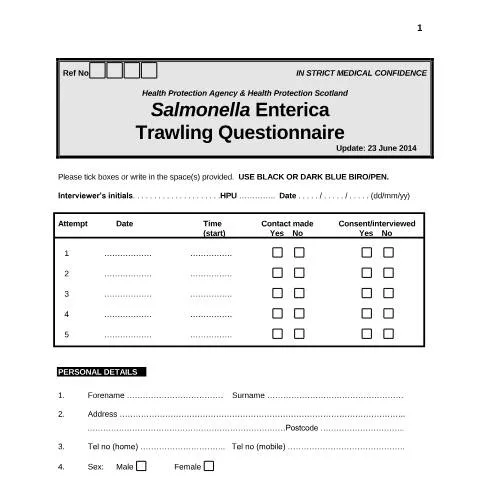
Understanding the Salmonella Enterica Trawling Investigation Process
When a laboratory confirms a case of Salmonella enterica infection, the wheels of public health surveillance spring into action across the UK. The Salmonella Enterica Trawling Questionnaire serves as the frontline investigative tool that helps health protection teams identify potential outbreak clusters and trace contamination sources before they spread further into the community.
This detailed interview form, administered by trained health protection officers, forms part of the UK Health Security Agency's systematic approach to foodborne illness surveillance. Unlike routine medical consultations, this process involves epidemiological detective work – piecing together the infected person's activities, contacts, and exposures during the critical five-day period before symptoms emerged.
The questionnaire's role becomes particularly crucial when multiple unconnected cases begin appearing within the same geographical area or timeframe. Each completed form contributes vital data points to national surveillance systems, enabling swift identification of common exposure sources such as contaminated food products, restaurants, or suppliers that might otherwise continue spreading infection undetected.
When Health Protection Teams Make Contact: The Interview Process Mechanics
The questionnaire documents up to five contact attempts, reflecting the reality that reaching confirmed cases often requires persistence. Health protection officers must balance urgency with respect for people who may be recovering from illness or managing work and family commitments.
Each contact attempt records specific details: the date, start time, whether contact was successfully made, and whether the person consented to participate in the full interview. This systematic tracking serves multiple purposes beyond mere administrative record-keeping. It demonstrates due diligence in outbreak investigations, ensures consistent follow-up protocols, and provides valuable data about response rates that inform future surveillance strategies.
The "strict medical confidence" marking at the top of the form reflects the sensitive nature of the information collected. Health protection officers must clearly explain the voluntary nature of participation while emphasising the public health importance of gathering complete information. Refusal to participate doesn't carry legal consequences, but cooperation significantly enhances the effectiveness of outbreak prevention efforts.
| Contact Attempt | Typical Timing | Success Factors |
|---|---|---|
| First attempt | Within 24-48 hours of laboratory notification | Clear explanation of purpose, convenient timing |
| Second attempt | Different time of day if first unsuccessful | Alternative contact methods (mobile vs landline) |
| Third attempt | Weekend or evening if previous attempts during work hours | Persistence while respecting privacy preferences |
Decoding the Critical Five-Day Window: Why Timing Matters
The questionnaire's consistent focus on the five days before illness onset reflects well-established scientific understanding of Salmonella's incubation period and transmission patterns. This window captures the most epidemiologically relevant exposure period while remaining within most people's reliable memory range.
For Salmonella enterica specifically, symptoms typically develop between 6 and 72 hours after exposure, with most cases manifesting within 12-36 hours. The five-day investigation period therefore encompasses virtually all possible exposure scenarios while accounting for individual variation in incubation times and the possibility of indirect transmission through contaminated surfaces or secondary cases.
This timeframe drives every major section of the questionnaire: household illness history, travel movements, animal contacts, and crucially, food consumption patterns. Health protection officers emphasise this five-day boundary repeatedly during interviews because human memory tends to conflate recent experiences, and precision in timing can make the difference between identifying or missing a contamination source.
Clinical Symptom Documentation Beyond Basic Diagnosis
While laboratory confirmation establishes Salmonella infection, the questionnaire's clinical section serves additional investigative purposes. The detailed symptom checklist – covering diarrhoea frequency, blood in stools, fever patterns, and associated symptoms – helps differentiate between different Salmonella serovars and severity patterns that might indicate specific contamination sources.
Hospitalisation details carry particular weight in outbreak investigations. Severe cases requiring admission often indicate high bacterial loads or particularly virulent strains, potentially pointing to specific food preparation failures or contamination events. The questionnaire captures exact admission and discharge dates, enabling health protection teams to correlate severe cases with specific exposure timelines.
Household Dynamics and Transmission Pathway Analysis
The questionnaire's approach to household illness reveals sophisticated understanding of Salmonella transmission patterns. Questions 15-17 form a critical decision tree that can fundamentally alter the investigation's direction and scope.
When household members developed diarrhoea in the five days before the confirmed case became ill, this strongly suggests person-to-person transmission rather than a common source outbreak. In such scenarios, the interview typically concludes early because the case likely represents secondary spread rather than primary exposure to a contaminated source that might affect the wider public.
Similarly, close contact with other diarrhoeal cases in healthcare settings, nurseries, or care environments suggests institutional transmission patterns that require different investigation approaches. These scenarios trigger specific protocols focused on infection control measures rather than food source tracing.
The questionnaire's logic reflects a fundamental principle of outbreak investigation: distinguishing between index cases (first exposures to contaminated sources) and secondary cases (person-to-person spread) determines whether resources should focus on source identification or transmission control.
Travel History: Distinguishing Domestic from International Risks
Travel-related questions follow a carefully structured hierarchy that reflects different risk levels and investigation priorities. International travel in the five-day window typically concludes the interview because overseas-acquired infections rarely indicate UK-based public health risks requiring immediate domestic intervention.
However, the questionnaire distinguishes between overnight stays outside the UK and domestic travel patterns. Domestic overnight stays – whether for business, leisure, or visiting friends and family – represent potential exposure opportunities that could affect other UK residents. Hotels, restaurants, and catering facilities serving multiple customers become investigation targets when multiple cases report similar domestic travel patterns.
Day trips within the UK receive particular attention because they often involve specific venues, events, or food outlets that serve large numbers of people within concentrated timeframes. Shopping centres, cinemas, parks, and business premises all feature as potential common exposure sites when multiple cases report visiting the same locations during their risk periods.
Geographic Precision in Venue Identification
The emphasis on obtaining complete addresses and postcodes reflects the practical requirements of follow-up investigations. Health protection teams need precise location data to coordinate with local environmental health officers, identify other customers who might have been exposed, and conduct site inspections of food preparation areas.
The questionnaire's prompting for specific details – hotel names, campsites, even "Central London" area designations – acknowledges that people often remember general locations better than exact addresses, while still gathering sufficient information for investigative purposes.
Animal Contact Protocols: Beyond Obvious Pet Interactions
The animal contact section reflects growing recognition of zoonotic transmission pathways that extend far beyond direct pet handling. Salmonella enterica can survive in various animal-derived products and environments, making seemingly indirect exposures epidemiologically significant.
Reptiles receive particular attention because they commonly carry Salmonella bacteria asymptomatically and can contaminate their environment through normal shedding. Terrapins, snakes, lizards, and even tortoises represent well-documented infection sources, particularly when people handle them or clean their enclosures without appropriate hygiene measures.
The questionnaire's focus on pet shop purchases acknowledges commercial pet food as a potential contamination vector. Dried dog treats, bird seed, fish food, and fresh meat products sold for pet consumption often receive less stringent food safety oversight than human food products, yet household members frequently handle these items without considering cross-contamination risks.
| Animal Product Type | Salmonella Risk Level | Investigation Priority |
|---|---|---|
| Reptile handling | High | Immediate source tracing |
| Raw pet food | Moderate-High | Batch identification required |
| Bird feed products | Moderate | Supplier investigation |
| Processed pet treats | Low-Moderate | Brand and batch tracking |
Documentation Standards and Interview Quality Assurance
The questionnaire's emphasis on using black or dark blue pen reflects practical requirements for document scanning and archival storage within national surveillance databases. Pencil marks fade over time, while light-coloured inks often fail to reproduce clearly in digital systems used for outbreak pattern analysis.
Health protection unit (HPU) identification and interviewer initials create accountability trails essential for quality assurance and follow-up investigations. When outbreak patterns emerge weeks or months later, these details enable supervisors to contact original interviewers for clarification or additional information that might not have seemed relevant during the initial investigation.
The structured attempt logging serves both administrative and scientific purposes. Response rates and contact success patterns inform resource allocation decisions and help identify optimal timing strategies for future investigations. Areas with consistently poor response rates might require alternative contact methods or community engagement approaches.
Confidentiality Safeguards in Practice
The "strict medical confidence" designation carries specific legal implications under the Data Protection Act 2018 and UK GDPR frameworks governing health data processing. Personal information collected through these questionnaires can only be used for legitimate public health purposes and must be stored securely with appropriate access controls.
Participants retain rights to request information about how their data is processed and stored, though they cannot typically demand deletion while active outbreak investigations remain ongoing. The questionnaire's design balances comprehensive data collection needs against privacy protection requirements, collecting only information directly relevant to transmission pathway identification.
Integration with National Surveillance Networks
Each completed questionnaire feeds into sophisticated epidemiological databases that enable real-time outbreak detection across England, Wales, Scotland, and Northern Ireland. The UK Health Security Agency's surveillance systems can rapidly identify clusters of cases sharing common exposures, triggering enhanced investigation protocols and public health interventions.
The questionnaire's standardised format ensures compatibility with automated analysis systems that flag potential outbreak patterns. When multiple cases report exposure to the same restaurant chain, food supplier, or commercial premises, alert systems notify relevant environmental health teams and trigger coordinated investigation responses.
This systematic approach has proven crucial in identifying widespread contamination events, from nationally distributed food products to large-scale catering suppliers serving multiple outlets. Individual questionnaires become pieces of a larger epidemiological puzzle that protects public health through early detection and rapid response to emerging threats.
Laboratory Testing Procedures and Timeline Expectations
When you submit a Salmonella enterica questionnaire to public health authorities, understanding the laboratory testing framework helps set realistic expectations for your case investigation timeline. The UK Health Security Agency coordinates with regional laboratories through the National Reference Laboratory Network, which processes samples using standardised protocols under ISO 15189 medical laboratory accreditation.
Initial isolation typically occurs at local NHS Trust laboratories within 24-48 hours of sample submission, depending on specimen type and transport conditions. Stool samples generally yield faster preliminary results than blood cultures, which may require extended incubation periods of up to 5 days for definitive identification. However, serotyping—the process that determines the specific Salmonella enterica subtype—exclusively takes place at reference laboratories, adding 3-7 working days to the overall diagnostic timeline.
Your questionnaire responses directly influence testing priorities and methodologies. For instance, if you report international travel within 14 days of symptom onset, laboratories may expedite antimicrobial susceptibility testing to screen for multidrug-resistant strains commonly associated with specific geographical regions. Similarly, indicating food handler employment or residence in a care home setting triggers enhanced testing protocols, including extended culture periods to detect low-level bacterial shedding.
Molecular typing techniques, such as whole genome sequencing (WGS), represent the gold standard for outbreak investigations but require additional processing time of 7-14 days. Your questionnaire data helps determine whether WGS is warranted—cases linked to common exposure sources, unusual travel histories, or atypical clinical presentations receive priority for advanced molecular analysis. The Gastrointestinal Bacteria Reference Unit at UKHSA Colindale processes these specialised tests, contributing data to national surveillance systems that track emerging strains and antimicrobial resistance patterns.
Laboratory results undergo multiple validation stages before reaching healthcare providers and public health teams. Quality assurance protocols include repeat testing for unusual serotypes, confirmation of antimicrobial resistance profiles, and verification of molecular typing results against established databases. This rigorous approach ensures accuracy but extends reporting timelines, particularly for complex cases requiring specialist interpretation.
Data Protection and Information Sharing Protocols
Completing a Salmonella enterica questionnaire involves sharing sensitive personal information that receives robust protection under the Data Protection Act 2018 and UK GDPR. Understanding how public health authorities handle your data provides essential context for informed participation in surveillance activities.
Your questionnaire responses are processed under the lawful basis of public task, specifically the prevention and control of communicable diseases as mandated by the Health and Social Care Act 2012. This legal framework permits collection and processing of personal data without explicit consent when necessary for public health protection. However, authorities must still adhere to data minimisation principles, collecting only information directly relevant to outbreak investigation and disease surveillance objectives.
Information sharing between agencies follows strict protocols governed by data sharing agreements and information governance frameworks. UKHSA shares anonymised surveillance data with local authority environmental health teams, NHS organisations, and relevant government departments, but individual identifiers are typically stripped from datasets used for epidemiological analysis. Your name, address, and contact details remain restricted to authorised personnel directly involved in case management and contact tracing activities.
Retention periods for questionnaire data vary according to information type and legal requirements. Clinical and epidemiological data may be retained for up to 30 years to support long-term surveillance and research activities, whilst contact details are typically deleted within 2-3 years following case closure. However, if your case contributes to a significant outbreak investigation or legal proceedings, retention periods may be extended under specific statutory provisions.
International data sharing occurs under carefully controlled circumstances, particularly when cases involve cross-border travel or multinational food distribution chains. The European Food Safety Authority and World Health Organization receive aggregated surveillance data from the UK, but individual case information requires explicit legal gateways, such as mutual assistance agreements or urgent public health risk notifications.
You maintain specific rights under data protection legislation, including access to your personal data, correction of inaccuracies, and—in limited circumstances—deletion of information. However, these rights must be balanced against ongoing public health investigations and statutory record-keeping requirements. Public health authorities provide clear information about data processing activities and your rights through privacy notices accompanying questionnaire materials.
Special Considerations for High-Risk Populations and Occupational Exposures
Certain population groups and occupational categories warrant enhanced surveillance measures when diagnosed with Salmonella enterica, necessitating more detailed questionnaire completion and extended follow-up protocols. Understanding these special considerations helps explain why some individuals face additional requirements during their case management.
Food handlers represent the highest priority group for intensive investigation and clearance procedures. If you work in food preparation, catering, or retail food sales, your questionnaire triggers immediate workplace risk assessment and potential exclusion from duties pending microbiological clearance. The Food Standards Agency guidelines require negative stool samples taken at least 48 hours apart, with the first sample collected no earlier than 48 hours after cessation of antimicrobial treatment. Some employers may require three consecutive negative samples, particularly in high-risk settings such as hospitals or care homes.
Healthcare workers face similar scrutiny, especially those involved in direct patient care, food preparation within healthcare settings, or clinical specimen handling. Your questionnaire responses help determine appropriate risk mitigation measures, which may include temporary redeployment to non-patient-facing roles rather than complete work exclusion. Occupational health services coordinate with local health protection teams to ensure safe return-to-work protocols that balance individual employment needs with patient safety requirements.
Childcare workers and teachers undergo enhanced surveillance due to the increased transmission risk in educational settings and the vulnerability of young children to severe salmonellosis. Your questionnaire helps identify potential classroom exposures and determines whether whole cohort screening is warranted. Educational establishments may implement additional hygiene measures based on your reported activities and contact patterns within the school environment.
Immunocompromised individuals, including those receiving chemotherapy, organ transplant recipients, or patients with HIV/AIDS, require extended monitoring due to prolonged bacterial shedding and increased risk of invasive disease. Your questionnaire responses help clinical teams tailor treatment protocols and determine appropriate follow-up intervals, which may extend several months beyond symptom resolution.
Pregnant women diagnosed with Salmonella enterica receive specialised care protocols addressing both maternal and foetal health risks. Your questionnaire informs obstetric teams about potential complications, guides antimicrobial selection decisions, and determines monitoring requirements throughout pregnancy. Certain serotypes, such as Salmonella Dublin and Salmonella Enteritidis, pose elevated risks for intrauterine infection and require enhanced surveillance measures.
Care home residents and staff face unique challenges due to the congregate living environment and vulnerable population characteristics. Your questionnaire responses inform facility-wide risk assessments, including evaluation of food preparation practices, infection control measures, and resident health status. Outbreak control measures may include cohort isolation, enhanced environmental cleaning, and temporary suspension of group activities depending on transmission risk factors identified through questionnaire data analysis.