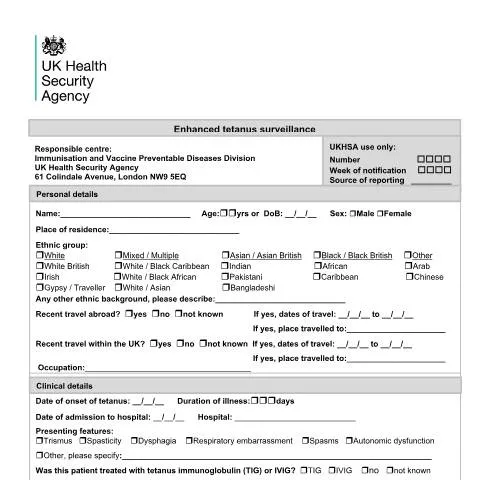
Understanding the Tetanus: Enhanced Surveillance Questionnaire
In the realm of public health, the management and monitoring of infectious diseases are paramount. The Tetanus: Enhanced Surveillance Questionnaire is a critical tool used by the UK Health Security Agency (UKHSA) to gather comprehensive data on cases of tetanus—allowing for informed responses and preventive strategies. This questionnaire is not just another form; it plays a vital role in safeguarding public health by providing insights into the epidemiology of tetanus, facilitating timely interventions, and enhancing the understanding of this potentially fatal disease.
The Profile of Individuals Required to Complete the Questionnaire
This questionnaire is primarily directed at healthcare professionals who encounter patients diagnosed with tetanus. It encompasses various demographics and scenarios, each with unique requirements and implications for filling out the form.
Who Completes the Questionnaire?
- Healthcare Providers: Doctors and nurses treating confirmed cases of tetanus.
- Emergency Services: Paramedics and emergency department staff who first assess patients.
- Public Health Officials: Those with a mandate to collect and analyze data related to vaccine-preventable diseases.
Specific Scenarios Where Completion is Necessary
In certain conditions, the questionnaire becomes essential, including:
- Patients Admitted with Tetanus: Any patient diagnosed upon admission must have their case documented through this form.
- Post-Exposure Assessments: Individuals who have sustained injuries or are suspected of being exposed to tetanus must also be included.
- Outbreak Situations: During outbreaks, rapid data collection is necessary to track and contain the spread.
Details of the Questionnaire: A Closer Look at Sections
The questionnaire comprises multiple sections designed to capture intricate details about the patient’s case, their travel history, occupational exposure, and prior immunization. Each section is vital for understanding the overall landscape of tetanus cases.
Section Breakdown
| Section | Purpose | Key Information Required |
|---|---|---|
| Personal Details | Collect basic patient information | Name, Age, Sex, Ethnic Group |
| Travel History | Identify potential exposure locations | Recent travel dates and locations |
| Clinical Details | Document the clinical presentation of the disease | Onset date, treatment, symptoms |
| Microbiology | Assess laboratory findings related to tetanus | Tetanus toxin levels, culture results |
| Immunization History | Evaluate the vaccination status of the patient | Dates of vaccinations, types administered |
| Outcome | Determine the final status of the patient | Discharge status, long-term consequences |
Filling Out the Questionnaire: Guidelines and Best Practices
Completing the Tetanus Enhanced Surveillance Questionnaire requires careful attention to detail. Each section must be filled out accurately to ensure the data collected is reliable and useful. Below are key guidelines for effective completion:
General Guidelines
- Accuracy is Key: Ensure that all provided information reflects the patient's actual situation.
- Be Comprehensive: Fill in every applicable section to avoid gaps in data.
- Use Clear Language: Avoid medical jargon when possible, opting for layman's terms that can be easily understood.
Common Sections and Their Specific Instructions
- Personal Details: Ensure that the age or date of birth format is correct (DD/MM/YYYY). This section should accurately reflect the patient's demographic details, which are important for data analysis.
- Travel History: Specify all recent travels both abroad and within the UK, including exact dates. An incomplete travel history might lead to missing potential infection sources.
- Clinical Details: Note all presenting features sequentially, as this section is key for understanding the severity of the case. Pay particular attention to the date of onset of illness, which could be crucial for outbreak investigations.
Submission Process: From Completion to Review
Once the questionnaire has been filled out, it must be submitted through designated channels. Adhering to submission guidelines ensures that the data reaches the appropriate entities for processing.
How and Where to Submit
- Email Submission: The completed questionnaire should be sent from a UKHSA account to [email protected] or from an NHS account to [email protected].
- Follow-Up: After submission, healthcare providers should follow up if they do not receive confirmation of receipt within a few days.
Potential Consequences of Non-Submission
Failing to submit the questionnaire can have significant ramifications. Without the data, public health officials are unable to accurately assess the epidemiology of tetanus within the community. This can lead to:
- Missed Opportunities for Intervention: Understanding the spread helps in strategizing vaccination campaigns and outreach programs.
- Inaccurate Public Health Data: Incomplete data can skew statistics and influence funding and resource allocation.
- Risks to Community Health: The absence of timely information can contribute to a lack of awareness and preparedness for future cases.
Complex Scenarios: Addressing Unique Circumstances
Some situations may require additional considerations when filling out the questionnaire. Understanding these nuances is crucial for proper documentation.
Special Cases to Consider
- Travel from High-Risk Areas: If the patient has traveled to a region known for higher incidences of tetanus, ensure this is highlighted in the questionnaire.
- Substance Misuse: For individuals with a history of injecting drug use, detailed information regarding their drug use should be documented to assess potential epidemiological links.
- Children and Minors: Special attention must be given to minors, particularly in terms of parental consent and the documentation of their vaccination history.
Final Thoughts: The Importance of Detailed Reporting
The Tetanus: Enhanced Surveillance Questionnaire is not merely a bureaucratic necessity; it is a fundamental tool that supports the UK's robust public health framework. By contributing to this data collection effort, healthcare professionals play a vital role in enhancing disease surveillance, informing public health decisions, and ultimately protecting communities.
For healthcare professionals, it is imperative to view the completion of this questionnaire not just as a task but as a commitment to safeguarding public health.
Understanding the Tetanus Enhanced Surveillance Questionnaire
The Tetanus Enhanced Surveillance Questionnaire (TESQ) is a vital tool utilized by healthcare professionals across the UK to monitor and manage cases of tetanus effectively. This questionnaire is designed to gather comprehensive information pertaining to patients diagnosed with tetanus to facilitate better epidemiological understanding and response strategies.
Administered by healthcare providers, the TESQ seeks specific data points regarding the patient's immunisation history, potential exposure circumstances, and clinical presentation of tetanus. The information collected plays a crucial role in identifying trends, outbreaks, and potential risk factors associated with tetanus infections within the community.
It's essential for healthcare professionals to ensure that the information provided in the TESQ adheres to the Data Protection Act 2018 and UK GDPR regulations. Patient consent is paramount, and all collected data must be managed transparently, ensuring that individuals are aware of how their data will be used for public health purposes.
Key Elements of the TESQ Data Collection Process
The TESQ comprises several critical components that enhance the data collection process. Understanding these elements can aid healthcare professionals in ensuring that they are collecting the necessary information accurately.
1. Patient Identification: This section includes basic demographic information to pinpoint the patient efficiently. It typically requires the patient's name, date of birth, and National Health Service (NHS) number. Ensuring accuracy here is crucial for tracking purposes and aligning the collected data with existing health records.
2. Immunisation History: This part assesses the patient's tetanus vaccination status, including the type of vaccine administered and the date of the last booster. Healthcare providers should check the patient's Immunisation History Record (IHR) and verify if the patient is up-to-date with their vaccinations, as this information is vital for understanding the likelihood of tetanus infection.
3. Exposure History: The questionnaire investigates any potential exposure to tetanus-prone wounds, including specific incidents that may have led to the infection. Healthcare professionals must gather detailed accounts from patients, including how the injury occurred, its severity, and any measures taken immediately after (like cleaning the wound). Such details are essential for epidemiological analysis and can inform public health responses.
4. Clinical Presentation: Documenting the clinical symptoms exhibited by the patient is paramount. This section captures the onset of symptoms, their progression, and any treatments received. Detailed information here can help identify patterns in tetanus cases and aid in developing better treatment protocols in the future.
Implications of Enhanced Surveillance for Public Health Policy
The data gathered through the Tetanus Enhanced Surveillance Questionnaire has significant implications for public health policy in the UK. By monitoring tetanus cases more closely, health authorities can identify at-risk populations and implement targeted interventions aimed at reducing incidence rates.
For instance, if the TESQ data reveals a particular demographic consistently under-vaccinated or suffering from tetanus infections, health officials may launch vaccination campaigns in those areas. Additionally, understanding the common sources of exposure, such as specific occupations or activities, can inform educational programs to raise awareness of proper wound care and the importance of vaccination.
Moreover, this enhanced surveillance can facilitate a quicker response to outbreaks. Should an increase in tetanus cases occur, public health officials equipped with real-time data can deploy resources more effectively to manage the situation, including establishing clinics for emergency vaccinations or providing additional training for healthcare professionals in primary care settings.
Finally, the findings from the TESQ can contribute to international health initiatives. With global health being interconnected, sharing insights derived from UK tetanus monitoring can assist other countries facing similar challenges, ultimately leading to better health outcomes worldwide.