The GPPAQ: A Clinical Tool for Assessing Physical Activity Levels in Primary Care
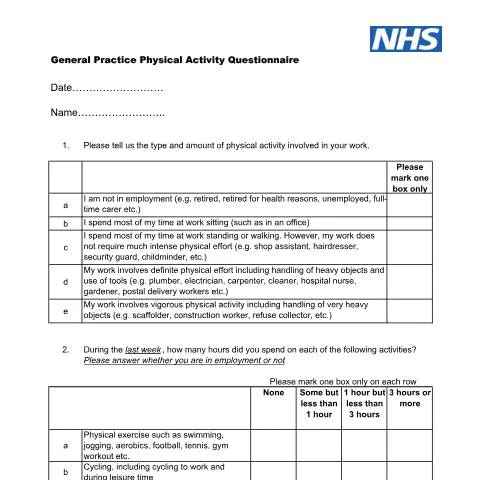
When you visit your GP surgery for a routine health check or consultation about lifestyle-related concerns, you might encounter a seemingly straightforward questionnaire that asks about your weekly physical activity. The General Practice Physical Activity Questionnaire (GPPAQ) represents a pivotal moment in your healthcare journey—a standardised tool that enables healthcare professionals to gauge your activity levels and determine appropriate interventions for your wellbeing.
This Department of Health and Social Care endorsed instrument serves as more than just a simple survey. It functions as a gateway to personalised health advice, potential referrals to exercise programmes, and evidence-based recommendations that could significantly impact your long-term health outcomes. Understanding how to complete this questionnaire accurately ensures you receive the most appropriate guidance for your individual circumstances.
Decoding the Three-Section Structure: What Each Component Reveals
The GPPAQ's deceptively simple format comprises three distinct sections, each designed to capture specific aspects of your physical activity profile. This structured approach enables healthcare professionals to build a comprehensive picture of your movement patterns and energy expenditure.
Section One: Occupational Activity Classification
The opening section focuses exclusively on workplace physical demands, requiring you to select from five predefined categories. This classification system recognises that occupational activity contributes significantly to overall energy expenditure, often accounting for eight or more hours of your daily routine.
The categories range from sedentary office work to vigorous manual labour. Precision matters here—if you're a nurse who spends equal time at a desk completing documentation and walking hospital corridors, consider which activity dominates your working hours. The questionnaire seeks your predominant work pattern, not occasional activities.
For those not in employment—whether retired, unemployed, or full-time carers—selecting the appropriate option ensures the assessment focuses on your leisure-time activities rather than attempting to extrapolate from non-existent work patterns.
Section Two: Weekly Activity Breakdown
This comprehensive section dissects your previous week's activities across five distinct categories, each measured in time bands rather than precise minutes. The approach acknowledges that most people estimate rather than meticulously track their activity duration.
| Activity Category | Examples Included | Common Misclassifications |
|---|---|---|
| Physical Exercise | Swimming, jogging, gym workouts, football | Gentle yoga often wrongly included |
| Cycling | Commuting, leisure cycling | Stationary bike sometimes omitted |
| Walking | Work commutes, shopping, pleasure walks | Very short distances incorrectly counted |
| Housework/Childcare | Cleaning, active childcare tasks | Sedentary childcare wrongly included |
| Gardening/DIY | Active maintenance, landscaping | Planning or light pruning overestimated |
The time bands—none, less than one hour, one to three hours, or three hours or more—reflect research-based thresholds that correlate with health benefits. When estimating your time, consider only continuous periods lasting at least ten minutes, as shorter bursts may not contribute meaningfully to your fitness profile.
Section Three: Walking Pace Assessment
The final section addresses walking intensity through self-reported pace categories. This seemingly subjective measure actually correlates strongly with cardiovascular fitness and metabolic health markers. The pace descriptors include specific mph references—slow pace under 3 mph, fast pace over 4 mph—providing objective anchors for your assessment.
Walking pace serves as a proxy for overall fitness level, as individuals who naturally walk briskly often possess better cardiovascular conditioning than those who favour leisurely strolls.
Completing the GPPAQ: Strategies for Accurate Self-Assessment
Accurate completion requires honest self-reflection and realistic time estimation. Healthcare professionals emphasise that this isn't a test to pass but rather a diagnostic tool requiring truthful responses to generate meaningful recommendations.
Time Estimation Techniques
Most people struggle with accurate time estimation, particularly for routine activities like walking or housework. Consider keeping a brief activity log for two or three days before your appointment, noting start and finish times for significant activities. This approach provides more reliable data than attempting to recall an entire week's activities during your consultation.
For cycling and walking, include all purposeful movement—commuting counts equally with leisure activities. However, distinguish between active engagement and passive time. Walking around a shopping centre while browsing qualifies; standing stationary while queuing does not.
Borderline Cases and Judgment Calls
Certain activities challenge the questionnaire's categories. Intensive gardening involving digging or heavy lifting clearly qualifies, but what about potting plants or light weeding? The key principle involves sustained physical effort that elevates your heart rate or breathing.
Similarly, childcare encompasses a spectrum from active play and pushchair walks to sedentary supervision. Focus on periods requiring continuous movement and physical engagement rather than passive monitoring activities.
The Clinical Context: How GPs Utilise GPPAQ Results
Your completed GPPAQ doesn't simply disappear into your medical records—it triggers a specific clinical pathway designed to optimise your health outcomes through targeted interventions.
Scoring and Classification System
Healthcare professionals use a standardised scoring algorithm that converts your responses into one of four physical activity categories: inactive, moderately inactive, moderately active, or active. This classification directly influences subsequent recommendations and potential referrals.
Patients classified as inactive or moderately inactive typically receive more intensive lifestyle counselling and may qualify for structured exercise programmes or specialist referrals. Those scoring as active might receive maintenance advice and encouragement to continue current patterns.
Integration with Health Assessments
The GPPAQ rarely stands alone—it typically forms part of broader health checks incorporating blood pressure monitoring, BMI calculation, and discussion of other lifestyle factors. Your activity level influences interpretation of other health markers and helps prioritise intervention strategies.
For instance, a patient with borderline hypertension who scores as inactive might receive more urgent lifestyle modification advice than an equally active individual with similar blood pressure readings.
Beyond the Consultation: Follow-Up Pathways and Interventions
Completing the GPPAQ often marks the beginning rather than the end of your physical activity journey within the healthcare system. Understanding potential follow-up pathways helps you prepare for subsequent appointments and interventions.
Exercise Referral Schemes
Patients scoring as inactive may qualify for exercise referral schemes—structured programmes delivered through local leisure centres or specialist providers. These schemes typically offer subsidised gym access, group exercise classes, or individual training sessions tailored to your fitness level and health conditions.
Referral criteria vary between Clinical Commissioning Groups, but generally include factors beyond GPPAQ scores—existing health conditions, motivation levels, and practical barriers to exercise all influence eligibility decisions.
Lifestyle Intervention Programmes
Some areas offer comprehensive lifestyle programmes addressing multiple risk factors simultaneously. These initiatives might combine physical activity promotion with dietary advice, smoking cessation support, and stress management techniques.
Your GPPAQ results help determine programme intensity and focus areas. Highly inactive individuals might begin with basic movement promotion, while moderately active patients could receive specific training advice or sport-specific guidance.
Addressing Complex Scenarios: When Standard Categories Don't Fit
The GPPAQ's standardised format occasionally struggles to capture complex individual circumstances that don't align neatly with predetermined categories.
Variable Work Patterns
Shift workers, seasonal employees, or those with dramatically varying weekly schedules may find the occupational classification challenging. In such cases, consider your typical pattern over recent months rather than focusing solely on the previous week.
Similarly, individuals transitioning between employment states—recently retired, temporarily unemployed, or returning from extended sick leave—should base responses on their current situation rather than historical patterns.
Health Limitations and Adaptations
The questionnaire doesn't explicitly address physical limitations or health conditions that might affect activity levels. However, your GP will consider these factors when interpreting results and making recommendations.
If chronic conditions, injuries, or disabilities significantly impact your activity choices, mention these during your consultation. This context ensures recommendations remain realistic and achievable within your individual constraints.
Seasonal Variations and Atypical Weeks
Weather patterns, holidays, illness, or unusual work demands might make the previous week unrepresentative of your normal routine. While the questionnaire specifically asks about the last week, discussing significant variations with your healthcare provider ensures more accurate assessment and appropriate recommendations.
Long-Term Monitoring and Reassessment Strategies
The GPPAQ functions as a snapshot rather than a permanent classification. Regular reassessment enables healthcare professionals to track progress, adjust interventions, and celebrate improvements over time.
Repeat Administration Protocols
Most practices readminister the GPPAQ annually during routine health checks or following significant health events. Some may use it more frequently when monitoring patients engaged in specific exercise programmes or lifestyle interventions.
Comparing scores over time provides objective evidence of behaviour change and helps identify successful strategies or persistent barriers to increased activity.
Self-Monitoring Between Appointments
While you cannot formally rescore your own GPPAQ, understanding the assessment framework enables ongoing self-evaluation of your activity patterns. This awareness often motivates gradual increases in movement and helps you prepare for subsequent healthcare consultations.
Many patients find value in periodically reviewing the questionnaire categories and honestly assessing whether their responses would differ from previous completions. This self-reflection process often highlights gradual improvements that might otherwise go unnoticed.
Maximising the GPPAQ's Clinical Value Through Preparation and Engagement
Approaching the GPPAQ as an active participant rather than a passive respondent enhances its clinical utility and your subsequent healthcare experience. Preparation and thoughtful engagement ensure the assessment generates meaningful, actionable insights.
Before your appointment, consider reviewing your typical weekly routine and identifying specific examples for each activity category. This preparation enables more accurate responses and facilitates productive discussion about realistic improvement strategies.
Remember that the GPPAQ represents a starting point for personalised health optimization rather than a judgment of your current lifestyle. Honest, accurate completion provides your healthcare team with essential information for developing appropriate, achievable recommendations that support your long-term wellbeing within the context of your individual circumstances and health goals.
Understanding GPPAQ Scoring and Health Professional Interpretation
The GPPAQ employs a sophisticated scoring system that translates your responses into one of four distinct physical activity categories: inactive, moderately inactive, moderately active, or active. This classification isn't arbitrary—it's based on established clinical guidelines from the National Institute for Health and Care Excellence (NICE) and aligns with the Chief Medical Officer's recommendations for physical activity in adults.
When your GP or practice nurse reviews your completed GPPAQ, they'll examine several key indicators beyond just your total score. The questionnaire captures both occupational and leisure-time activities, recognising that a warehouse worker who walks extensively during their shift has different exercise needs compared to an office-based professional. Your responses about work-related physical demands are weighted alongside your leisure activities to create a comprehensive activity profile.
Health professionals pay particular attention to sedentary time patterns revealed in your responses. Research consistently shows that prolonged sitting—regardless of other activity levels—presents independent health risks. If your GPPAQ indicates high sedentary time combined with low leisure activity, your healthcare provider might prioritise interventions targeting both movement frequency and structured exercise.
The scoring also considers activity intensity and duration. Brief, high-intensity activities like sprinting for a bus are captured differently from sustained moderate activities like brisk walking. This nuanced approach helps healthcare providers understand whether you're meeting the recommended 150 minutes of moderate-intensity activity weekly, or the equivalent 75 minutes of vigorous activity, as outlined in UK physical activity guidelines.
Crucially, healthcare professionals use GPPAQ results as a starting point for conversation rather than a definitive diagnosis. A 'moderately inactive' classification doesn't automatically trigger a specific intervention—instead, it prompts your GP to explore barriers to physical activity, discuss realistic goal-setting, and potentially refer you to local exercise programmes or physiotherapy services available through your local Clinical Commissioning Group.
GPPAQ Integration with NHS Health Checks and Preventive Care
The GPPAQ forms a cornerstone of the NHS Health Check programme, the national risk assessment and management system offered to adults aged 40-74 across England. During these quinquennial health assessments, the questionnaire provides crucial data that healthcare professionals combine with other measurements—blood pressure, cholesterol levels, BMI, and smoking status—to calculate your 10-year cardiovascular disease risk using tools like QRISK3.
Within this broader health assessment framework, your GPPAQ results directly influence clinical decision-making. If your physical activity levels are classified as 'inactive' or 'moderately inactive', this factor significantly impacts your overall cardiovascular risk score. Healthcare providers may then recommend specific interventions, ranging from brief advice sessions to formal referrals to exercise programmes commissioned by your local authority.
The questionnaire also plays a vital role in chronic disease management pathways. For patients with established conditions like type 2 diabetes, hypertension, or obesity, GPPAQ results help determine the appropriateness of exercise-based interventions. Your responses might influence whether you're referred to specialist services such as cardiac rehabilitation programmes, diabetes prevention initiatives, or weight management services delivered through your local Integrated Care System.
Importantly, GPPAQ data contributes to population health monitoring at both practice and regional levels. Anonymised results help Public Health England and local authorities understand physical activity patterns across different demographics, informing commissioning decisions for community exercise programmes, active travel initiatives, and green space development.
Healthcare professionals also use GPPAQ results to identify patients who might benefit from social prescribing initiatives. If your questionnaire reveals barriers to physical activity—such as lack of social connections or mental health concerns—your GP might refer you to a social prescribing link worker who can connect you with local community groups, walking clubs, or gardening projects that combine physical activity with social interaction.
The integration extends to practice-level quality improvement activities. GP surgeries monitor the proportion of patients completing physical activity assessments and track changes in activity levels over time. This data supports practices in meeting Quality and Outcomes Framework (QOF) indicators related to lifestyle advice and contributes to their overall performance in preventive care delivery.
Addressing Common Challenges and Maximising GPPAQ Accuracy
Many patients encounter specific difficulties when completing the GPPAQ that can significantly impact the accuracy of their results. Understanding these common challenges helps ensure your responses truly reflect your physical activity patterns and enables healthcare providers to offer more targeted support.
Seasonal variation in activity levels presents a frequent challenge for accurate completion. Your physical activity patterns likely differ substantially between summer and winter months—perhaps you cycle to work during warmer weather but use public transport in winter, or engage in outdoor sports seasonally. When completing the GPPAQ, consider your activity patterns over the past month specifically, rather than averaging across seasons. If you're completing the questionnaire during an atypical period (such as recovering from illness or during holiday periods), mention this context to your healthcare provider.
The questionnaire's focus on structured exercise versus incidental activity can create confusion. Many people underestimate their physical activity levels because they don't recognise that activities like gardening, housework, or playing with children contribute significantly to overall energy expenditure. Conversely, some overestimate their activity by including brief, low-intensity movements. The GPPAQ specifically seeks information about activities that make you 'breathe harder than normal'—this physiological marker helps distinguish between light activity and exercise that provides cardiovascular benefits.
Occupational activity assessment requires careful consideration of your actual work demands versus job title assumptions. A 'desk job' might involve significant walking if you frequently move between meetings or buildings, while some manual roles might involve repetitive tasks with limited cardiovascular benefit. Focus on the physical demands you actually experience rather than generic job category expectations.
Patients with chronic conditions or disabilities may find standard GPPAQ categories don't adequately capture their activity levels. If you use mobility aids, have chronic fatigue, or experience activity limitations due to medical conditions, discuss these factors with your healthcare provider when reviewing your results. They can interpret your responses within the context of your individual circumstances and capabilities.
Memory and recall accuracy can affect response quality, particularly for older adults or those with cognitive concerns. Keeping a simple activity diary for a week before your appointment can improve accuracy. Note not just formal exercise, but activities like shopping trips, household tasks, and social activities that involve physical movement.
Finally, cultural and linguistic barriers may impact completion accuracy. If English isn't your first language, ask whether interpreter services are available or if translated versions exist. Some activities common in specific cultural communities—such as traditional dances, martial arts, or specific sports—might not fit neatly into standard categories, so providing specific examples helps healthcare providers understand your actual activity patterns.