When Mental Health Meets the Road: Understanding DVLA's Medical Reporting Requirements
Every day, thousands of drivers across the UK navigate the roads whilst managing mental health conditions ranging from anxiety to more complex psychiatric disorders. What many don't realise is that certain mental health diagnoses trigger a legal obligation to notify the Driver and Vehicle Licensing Agency. The M1V form serves as the gateway for this crucial communication, designed specifically for vocational drivers whose mental health status could impact their ability to safely operate commercial vehicles.
The stakes are particularly high for professional drivers. A bus driver experiencing severe depression, a lorry driver managing bipolar disorder, or a taxi driver dealing with anxiety attacks face not only personal health challenges but also potential career implications. The M1V form represents DVLA's systematic approach to balancing public safety with individual rights to maintain employment in driving-related professions.
The Legal Framework Behind Mental Health Disclosure
The requirement to report mental health conditions stems from the Road Traffic Act 1988 and subsequent regulations that place a continuing duty on licence holders to notify DVLA of any condition that might affect their driving ability. This isn't merely administrative bureaucracy—it's a legal obligation with serious consequences for non-compliance.
Under current legislation, failure to disclose a relevant medical condition can result in prosecution and a fine of up to £1,000. More significantly, insurance policies may become invalid if undisclosed conditions contribute to an incident. The M1V form provides a structured pathway for drivers to fulfil these legal requirements whilst ensuring their case receives appropriate medical consideration.
The form specifically targets vocational driving entitlements—categories C, C1, CE, C1E, D, D1, DE, and D1E—which cover everything from small goods vehicles to passenger-carrying vehicles and articulated lorries. These categories demand higher medical standards than ordinary car licences, reflecting the greater responsibility these drivers bear for public safety.
Mental Health Conditions Requiring Disclosure
The M1V form categorises mental health conditions into distinct groups, each carrying different implications for driving fitness:
| Condition Category | Examples | Typical Assessment Approach |
|---|---|---|
| Anxiety/Depression (mild) | Without concentration/memory impairment | Medical questionnaire review |
| Anxiety/Depression (severe) | With suicidal thoughts or cognitive impairment | Specialist assessment likely required |
| Bipolar Disorder | All types | Psychiatric evaluation essential |
| Psychotic Disorders | Schizophrenia, delusional disorders | Comprehensive psychiatric review |
| Personality Disorders | Any diagnosed type | Case-by-case assessment |
Completing the M1V: A Section-by-Section Breakdown
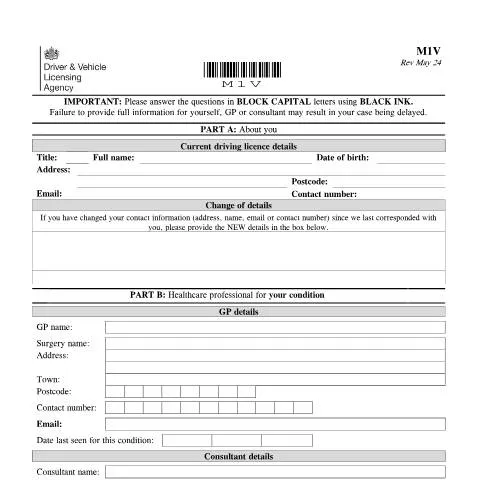
The M1V form's structure reflects DVLA's need for comprehensive information whilst remaining accessible to drivers who may be dealing with challenging mental health symptoms. Each section serves a specific purpose in building a complete picture of the applicant's condition and support network.
Personal Details and Contact Information
Part A demands meticulous attention to detail. Any discrepancies between the information provided and DVLA's existing records can trigger delays. Drivers who have recently moved, changed their name following marriage or divorce, or updated contact details must clearly indicate these changes in the designated section. The emphasis on block capitals and black ink isn't pedantry—it ensures accurate data capture and reduces processing errors.
Healthcare Professional Information
Part B requires comprehensive details for both GP and consultant contacts. This dual approach recognises that mental health care often involves multiple professionals. The form specifically requests the date of last consultation, which helps DVLA assess the currency of medical information and the ongoing nature of treatment.
Incomplete healthcare professional details represent one of the most common causes of case delays. DVLA cannot proceed with medical assessments without being able to contact relevant professionals directly. Drivers should verify surgery names, full postal addresses including postcodes, and current telephone numbers before submission.
The Medical Questionnaire Component
The questionnaire section adopts a checkbox approach that allows for multiple diagnoses—a recognition that mental health conditions often co-occur. The distinction between anxiety/depression with and without cognitive impairment reflects the different implications these presentations have for driving safety.
The specific question about Clozapine medication deserves particular attention. This antipsychotic medication can cause side effects including sedation and orthostatic hypotension, both of which have obvious implications for driving safety. Its mention signals DVLA's awareness of how specific treatments can impact driving ability beyond the underlying condition itself.
The Assessment Process: What Happens After Submission
Once submitted, the M1V form triggers a multi-stage assessment process that varies significantly depending on the condition reported and its severity. Understanding this process helps drivers set realistic expectations and prepare for potential requirements.
Initial Review and Medical Information Gathering
DVLA's Drivers Medical Group conducts an initial review to determine the appropriate assessment pathway. For straightforward cases—such as well-controlled anxiety without functional impairment—this may involve only requesting a medical report from the treating GP or consultant.
More complex cases trigger comprehensive medical information gathering. DVLA may request detailed reports covering diagnosis, treatment history, current medication, functional assessment, and prognosis. The form's authorisation section permits this information sharing whilst maintaining appropriate confidentiality safeguards.
Specialist Assessments and Advisory Panels
Certain conditions automatically require specialist input. The Secretary of State's Honorary Medical Advisory Panels include experts in psychiatry, neurology, and other relevant specialties who provide independent advice on complex cases. These panels operate under strict confidentiality agreements and focus solely on fitness-to-drive implications rather than general medical care.
Some drivers may be required to undergo independent medical examinations or practical driving assessments. These typically occur at designated assessment centres and involve healthcare professionals specifically trained in driving-related medical evaluation.
Timeline Expectations and Case Progression
Processing times for M1V forms vary considerably based on case complexity and the responsiveness of healthcare providers. Simple cases with readily available medical information may be resolved within weeks, whilst complex cases requiring specialist assessment can extend to several months.
The most significant delays typically occur when:
- Healthcare professional details are incomplete or inaccurate
- Medical records are insufficient to assess driving fitness
- Specialist reports are required from busy NHS consultants
- Independent assessments need scheduling
Drivers can check their application progress through DVLA's online services or by telephone. The reference number provided upon submission enables tracking throughout the assessment process.
Potential Outcomes and Their Implications
The M1V assessment process can result in several different outcomes, each carrying specific implications for the driver's vocational entitlements and ongoing obligations.
Unconditional Licence Retention
Drivers with well-controlled conditions that don't impair driving ability may retain their vocational entitlements without restrictions. This outcome typically applies to mild anxiety or depression that's responding well to treatment and isn't affecting concentration, judgement, or reaction times.
Conditional Licensing Arrangements
Many drivers receive conditional licences requiring regular medical review. These arrangements might specify:
- Annual medical reports from treating consultants
- Restrictions on certain vehicle categories
- Requirements for ongoing psychiatric care
- Medication compliance monitoring
Conditional arrangements allow drivers to maintain their livelihoods whilst ensuring appropriate medical oversight. The conditions imposed reflect the specific risks associated with individual cases.
Licence Revocation and Appeal Rights
Some conditions result in vocational licence revocation, particularly where there's evidence of impaired insight, poor treatment compliance, or safety-critical symptoms. Revocation doesn't necessarily affect ordinary car driving entitlements, but it prevents commercial vehicle operation.
Drivers who disagree with DVLA's decision can appeal to the Magistrates' Court within six months. Successful appeals typically involve new medical evidence demonstrating improved condition management or questioning the original assessment's accuracy.
Supporting Documentation and Evidence Gathering
Whilst the M1V form itself contains the core information requirements, gathering supporting documentation beforehand can significantly smooth the assessment process. Proactive drivers often benefit from preparing comprehensive medical summaries that demonstrate good condition management and stable functioning.
Medical Records and Treatment History
Complete medical records provide DVLA with the context needed for informed decision-making. Drivers should ensure their healthcare providers have comprehensive documentation covering:
- Initial diagnosis and diagnostic criteria met
- Treatment response and medication effectiveness
- Functional assessment in work and daily life contexts
- Any incidents or relapses and their management
- Current treatment plans and monitoring arrangements
Occupational Health Assessments
Professional drivers who have undergone occupational health assessments through their employers may find these reports valuable supporting evidence. These assessments often focus specifically on work-related functional capacity and can complement clinical medical reports.
Digital Submission and Processing Considerations
The M1V form offers both postal and email submission options, each with distinct advantages and considerations. Digital submission via [email protected] typically results in faster processing, as forms enter the system immediately rather than waiting for postal handling.
However, drivers choosing email submission must ensure document quality remains high. Scanned forms should be clearly legible, with all handwritten information easily readable. Poor-quality scans that require clarification can actually delay processing more than traditional postal submission.
The form's authorisation section includes options for electronic communication throughout the assessment process. Drivers comfortable with digital communication often experience more efficient case management, as email exchanges with medical professionals and DVLA staff can resolve queries more rapidly than postal correspondence.
Professional drivers facing mental health challenges need not view the M1V form as a career-ending obstacle. Rather, it represents a structured pathway for demonstrating fitness to continue vocational driving whilst receiving appropriate medical support. The key lies in complete, accurate information provision and proactive engagement with the assessment process. Those who approach the M1V requirements systematically, with proper medical documentation and realistic expectations, often find the process more manageable than initially feared.
Medical Evidence Requirements and Supporting Documentation
The M1V form requires substantial medical evidence to support your condition report, and understanding what documentation DVLA accepts can significantly impact the processing of your application. Medical evidence must be current, comprehensive, and from recognised healthcare professionals registered with the General Medical Council (GMC) or equivalent professional bodies.
Hospital discharge summaries carry considerable weight, particularly if they detail your diagnosis, treatment received, and ongoing management plan. These documents should ideally be dated within the last six months for acute conditions, though chronic conditions may accept older documentation if supplemented by recent medical reviews. Consultant letters from NHS hospitals or private healthcare providers must include the consultant's GMC registration number and be printed on official headed paper.
GP reports form another crucial category of supporting evidence. Your general practitioner can complete form D4 (medical examination report for drivers) alongside your M1V submission, though this isn't always mandatory depending on your specific condition. The GP report should detail how your condition affects your ability to drive safely, including any medication effects, symptom frequency, and functional limitations.
Specialist reports may be required for certain conditions. For neurological conditions, you'll need reports from neurologists; for cardiac conditions, cardiologist assessments; and for psychiatric conditions, reports from psychiatrists or clinical psychologists. These specialists must be recognised by their respective royal colleges and practice within the UK healthcare system.
Diagnostic test results should accompany clinical reports where relevant. Visual field tests for eye conditions, ECG results for heart conditions, or blood glucose monitoring records for diabetes all strengthen your application. However, raw test data without clinical interpretation may not be sufficient – ensure results are accompanied by professional commentary explaining their significance for driving safety.
Medication lists require particular attention on form M1V. You must declare all prescribed medications, including dosages and administration times. Over-the-counter medications that could affect driving ability should also be disclosed. Pharmacist reports can supplement this information, particularly for complex medication regimens or where drug interactions might impact driving capability.
Private medical insurance documentation may be acceptable, but ensure providers are UK-recognised and practitioners hold appropriate professional registrations. International medical evidence requires additional validation and may need translation by certified translators registered with professional translation bodies.
Impact on Different Licence Categories and Endorsements
Medical conditions affect various licence categories differently, and form M1V must specify which categories you currently hold or intend to apply for. Group 1 licences (cars and motorcycles) have different medical standards compared to Group 2 licences (lorries and buses), with Group 2 requirements being considerably more stringent due to public safety considerations.
For standard car licences (category B), many conditions that might prevent Group 2 licensing may still allow continued driving with appropriate management. Diabetes controlled by insulin, for instance, may permit car driving with regular monitoring but typically precludes lorry driving unless exceptional circumstances apply. The M1V form allows you to specify which categories you're reporting for, enabling DVLA to make category-specific decisions.
Motorcycle licences (categories A, A1, A2) may face additional restrictions where balance, coordination, or reaction times are affected. Conditions affecting limb function might permit car driving with adaptations but prevent safe motorcycle operation. Provisional licence holders face particular scrutiny, as learning to drive while managing a medical condition requires careful assessment of both current ability and likely progression.
Professional driving entitlements (categories C, D, and their subcategories) undergo the most rigorous medical assessment. Bus and coach drivers (category D) must meet public service vehicle medical standards, while lorry drivers (category C) face goods vehicle medical requirements. These assessments often require additional medical examinations beyond the M1V submission, including periodic health reviews.
Existing endorsements on your licence may interact with medical condition declarations. Traffic offence endorsements combined with medical conditions could result in revocation where either factor alone might not. The M1V form requires disclosure of any pending prosecutions or recent convictions, as these form part of DVLA's overall fitness assessment.
Tractor and special vehicle licences (category F, G, H, K) have specific medical considerations related to agricultural and industrial environments. These categories may continue despite conditions that would prevent road vehicle licensing, though individual assessment remains necessary.
International driving permits may be affected by medical condition declarations. If you regularly drive abroad, consider how M1V submissions might impact your ability to obtain international permits, particularly for countries with reciprocal medical assessment agreements.
Ongoing Monitoring and Review Procedures
Submitting form M1V often initiates ongoing monitoring relationships with DVLA rather than representing a one-off declaration. Understanding these review procedures helps manage expectations and ensures continued compliance with licensing requirements.
Periodic review licences represent the most common outcome for progressive or variable conditions. These licences typically last one, two, or three years instead of the standard validity period, requiring fresh medical evidence before renewal. The review period depends on your condition's nature – rapidly progressive conditions like certain neurological disorders may warrant annual reviews, while stable conditions might justify three-yearly assessments.
Condition-specific monitoring may require additional reporting obligations. Epilepsy cases must report any seizure activity within specified timeframes, while diabetes patients may need to demonstrate ongoing glucose monitoring compliance. These requirements extend beyond the initial M1V submission and become ongoing licence conditions.
Medical examination requirements may be imposed following M1V assessment. DVLA can request independent medical examinations by approved doctors, driving assessments by occupational therapists, or specialist consultations. These examinations are typically arranged and funded by DVLA but require your cooperation and attendance.
Deterioration reporting obligations continue throughout your licence validity. If your condition worsens significantly, you must submit updated medical evidence promptly rather than waiting for scheduled reviews. Failure to report deterioration can result in prosecution under Road Traffic Act provisions.
Review outcome variations include licence renewal with continued monitoring, licence revocation due to deterioration, or discharge from monitoring if conditions improve or stabilise favourably. Some conditions may eventually warrant return to standard licence validity periods if long-term stability is demonstrated.
Administrative review processes allow challenges to DVLA decisions through formal review procedures. If you disagree with monitoring frequency or licence restrictions, you can request administrative review within specified timeframes. Independent medical panels may be convened for complex cases requiring specialist expertise beyond standard DVLA medical advisers.
Record-keeping becomes crucial under ongoing monitoring arrangements. Maintain comprehensive medical records, appointment documentation, and correspondence with healthcare providers. These records support review applications and demonstrate ongoing condition management compliance.