When Your Neurological Condition Affects Your Right to Drive
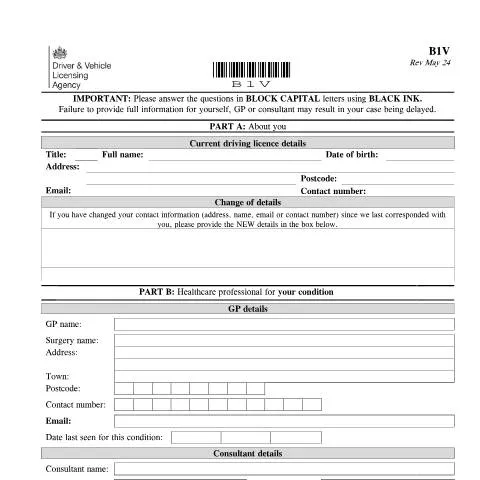
The moment you experience a seizure, blackout, or receive a neurological diagnosis, your relationship with driving changes fundamentally. Form B1V sits at the heart of this transformation, serving as the critical communication bridge between drivers with neurological conditions and the DVLA's medical assessment team. Unlike routine licence renewals, this seven-page medical questionnaire demands complete transparency about conditions that could compromise road safety—from epilepsy and brain haemorrhages to severe head injuries requiring hospital treatment.
The form's title, "Report your medical condition," reflects its dual purpose: it's both a legal obligation for drivers who develop qualifying conditions and a pathway for those seeking to maintain or regain their driving privileges. The DVLA uses B1V submissions to determine whether someone can continue driving, needs restrictions, or must surrender their licence temporarily or permanently.
Mandatory reporting applies to specific neurological events. If you've experienced a seizure, blackout, or altered consciousness level, you must notify the DVLA immediately—even before receiving the B1V form. The form then provides the detailed medical picture needed for their decision-making process.
Decoding the Medical Questionnaire Structure
Form B1V follows a methodical progression through your neurological history, with each section building upon the previous one. Part A captures basic identity verification—current licence details, contact information, and any recent changes to your personal circumstances. This administrative foundation proves crucial, as incomplete contact details frequently delay medical assessments.
Part B establishes your healthcare network, requiring comprehensive details for both your GP and any consultant specialists. The form demands specific information: full names, practice addresses, contact numbers, and—critically—the dates of your most recent consultations for the neurological condition. This timeline helps DVLA medical advisers understand the recency and continuity of your care.
The medical questionnaire proper begins with question 1, which covers three major categories: brain haemorrhages (including subarachnoid bleeds, aneurysms, and arteriovenous malformations), severe head injuries requiring inpatient treatment, and an open "any other condition" category. Each requires detailed descriptions and dates, including any brain surgery.
The Epilepsy and Seizure Section
Questions 4 through 7 form the form's most complex section, addressing seizures and epilepsy with surgical precision. The questionnaire distinguishes between first-ever seizures and recurrent seizures or epilepsy, as these carry different licensing implications under DVLA guidelines.
| Seizure Type | Key Information Required | Typical DVLA Response |
|---|---|---|
| First-ever seizure | Exact date, circumstances, description | Usually 6-month driving ban |
| Recurrent seizures | Dates of first/last awake and sleep seizures | Longer restrictions, ongoing monitoring |
| Medication-related seizures | Medication changes, restart dates, effectiveness | Case-by-case assessment |
The form's sophistication shows in how it handles sleep versus awake seizures. Sleep seizures carry different licensing implications, so the questionnaire requires separate dating for each type, including any crossover patterns where sleep seizures occur after awake ones.
Healthcare Professional Coordination and Medical Evidence
Form B1V doesn't operate in isolation—it triggers a coordinated information-gathering process involving your medical team. The DVLA will typically contact your GP and consultants directly, using the details you provide to request detailed medical reports. This dual-track approach—your self-reported information plus professional medical assessments—forms the complete picture needed for licensing decisions.
Recent consultation dates prove particularly important. If your last specialist appointment occurred more than six months ago, the DVLA may require you to arrange fresh assessments before processing your case. This requirement reflects their need for current medical information when making driving fitness determinations.
The form asks whether you've discussed it with your healthcare professional, and this isn't merely suggested—it's practically essential. Your GP or consultant can help ensure accurate completion, particularly for complex medical histories or medication timelines. They can also advise whether additional medical evidence might strengthen your case.
Medication Management and Driving Safety
Question 8 addresses all medications, not just anti-epileptic drugs. The form requires start and end dates for each medication, creating a chronological map of your treatment history. Crucially, it asks whether any medication causes drowsiness or confusion while driving—a direct safety assessment that influences licensing decisions.
For those on anti-epileptic medication, question 7g opens a complex pathway addressing medication compliance, withdrawal seizures, and treatment effectiveness. The form recognises that some seizures result from medical advice to stop, reduce, or change medications, and these circumstances may influence how the DVLA assesses your case.
Submission Pathways and Processing Timelines
Form B1V must be submitted by post to the DVLA's medical section—there's no online submission option for this document. The completed form should be sent to: DVLA, Medical Section, Swansea, SA99 1TU. Include your driving licence number on all correspondence to ensure proper file linking.
Processing times vary significantly based on case complexity. Simple cases with clear-cut conditions might receive decisions within 4-6 weeks, while complex neurological cases requiring specialist input can take 12 weeks or longer. The DVLA may request additional medical reports, which extends timelines further.
During the assessment period, your driving status depends on your specific condition and circumstances. Some drivers must stop immediately upon developing certain conditions, while others may continue driving until receiving a formal decision. The form's accompanying guidance letter typically clarifies your interim driving status.
Following Up on Your Submission
The DVLA provides limited progress updates during medical assessments, but you can contact their medical enquiry line for status updates after reasonable processing periods. Keep your B1V reference number and driving licence number readily available for any follow-up communications.
If the DVLA requests additional information—whether from you or your medical team—respond promptly. Delays in providing requested documentation directly extend your case processing time and may result in automatic licence revocation in some circumstances.
Special Controls, Visual Issues, and Adaptive Driving
Questions 10-12 address the practical implications of neurological conditions on driving ability. Double vision (diplopia) receives particular attention, as it directly affects road safety. The form asks how you manage double vision while driving—through eye patches, prisms, special glasses, or other methods. The DVLA needs this information to determine whether your condition is adequately controlled for safe driving.
Special controls or automatic transmission requirements are covered in question 12, distinguishing between Group 1 (cars and motorcycles) and Group 2 (buses and lorries) vehicles. If your neurological condition affects your physical ability to operate standard vehicle controls, you may need to use vehicles with adaptations or automatic transmissions only.
The form asks whether you've previously declared special control requirements, helping the DVLA track changes in your condition and adaptation needs over time. New requirements for special controls typically trigger reassessment of your overall driving fitness.
Declaration Commitments and Legal Obligations
For drivers with epilepsy or multiple seizures, Form B1V includes a formal declaration section requiring your signature and date. This declaration creates three specific legal commitments: following your doctor's treatment advice, attending necessary monitoring appointments, and informing the DVLA of any further attacks.
This declaration isn't merely administrative—it establishes ongoing obligations that continue throughout your driving career. Failure to inform the DVLA of subsequent seizures or medical changes can result in prosecution, licence revocation, and potential issues with motor insurance claims.
The declaration reflects the DVLA's recognition that neurological conditions often require ongoing management rather than one-time assessments. Your commitment to medical compliance and honest reporting becomes part of your licensing conditions.
Post-Submission Outcomes and Next Steps
Form B1V submissions typically result in one of several outcomes. The DVLA may issue an unrestricted licence if your condition doesn't affect driving safety, impose restrictions (such as requiring regular medical reviews or limiting licence validity periods), or refuse/revoke your licence if the condition poses unacceptable safety risks.
Restricted licences often include conditions such as annual medical reviews, requirements for specialist assessments, or limitations to specific vehicle types. These restrictions appear as codes on your driving licence and must be observed strictly—driving outside your restrictions invalidates your licence.
If your licence is refused or revoked, you have appeal rights through the magistrates' court system. However, appeals focus on whether the DVLA followed proper procedures rather than challenging medical judgments. Most successful appeals involve procedural errors or consideration of new medical evidence.
For temporary conditions or those showing improvement, the DVLA may set review dates for reassessment. Mark these dates carefully—failure to respond to review requests typically results in automatic licence cancellation. The ongoing relationship between your medical condition, treatment progress, and driving privileges continues well beyond your initial B1V submission, making this form the first step in a potentially long-term process of medical monitoring and licence management.
Common Medical Conditions and Their B1V Requirements
Different medical conditions trigger varying levels of scrutiny and documentation requirements when completing form B1V. Understanding these distinctions helps ensure you provide appropriate evidence whilst avoiding unnecessary delays in your application process.
Vision-Related Conditions
Visual impairments represent one of the most frequently reported categories on form B1V. The DVLA distinguishes between correctable vision problems and progressive conditions that may worsen over time. If you wear glasses or contact lenses that bring your vision to the required standard (typically 6/12 on the Snellen chart with both eyes open), you'll generally need to confirm this rather than provide extensive medical documentation.
However, conditions such as glaucoma, diabetic retinopathy, or macular degeneration require more detailed reporting. You must declare these even if your current vision meets driving standards, as they're progressive conditions that could affect future driving ability. The DVLA may request visual field tests, specialist reports, or impose periodic review requirements on your licence.
Monocular vision (sight in one eye only) doesn't automatically disqualify you from driving, but you must declare it on form B1V. The DVLA will typically require confirmation that you've adapted to monocular vision and may impose restrictions such as prohibiting you from driving certain vehicle categories or requiring more frequent medical reviews.
Neurological and Mental Health Conditions
Epilepsy reporting carries specific legal obligations under Road Traffic Act provisions. You must surrender your licence immediately upon diagnosis and cannot legally drive until you've been seizure-free for at least twelve months (or three months for certain provoked seizures). Form B1V requires detailed information about seizure types, frequency, medication compliance, and any triggers or warning signs.
Mental health conditions present more nuanced reporting requirements. Anxiety and depression, whilst common, only require declaration if they significantly impair your driving ability or if you're taking medication that affects concentration or reaction times. However, conditions such as bipolar disorder, schizophrenia, or severe personality disorders typically require specialist psychiatric assessment and ongoing monitoring.
Dementia and cognitive impairment cases demand immediate attention. Even mild cognitive impairment should be declared, as the DVLA will arrange cognitive assessments to determine continued driving fitness. Family members or healthcare providers can also contact the DVLA if they have concerns about a driver's cognitive abilities, though this can create sensitive family dynamics.
Cardiovascular and Diabetes Considerations
Heart conditions vary significantly in their impact on driving eligibility. A straightforward heart attack may only require a temporary driving suspension, whilst complex arrhythmias or heart failure might necessitate ongoing restrictions. The key factor is whether your condition could cause sudden incapacitation whilst driving.
Diabetes reporting depends on your treatment method. If you manage diabetes through diet alone, you typically don't need to notify the DVLA unless you develop complications. However, insulin-dependent diabetes requires declaration, and you'll need to demonstrate adequate glucose awareness and control. Hypoglycaemic episodes must be reported, particularly if they occur whilst driving or result in loss of consciousness.
Pacemaker and implantable cardioverter defibrillator (ICD) recipients face specific restrictions. Pacemaker patients usually can resume driving one week after implantation, whilst ICD patients face longer restrictions due to the risk of sudden device activation causing incapacitation.
Navigating Medical Professional Requirements and Assessments
The B1V process often extends beyond simple self-declaration, involving various medical professionals and assessment procedures. Understanding these requirements helps you prepare effectively and maintain compliance throughout the evaluation process.
GP and Specialist Involvement
Your general practitioner plays a crucial role in the B1V process, often serving as the primary source of medical evidence. However, GPs cannot override DVLA decisions or provide driving fitness certificates beyond their scope of practice. They can provide factual medical information, current medication lists, and treatment summaries, but fitness-to-drive determinations remain with DVLA medical advisers.
When the DVLA requests GP reports, these typically follow standardised formats covering your medical history, current treatment, prognosis, and any functional limitations. Your GP may charge for these reports, as they fall outside NHS services. Processing times can vary significantly between practices, so factor this into your planning if you're approaching licence renewal deadlines.
Specialist consultants become involved when your condition requires expert assessment. Cardiologists, neurologists, psychiatrists, and ophthalmologists may need to provide detailed reports or conduct specific tests. These specialists understand DVLA requirements and can provide targeted assessments addressing driving-specific concerns rather than general medical management.
Independent Medical Examinations
The DVLA may arrange independent medical examinations when existing medical evidence is insufficient or conflicting. These examinations, conducted by DVLA-approved doctors, focus specifically on driving-related functional abilities rather than general health status.
During these examinations, expect assessments of cognitive function, physical coordination, reaction times, and condition-specific tests. For instance, cardiovascular assessments might include exercise tolerance tests, whilst neurological examinations could involve detailed cognitive screening. The examining doctor will be familiar with DVLA medical standards and focus on functional abilities relevant to safe driving.
These examinations are typically arranged at locations reasonably accessible to your home, though you may need to travel to specialist centres for certain assessments. The DVLA covers examination costs, but you're responsible for travel expenses. Results feed directly into DVLA decision-making processes, and you'll receive copies of reports for your records.
Ongoing Monitoring and Review Cycles
Many medical conditions require periodic review rather than one-time assessment. The DVLA establishes review cycles based on condition stability and progression risk. Stable conditions might require review every three years, whilst rapidly progressive conditions could necessitate annual or even six-monthly assessments.
Review requirements typically involve updated medical reports, repeat specialist assessments, or functional testing. You'll receive renewal notices well in advance, but responsibility for initiating the review process rests with you. Failing to complete required reviews by specified deadlines can result in automatic licence revocation.
Some conditions qualify for self-certification renewal, where you confirm that your condition remains stable and hasn't deteriorated. However, any significant changes in your medical status between reviews must be reported immediately, regardless of the review cycle timeline.
Legal Obligations and Consequences of Non-Compliance
Understanding your legal obligations when reporting medical conditions extends beyond simply completing form B1V. The regulatory framework creates specific duties and potential consequences that affect both your driving privileges and legal standing.
Statutory Reporting Requirements
The Road Traffic Act 1988 creates a legal duty to notify the DVLA of any medical condition that could affect your driving ability. This obligation is ongoing and immediate – you cannot wait until your next licence renewal if your condition changes or deteriorates. The legislation uses the term "prescribed disability," which encompasses a broad range of conditions beyond obvious physical impairments.
Importantly, the duty to report exists regardless of whether you believe the condition affects your driving. The determination of driving fitness rests with DVLA medical advisers, not with individual drivers or their healthcare providers. This means conditions that seem minor or well-controlled still require notification if they fall within prescribed categories.
Family members and healthcare professionals also have reporting mechanisms available when they have genuine concerns about a driver's medical fitness. Whilst these reports can create difficult personal situations, they exist to protect public safety and the individual driver from potential harm.
Insurance and Legal Implications
Motor insurance validity depends partly on compliance with DVLA medical reporting requirements. Insurance companies can refuse claims or void policies if they discover you've failed to declare relevant medical conditions to the DVLA. This creates a complex interaction between DVLA notification, insurance disclosure, and policy validity.
Even if the DVLA allows you to continue driving with medical conditions, your insurance company may impose additional premiums, restrictions, or coverage limitations. Some insurers specialise in covering drivers with medical conditions and may offer more competitive rates than mainstream providers.
Criminal liability can arise from driving whilst medically unfit, even if you hold a valid licence. Courts can impose driving bans, fines, or even imprisonment for dangerous driving related to medical conditions. These penalties apply regardless of whether you've completed form B1V correctly – the key factor is whether your medical condition actually impaired your driving ability at the time of an incident.
Appeals and Dispute Resolution
The DVLA decision-making process includes appeal mechanisms when you disagree with medical fitness determinations. Initial appeals typically involve requesting reconsideration based on additional medical evidence or clarification of your condition's impact on driving ability.
Formal appeals proceed through the Magistrates' Court system, where independent medical evidence can be presented to challenge DVLA decisions. These proceedings focus on whether the DVLA's determination was reasonable based on available medical evidence and established fitness standards. Legal representation may be advisable given the technical medical and legal issues involved.
Alternative dispute resolution options include seeking independent medical opinions that address specific concerns raised by DVLA medical advisers. Sometimes, additional specialist testing or treatment modifications can address fitness concerns and lead to revised decisions without formal appeal proceedings.
The appeals process can be lengthy, during which driving restrictions typically remain in place. However, successful appeals can result in licence restoration, modified restrictions, or reduced review periods. Understanding these options helps you make informed decisions about challenging adverse DVLA determinations while maintaining compliance with legal requirements.