When Laboratory Findings Trigger National Surveillance: The UKHSA Referral Process
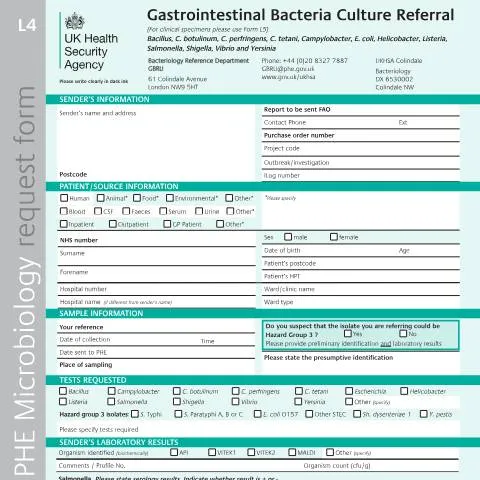
When a clinical laboratory identifies potentially significant gastrointestinal bacteria in a patient sample, the discovery often marks the beginning of a crucial public health process. The Gastrointestinal Bacteria Culture Referral form serves as the gateway between local diagnostic findings and national surveillance systems, enabling the UK Health Security Agency's Gastrointestinal Bacteria Reference Unit (GBRU) to conduct specialised testing that local facilities cannot perform.
This referral mechanism becomes particularly critical when laboratories encounter Hazard Group 3 pathogens such as Salmonella Typhi, Shiga toxin-producing E. coli O157, or Shigella dysenteriae type 1. These organisms carry significant public health implications, potentially triggering outbreak investigations or requiring immediate infection control measures. The form's structured approach ensures that vital clinical and epidemiological information accompanies each isolate, providing GBRU specialists with the context necessary for accurate identification and risk assessment.
Decoding Laboratory Responsibilities: Who Submits and When
The form's primary users are clinical microbiology laboratories across England, though it specifically excludes direct clinical specimens, which require the separate L5 form. This distinction reflects the referral system's focus on bacterial isolates that have already undergone preliminary identification but require confirmation, typing, or antimicrobial susceptibility testing beyond local capabilities.
Hospital laboratories typically initiate referrals when their routine identification methods—whether biochemical testing, API systems, VITEK platforms, or MALDI-TOF mass spectrometry—yield results suggesting significant pathogens. The form's design accommodates various identification methodologies, acknowledging that different laboratories employ different diagnostic approaches.
Private laboratories, Public Health England regional laboratories, and NHS Foundation Trust microbiology departments all utilise this referral pathway. Importantly, the form serves laboratories investigating both sporadic cases and outbreak situations, with specific fields dedicated to outbreak documentation and investigation codes.
Timing Considerations for Referral Submission
Time-sensitive factors influence referral decisions. Laboratories must consider the organism's viability during transport, particularly for fastidious bacteria requiring specific growth conditions. The form includes collection and dispatch dates, enabling GBRU to assess sample integrity upon arrival.
For suspected Hazard Group 3 organisms, immediate referral becomes essential. These pathogens pose significant risks to laboratory staff and public health, requiring specialised containment facilities and expertise available only at reference laboratories.
Navigating the Complex Specimen Information Framework
The form's specimen documentation section reflects the diverse contexts in which gastrointestinal bacteria emerge. Beyond traditional clinical samples, the referral system accommodates food samples, environmental specimens, and animal-derived isolates, recognising that foodborne outbreaks often require investigation across multiple sample types.
| Sample Type | Typical Source | Referral Context |
|---|---|---|
| Human clinical | Faeces, blood, CSF, urine | Patient diagnosis, outbreak investigation |
| Food specimens | Ready-to-eat products, raw ingredients | Food safety incidents, source identification |
| Environmental | Water, surfaces, soil | Outbreak source investigation |
| Animal samples | Veterinary specimens | Zoonotic transmission studies |
This comprehensive approach enables GBRU to construct epidemiological pictures linking human illness to potential sources, supporting both individual patient management and broader public health interventions.
Clinical Context Documentation: Beyond Basic Patient Details
The form's clinical information section captures essential epidemiological data that transforms isolated laboratory findings into public health intelligence. Travel history receives particular emphasis, with specific notation that certain countries present high risks for Hazard Group 3 pathogens. This information proves crucial for outbreak detection and source attribution.
Symptom documentation follows established clinical patterns for gastrointestinal infections. The form distinguishes between bloody diarrhoea and watery diarrhoea, reflecting different pathogenic mechanisms and helping guide appropriate testing strategies. Additional symptoms—pyrexia, vomiting, abdominal pain—provide clinical context supporting laboratory findings.
Patient Demographics and Healthcare Setting Context
NHS number inclusion enables linkage with national healthcare databases, supporting long-term surveillance and follow-up activities. The healthcare setting information—inpatient, outpatient, GP practice—provides context for infection acquisition and transmission risk assessment.
Hospital-acquired infections receive particular scrutiny, with ward type and hospital details enabling investigation of potential nosocomial transmission. Healthcare-associated gastrointestinal infections often indicate system failures requiring immediate intervention.
Specialised Testing Requests: Tailoring Analysis to Clinical Need
The form's testing request section reflects GBRU's comprehensive analytical capabilities. Serotyping requests for Salmonella isolates involve specific antigen testing patterns, with the form accommodating both O (somatic) and H (flagellar) antigen determinations. This detailed serotyping enables precise outbreak tracking and epidemiological investigation.
For Shigella isolates, the form addresses the critical distinction between traditional Shigella species and atypical verocytotoxin-producing E. coli (VTEC) that may present similar agglutination patterns. This diagnostic challenge requires specialist expertise, as misidentification could compromise patient management and outbreak response.
Antimicrobial Susceptibility and Resistance Monitoring
While not explicitly detailed on the basic form structure, GBRU's role includes antimicrobial resistance surveillance for gastrointestinal pathogens. Referral laboratories often include preliminary susceptibility data, enabling GBRU to conduct confirmatory testing and contribute to national resistance monitoring programmes.
This surveillance function proves particularly important for multi-drug resistant Salmonella strains and emerging resistance patterns in Campylobacter species, supporting both clinical treatment guidance and public health policy development.
Operational Logistics: From Laboratory Bench to National Reference
The physical referral process requires careful attention to specimen preservation and transport conditions. GBRU's location at Colindale Avenue, London NW9 5HT serves as the central hub for England's gastrointestinal bacteria reference services, though the form's DX addressing system (DX 6530002 Colindale NW) provides alternative postal routing for laboratory users.
Contact information includes both telephone (+44 20 8327 7887) and email ([email protected]) options, enabling referring laboratories to discuss complex cases or urgent situations directly with reference laboratory staff. This direct communication pathway proves essential for outbreak investigations requiring rapid coordination.
Quality Assurance and Accreditation Context
The form's version control system (BRDW0142.06, effective April 2025) reflects ongoing quality management processes. UKHSA's standard terms and conditions apply to all requests, ensuring consistent service delivery and maintaining accreditation standards across the reference laboratory network.
Documentation requirements support both clinical governance and research activities, with project codes and purchase order numbers enabling appropriate cost allocation for different funding streams.
Public Health Intelligence: From Individual Cases to Population Surveillance
Each completed referral form contributes to England's national gastrointestinal surveillance system, feeding data into broader epidemiological monitoring programmes. Outbreak investigation codes enable linkage between related cases, supporting cluster detection and source identification activities.
The form's design reflects the interconnected nature of modern foodborne disease surveillance, where individual clinical cases may represent broader public health threats requiring coordinated response. Travel-associated infections, in particular, may indicate international disease transmission requiring liaison with global health networks.
GBRU's analytical results ultimately inform clinical management decisions, public health interventions, and policy development. The referral form serves as the critical first step in this process, ensuring that essential contextual information accompanies each isolate throughout its analytical journey. For referring laboratories, completion accuracy directly impacts the quality and relevance of reference laboratory reports, making careful attention to form completion an essential professional responsibility.
Laboratory Processing Timelines and Result Interpretation
Understanding the laboratory workflow for gastrointestinal bacteria culture helps manage patient expectations and clinical decision-making. Once your referral form reaches the microbiology laboratory, specimens typically undergo initial processing within 24 hours of receipt during weekdays. However, samples arriving on Friday evenings or weekends may experience delays until the following Monday.
The culture process follows a standardised protocol across NHS laboratories. Primary plating occurs on selective and non-selective media, including MacConkey agar for gram-negative bacteria, blood agar for general bacterial growth, and specialised media such as Campylobacter blood agar when specific pathogens are suspected. Incubation periods vary significantly depending on the target organism—whilst most common enteric bacteria like Salmonella and Shigella show growth within 24-48 hours, Campylobacter species may require 48-72 hours under microaerophilic conditions.
Preliminary results often become available within 48-72 hours for negative cultures or when common pathogens are isolated. However, complete identification and antimicrobial susceptibility testing typically requires 3-5 working days. Some fastidious organisms or those requiring biochemical confirmation may extend this timeframe to 7-10 days. Emergency situations, such as suspected food poisoning outbreaks or immunocompromised patients, may warrant expedited processing—contact the laboratory directly to discuss prioritisation options.
Result interpretation requires clinical correlation with patient symptoms and epidemiological factors. A negative culture doesn't definitively rule out bacterial gastroenteritis, particularly if the patient has already commenced antibiotic therapy or if viral causes are responsible. Conversely, isolation of potential pathogens like Clostridium difficile requires careful clinical assessment, as asymptomatic carriage occurs in certain populations, especially elderly care home residents.
Laboratory reports typically include organism identification, colony counts when relevant, and antimicrobial susceptibility patterns. Pay particular attention to resistance markers such as ESBL (Extended Spectrum Beta-Lactamase) production in E. coli or carbapenemase resistance, which have significant infection control implications. Multi-drug resistant organisms trigger automatic notification to infection prevention and control teams, who may implement additional isolation precautions.
Infection Prevention and Public Health Reporting Requirements
Gastrointestinal bacterial infections carry substantial public health implications, particularly when foodborne transmission or healthcare-associated spread is suspected. The referral form serves as the initial trigger for surveillance systems designed to detect outbreaks and implement control measures. Understanding these reporting pathways helps healthcare providers contribute effectively to disease prevention efforts.
Certain bacterial isolates constitute notifiable diseases under the Health Protection (Notification) Regulations 2010. Salmonella species (excluding S. Typhi and S. Paratyphi, which require separate notification as typhoid/paratyphoid fever), Shigella species, and E. coli O157 fall into this category. Laboratory confirmation automatically triggers notification to the UK Health Security Agency (UKHSA) through the Second Generation Surveillance System (SGSS), but clinical suspicion may warrant earlier notification through local health protection teams.
Food handlers, healthcare workers, and childcare staff face specific restrictions following confirmed bacterial gastroenteritis. The referral form should clearly identify patients working in these high-risk occupations, as clearance requirements vary by pathogen. Salmonella and Shigella infections typically require two consecutive negative stool samples taken at least 48 hours apart and at least 48 hours after completing antibiotic treatment before return to work is permitted.
Healthcare-associated infections require additional documentation and investigation. If symptoms develop more than 48 hours after hospital admission or within 28 days of discharge, this constitutes a healthcare-associated infection requiring root cause analysis. The referral form should capture relevant exposure history, including recent healthcare contacts, antibiotic use, and proton pump inhibitor therapy, which predisposes to C. difficile infection.
Outbreak situations demand enhanced surveillance and control measures. When multiple cases share common exposures—such as attendance at the same event, consumption of food from the same source, or residence in the same care facility—coordinate with local health protection teams for epidemiological investigation. Enhanced laboratory typing, including whole genome sequencing for outbreak strain characterisation, may be requested to establish transmission links.
International travel history assumes particular importance for surveillance purposes. Patients returning from areas with endemic typhoid fever, cholera, or antimicrobial-resistant organisms require enhanced monitoring and may need extended culture protocols. The Global Health Security Programme tracks imported infections to prevent secondary transmission and monitor emerging resistance patterns.
Quality Assurance and Laboratory Accreditation Standards
NHS microbiology laboratories operate under stringent quality assurance frameworks ensuring reliable results for gastrointestinal bacteria culture. Understanding these standards helps healthcare providers interpret results appropriately and identify when additional testing may be warranted. All clinical microbiology laboratories must hold UKAS (United Kingdom Accreditation Service) accreditation to ISO 15189:2012 standards, demonstrating competence in medical laboratory testing.
Internal quality control measures include daily testing of culture media, equipment calibration, and staff competency assessments. External quality assessment schemes, coordinated by organisations such as NEQAS (National External Quality Assessment Service), provide independent verification of laboratory performance. Participation in these schemes ensures consistent results across different laboratories and identifies potential systematic errors.
Specimen quality significantly impacts culture reliability, and laboratories employ standardised rejection criteria to maintain result integrity. Specimens arriving more than 48 hours after collection (unless transported in appropriate preservative media), those showing evidence of contamination, or samples in inappropriate containers may be rejected. The referral form plays a crucial role in specimen acceptance decisions—incomplete or illegible forms may delay processing or result in specimen rejection.
Chain of custody documentation ensures traceability from collection through to result reporting. Each specimen requires unique identification linking to the referral form, with electronic laboratory information management systems (LIMS) tracking processing stages and staff involvement. This documentation proves essential during outbreak investigations or when results face legal scrutiny.
Method validation and verification procedures ensure new testing protocols meet performance specifications before implementation. When laboratories introduce novel identification techniques, such as MALDI-TOF mass spectrometry for rapid organism identification, extensive validation studies demonstrate equivalence to established methods. These improvements may reduce turnaround times but require careful correlation with clinical presentation.
Staff qualification requirements ensure appropriate expertise for complex cases. Consultant clinical microbiologists oversee result interpretation, particularly for unusual organisms or antimicrobial resistance patterns. Biomedical scientists undergo continuous professional development, maintaining registration with the Health and Care Professions Council (HCPC) and participating in specialist training programmes for advanced techniques.
Inter-laboratory comparison studies verify result consistency when specimens require referral to specialist centres. Reference laboratories, such as those within UKHSA, provide confirmatory testing for unusual isolates, outbreak investigations, and antimicrobial resistance characterisation. The referral form accompanies specimens to these facilities, ensuring clinical context remains available throughout the testing process.