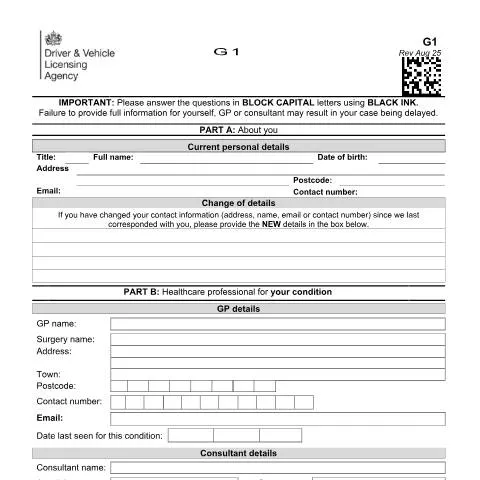
When Health Conditions Meet the Highway: Understanding the G1 Medical Declaration
Every year, thousands of UK drivers face the challenging moment when their health condition requires them to make a critical decision: should they continue driving? The G1 form, officially titled "Report your medical condition," serves as the formal gateway for drivers to declare health issues that might affect their ability to safely operate a vehicle. This six-page document represents far more than mere bureaucracy—it's the cornerstone of road safety legislation that balances individual mobility rights with public protection.
The legal framework surrounding medical fitness to drive stems from the Road Traffic Act 1988, which places a statutory duty on all licence holders to notify DVLA of any medical condition that could impair their driving ability. Failure to do so isn't just an administrative oversight—it constitutes a criminal offence potentially punishable by a fine of up to £1,000, and can invalidate insurance policies entirely.
Unlike many DVLA forms that serve straightforward administrative purposes, the G1 operates within a complex web of medical assessment, legal compliance, and practical driving evaluation. It's designed to capture not just the existence of a medical condition, but its real-world impact on driving capability, the ongoing medical management, and any adaptive measures already in place.
The Medical Reporting Imperative: Who Must Complete Form G1
The scope of individuals required to submit a G1 form extends far beyond those with obvious mobility impairments. DVLA maintains an extensive list of notifiable medical conditions that spans virtually every medical specialty. These range from neurological conditions like epilepsy and multiple sclerosis, through cardiovascular issues including heart attacks and pacemaker implantation, to psychiatric conditions such as severe depression or bipolar disorder.
Crucially, the obligation to report isn't triggered solely by diagnosis—it's the potential impact on driving ability that matters. A diabetic driver whose condition is well-controlled through diet alone may not need to report, whereas someone experiencing frequent hypoglycaemic episodes must submit a G1 immediately. This nuanced approach recognises that medical conditions exist on a spectrum of severity and functional impact.
| Condition Category | Typical Reporting Requirement | Key Assessment Factors |
|---|---|---|
| Neurological disorders | Immediate reporting required | Seizure control, cognitive function, motor skills |
| Cardiovascular conditions | Within defined timeframes | Exercise tolerance, medication stability, arrhythmias |
| Visual impairments | Immediate if below standards | Visual acuity, field defects, night vision |
| Mental health conditions | When affecting daily function | Treatment compliance, insight, risk assessment |
Professional drivers holding Group 2 licences (categories C, D, C1, D1) face more stringent medical standards and must report conditions that wouldn't necessarily affect ordinary car drivers. A lorry driver with mild diabetes might need to surrender their vocational entitlement while retaining their car licence, illustrating how the same medical condition can have differential impacts across licence categories.
Navigating the G1's Clinical Architecture
The G1 form's structure reflects decades of refinement in medical assessment protocols. Part A establishes the applicant's identity and ensures DVLA can maintain accurate records—particularly crucial given that medical files may span many years and multiple addresses. The emphasis on block capitals and black ink isn't bureaucratic pedantry; it ensures optical character recognition systems can accurately process handwritten information.
The change of details section addresses a common source of delay: outdated contact information. When DVLA needs to request additional medical reports or arrange driving assessments, incorrect addresses can add weeks to processing times. This section also captures name changes due to marriage or deed poll, ensuring continuity across medical records.
Part B's healthcare professional details serve multiple critical functions. DVLA's medical team routinely contacts GPs and consultants to obtain detailed reports, and the quality of information provided here directly impacts assessment speed and accuracy. The form specifically requests both GP and consultant details because many conditions require specialist management, and consultant reports often carry additional weight in complex cases.
The "date last seen" fields help DVLA assess whether medical information is current. A neurological condition assessed two years ago may have progressed significantly, prompting requests for updated examinations. Conversely, recent consultant reviews suggesting stable conditions can expedite positive decisions.
Self-Declaration Questions: The Heart of Medical Assessment
Questions 1-8 represent the form's clinical core, designed to elicit information that directly correlates with driving safety. The request for approximate diagnosis dates isn't merely administrative—it helps medical advisers understand disease progression and treatment response patterns. Newly diagnosed conditions often carry higher uncertainty about prognosis, potentially triggering more frequent licence reviews.
The distinction between illness-related, accident-related, and head injury-related conditions reflects different assessment pathways. Head injuries, regardless of apparent severity, trigger automatic referral to the B1 questionnaire process, recognising that traumatic brain injury can have subtle but significant effects on driving-relevant cognitive functions like attention, processing speed, and executive function.
Question 4's focus on subjective driving impact acknowledges that patients often have valuable insights into their functional limitations. A Parkinson's disease patient might report difficulty with fine motor control affecting indicator use, while someone with chronic fatigue might describe concentration problems during longer journeys. This patient-reported information complements objective medical assessments.
Special Controls and Adaptive Driving Solutions
Section 8's detailed exploration of special controls reflects DVLA's commitment to maintaining driving independence wherever safely possible. The comprehensive list of modifications—from simple automatic transmission requirements to complex combined brake/accelerator/steering systems—demonstrates how modern assistive technology can overcome many physical limitations.
The distinction between Group 1 (cars) and Group 2 (commercial vehicles) modifications acknowledges different practical requirements. A car driver might manage with left-foot braking adaptations, while a bus driver needs more sophisticated systems due to vehicle size and passenger responsibility.
Motorcycle modifications receive separate consideration because two-wheeled vehicles present unique challenges. Balance requirements, the need for simultaneous clutch and brake operation, and exposure to weather conditions mean that some modifications suitable for cars aren't transferable to motorcycles.
The automatic gears question specifically excludes voluntary choice, recognising that many drivers prefer automatics for convenience rather than medical necessity. This distinction matters because medical restrictions appear on licences and affect insurance classifications, while personal preferences don't.
Professional Assessment Integration
Question 6's inquiry about driving assessments reflects the growing role of mobility centres in medical licence decisions. These specialised facilities, staffed by occupational therapists and driving instructors, provide objective evaluations of driving ability that complement medical opinions. Their reports carry significant weight because they assess actual driving performance rather than theoretical capability.
Driving assessments typically involve both off-road evaluations (reaction times, cognitive testing, vision screening) and on-road driving in various conditions. The assessor might recommend specific modifications, training courses, or in some cases, confirm that safe driving isn't possible despite medical treatment.
The Medical Advisory Infrastructure
The authorisation section reveals DVLA's extensive medical advisory network. The Honorary Medical Advisory Panels comprise specialist consultants who volunteer their expertise to assess complex cases. These panels, covering specialties from cardiology to psychiatry, ensure that licence decisions reflect current medical understanding and best practice.
The data sharing provisions might concern some applicants, but they're essential for comprehensive assessment. A diabetic driver's fitness might depend on input from their endocrinologist, diabetes specialist nurse, and optometrist (for diabetic retinopathy screening). The authorisation allows DVLA to obtain a complete clinical picture rather than relying on potentially incomplete GP summaries.
The reference to orthoptists highlights DVLA's sophisticated approach to visual assessment. Unlike simple vision tests, orthoptic evaluations can detect subtle visual field defects, eye movement disorders, and binocular vision problems that significantly impact driving safety but might not be apparent in routine examinations.
Confidentiality and Information Governance
DVLA's handling of medical information operates under strict confidentiality protocols aligned with the Data Protection Act 2018 and UK GDPR. Medical information is only shared with healthcare professionals directly involved in fitness-to-drive assessments, and only to the extent necessary for that specific purpose.
The privacy notice referenced in the form provides detailed information about data retention periods, individual rights, and complaint procedures. Medical files are typically retained for specified periods after licence surrender or death, reflecting potential legal requirements and insurance investigations.
Processing Pathways and Decision Timelines
Once submitted, G1 forms enter different processing streams depending on the medical condition and complexity. Straightforward cases with clear medical evidence might be resolved within 4-6 weeks, while complex conditions requiring specialist input can take several months.
DVLA's medical team includes qualified doctors, nurses, and paramedical staff who review submissions against published medical standards. These standards, regularly updated to reflect medical advances, provide consistency in decision-making while allowing for individual circumstances.
The outcome might be licence retention without restrictions, licence retention with specific conditions (such as periodic medical reviews), requirement for modifications, or in some cases, licence revocation. Importantly, decisions aren't necessarily permanent—many conditions improve with treatment, and periodic reviews allow for licence restoration when medical circumstances change.
Appeals and Representation Rights
Applicants dissatisfied with DVLA medical decisions can appeal to an independent tribunal. This process recognises that medical assessment involves clinical judgement, and different medical professionals might reasonably reach different conclusions about driving fitness.
The appeals process requires fresh medical evidence, typically from specialists familiar with both the medical condition and driving requirements. Success rates vary considerably depending on the condition and quality of supporting evidence, but the availability of independent review provides important protection against arbitrary decisions.
Beyond Form Submission: The Ongoing Medical Licence Journey
Completing and submitting a G1 form marks the beginning, not the end, of medical licence management. Many conditions require periodic review, with intervals ranging from annual assessments for progressive conditions to five-yearly reviews for stable situations.
Drivers retain ongoing obligations to report significant changes in their medical condition, even between formal reviews. A diabetic whose control deteriorates, or a cardiac patient experiencing new symptoms, must inform DVLA promptly rather than waiting for their next scheduled review.
The interaction between medical licensing and insurance creates additional complexity. Insurance providers typically require disclosure of medical conditions and any DVLA restrictions. Failure to disclose can void policies, potentially leaving drivers facing unlimited liability in accident situations.
For many drivers, the G1 process ultimately demonstrates that medical conditions need not end driving independence. With appropriate medical management, suitable vehicle modifications, and regular monitoring, many people continue driving safely for years after diagnosis. The form serves not as a barrier to driving, but as a gateway to safe, legally compliant mobility that protects both the individual driver and other road users.
Medical Evidence Requirements and Supporting Documentation
When completing form G1, the quality and comprehensiveness of your medical evidence can significantly impact the outcome of your application. The DVLA requires specific types of documentation that demonstrate both the nature of your condition and its potential effect on your driving ability.
Primary medical evidence must come from a registered medical practitioner who has direct knowledge of your condition. This typically includes your GP, consultant, or specialist who has been treating you. Hospital discharge summaries, clinic letters, and diagnostic reports carry substantial weight in the assessment process. However, the DVLA may not accept medical evidence that is older than 12 months for progressive conditions, though this timeframe can vary depending on the specific medical condition being reported.
For certain conditions, specialist reports are particularly valuable. Cardiovascular conditions often require input from a cardiologist, including recent ECG results, exercise tolerance tests, or echocardiograms. Neurological conditions may need documentation from a neurologist, potentially including brain scans, nerve conduction studies, or cognitive assessments. Mental health conditions typically require psychiatric or psychological evaluation, with particular attention to medication compliance, symptom stability, and functional capacity.
The DVLA places considerable emphasis on functional assessment rather than diagnosis alone. Medical evidence should clearly articulate how your condition affects specific driving-related functions such as vision, reaction times, concentration, or physical coordination. For instance, a diagnosis of diabetes is less significant than evidence showing whether you experience hypoglycaemic episodes that could impair consciousness while driving.
Medication reviews form a crucial component of medical evidence. You must disclose all prescribed medications, including dosages and any recent changes. Some medications carry specific driving restrictions—for example, certain antiepileptic drugs may require a period of medication stability before driving can resume. Benzodiazepines, opioid painkillers, and some antidepressants can impair driving ability, and the DVLA needs evidence of how these affect your individual functioning.
For conditions requiring ongoing monitoring, such as epilepsy or cardiac arrhythmias, the DVLA may request regular medical updates. These typically occur at predetermined intervals—annually for many cardiac conditions, or every three years for controlled epilepsy. Your medical practitioner should maintain detailed records of your condition's progression, treatment response, and any episodes or complications that could affect driving safety.
Processing Timelines and Decision Outcomes
Understanding the DVLA's decision-making process and expected timelines helps manage expectations and plan accordingly. Processing times for form G1 vary considerably based on the complexity of your medical condition, the completeness of submitted documentation, and current application volumes.
Standard processing for straightforward cases typically takes 4-6 weeks from receipt of a complete application with all required medical evidence. However, complex cases requiring specialist medical input or independent medical examinations can extend to 12-16 weeks or longer. The DVLA prioritises applications based on medical urgency and public safety considerations, which means some conditions receive faster processing than others.
During the assessment period, the DVLA may request additional information from your medical practitioner or arrange an independent medical examination. These requests can add 4-8 weeks to the processing timeline. Independent medical examinations are typically arranged when the submitted medical evidence is insufficient, contradictory, or when the DVLA requires specialist assessment of functional capacity for driving.
The DVLA can reach several decision outcomes following assessment of your G1 form. A licence may be renewed without restrictions if your condition is well-controlled and poses no significant driving risk. Alternatively, the DVLA may issue a licence with specific restrictions, such as limiting driving to daylight hours for certain visual conditions, or restricting heavy goods vehicle entitlement while maintaining car driving privileges.
For progressive conditions, the DVLA often issues shorter-term licences requiring more frequent medical review. These may be valid for one, two, or three years instead of the standard ten-year period, ensuring regular monitoring of condition progression. This approach is common for conditions like dementia, Parkinson's disease, or unstable cardiac conditions.
In cases where medical evidence suggests significant driving impairment, the DVLA may refuse or revoke driving entitlements. This decision is not necessarily permanent—many conditions can be reviewed if medical circumstances change significantly. For example, successful cardiac surgery, stabilisation of epilepsy, or effective treatment of mental health conditions may warrant licence restoration.
Appeal processes are available if you disagree with the DVLA's decision. You can request a review by providing additional medical evidence or arrange an independent medical assessment. In some cases, appeals may progress to the Magistrates' Court, particularly for commercial driving licences where livelihood implications are significant.
Condition-Specific Considerations and Requirements
Different medical conditions carry varying implications for driving safety, and the DVLA applies specific assessment criteria tailored to each condition category. Understanding these condition-specific requirements helps ensure your G1 form addresses the particular concerns relevant to your circumstances.
Cardiovascular conditions are assessed primarily on functional capacity and risk of sudden incapacitation. Following myocardial infarction, driving is typically prohibited for at least four weeks for car drivers, extending to six weeks for commercial vehicles. The DVLA requires evidence of left ventricular function, exercise tolerance, and absence of unstable angina. Conditions like atrial fibrillation may permit continued driving if well-controlled, but require regular cardiac monitoring and medication compliance documentation.
Neurological conditions present complex assessment challenges due to their often progressive nature and varied presentations. Epilepsy requires complete seizure freedom for specific periods—typically 12 months for car licences and five years for commercial vehicles, though these periods may be reduced with medical evidence of excellent seizure control. Multiple sclerosis assessments focus on functional impairment, particularly affecting vision, coordination, and cognitive function, with regular review intervals reflecting disease progression patterns.
Visual impairments are subject to precise legal standards that cannot be waived. The minimum visual acuity requirement is 6/12 vision using both eyes, or 6/9 in the better eye if sight is lost in one eye. Visual field requirements specify adequate peripheral vision, and certain conditions like homonymous hemianopia typically result in licence refusal. However, some visual conditions may permit restricted licences, such as daylight-only driving for certain retinal conditions.
Mental health conditions are assessed based on functional impairment rather than diagnosis alone. Severe depression or anxiety may temporarily affect concentration and decision-making abilities essential for safe driving. Psychotic conditions typically require evidence of stable treatment and absence of delusions or hallucinations that could impair driving judgement. Medication side effects, particularly sedation or cognitive impairment, are carefully evaluated.
Substance misuse conditions require evidence of sustained recovery and abstinence. Alcohol dependency typically requires at least 12 months of documented sobriety, supported by medical evidence and sometimes blood testing. Drug dependency assessments vary based on the substance involved, with particular concern for substances affecting reaction times, coordination, or consciousness levels.
Diabetes management focuses on hypoglycaemia risk and awareness. Insulin-treated diabetes requires evidence of hypoglycaemia awareness and appropriate blood glucose monitoring. Severe hypoglycaemic episodes may result in temporary driving restrictions until glucose control is re-established. Non-insulin treated diabetes typically requires less stringent monitoring unless complications affect vision or peripheral sensation.
For age-related conditions, the DVLA applies increasingly stringent assessment criteria, particularly for drivers over 70 years. Cognitive assessments may be required for suspected dementia, while multiple minor conditions may cumulatively affect driving safety even when individually manageable. The assessment considers the interaction between multiple medications, sensory impairments, and physical limitations that commonly accompany advancing age.