When Your Vision Changes: Understanding the DVLA's Medical Reporting Requirements
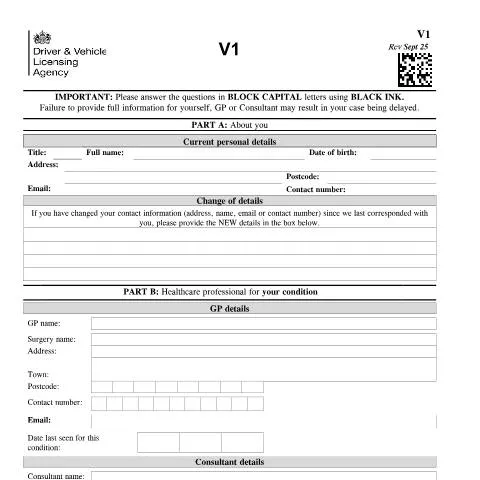
Every year, thousands of drivers across the UK face a moment of uncertainty when their optician delivers news about declining eyesight or when a medical diagnosis affects their vision. The V1 form - Report your medical condition becomes their lifeline to maintaining legal driving privileges whilst ensuring road safety. This comprehensive seven-page document serves as the Driver and Vehicle Licensing Agency's primary tool for assessing whether drivers with vision-related conditions can continue to hold their licence safely.
Unlike many DVLA forms that deal with straightforward administrative changes, the V1 form tackles one of driving's most fundamental requirements: the ability to see clearly enough to operate a vehicle safely. The stakes are particularly high because inadequate vision combined with driving can invalidate motor insurance and lead to prosecution if an accident occurs.
The Critical Vision Standards That Trigger Form Submission
The V1 form centres around the UK's legal eyesight standards for driving, which are more nuanced than many drivers realise. The primary requirement states that drivers must be able to read a standard number plate from 20 metres - roughly the length of five parked cars. However, the medical threshold goes deeper: vision must not fall below 6/12 on the Snellen scale (decimal 0.5) as measured during professional eye examinations.
Several specific conditions automatically require V1 form completion:
- Monocular vision (sight in only one eye) - regardless of whether this occurred from birth, childhood, or later injury
- Visual field defects affecting peripheral vision, particularly when caused by neurological conditions
- Glaucoma in any stage, affecting one or both eyes
- Retinitis pigmentosa, a progressive condition causing night blindness and tunnel vision
- Blepharospasm (involuntary eyelid spasms) requiring medical management
- Diplopia (double vision), whether controlled or persistent
- Night blindness (nyctalopia) affecting safe driving in low-light conditions
The form also addresses drivers who've undergone laser eye treatment beyond simple refractive surgery, requiring detailed dates of first and last treatments for each eye.
Navigating the Complex Healthcare Professional Requirements
Part B of the V1 form demands comprehensive details about both GP and consultant involvement, reflecting the DVLA's recognition that vision conditions often require specialist care. The form requires complete contact information for both healthcare providers, including specific dates of last consultation for the reported condition.
For consultant details, drivers must provide the specialist's department, hospital affiliation, and contact information. This dual-reporting system ensures the DVLA can verify medical information from both primary care providers and specialists who understand the specific nuances of complex vision conditions.
| Healthcare Professional Type | Required Information | Critical Details |
|---|---|---|
| General Practitioner | Name, surgery details, full address | Date last seen for this specific condition |
| Consultant Specialist | Department, specialty, hospital name | Complete contact details including email |
| Optician/Optometrist | Referenced throughout form | Professional opinion on adaptation and standards |
The form explicitly states that failure to provide complete healthcare professional information may result in case delays, emphasising the importance of thoroughness over speed in completion.
Self-Declaration Sections: Where Driver Honesty Meets Legal Obligation
The V1 form's self-declaration components require drivers to make honest assessments about their vision capabilities. Question 1 directly asks whether drivers meet the eyesight standard, offering three options: meeting standards without correction, with glasses or corrective lenses, or failing to meet standards entirely.
For drivers with monocular vision, the form includes a specific declaration requiring confirmation that they have "fully adapted to having vision in only one eye" as advised by their healthcare professional. This adaptation process is crucial because monocular vision affects depth perception and peripheral awareness - factors that significantly impact driving safety.
The double vision section includes a particularly detailed declaration acknowledging that adaptation to corrective measures (patches, prisms, frosted glasses, or specialised lenses) can take three months or more. Drivers must understand that their ability to judge distances may be compromised and that they may not be aware of objects to either side during this adaptation period.
The form requires drivers to sign and date their understanding that they should not drive until their healthcare professional confirms full adaptation to vision correction aids.
Cross-Referenced Medical Conditions: When V1 Isn't Enough
The V1 form includes an important caveat that catches many drivers off-guard: if vision problems stem from certain underlying medical conditions, additional specialist forms must be completed. These cross-referenced conditions include:
- Brain tumour - requires BT1 form completion
- Head injury - requires B1 form submission
- Stroke or Transient Ischaemic Attack (TIA) - requires STR1 form
- Myasthenia Gravis - requires CN1 form completion
This cross-referencing system reflects the DVLA's understanding that vision problems often indicate broader neurological issues that could affect driving ability beyond simple eyesight concerns. Drivers cannot currently use online services to report multiple health conditions, necessitating paper form completion for complex cases.
The form specifically notes that all additional forms can be downloaded from the government's official driving medical conditions webpage, ensuring drivers have access to the complete documentation required for their specific situation.
Progressive Conditions and Ongoing Monitoring
For conditions like glaucoma and retinitis pigmentosa, the V1 form recognises the progressive nature of these diseases. Rather than simply recording current status, the form establishes a baseline for ongoing monitoring. The DVLA uses this information to determine appropriate licence restrictions and review periods.
Retinitis pigmentosa, in particular, receives special attention due to its characteristic progression from night blindness to tunnel vision. The form's questions about which eyes are affected help the DVLA assess whether drivers retain sufficient visual field for safe driving.
Technical Completion Requirements and Common Pitfalls
The V1 form opens with explicit technical instructions that, while seemingly basic, are crucial for processing efficiency. All responses must be completed in BLOCK CAPITAL letters using BLACK INK - requirements that reflect the form's processing through both human review and optical scanning systems.
Part A requires current personal details but includes a specific section for changed information since the DVLA's last correspondence. This detail is particularly important for drivers who've moved or changed contact information during ongoing medical assessments or licence reviews.
The form's structure progresses logically through vision-related questions, but several sections contain conditional routing that can confuse applicants:
- Question 2 about binocular vision routes monocular drivers through additional subsections about adaptation and professional advice
- Question 3 about visual field problems includes specific routing for brain-related causes versus eye-specific conditions
- Question 6 excludes routine refractive surgery from laser treatment reporting requirements
- Question 9 requires detailed assessment of double vision control and adaptation timelines
The Twelve-Month Contact Rule
Question 11 establishes a crucial timeline by asking about healthcare professional contact within the last twelve months. This requirement reflects the DVLA's expectation that vision conditions require regular professional monitoring. The question encompasses telephone, video, and face-to-face consultations, acknowledging modern healthcare delivery methods.
Drivers who haven't had recent professional contact may face additional scrutiny or requirements for updated assessments before licence decisions are made.
Processing Timelines and DVLA Decision-Making Framework
Once submitted, the V1 form enters the DVLA's medical licensing unit, where decisions involve both administrative review and consultation with the agency's medical advisers. Processing times vary significantly depending on the complexity of reported conditions and the completeness of submitted information.
The DVLA may request additional information from healthcare providers listed on the form, potentially extending processing times. For straightforward cases where drivers clearly meet vision standards with appropriate correction, decisions may be reached within weeks. Complex cases involving progressive conditions or adaptation periods may require months of assessment.
Possible outcomes include:
- Unrestricted licence continuation for drivers meeting all standards
- Restricted licences limiting driving to daylight hours or specific conditions
- Periodic review requirements with mandated reassessment timelines
- Licence revocation for drivers who cannot meet minimum safety standards
Appeals and Reassessment Procedures
Drivers who disagree with DVLA decisions based on V1 form submissions have specific appeal rights. The process typically involves independent medical assessment and may require updated specialist reports addressing the DVLA's specific concerns about driving safety.
For progressive conditions, the form establishes baseline information that becomes crucial during reassessment periods. Drivers should maintain records of their V1 submission and subsequent correspondence to support future reviews or appeals.
Insurance Implications and Legal Responsibilities
The V1 form carries significant weight beyond DVLA licence decisions. The document serves as legal evidence that drivers have properly disclosed vision conditions to authorities. Failure to complete and submit the form when required can invalidate motor insurance and expose drivers to prosecution if accidents occur.
Insurance companies increasingly cross-reference DVLA medical records when assessing claims, particularly those involving vision-related factors. The V1 form's detailed medical history and professional contact information provide insurers with comprehensive background for claim evaluation.
The form's emphasis on regular eyesight testing reflects the legal principle that drivers must continuously meet vision standards. The document explicitly warns that inadequate vision combined with continued driving can lead to prosecution, regardless of whether formal restrictions have been imposed.
Motor insurance becomes invalid when drivers fail to meet legal vision standards, creating potential financial liability extending far beyond licence penalties.
For drivers whose conditions improve or stabilise, the V1 form provides a pathway for demonstrating ongoing fitness to drive. Regular professional monitoring documented through the form's healthcare provider sections helps establish patterns of stable or improving vision that support continued driving privileges.
The document ultimately serves dual purposes: protecting public safety through appropriate medical screening whilst providing a transparent process for drivers to maintain their independence when vision conditions allow safe continued driving.
Medical Evidence Requirements and Supporting Documentation
The V1 form requires robust medical evidence to support your declaration, and understanding what constitutes acceptable documentation can significantly impact the outcome of your application. The DVLA medical team evaluates submissions based on specific clinical criteria, making the quality and comprehensiveness of your supporting evidence crucial.
Primary medical evidence typically includes consultant letters, discharge summaries from hospital admissions, and specialist clinic reports. These documents must be recent—generally within the last 12 months for ongoing conditions—and should clearly outline your diagnosis, treatment plan, and functional limitations. For neurological conditions such as epilepsy, the DVLA requires detailed seizure logs maintained over specific periods, often spanning 12 months for Group 1 licences or three years for Group 2 commercial licences.
Mental health conditions present particular documentation challenges. The DVLA accepts reports from consultant psychiatrists, clinical psychologists, and in some cases, specialist mental health nurses. However, reports from counsellors or non-medical therapists alone are typically insufficient. For conditions like severe depression or anxiety disorders, the evidence must demonstrate functional capacity rather than simply confirming diagnosis—this includes your ability to concentrate, make decisions under pressure, and maintain consistent attention whilst driving.
Cardiac conditions require specific functional assessments. Exercise tolerance tests, echocardiograms, and angiography results provide objective measures of your cardiovascular fitness. The DVLA particularly values functional capacity assessments that demonstrate your ability to perform activities equivalent to the physical demands of driving. For commercial drivers, these requirements are more stringent, often requiring evidence of exercise tolerance equivalent to 7 METs (metabolic equivalents) for Group 2 entitlement.
Visual field defects demand precise documentation through formal perimetry testing conducted by qualified optometrists or ophthalmologists. Standard high street eye tests are insufficient—the DVLA requires Esterman visual field charts or Goldmann perimetry results that specifically measure your binocular field of vision. These tests must be conducted using standardised protocols, and the results must demonstrate compliance with specific visual field standards outlined in the DVLA's medical guidelines.
Drug and alcohol-related declarations require evidence of sustained abstinence and, where applicable, successful completion of treatment programmes. Independent medical examinations, blood markers such as CDT (carbohydrate-deficient transferrin) or PEth (phosphatidylethanol), and reports from addiction specialists carry significant weight. The DVLA often requires evidence spanning 6-12 months for alcohol-related issues, depending on the severity of the original problem.
Appeal Processes and Administrative Reviews
When the DVLA makes an adverse decision regarding your medical fitness to drive, several formal challenge mechanisms exist, each with specific timeframes and procedural requirements. Understanding these processes can mean the difference between a successful appeal and permanent licence loss.
The initial review process allows you to request reconsideration of a DVLA decision within 28 days of receiving their determination letter. This administrative review examines whether the original decision was made correctly based on the evidence available at the time. You can submit additional medical evidence during this review period, but the 28-day window is strictly enforced—late submissions are typically rejected unless exceptional circumstances apply.
If the administrative review upholds the original decision, you have the right to appeal to a Magistrates' Court within six months. This legal challenge requires you to demonstrate that the DVLA's decision was wrong in law or that they failed to consider relevant evidence properly. Court appeals are adversarial proceedings where the DVLA will defend their decision, often with expert medical witnesses. Legal representation, whilst not mandatory, is highly advisable given the technical medical and legal arguments typically involved.
The appeals process operates differently across the UK's jurisdictions. In England and Wales, appeals proceed through the Magistrates' Court system, whilst in Scotland, the process involves the Sheriff Court. Northern Ireland follows a similar structure to England and Wales but with some procedural variations. Each jurisdiction has specific court fees—currently around £154 for Magistrates' Court appeals in England and Wales, though fee remission may be available based on financial circumstances.
Independent medical examinations often form a crucial part of the appeals process. You can commission reports from relevant medical specialists to counter the DVLA's medical advisers' conclusions. However, these reports must address the specific medical standards applied by the DVLA rather than simply providing general medical opinions. The most effective appeal evidence directly challenges the DVLA's interpretation of your medical condition against their published medical standards.
Interim driving arrangements during appeals vary depending on your circumstances. If you held a valid licence when the medical issue arose, you may be entitled to continue driving pending the appeal outcome, provided you meet specific criteria. However, this right doesn't apply to all medical conditions—certain high-risk conditions such as uncontrolled epilepsy or severe cardiac events typically result in immediate licence suspension regardless of pending appeals.
Alternative dispute resolution mechanisms exist outside formal court proceedings. The Parliamentary and Health Service Ombudsman can investigate complaints about DVLA's administrative handling of medical cases, though they cannot overturn medical decisions. Their investigations focus on procedural failures, unreasonable delays, or inadequate communication rather than challenging clinical judgements.
Ongoing Monitoring and Licence Renewal Requirements
Medical licensing decisions rarely result in permanent determinations—most conditions require ongoing monitoring through periodic reviews, shortened licence periods, or conditional licensing arrangements. Understanding these long-term requirements helps you maintain legal driving status whilst managing your medical condition effectively.
Periodic licensing reviews typically occur at intervals ranging from one to five years, depending on your condition's nature and stability. Diabetes managed with insulin requires annual reviews, whilst stable neurological conditions might warrant three-year review cycles. The DVLA automatically generates review reminders approximately eight weeks before your medical licence expires, but responsibility for timely renewal ultimately rests with you as the licence holder.
Conditional licensing arrangements impose specific restrictions on your driving entitlement. These might include geographical limitations, time-of-day restrictions, or requirements for vehicle modifications. Eyesight conditions sometimes result in daylight-only driving permissions, whilst certain neurological conditions might restrict motorway driving. Breaching these conditions constitutes driving without a valid licence, carrying the same penalties as unlicensed driving.
Medical advisory panels provide specialist input for complex or borderline cases. These panels, comprising relevant medical specialists, review cases where standard guidelines don't provide clear direction. Panel recommendations significantly influence final licensing decisions, and their involvement often indicates particularly challenging medical circumstances requiring expert interpretation.
Deteriorating conditions require proactive reporting rather than waiting for scheduled reviews. The continuing legal obligation to notify the DVLA of significant changes means you must report worsening symptoms, new diagnoses, or treatment changes that might affect your driving ability. Failure to report deteriorating conditions can invalidate your insurance and result in prosecution for driving without a valid licence.
Occupational health considerations affect professional drivers differently from private motorists. Commercial drivers face more stringent medical standards and frequent monitoring requirements. Regular medical examinations, often annually after age 45 for Group 2 entitlements, ensure continued fitness for commercial driving responsibilities. These examinations must be conducted by DVLA-approved medical practitioners and cover comprehensive health assessments beyond the specific condition declared on form V1.
Technology integration increasingly influences medical monitoring requirements. Some conditions now permit or require electronic monitoring devices—continuous glucose monitors for diabetes management or cardiac event monitors for heart conditions. Data from these devices can support licence applications or renewals by providing objective evidence of condition stability and effective management.
International driving implications arise when UK medical restrictions affect overseas driving privileges. While UK medical licensing decisions don't automatically transfer to other countries, insurance companies and rental agencies may require disclosure of medical restrictions. EU countries, despite Brexit, often recognise UK medical licensing decisions through reciprocal arrangements, though these agreements continue evolving.