When Everyday Activities Become Mountainous Challenges: The Gateway to Attendance Allowance
Reaching State Pension age doesn't guarantee a life free from physical or mental health difficulties. For many people aged 65 and over, conditions such as arthritis, dementia, heart problems, or mobility issues can transform simple daily tasks into significant obstacles. The Attendance Allowance claim form serves as the official route to securing financial support for those who need help with personal care or supervision due to disability or illness, without the requirement of having paid specific National Insurance contributions.
Unlike means-tested benefits, Attendance Allowance focuses purely on care needs rather than financial circumstances. The Department for Work and Pensions designed this benefit to acknowledge that age-related health conditions often create care requirements that weren't anticipated when individuals were younger and working. The claim form itself represents more than just paperwork—it's a comprehensive assessment tool that captures the reality of living with significant care needs in later life.
The form's structure reflects the DWP's understanding that care needs vary dramatically between individuals. Some applicants require constant supervision due to cognitive impairment, while others need physical assistance with washing, dressing, or moving around safely. The application process recognises these diverse circumstances through detailed questioning about daily living activities and care requirements.
Understanding the Two-Tier Structure and Special Circumstances
Attendance Allowance operates on a two-rate system that directly influences how applicants should approach their claim form. The lower rate applies to those needing frequent help or continual supervision during either the day or night, whilst the higher rate covers individuals requiring care during both day and night periods. This distinction shapes every section of the application, as the DWP assessors use the information provided to determine which rate applies.
The form includes a critical early decision point regarding special rules for terminal illness. Applicants who are not expected to live longer than twelve months can claim under these expedited provisions, which significantly alter the application process. When claiming under special rules, applicants bypass the standard care questions (questions 21 to 46) and instead rely on medical evidence provided through the DS1500 form, which healthcare professionals complete.
| Circumstance | Application Route | Key Requirement | Processing Priority |
|---|---|---|---|
| Standard claim | Complete all sections | 6-month qualifying period | Standard timeframe |
| Special rules | Skip care questions 21-46 | DS1500 medical form | Fast-track processing |
| EEA nationals | Additional residence checks | UK residence before 1 January 2021 | Extended verification |
For individuals from European Economic Area countries, the form includes specific questions about residence status before Brexit. These applicants must demonstrate they were living in the UK before 1 January 2021 to maintain eligibility, adding an extra layer of documentation requirements to their application.
The SR1 Form Partnership
When claiming under special rules, the Attendance Allowance form works in tandem with the SR1 form, which medical professionals complete. The form explicitly states that applicants should not wait for the SR1 to be completed before submitting their claim, as this could delay payments. This instruction reflects the DWP's recognition that terminally ill individuals need financial support urgently, and the administrative processes should not create additional stress during difficult circumstances.
Deconstructing Personal Information Requirements Beyond Basic Details
The personal details section extends far beyond standard name and address collection. The National Insurance number field serves as the primary identifier that links the application to existing DWP records, including State Pension entitlements and previous benefit claims. Accuracy in this field is crucial, as incorrect National Insurance numbers can result in significant processing delays or applications being linked to wrong records.
The nationality questions carry particular weight for post-Brexit applications. Swiss and EEA nationals face additional scrutiny regarding their residence status, with the form specifically asking about UK residence before 1 January 2021. This isn't merely administrative curiosity—it determines fundamental eligibility for the benefit. Applicants who cannot demonstrate pre-Brexit UK residence may find their claims rejected regardless of their care needs.
Contact details serve multiple purposes beyond simple communication. The DWP uses phone numbers for verification calls during the assessment process, and providing both mobile and landline numbers can expedite these contacts. The form's emphasis on including dialling codes reflects the reality that many applicants may be in residential care or staying with family members in different areas, where local dialling assumptions could cause communication failures.
Address Complications and Care Settings
The address field requires the location where applicants "permanently live," which can create confusion for individuals in transitional care situations. Those moving between family members' homes, recently discharged from hospital, or considering residential care need to provide their most stable address. The DWP uses this information not only for correspondence but also for determining which regional office handles the claim and potentially for arranging face-to-face assessments.
Navigating the Care Needs Assessment Framework
The heart of the Attendance Allowance application lies in questions 21 through 46, which systematically explore care needs across different daily activities. These questions aren't designed to catch applicants out, but rather to build a comprehensive picture of how health conditions affect practical living. The DWP assessors use this information to determine whether care needs meet the threshold for either rate of Attendance Allowance.
Each care activity receives detailed exploration, from personal hygiene and dressing to mobility and medication management. The form recognises that care needs fluctuate—someone with arthritis might manage independently on good days but require significant help during flare-ups. Applicants should describe their worst days rather than attempting to present an average, as Attendance Allowance specifically supports those with substantial care requirements.
The questioning approach acknowledges different types of care needs. Physical assistance with washing or dressing represents obvious care requirements, but the form also captures supervision needs for those with cognitive impairment or mental health conditions. Someone with dementia might physically perform tasks but require constant supervision to ensure safety, and this supervision counts as care for Attendance Allowance purposes.
Timing and Frequency Specifications
The DWP assessors pay particular attention to timing details within care descriptions. Stating that help is needed "sometimes" provides insufficient information for decision-making. Instead, applicants should specify whether assistance is required daily, several times per week, or in response to particular symptoms or conditions. The six-month qualifying period means that temporary care needs following surgery or acute illness typically won't qualify unless the underlying condition creates ongoing care requirements.
Night-time care receives special attention because it often determines eligibility for the higher rate. This includes not only physical assistance during night hours but also supervision requirements. Someone who experiences confusion at night, requires regular medication, or needs help getting to the bathroom safely demonstrates night-time care needs that could qualify for the higher rate.
Medical Evidence Strategy and Healthcare Professional Involvement
While the Attendance Allowance form doesn't require medical evidence to be submitted with the initial application, the information provided about healthcare professionals significantly influences the assessment process. The DWP routinely contacts GPs, consultants, and other medical professionals to verify the care needs described in applications. Accurate and complete medical professional details expedite this verification process and reduce the likelihood of delays or requests for additional information.
The form asks for details of all healthcare professionals involved in the applicant's care, not just the GP. This includes hospital consultants, community nurses, physiotherapists, occupational therapists, and mental health professionals. Each professional offers a different perspective on care needs—a consultant might focus on medical diagnosis and prognosis, while an occupational therapist provides detailed insights into daily living difficulties.
Recent medical appointments and treatments receive particular attention because they provide current evidence of health conditions and their impact. The DWP assessors understand that some conditions fluctuate or deteriorate over time, so recent medical contact demonstrates ongoing health management and supports the care needs described in the application.
Medication Management as Care Evidence
The medication section serves multiple purposes within the assessment framework. Complex medication regimens often indicate serious health conditions requiring careful management. More importantly, if someone needs reminding to take medication, help with dosages, or supervision due to confusion about medications, this constitutes care that supports an Attendance Allowance claim.
The form explores not just what medications are taken, but how they're managed. Someone who uses a dosette box filled by a family member demonstrates care needs, as does someone who requires supervision to ensure medications are taken correctly. These practical care activities often provide clearer evidence of care needs than complex medical diagnoses.
Submission Pathways and Post-Application Processes
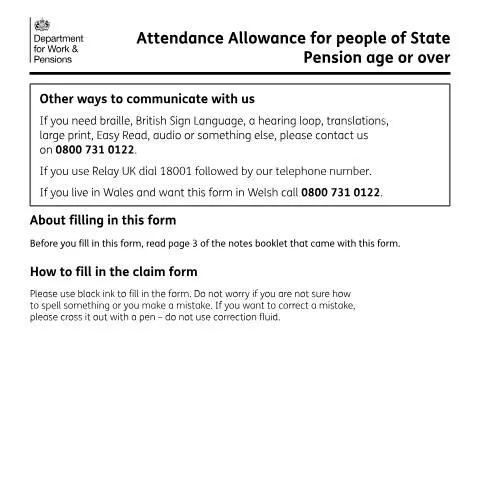
The Attendance Allowance claim form can be submitted through multiple channels, each with different implications for processing times and verification procedures. Postal submission remains the most common route, with forms sent to the DWP's centralised processing centre. The form includes accessibility provisions, mentioning that applicants can request alternative formats including Braille, British Sign Language interpretation, hearing loops, translations, large print, Easy Read, or audio versions by calling the dedicated helpline on 0800 731 0122.
Welsh language support receives specific mention, reflecting the DWP's statutory obligations under Welsh language legislation. Welsh speakers can request forms in Welsh by calling the same helpline number, ensuring that language barriers don't prevent access to this crucial support.
Once submitted, the application enters a structured assessment process that typically involves medical evidence gathering, potential telephone contact for clarification, and in some cases, face-to-face assessments. The DWP aims to make decisions based on the written application and medical evidence where possible, but complex cases or unclear care needs may require additional assessment.
Decision Timeframes and Communication
Standard applications typically receive decisions within several weeks, though complex cases or those requiring extensive medical evidence gathering may take longer. The DWP communicates decisions in writing, providing detailed explanations for both awards and refusals. Successful applications result in benefit payments backdated to the date of claim, providing financial recognition that care needs existed from the application date.
For applications claiming under special rules, the DWP prioritises processing to provide financial support as quickly as possible during difficult circumstances. These fast-track procedures recognise that terminally ill individuals and their families need certainty about financial support without lengthy administrative delays.
Rights of Challenge and Administrative Recourse
The Attendance Allowance decision process includes built-in challenge mechanisms for applicants who disagree with initial decisions. The mandatory reconsideration process allows applicants to request that the DWP reviews their decision using the same evidence or additional information that supports their care needs. This internal review process often resolves disputes without requiring tribunal proceedings.
During mandatory reconsideration, applicants can provide additional medical evidence, more detailed care need descriptions, or corrections to factual errors in the original assessment. The DWP must complete this reconsideration within a specified timeframe and provide written explanations for any decision to maintain the original outcome.
If mandatory reconsideration doesn't resolve the dispute, applicants retain the right to appeal to an independent tribunal. These tribunals include medical professionals and disability specialists who can reassess care needs based on all available evidence. Tribunal appeals often succeed where applicants can demonstrate that their care needs were inadequately understood or assessed during the initial decision process.
Ongoing Obligations and Review Cycles
Successful Attendance Allowance awards aren't necessarily permanent. The DWP operates review cycles to ensure that benefits continue to match care needs, particularly for conditions that might improve or deteriorate over time. Review frequencies vary based on the nature of health conditions—progressive conditions like dementia might receive longer award periods, while conditions with potential for improvement face more frequent reviews.
During reviews, recipients must provide updated information about their care needs and health conditions. The review process essentially mirrors the initial application, requiring detailed descriptions of current care requirements and medical professional involvement. Recipients should prepare for reviews by maintaining records of care needs and medical appointments, ensuring they can demonstrate continued eligibility when reviews occur.