When Childhood Disability Demands Urgent Support: Navigating the DLA Child Claim Process
For families facing the daily reality of caring for a child with substantial disabilities, Disability Living Allowance (DLA) for children under 16 represents far more than a monthly payment—it's recognition of extraordinary care needs and a lifeline that can transform how families manage complex medical routines, mobility challenges, and round-the-clock supervision requirements. The Department for Work and Pensions administers this non-means-tested benefit through a comprehensive 40-page claim form that delves deep into the practical realities of how disability affects a child's daily life.
Unlike many other benefits, DLA for children acknowledges that some youngsters require substantially more help than their peers of the same age, whether due to physical disabilities, learning difficulties, behavioural conditions, or complex medical needs. The claim form serves as the primary gateway to accessing this support, but its detailed questioning style often catches families off guard—particularly those dealing with invisible disabilities or fluctuating conditions that don't fit neat categories.
The Special Rules Pathway: When Time Cannot Wait
The form immediately presents a crucial fork in the road through its special rules provision. Question 01 asks whether you're claiming for a child under special rules—a fast-track process reserved for children with terminal illnesses who are not expected to live longer than 12 months. This isn't merely an administrative convenience; it represents a fundamental shift in how the claim is processed.
Children qualifying under special rules bypass the standard care component questions (questions 54 to 72) entirely. The Department for Work and Pensions recognises that families facing such circumstances shouldn't navigate lengthy assessments about daily living needs when every moment counts. Instead, they automatically receive the highest rate of care component, with decisions typically made within days rather than the standard processing timeframe.
The SR1 medical form becomes critical here. While families can submit their DLA claim immediately, they must also ensure their child's doctor or specialist completes form SR1, which provides the medical evidence required under special rules. The form specifically advises that waiting for the SR1 could delay payments, so families should submit their claim first, then follow up with the medical evidence as quickly as possible.
Decoding the Child's Identity: More Than Basic Demographics
The "About the child" section appears straightforward but contains several administrative tripwires that can complicate processing. The requirement to use BLOCK CAPITALS for the child's name isn't stylistic preference—it ensures accurate data entry into DWP systems and prevents delays caused by misread handwriting.
Question 05 regarding the National Insurance number often puzzles parents, as children under 16 typically don't possess NI numbers. The form acknowledges this reality by explicitly stating to leave this section blank if unknown, with a reference to page 8 of the accompanying information booklet for clarification. This detail matters because some parents assume they need to apply for an NI number first, potentially delaying their claim unnecessarily.
The nationality question (09) extends beyond simple citizenship status. The form specifies recording nationality "as shown on their passport or legal documents," which becomes particularly relevant for children born in the UK to non-British parents, or those with dual citizenship. This information links directly to residence and presence tests that determine benefit eligibility.
Residency Rules and Cross-Border Complications
Questions 10 through 17 navigate the complex territory of residency requirements, reflecting post-Brexit benefit entitlements and devolved administration across the UK. The Swiss/EEA national question (10) specifically references the pre-Brexit cutoff date of 1 January 2021, establishing different rules for families who were resident before this date versus those who arrived afterwards.
| Residency Scenario | Key Consideration | Required Evidence |
|---|---|---|
| Scottish child moving to England/Wales | Must have moved since 1 July 2021 | Date of move (Question 13) |
| Recent arrival in Great Britain | Movement within last 3 years | Arrival date and passport number |
| EEA national pre-2021 | Established residence rights | Residence documentation |
| Child Disability Payment overlap | Cannot claim both benefits | Declaration of existing claims |
The Scotland-England/Wales distinction reflects the fact that Scotland administers its own Child Disability Payment, replacing DLA for new Scottish residents. Question 12 specifically targets children who moved from Scotland after 1 July 2021, when this devolved benefit launched. Families attempting to claim both benefits face automatic rejection, making accurate completion of these residency questions essential.
Understanding the Two-Component Architecture
DLA for children operates through two distinct components: care component (addressing help with daily living activities) and mobility component (covering movement and supervision needs). Unlike adult disability benefits that often focus on work capability, DLA for children recognises that disability creates additional care needs compared to other children of the same age.
The care component acknowledges various support needs: help with bodily functions, supervision to avoid substantial danger, and overnight watching requirements. Crucially, it doesn't require the child to be physically unable to perform tasks—a child with severe learning difficulties might physically walk but need constant supervision outdoors, qualifying for mobility component support.
The mobility component splits into higher and lower rates. The higher rate applies to children who cannot walk or whose walking ability is severely restricted, typically from age 3 onwards. The lower rate covers children who can walk but need supervision or guidance when outdoors due to learning difficulties, behavioural problems, or conditions affecting their awareness of danger.
Age Thresholds and Assessment Variations
Different components have varying age requirements that reflect developmental expectations. The mobility component generally applies from age 3, recognising that younger children naturally require adult supervision. However, children with severe mobility impairments might qualify earlier if their needs clearly exceed normal toddler dependency.
For the care component, assessments compare the child's needs against typical development milestones. A 10-year-old requiring help with washing and dressing might qualify, whereas the same needs in a 3-year-old would be considered age-appropriate. This comparative approach means that claims require detailed explanation of how the child's needs differ from their peers.
The Critical Role of Supporting Evidence
While the claim form captures the family's perspective on their child's needs, supporting evidence provides the clinical foundation for decision-making. The form references page 7 of the information booklet for evidence requirements, but families often underestimate the breadth of documentation that strengthens their case.
Medical evidence extends beyond consultant letters to include physiotherapy reports, occupational therapy assessments, educational psychologist evaluations, and school care plans. For children with fluctuating conditions, care diaries documenting good and bad periods prove invaluable, particularly for conditions like epilepsy, autism spectrum disorders, or chronic fatigue syndrome where needs vary significantly.
Educational evidence carries particular weight because schools observe children in structured environments with peer comparison readily available. Statements of Special Educational Needs, Education Health and Care Plans, or even detailed letters from SENCOs (Special Educational Needs Coordinators) provide independent professional perspectives on the child's support requirements.
Timing Evidence Submission
The form advises against delaying submission while gathering evidence, particularly emphasising this point for special rules claims. DWP can make decisions on incomplete applications but may request additional information, potentially extending processing times. The strategic approach involves submitting the claim promptly with available evidence, then forwarding additional documentation as it becomes available.
Practical Completion Strategies and Common Pitfalls
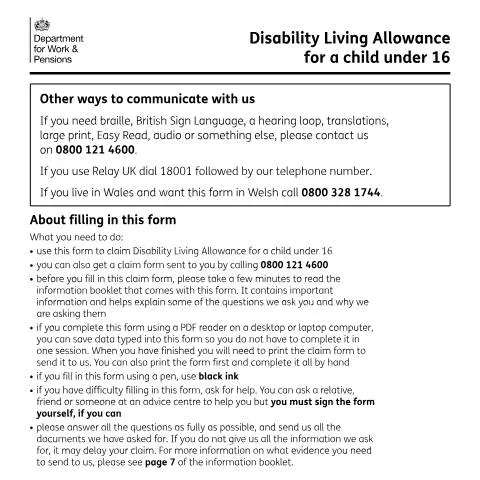
The form's digital completion option offers significant advantages beyond convenience. Using a PDF reader on a computer allows families to save progress and return to incomplete sections—crucial when gathering detailed information about complex medical histories or consulting with multiple healthcare professionals. The requirement to print and post the completed form maintains security standards while accommodating families who prefer digital preparation.
For handwritten completion, the black ink requirement ensures optical character recognition systems can process the form accurately. This technical specification prevents delays caused by unclear scanning or manual data entry errors.
The form explicitly addresses assistance with completion, acknowledging that families dealing with childhood disability often feel overwhelmed by bureaucratic processes. While friends, relatives, or advice centre workers can provide help, the legal requirement remains that the claimant (typically a parent or guardian) must sign the form personally if they are capable of doing so.
Information Completeness and Delay Prevention
The form's emphasis on providing complete information reflects DWP processing realities. Incomplete applications trigger correspondence requesting missing details, extending processing times significantly. For families already managing complex care routines, these delays can create additional stress and financial pressure.
The reference to "page 7 of the information booklet" for evidence requirements isn't casual guidance—it's essential reading that details specific documentation types that support different aspects of the claim. Families who invest time in understanding these requirements before submission typically experience smoother processing.
After Submission: Decision Making and Next Steps
Once submitted, the DLA child claim enters a assessment process that typically takes 8-12 weeks for standard applications, though special rules claims receive priority processing. The Department for Work and Pensions may contact healthcare professionals directly, request additional evidence, or arrange face-to-face assessments, though the latter remains relatively uncommon for children's claims.
The decision notification explains not only whether the claim succeeds, but also details the specific component rates awarded and the reasoning behind the decision. Understanding this breakdown proves crucial if families need to challenge the decision through mandatory reconsideration or tribunal appeal processes.
Successful claims typically result in backdated payments to the date of application, providing families with a lump sum covering the processing period. However, the ongoing monthly payments represent the real value—providing predictable income that families can use for disability-related expenses, from specialist equipment to increased heating costs or additional childcare support.
The text message confirmation service mentioned in the form provides peace of mind for anxious families, confirming that their application has reached DWP systems. Given the sensitive nature of the information and the importance of the benefit to family finances, this simple acknowledgment can significantly reduce stress during the waiting period.
For families whose children approach their 16th birthday while claiming DLA, transition planning becomes essential. The form represents the final opportunity to access DLA for children, as 16-year-olds must apply for Personal Independence Payment instead—a process with different criteria and assessment methods that requires separate preparation and understanding.
Understanding the Assessment Process and Decision Timeline
The DLA assessment process for children involves several distinct stages that can significantly impact both the timeline and outcome of your claim. Unlike adult disability benefits that may require face-to-face assessments, DLA for children under 16 relies primarily on the written evidence you provide in your claim form and supporting documentation.
Once DWP receives your completed claim form, a specialist decision maker trained in childhood disability assessments will review your case. This individual examines not only your responses but also any medical evidence, school reports, and professional assessments you've submitted. The decision maker may contact your child's healthcare providers directly for additional information, though they should inform you if they intend to do this.
Processing times can vary considerably depending on the complexity of your child's condition and the quality of evidence provided. Straightforward cases with clear medical documentation might be processed within 8-12 weeks, whilst more complex situations involving multiple conditions or where additional evidence is required could take several months. During peak periods or when DWP experiences staffing challenges, even routine claims may face delays.
If the decision maker requires clarification about specific aspects of your child's care needs, they may send a follow-up questionnaire or request additional medical evidence. This doesn't necessarily indicate problems with your claim—it's often a standard part of ensuring they have sufficient information to make an accurate assessment. However, failing to respond promptly to these requests can significantly delay your claim or even result in refusal due to insufficient information.
The decision notification will arrive by post and includes detailed reasoning for the outcome. If your claim is successful, the letter specifies which components have been awarded (care, mobility, or both), the rate for each component (lowest, middle, or highest for care; lower or higher for mobility), and the effective start date for payments. This start date is typically the date DWP received your claim form, provided it was submitted within the required timeframe after initially expressing interest in claiming.
Should your initial claim be refused, the decision letter explains the reasons and outlines your right to request a mandatory reconsideration. This is a crucial first step before any appeal to an independent tribunal, and you have one month from the decision date to request this review. During mandatory reconsideration, a different decision maker examines your case afresh, considering any additional evidence you provide alongside your original claim.
Navigating Complex Medical Conditions and Multiple Disabilities
Children with multiple conditions or complex medical needs require particularly careful consideration when completing the DLA claim form. The cumulative impact of several conditions often creates care and mobility needs that exceed what might be expected from any single diagnosis, and the claim form must effectively communicate this reality to decision makers.
When describing conditions that interact with each other, focus on the practical daily consequences rather than listing medical terms. For instance, a child with both autism and epilepsy may need constant supervision not just because of seizure risk, but because their autism affects their ability to recognize and communicate about early seizure symptoms. Similarly, a child with cerebral palsy and learning difficulties may need help with mobility not just due to physical limitations, but because they cannot safely navigate their environment independently.
Fluctuating conditions present particular challenges in DLA applications. Conditions such as juvenile arthritis, Crohn's disease, or certain mental health conditions can vary dramatically from day to day or week to week. The key is describing your child's needs on their worst days while also explaining how frequently these occur. Decision makers need to understand that even if your child has some 'good days,' their overall care and mobility needs remain significantly above those of other children their age.
For children with rare conditions, providing comprehensive medical evidence becomes even more critical. Decision makers may be less familiar with unusual diagnoses, so clear explanations from specialists about how the condition affects daily functioning are essential. If your child's condition has no standard treatment pathway or if they're participating in clinical trials, this information helps decision makers understand the severity and ongoing nature of their needs.
Mental health conditions in children require particularly sensitive handling in DLA applications. While the form asks about physical care needs, children with conditions such as severe anxiety, depression, or eating disorders often require intensive supervision and support that may not be immediately obvious. For example, a child with severe OCD might need constant reassurance and supervision during routine activities, whilst a child with an eating disorder requires careful monitoring during all meals and may need encouragement or assistance with basic nutrition.
Developmental conditions such as autism spectrum disorders or ADHD affect children differently at various ages and stages. What might seem like typical toddler behavior in a three-year-old becomes concerning when the same behaviors persist in a seven-year-old. The claim form should reflect not just current needs but also explain why these needs are significantly greater than expected for your child's chronological age and are likely to continue.
Maximizing Success Through Strategic Evidence Gathering
Building a compelling DLA claim requires systematic evidence gathering that goes beyond basic medical records. The most successful claims present a comprehensive picture of your child's daily reality through multiple perspectives and types of documentation.
Professional evidence forms the backbone of strong DLA claims, but not all professional input carries equal weight. Consultant reports and specialist assessments typically carry more influence than GP letters, particularly when they specifically address functional limitations rather than just confirming diagnoses. When requesting professional support, ask specifically for information about how your child's condition affects their daily activities, mobility, and need for supervision compared to other children of the same age.
Educational evidence provides crucial insight into your child's functioning in structured environments. Special Educational Needs Coordinators (SENCOs), teachers, and teaching assistants can provide detailed observations about your child's needs during school hours. This might include information about toilet assistance, help with eating, supervision requirements, or mobility support needed within the school environment. Educational Health and Care Plans (EHCPs) or statements of special educational needs contain particularly valuable information about recognized support requirements.
Therapy reports from occupational therapists, physiotherapists, speech and language therapists, or behavioral specialists offer professional perspectives on your child's functional abilities and support needs. These professionals often have specific expertise in assessing daily living skills and can provide detailed information about why your child requires more help than their peers.
Maintaining detailed care diaries strengthens your application significantly, though they need not be lengthy novels. Focus on recording specific incidents that illustrate your child's needs—times when they required help that other children their age wouldn't need, safety incidents that demonstrate supervision requirements, or examples of the extra time and effort required for routine activities. Even a week's worth of detailed entries can provide powerful evidence of daily care requirements.
Photographic evidence can be particularly effective for certain types of claims, especially those involving mobility equipment, home adaptations, or visible aspects of your child's condition. However, ensure any photographs respect your child's dignity and privacy, and only include them if they genuinely add value to your claim.
Witness statements from family members, friends, or other caregivers who regularly spend time with your child can provide additional perspectives on their needs. These should focus on specific observations rather than general statements about difficulty, and ideally come from people who have experience with other children of similar ages for comparison.
When organizing evidence, create a clear summary sheet that cross-references different pieces of evidence with specific sections of your claim form. This helps ensure consistency across your application and makes it easier for decision makers to locate relevant supporting information. Remember that decision makers may have limited time to review each claim, so well-organized, clearly relevant evidence is more likely to be thoroughly considered than large volumes of general medical records.