When Industrial Lung Disease Claims Meet Government Support
Each year, thousands of workers and their families face the devastating reality of asbestos-related lung diseases. The mesothelioma payment claim form represents a critical lifeline for those whose exposure to industrial dusts has resulted in life-threatening conditions. Unlike standard benefits applications, this specialised claim form addresses the unique circumstances of occupational lung disease sufferers, providing access to compensation even when traditional legal avenues have failed.
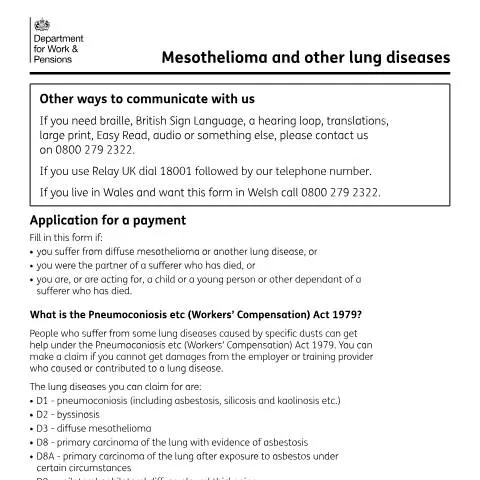
The Department for Work and Pensions administers two distinct compensation schemes through this single application process: the Pneumoconiosis etc (Workers' Compensation) Act 1979 and the 2008 Diffuse Mesothelioma Scheme. Each scheme serves different circumstances, yet both recognise the profound impact of workplace dust exposure on workers' health and their families' financial security.
The Six Qualifying Lung Diseases Under Government Compensation
Not every respiratory condition qualifies for these specialised payments. The legislation specifically covers six distinct lung diseases, each with precise medical definitions and diagnostic codes that must be evidenced in your application.
Primary Conditions Covered
| Disease Code | Condition | Key Characteristics |
|---|---|---|
| D1 | Pneumoconiosis | Includes asbestosis, silicosis, and kaolinosis |
| D2 | Byssinosis | Cotton, flax, or hemp dust exposure |
| D3 | Diffuse mesothelioma | Aggressive cancer affecting lung lining |
| D8 | Primary lung carcinoma | With evidence of asbestos exposure |
| D8A | Primary lung carcinoma | After specific asbestos exposure circumstances |
| D9 | Diffuse pleural thickening | Unilateral or bilateral lung membrane scarring |
The distinction between these conditions matters significantly for your claim. Diffuse mesothelioma cases, for instance, may qualify under both schemes depending on whether workplace exposure can be proven, whilst other conditions typically fall under the 1979 Act provisions only.
Medical Evidence Requirements
Your medical diagnosis must be formally documented by recognised healthcare professionals. The Department accepts evidence from consultants, hospital doctors, or specialist nurses within lung cancer networks. A simple GP letter stating suspicion of the condition will not suffice – you need definitive diagnostic confirmation including the date of diagnosis.
Navigating Two Compensation Routes Through One Application
The genius of this application system lies in its ability to assess your eligibility across both compensation schemes simultaneously. However, the pathways differ significantly in their requirements and qualifying criteria.
The Pneumoconiosis etc (Workers' Compensation) Act 1979 Route
This established scheme requires demonstrable workplace causation. You must prove that your lung disease resulted from employment or approved training where dust exposure occurred. Crucially, several conditions must align:
- You're entitled to Industrial Injuries Disablement Benefit for the specified lung disease
- No court action for damages has been initiated or settled regarding the condition
- Your employer or training provider has either ceased trading or cannot realistically provide compensation
- The harmful work exposure occurred more than 20 years ago
The 20-year rule recognises that lung diseases often develop decades after initial exposure, protecting claimants from being disadvantaged by the passage of time.
The 2008 Diffuse Mesothelioma Scheme Alternative
This more recent scheme specifically addresses diffuse mesothelioma cases where workplace causation cannot be established or where the 1979 Act conditions aren't met. It provides a single lump-sum payment without requiring proof of occupational exposure, acknowledging that mesothelioma almost exclusively results from asbestos contact, whether occupational or environmental.
Under this scheme, you complete different sections of the same form – specifically the About you section (questions 1-11), About the disease section (questions 30-38), and Compensation and court action section (from question 75). The Department then determines whether you qualify for this alternative compensation route.
Critical Timing Rules That Determine Your Claim's Validity
Time limits operate differently across both schemes, and understanding these deadlines can mean the difference between receiving compensation and losing your right to claim entirely.
The 12-Month Windows
Both schemes impose strict 12-month application deadlines, but the trigger dates differ:
- For 1979 Act claims: 12 months from when you become entitled to Industrial Injuries Disablement Benefit
- For 2008 Scheme claims: 12 months from your formal diagnosis date
The Department emphasises that applications should be submitted "as soon as you know that you have a lung disease". Late applications face potential rejection, though exceptional circumstances may occasionally be considered.
Recovery of Payments
A crucial consideration affects your decision-making timeline: if you subsequently receive other compensation for the same condition, the Department may recover money paid under these schemes. This recovery right protects public funds whilst ensuring you don't receive double compensation for the same injury.
Who Can Submit Claims Beyond the Primary Sufferer
Lung diseases covered by these schemes are often fatal, and the legislation recognises that family members may need to pursue claims after a patient's death. The application process accommodates three distinct categories of potential claimants.
Partner Claims After Bereavement
If someone dies from a qualifying lung disease without having claimed compensation, their partner can submit a posthumous application. The partner must act within 12 months of the death date and include a death certificate with their application. This provision acknowledges both the emotional trauma of bereavement and the practical reality that many patients may be too unwell to complete applications before death.
Dependent Children and Young People
Claims can also be made on behalf of dependent children or young people who have lost a parent to these conditions. The application process recognises that financial hardship often follows the death of a wage-earning parent, particularly when the death results from occupational disease exposure that occurred decades earlier.
Acting on Behalf of Others
The form accommodates situations where individuals act for sufferers who cannot complete applications themselves due to their medical condition. This might include family members, carers, or legal representatives managing affairs for someone whose illness prevents them from handling complex paperwork.
Practical Application Completion and Submission Process
The mesothelioma payment claim form requires careful completion in black ink using capital letters – a seemingly minor detail that reflects the form's processing through optical character recognition systems. The Department provides comprehensive support for applicants struggling with the paperwork demands.
Support Services During Application
Recognising that applicants often face serious illness or bereavement, the Department offers extensive accessibility support. The freephone number 0800 279 2322 provides assistance for those needing braille, British Sign Language interpretation, hearing loops, translations, large print formats, Easy Read versions, or audio alternatives. Welsh speakers can request forms in Welsh through the same number.
Relay UK users can access services by dialling 18001 followed by the Department's telephone number, ensuring communication barriers don't prevent legitimate claims from being processed.
Submission to Barnsley Processing Centre
All completed applications must be posted to the specialist Industrial Injuries Disablement Benefit office in Wolverhampton:
Barnsley Industrial Injuries Disablement Benefit office Mail Handling Site A Wolverhampton WV98 1SY
This centralised processing ensures specialist staff familiar with occupational lung disease claims handle your application. The same office manages both scheme applications, streamlining the assessment process regardless of which compensation route ultimately applies to your circumstances.
Medical Evidence Standards and Professional Documentation
The strength of your medical evidence often determines your claim's success. The Department requires specific types of professional documentation that go beyond basic GP records or hospital discharge summaries.
Acceptable Medical Professionals
Evidence must come from qualified healthcare professionals with appropriate expertise in respiratory conditions. The Department specifically accepts documentation from:
- Hospital consultants specialising in respiratory medicine or oncology
- Specialist nurses working within lung cancer networks
- Doctors with recognised expertise in occupational lung disease
- Medical practitioners involved in formal diagnostic processes
The medical evidence must clearly state your diagnosis and the date when it was confirmed. Provisional diagnoses or suspected conditions don't meet the evidential threshold – you need definitive confirmation of one of the six qualifying lung diseases.
Additional Documentation for Complex Cases
Some applications require supplementary evidence beyond basic medical confirmation. If you're claiming under the 1979 Act, you may need employment records, training course documentation, or historical workplace safety reports to establish the occupational link. Death certificates become essential for posthumous claims, whilst proof of dependency relationships may be required for children's claims.
Understanding Payment Outcomes and Further Compensation Rights
Successful applications result in lump-sum payments rather than ongoing benefits, reflecting the schemes' design as compensation for industrial injury rather than welfare support. However, receiving these payments doesn't necessarily close all compensation avenues.
The Department retains recovery rights if you subsequently receive other compensation for the same lung disease. This might occur through successful civil litigation against former employers, insurance settlements, or other compensation schemes. The recovery provision ensures public funds aren't used to provide duplicate compensation whilst preserving your right to pursue all legitimate compensation sources.
For many families facing terminal diagnoses, these government schemes provide crucial financial support during extremely difficult circumstances. The application process, whilst detailed, recognises the unique challenges faced by industrial lung disease sufferers and their families, offering both practical support and financial recognition of the workplace exposures that caused their conditions.
Understanding the Medical Evidence Requirements for Your Claim
The strength of your mesothelioma compensation claim fundamentally depends on comprehensive medical documentation that establishes both your diagnosis and the link to asbestos exposure. The Diffuse Mesothelioma Payment Scheme requires specific types of medical evidence, and understanding these requirements can significantly impact your claim's success rate and processing timeline.
Your primary medical evidence must include a definitive histological diagnosis of diffuse mesothelioma from a consultant pathologist. This typically involves tissue samples obtained through procedures such as thoracoscopy, CT-guided biopsy, or surgical resection. The pathology report should clearly state the mesothelioma subtype—epithelioid, sarcomatoid, or biphasic—as this information may influence compensation calculations and treatment planning.
Imaging studies play a crucial supporting role in your medical evidence portfolio. High-resolution CT scans of the chest and abdomen provide detailed visualisation of pleural thickening, effusions, and tumour extent. These scans often reveal characteristic patterns that support the mesothelioma diagnosis and may show evidence of asbestos-related pleural plaques, which strengthen the occupational exposure connection.
Occupational health records, where available, can provide invaluable supporting evidence. If you worked in high-risk industries such as shipbuilding, construction, or manufacturing, employment records showing your job titles, duties, and workplace locations help establish probable asbestos exposure pathways. Trade union records, apprenticeship certificates, and pension documentation may also contain relevant occupational history details.
Medical professionals completing your supporting documentation should include detailed exposure histories in their reports. Respiratory specialists and occupational health physicians are particularly well-positioned to comment on the likely causal relationship between your documented workplace activities and subsequent mesothelioma development, given the established latency periods of 20-50 years for asbestos-related diseases.
When gathering medical records, ensure you obtain complete documentation from all treating hospitals and specialists. Private healthcare records, NHS treatment summaries, and consultant correspondence should all form part of your evidence package. If you've received treatment at multiple centres, coordinate with each facility to ensure comprehensive record collection, as incomplete medical documentation frequently causes claim delays.
Navigating Complex Exposure Scenarios and Multi-Defendant Claims
Many mesothelioma cases involve complex exposure scenarios where multiple employers, premises, or products contributed to asbestos contact over extended periods. Understanding how the compensation system addresses these multi-factorial exposure situations is essential for maximising your claim outcome and ensuring all responsible parties are properly identified.
The legal principle of joint and several liability applies to mesothelioma cases, meaning that any employer who materially contributed to your asbestos exposure may be held fully liable for your damages, regardless of the proportion of their contribution. This principle becomes particularly important when some former employers have ceased trading or lack adequate insurance coverage, as remaining defendants may bear increased liability.
Secondary exposure claims present unique challenges and opportunities within the compensation framework. If you developed mesothelioma through exposure to asbestos fibres brought home on a family member's work clothing, specific legal precedents support your right to compensation. These cases require detailed documentation of the primary worker's employment history, their typical work practices, and evidence of domestic exposure patterns such as washing contaminated clothing.
Environmental exposure scenarios, while less common, may qualify for compensation under certain circumstances. Living near asbestos processing facilities, attending schools with asbestos-containing materials, or residing in properties with significant asbestos contamination can potentially establish liability. These cases often require expert environmental assessment and detailed historical research into local industrial activities.
When multiple insurance companies are involved, coordination between insurers can affect claim processing timelines and settlement negotiations. The Employers' Liability Tracing Office (ELTO) database helps identify relevant insurance policies, but complex corporate structures, company mergers, and historical policy transfers may require specialist legal assistance to navigate effectively.
Product liability claims against asbestos manufacturers present additional complexity layers. If your exposure involved specific asbestos-containing products such as gaskets, brake linings, or insulation materials, identifying the manufacturers and their current corporate status requires specialist knowledge. Many original manufacturers have established trust funds specifically for asbestos claims, which may provide alternative compensation routes.
Documentation requirements for complex exposure scenarios typically exceed standard single-employer claims. Detailed workplace descriptions, contemporary safety procedures, witness statements from former colleagues, and expert industrial hygiene assessments may all contribute to establishing liability across multiple defendants. Professional legal representation becomes increasingly valuable as case complexity increases.
Post-Claim Considerations and Ongoing Support Systems
Receiving compensation represents just one aspect of managing mesothelioma's impact on your life and family circumstances. Understanding the broader support ecosystem and planning for ongoing needs ensures you maximise available resources and maintain quality of life throughout your treatment journey.
Tax implications of mesothelioma compensation vary depending on the payment structure and your individual circumstances. Lump-sum damages for pain, suffering, and loss of amenity are typically tax-free, but ongoing periodic payments for loss of earnings may have different tax treatments. Consulting with a qualified accountant familiar with personal injury compensation can help optimise your financial position and avoid unexpected tax liabilities.
Benefits interaction requires careful consideration to prevent inadvertent overpayments or benefit suspensions. Large compensation awards may affect means-tested benefits such as Universal Credit, Housing Benefit, or Council Tax Support. However, certain compensation elements, particularly those for pain and suffering, may be disregarded for benefit calculation purposes. The DWP provides specific guidance on how personal injury compensation affects benefit entitlements.
Specialist mesothelioma support organisations offer comprehensive assistance beyond financial compensation. Mesothelioma UK provides clinical nurse specialists who coordinate care pathways, offer treatment guidance, and provide emotional support throughout your journey. These services complement NHS provision and can help navigate complex treatment decisions and clinical trial opportunities.
Estate planning considerations become particularly important given mesothelioma's prognosis. Ensuring your will reflects your compensation award, considering inheritance tax implications, and establishing appropriate trusts for surviving family members requires specialist legal and financial advice. Powers of attorney documentation may also need updating to reflect changed circumstances and increased asset values.
Family support extends beyond immediate financial provision to encompass psychological counselling, practical assistance, and long-term planning. Many compensation settlements include provision for family counselling services, domestic help, and adaptations to family homes to accommodate changing mobility needs. Understanding these available supports helps ensure comprehensive care planning.
Treatment funding represents another crucial consideration area. While NHS treatment remains free at the point of delivery, private treatment options, experimental therapies, or overseas treatment programmes may require significant financial investment. Compensation awards can provide the resources necessary to pursue all available treatment options, potentially extending survival and improving quality of life.
Regular financial review becomes essential as circumstances change throughout your treatment journey. Treatment costs, care needs, and family circumstances may evolve significantly, requiring adjustments to financial planning and resource allocation. Professional financial advice specifically tailored to serious illness circumstances can help maintain financial security and treatment access throughout your journey.