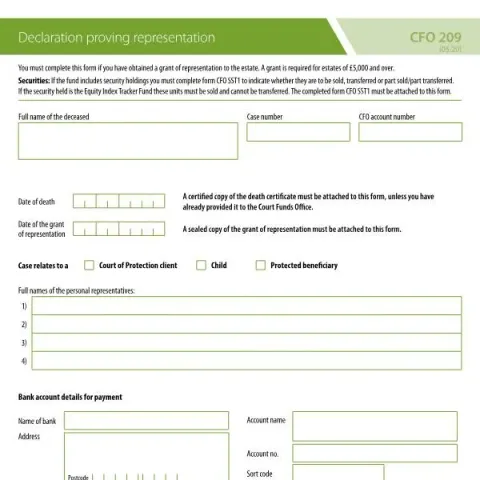
Navigating the Court Funds: The Declaration Proving Representation
Imagine this: you've recently faced the immense task of managing a loved one’s estate following their passing. As a personal representative, you must ensure that all legal requirements are met, including submitting the essential Declaration Proving Representation to the Ministry of Justice’s Court Funds Office. This document plays a crucial role in the administration of the deceased's estate, particularly if the estate is valued at £5,000 or more.
Understanding the Unique Role of the Declaration in Estate Management
At first glance, you might confuse the Declaration Proving Representation with similar forms such as the Grant of Representation. However, this declaration serves a distinct purpose. Specifically, it is a key document confirming the appointment of the personal representative and their authority to manage the deceased's financial assets.
While the Grant of Representation approves the personal representative's status, the declaration provides official recognition for the distribution of funds held within court. Its significance becomes apparent when you consider the implications of estate management and the legal responsibilities that come with it.
The Importance of Accurate Filing
Completing this document accurately is not simply a procedural formality; it's vital for the timely release of funds. If errors occur or information is missing, it could lead to delays in accessing necessary resources for the beneficiaries. For instance, without a proper declaration, access to funds may be stalled for weeks or even months, complicating the settlement of debts and distribution among heirs.
Breaking Down the Form: Key Sections and Common Pitfalls
The CFO 209 form requires several pieces of information that must be filled out with precision to avoid issues down the line. Here’s a detailed look at each section.
Personal Details of the Deceased
- Full Name of the Deceased: Ensure the spelling matches the death certificate.
- Date of Death: This must correspond with official records.
Personal Representatives Information
Here, you will provide the full names of all personal representatives, which are those appointed to handle the deceased's estate.
- Names: If multiple representatives are involved, ensure that the information for each is complete and accurate.
- Signature Requirement: The form requires the personal representative's signature, which must be witnessed by an eligible professional.
Grant of Representation
In this section, you need to include details of the grant obtained. This can be a sealed copy that should be attached to the declaration form.
- Date of Grant: Ensure this matches the document you received from the court.
- Case Number: Essential for tracking your application.
Bank Account Details
Specify the bank account to which funds are to be transferred. High accuracy is crucial here.
- Account Name: This must reflect the name of the personal representative or the estate.
- Account Number and Sort Code: Double-check for accuracy to prevent payment issues.
Witness Signature
One critical aspect of the form is the witness signature. The witness must be someone of standing in the community, not a relative of the payee. Ensure you select an appropriate witness.
- Acceptable Witnesses: This can include professionals such as doctors, lawyers, or social workers.
- Sign and Date: The witness must sign and date the form in your presence as a verification of identity.
When Things Go Wrong: Addressing Refusals and Missing Information
Even with careful attention to detail, it is possible for an application to be refused due to minor errors or omissions. Here’s what to do if you encounter issues:
Responding to a Refusal
- Review the Rejection Notice: The Court Funds Office will provide a detailed description of why your application was not accepted.
- Correcting Errors: If the refusal stems from clerical errors, promptly rectify them and resubmit the form.
Missing Information
If your application lacks vital information, you'll need to gather what’s missing before reapplying. This can include:
- Certified copies of required documents (like the death certificate).
- Additional signatures if more than one representative is involved.
Timelines: From Submission to Payment
Understanding the timeline associated with your declaration is crucial for planning. Here's how the process typically unfolds:
Submission Timeline
Once you submit the CFO 209 form, the Court Funds Office initiates a review process. Generally, you can expect:
- Initial Review: 4 to 6 weeks for processing.
- Payment Processing: Once approved, funds typically will be transferred within an additional 2 weeks.
Potential Delays
If the office requests additional information, this can extend the timeline significantly. Always respond as quickly as possible to avoid undue delays.
How to Submit Your Declaration: Channels and Guidelines
The method of submission can affect both the speed and efficiency of the process. Here’s an outline of your options:
Online Submission
While not all forms can be submitted online, checking the Ministry of Justice website is advisable for updates. An online submission can expedite responses.
Postal Submission
Submitting via post is the traditional route:
- Address: Send your completed CFO 209 to the Court Funds Office at Sunderland SR43 3AB.
- Tracking: Always send your application via a trackable service to ensure it arrives safely.
In-Person Submission
If you prefer face-to-face interaction or have questions, visiting in person might be beneficial. However, appointments are often necessary, so check ahead.
The Administrative Handling: Monitoring Your Application
Once your application is submitted, you may wish to keep track of its status. Here’s how:
Contacting the Court Funds Office
- Phone: Use the customer helpline at 0300 0200 199 for quick inquiries.
- Email: For non-urgent matters, consider emailing [email protected].
What to Expect
The Court Funds Office typically provides updates on progress if requested, although response times may vary. Be patient, as the office processes many similar applications.
Preparing Your Supporting Documents: A Checklist
To facilitate a smooth application process, ensure that you have all necessary documentation prepared in advance. Here’s a checklist of what to gather:
Essential Documents| Document | Description | Notes |
|---|---|---|
| Grant of Representation | Sealed copy required | Must be attached to the declaration |
| Death Certificate | Certified copy | Required unless already submitted |
| Bank Details | Account name, number, sort code | Must match the payee's name |
| Witness Signature | From an eligible person | Must not be a relative |
In summary, navigating the Declaration Proving Representation process can be complex, but understanding its significance and adhering to precise guidelines can ensure a smoother experience. Take the time to prepare your documents and seek assistance when needed to facilitate the process of managing a loved one’s estate efficiently.
Understanding Court Funds and Their Management
In the United Kingdom, Court Funds refer to the money held by the Court on behalf of individuals who are unable to manage their funds due to various reasons. These reasons often include mental incapacity or being a minor. The management of these funds falls under the jurisdiction of the Court of Protection, which ensures that the funds are used in the best interest of the person represented. This section will delve into the procedures involved in declaring representation for court funds and the roles of different stakeholders in managing these funds.
Fill in your form directly online
No printing: type your details into the boxes of the official form, tick, then download the PDF ready to send.
- 1Type into the form boxes
- 2Tick in one click
- 3Save and download the PDF
Upon the establishment of a case, individuals must provide proof of representation. This is typically achieved through the submission of a Lasting Power of Attorney (LPA) or a Deputyship Order. An LPA allows one person (the attorney) to make decisions on behalf of another (the donor) concerning their financial affairs. In contrast, a Deputyship Order is granted where an individual does not have the capacity to make decisions, and it appoints a deputy to manage their affairs on their behalf.
To facilitate these processes, applicants should be aware of the necessary documentation required by the Court of Protection. This includes identification documents, evidence of the individual’s incapacity, and a comprehensive outline of how the funds are to be managed and used. Understanding these requirements not only streamlines the process but also ensures compliance with legal obligations set forth by the court.
Navigating the Declaration Process for Court Funds
The declaration process for proving representation in the context of court funds is multifaceted and requires meticulous attention to detail. Initially, individuals must identify the type of representation they are seeking—whether it's through an LPA, Deputyship, or another legal instrument recognized by the Court of Protection.
Once the appropriate representation type has been determined, the individual must complete the relevant application form. For an LPA, this would involve completing the LPA forms (LPA001 for Property and Financial Affairs). For deputyship, the applicant would use Form COP1 to apply to the Court of Protection for an order. Each form requires detailed personal information about both the applicant and the individual they seek to represent.
As part of the application, it is also necessary to submit a declaration regarding the person’s mental capacity. This often involves obtaining a mental health assessment or a report from a qualified medical professional. The court may request additional information or documentation, which may delay the process, so it is crucial to be thorough and forthcoming with all requested details.
Once the application is submitted, the Court of Protection will review the case. If satisfied with the provided documentation and evidence, the court will issue a formal ruling recognizing the representation, allowing the designated individual to manage the funds as outlined in their application. It is essential for the representative to keep accurate and detailed records of all transactions made on behalf of the individual, as these may be scrutinized in subsequent reviews by the court.
Legal and Financial Responsibilities of the Representative
Being appointed as a representative for court funds carries with it significant legal and financial responsibilities. The representative must prioritize the best interests of the individual they are representing, ensuring that all financial decisions are made with care and due diligence. Additionally, they are responsible for keeping accurate records of all financial transactions, which include income and expenses related to the management of the individual’s funds.
The representative is also required to comply with the guidelines set forth by the Court of Protection, which may include submitting annual accounts detailing how the funds have been managed. Failure to adhere to these guidelines could result in legal action, including the removal of the representative or potential penalties. It's crucial for anyone taking on this role to familiarize themselves with their obligations, ensuring that they maintain transparency and accountability in the management of the funds.
Moreover, representatives must be aware of the tax implications associated with managing court funds. Depending on the amount and nature of the income generated from those funds, there may be obligations to file tax returns with HM Revenue and Customs (HMRC). A representative may need to complete a self-assessment tax return (SA100) if the interests or dividends earned exceed the allowances set by HMRC. Keeping abreast of these responsibilities can help prevent unexpected financial liabilities.
Overall, thorough understanding and adherence to the guidelines set by the Court of Protection, coupled with sound financial management, will ensure that the representative can effectively fulfill their duties and protect the financial wellbeing of the individual they represent.