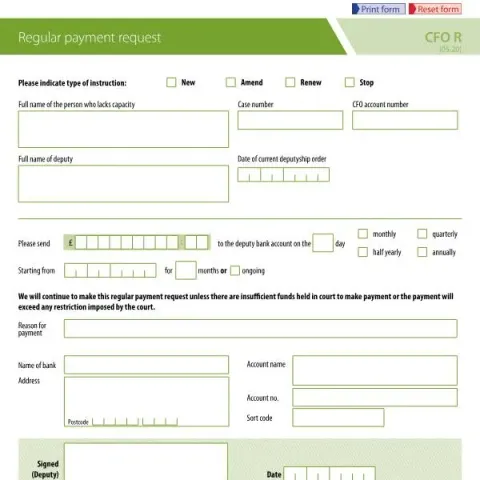
Understanding the Court Funds: Navigating the Regular Payment Request Process
In the complex landscape of legal and financial responsibilities, the Regular Payment Request form stands out as a crucial tool for those managing court-held funds on behalf of individuals unable to manage their own finances. This document is essential for deputies appointed under the Court of Protection, granting them the ability to request regular payments from funds held in court to support the financial needs of the person they represent.
Who Might Engage with the Regular Payment Request?
The Regular Payment Request process is primarily engaged by deputies who have been appointed to manage the affairs of individuals lacking mental capacity. Understanding the characteristics of these users is key:
- Deputies: Individuals designated by the Court of Protection to manage financial and property matters for those who cannot do so themselves.
- Individuals with Mental Capacity Issues: The persons for whom deputies are acting. This may include those with conditions such as dementia, brain injuries, or severe learning disabilities.
- Family Members: In some cases, family members may step in as deputies, especially when they have a close relationship with the incapacitated individual.
Each scenario presents unique circumstances and may affect the specifics of the request process.
The Journey of a Regular Payment Request: From Motivation to Submission
To comprehend the full breadth of the Regular Payment Request, it is essential to follow the chronological journey of a request:
- Identification of Need: A deputy identifies a financial need for the person lacking capacity, be it for healthcare costs, living expenses, or other necessary payments.
- Preparation of the Form: The deputy gathers the necessary information, including bank details and the amount required.
- Submission of the Request: The completed Regular Payment Request form is sent to the Court Funds Office.
- Processing by the Court Funds Office: The office reviews the request to ensure there are sufficient funds and that the payment aligns with court restrictions.
- Notification of Outcome: The deputy receives confirmation regarding the approval or denial of the request.
Connecting the Dots: The Role of the Regular Payment Request within the Wider Framework
The Regular Payment Request does not exist in isolation. It is part of a broader ecosystem of legal and financial measures that protect individuals who lack capacity:
- Deputyship Orders: These are necessary legal documents that empower a deputy to act on behalf of the individual.
- Financial Management: Effective use of the Regular Payment Request is critical for ongoing management of the individual's finances.
- Communication with the Court: Regular updates and transparency are vital in maintaining the court’s confidence in the deputy’s management.
This interconnectedness highlights the importance of understanding not only how to complete the Regular Payment Request but also how it fits into the overall responsibilities of a deputy.
Implications of the Regular Payment Request: Rights and Responsibilities
For deputies, submitting a Regular Payment Request comes with a range of rights and responsibilities:
- Rights:
- The right to access funds necessary for the individual's care and wellbeing.
- The right to receive clear guidance and support from the Court Funds Office.
- Responsibilities:
- Accurate and timely completion of the request form to avoid delays.
- Maintaining transparent records regarding all requests and expenditures.
- Adhering to any restrictions or limitations imposed by the court regarding fund usage.
Failure to adhere to these obligations can lead to significant consequences, including allegations of mismanagement or potential legal repercussions.
Preparing for Submission: Key Information and Documentation
Before submitting the Regular Payment Request, it is crucial to ensure that all relevant information and documentation are prepared and accurate. Here’s what you need to gather:
| Required Information | Details |
|---|---|
| Full Name of the Person Lacking Capacity | As it appears on court documents. |
| Deputy’s Full Name | The individual authorized by the court. |
| Reason for Payment | Clearly state what the funds will be used for. |
| Payment Amount | The specific sum to be withdrawn. |
| Account Details | Bank name, sort code, account number, and account name for the deputy’s bank account. |
| Payment Frequency | Choose from monthly, quarterly, half-yearly, or annually. |
| Start Date | Date from which payments should commence. |
After Submission: What to Expect next?
Once the Regular Payment Request has been submitted, several outcomes may occur:
- Approval: If the request is approved, the Court Funds Office will arrange for the payment to be processed as per the specifications detailed in the request.
- Request for Further Information: If the form is incomplete or lacks necessary justification, the office may reach out for additional details.
- Denial: If there are insufficient funds or the request does not comply with court restrictions, it may be denied, and the deputy will be informed accordingly.
- Ongoing Monitoring: The deputy may be required to provide ongoing updates regarding the use of funds, ensuring compliance with the court’s directives.
Final Thoughts: Navigating the Regular Payment Request with Confidence
Successfully managing the Regular Payment Request process requires a clear understanding of both the procedural and ethical dimensions of acting as a deputy. A well-prepared form, thorough documentation, and a keen awareness of the rights and responsibilities that come with the role can significantly ease the experience. Engaging with the Court Funds Office can provide further clarity and support, ensuring the financial needs of individuals lacking capacity are met with diligence and integrity.
For more specific advice or to address particular queries, deputies can reach out directly to the Court Funds Office at:
Telephone: 0300 0200 199
Email: [email protected]
Address: Court Funds Office, Sunderland, SR43 3AB
Understanding Court Funds: An Overview of Regular Payment Requests
When dealing with court funds in the UK, understanding the process of regular payment requests is crucial. Court funds can arise in various legal situations, often where funds are held on behalf of someone, such as in the case of minors or incapacitated individuals. The funds are typically managed by the Court Funds Office, which is part of HM Courts and Tribunals Service.
Fill in your form directly online
No printing: type your details into the boxes of the official form, tick, then download the PDF ready to send.
- 1Type into the form boxes
- 2Tick in one click
- 3Save and download the PDF
Regular payment requests are specifically designed for individuals who need to access funds regularly from their court-held accounts. This might be relevant in cases where a claimant receives a structured settlement, or where a financial deputy is managing funds for a vulnerable person. In such cases, the applicant needs to ensure they follow proper procedures to access these funds efficiently.
When preparing a request for a regular payment, it is essential to specify the amount and frequency of payments clearly. Additionally, you will need to provide supporting documentation that outlines the need for these payments. This could include evidence of ongoing care costs, living expenses, or other financial commitments that necessitate regular disbursement of funds.
Understanding the nuances of the payment request process can alleviate potential delays or complications. This involves familiarizing oneself with the appropriate forms, such as the 'Form C7' for regular payments, and understanding the timelines involved in processing these requests. Typically, requests can take several weeks to process, so early submission is recommended.
Eligibility Criteria for Regular Payment Requests
Not all individuals entitled to court-held funds automatically qualify for regular payment requests. Understanding the eligibility criteria is crucial to ensure smooth transactions. Generally, you need to meet specific requirements, including:
- Age and Capacity: Applicants must be over the age of 18 unless they are minors represented by a litigation friend. For minors, the request must be made by an authorized adult.
- Legal Status: You must have a recognized legal claim that is acknowledged by the court. This could be due to a personal injury settlement, inheritance, or other legal matters that have resulted in court-held funds.
- Documentation: Provide necessary documentation that clearly states the reason for the regular payment and justifies the amounts requested.
Additionally, circumstances may vary significantly depending on the specifics of your situation. Notably, if you are applying for funds on behalf of someone else, additional requirements may apply to validate your authority to act on their behalf.
Common Challenges and Solutions in Making Regular Payment Requests
While the process of requesting regular payments from court funds is straightforward, applicants often encounter challenges that can complicate their requests. Below are some common issues and potential solutions:
- Incomplete Applications: One of the most common pitfalls is submitting incomplete forms. Ensure that you double-check your application for missing documentation or details. Consider creating a checklist of required documents to avoid overlooking anything important.
- Delays in Processing: Payment requests may experience delays due to high volumes of applications or incomplete submissions. To counter this, always submit your request well ahead of any known financial needs. Following up with the Court Funds Office after a couple of weeks can also help ensure your application is on track.
- Insufficient Justification: If the court finds that your reasons for requesting regular payments are not adequately justified, your request may be denied. To prevent this, provide comprehensive documentation, such as bank statements, receipts, or letters from professionals who can vouch for your financial needs.
By being aware of these challenges and preparing accordingly, you can significantly streamline the process and increase your chances of a successful regular payment request.