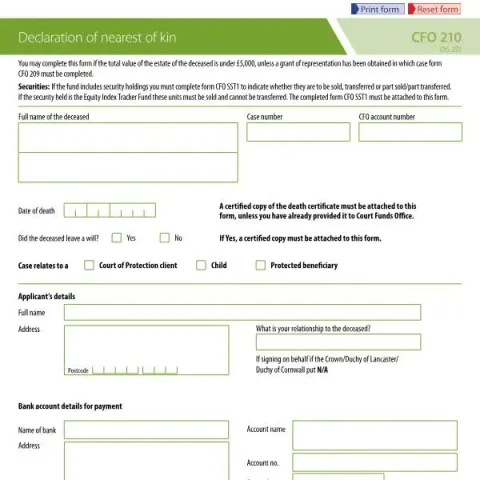
Understanding the Essentials of the Declaration of Nearest of Kin
In the aftermath of a loved one's passing, navigating the complexities of the legal and financial landscape can be daunting. One critical step in this process is submitting the *Declaration of Nearest of Kin* to the Ministry of Justice. This official document plays a vital role in accessing funds held in court when the deceased's estate is valued at less than £5,000. Familiarizing oneself with this form and the accompanying requirements can help streamline the process and alleviate stress during a challenging time.Initiating the Process: Triggering Events and Eligibility
The journey begins when a person passes away, and their estate remains largely unclaimed or undistributed. In such cases, the *Declaration of Nearest of Kin* is the appropriate form when the estate's total value is below the £5,000 threshold and no grant of representation has been obtained. It's essential to first ascertain whether the deceased left a will. If there is a will, a certified copy must accompany the application. On the contrary, if the deceased did not leave a will, the rules of intestacy will govern the distribution of their estate.Who Can Submit the Declaration?
The declaration can be completed by individuals who are considered the nearest of kin to the deceased. This designation typically includes:- Spouse or civil partner
- Children
- Parents
- Siblings
- Other relatives, depending on the family structure
Unpacking the Form: A Guide to Each Section
Completing the *Declaration of Nearest of Kin* requires careful attention to detail and understanding the purpose of each section within the form. Below is a breakdown of the primary components that must be addressed:1. Full Name of the Deceased
Providing the full name of the deceased is foundational. Ensure that the name matches the one on the death certificate and any related legal documents to avoid delays.2. Applicant's Details
This section requires the applicant to furnish their personal details, including:- Full name
- Address (including postcode)
- Date of death of the deceased
3. Relationship to the Deceased
Clearly indicating your relationship to the deceased is essential. This is where clarity matters; misrepresentation may lead to complications. For instance, siblings may need to provide additional proof if there are multiple siblings claiming rights.4. Financial Considerations
When addressing the financial aspects, the applicant must confirm that the total value of the deceased's estate, including the funds held in court, does not exceed £5,000. If the value exceeds this limit, you will need to complete a different form (CFO 209) to seek a grant of representation.5. Bank Details for Payment
An accurate entry of bank account details is crucial for fund disbursement. This section requires:- Name of the bank
- Sort code
- Account name
- Account number
Navigating Additional Requirements
In certain instances, there may be supplementary requirements based on the specifics of the case. Notably:Certified Copies of Documents
You will need to attach a certified copy of the death certificate unless you have already submitted it to the Court Funds Office. It is also necessary to provide a certified copy of the will if applicable. If the deceased's executor has passed away, a certified copy of their death certificate is required as well.Signature and Witnessing
The form must be signed in the presence of a witness. The roles of acceptable witnesses are clearly delineated, including:- Commissioners for Oaths
- Practicing solicitors
- Justices of the Peace
- Circuit judges or district judges
What Happens Next? The Path Forward After Submission
Once the *Declaration of Nearest of Kin* is completed and submitted to the Court Funds Office, the next stages are crucial:Processing the Application
The Court Funds Office will review your submission, and it may take several weeks for processing to be completed. During this time, it is vital to ensure that you are reachable, as they may contact you for additional information or clarification.Receiving the Funds
Upon approval, the funds will be disbursed to the designated bank account. This transfer may take additional time, depending on banking procedures. Keep track of the application status; you can potentially contact the Court Funds Office for updates.Considerations for Refusals or Errors
If your application is refused due to errors or missing documentation, it is important to understand the appeals process. You will typically receive a detailed explanation outlining the reasons for refusal. Common issues include:- Incorrect personal details
- Missing signatures or witness verification
- Insufficient documentation
Avoiding Confusion with Similar Forms
It is essential to distinguish the *Declaration of Nearest of Kin* from other forms that might seem similar, such as:| Form | Purpose | Applicable Value Limit |
|---|---|---|
| CFO 210 | Declaration of Nearest of Kin | Under £5,000 |
| CFO 209 | Application for Grant of Representation | Above £5,000 |
Final Reminders and Best Practices
Before submitting your *Declaration of Nearest of Kin*, ensure all documentation is accurately filled out and that you have included all required attachments. Here are some practical tips:- Double-check personal information against legal documents.
- Ensure that witness signatures are valid and provided correctly.
- Follow up with the Court Funds Office if there is a delay after submission.
Understanding the Role of the Nearest of Kin in Court Funds
When it comes to the management and distribution of court funds in the UK, the role of the nearest of kin cannot be understated. This individual is typically recognized as the closest living relative of a person who has passed away or is unable to manage their own affairs. The responsibilities and rights of the nearest of kin can vary depending on the specific circumstances and the court's decision. It is vital for parties involved to understand that the nearest of kin may need to formally navigate legal processes to ensure that funds held in court are properly managed.
The declaration of the nearest of kin often involves submitting a form or written statement to the relevant court, detailing the relationship to the individual whose funds are under consideration. This can be a critical step for those wishing to access or make decisions about the funds. It is important to note that the nearest of kin does not automatically have the right to access these funds; rather, they must demonstrate their relationship and potentially their suitability to act on behalf of the individual concerned.
In many cases, if the nearest of kin does not take the initiative, the court may appoint an administrator or guardian to manage the court funds. This further highlights the importance of ensuring that the nearest of kin is properly identified and involved in the process as early as possible. Legal representation may also be advisable to navigate these waters effectively.
Impact of the Data Protection Act on Nearest of Kin Declarations
The Data Protection Act 2018 and the UK GDPR play a vital role in how information regarding the nearest of kin is handled during the declaration process. Personal data relating to living individuals, such as names, addresses, and relationships, is protected under these laws. Consequently, when declaring a nearest of kin in the context of court funds, it is crucial to ensure compliance with data protection principles.
For instance, organizations and courts are required to process personal data fairly and lawfully. The nearest of kin declaration may involve sharing sensitive information with court officials, solicitors, and relevant agencies. Therefore, understanding consent is paramount; the nearest of kin should be made aware of how their information will be used and stored. Furthermore, courts must limit data collection to only what is necessary for the specific purpose of managing court funds.
Individuals involved in the declaration process should also be aware of their rights under the Data Protection Act, including the right to access their data, the right to rectify inaccurate data, and the right to object to processing in some circumstances. This is essential for protecting the privacy and interests of the nearest of kin when handling sensitive information.
Challenges and Considerations in Declaring Nearest of Kin
The process of declaring a nearest of kin in relation to court funds can come with its own set of challenges and considerations. First and foremost, determining who qualifies as the nearest of kin can sometimes be complicated, especially in cases where family dynamics may be strained or where multiple potential claimants exist. This can lead to disputes, particularly if there are competing claims from siblings, partners, or other relatives.
Moreover, in instances where the deceased left no formal will, the next of kin may be determined according to intestacy rules, which dictate the hierarchy of relatives entitled to inherit. This can further complicate the declaration process, as individuals may need to navigate legal advice or mediation to resolve disagreements.
Fill in your form directly online
No printing: type your details into the boxes of the official form, tick, then download the PDF ready to send.
- 1Type into the form boxes
- 2Tick in one click
- 3Save and download the PDF
Additionally, there could be issues surrounding the financial acumen and capability of the nearest of kin. Courts may require proof of the intended individual’s ability to handle the funds wisely and ethically, especially if substantial sums are involved. This could include assessing their financial background or making sure they understand their responsibilities thoroughly.
Finally, emotional factors can come into play, as the process often takes place during an already stressful time for families dealing with a loss or incapacity. Therefore, providing support not only legally but also emotionally can be crucial to facilitate a smoother declaration process for the nearest of kin.