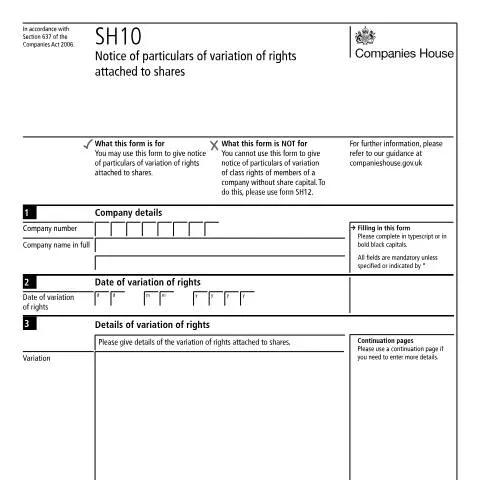
When Share Rights Change: Understanding the SH10 Notice Requirement
The moment a company decides to alter the fundamental rights attached to its shares, it triggers a statutory obligation that many directors overlook until their solicitor mentions it in passing. The SH10 form represents Companies House's mechanism for ensuring that any variation to share rights becomes part of the permanent public record, creating transparency for current shareholders, potential investors, and creditors who rely on understanding a company's capital structure.
Unlike straightforward share allotments or transfers, variations of share rights can fundamentally reshape the balance of power within a company. Whether converting non-voting shares to voting shares, adjusting dividend entitlements, or modifying liquidation preferences, these changes require formal notification under Section 637 of the Companies Act 2006. The SH10 serves as the official vehicle for this notification, transforming what might otherwise remain an internal corporate decision into public knowledge.
The Scope and Boundaries of SH10 Applications
The SH10 form operates within clearly defined parameters that distinguish it from other Companies House filings. Most critically, it applies exclusively to companies with share capital where existing rights attached to particular shares undergo modification. This creates an immediate boundary: companies without share capital, such as companies limited by guarantee, fall outside the SH10's remit entirely.
For companies without share capital that need to vary class rights of members, Companies House provides the SH12 form instead. This distinction proves vital because using the wrong form can delay the filing process and potentially create compliance issues if the variation becomes effective before proper notification occurs.
The form captures variations across the full spectrum of share rights, including:
- Voting rights modifications – converting non-voting shares to voting shares, or vice versa
- Dividend entitlement changes – altering preferential dividend rights or distribution priorities
- Capital repayment adjustments – modifying rights on winding up or capital reduction
- Transfer restriction alterations – changing pre-emption rights or approval requirements
- Conversion rights – introducing or removing rights to convert between share classes
Timing Considerations and the Critical Date Element
The SH10's effectiveness hinges on accurate recording of the variation date, which Companies House treats as the definitive moment when the rights change took legal effect. This date drives several critical considerations that companies must navigate carefully.
The variation date typically corresponds to when the board resolution or special resolution authorising the change was passed, though the specific timing can vary depending on the company's articles of association and the nature of the variation. For variations requiring shareholder approval, the date would normally reflect when the necessary resolution achieved the required majority.
| Variation Type | Typical Effective Date | Key Considerations |
|---|---|---|
| Board-authorised variations | Date of board resolution | Check articles permit board authority |
| Shareholder-approved changes | Date of special resolution | Ensure proper notice and voting thresholds |
| Scheme of arrangement variations | Court approval date | Complex timing with multiple approval stages |
Companies must file the SH10 within the prescribed timeframe following the variation date, though the specific deadline isn't detailed in the form itself. This creates a practical imperative to file promptly after the variation takes effect, as delayed filings can result in penalties and may create confusion for parties relying on the public record.
Navigating the Documentation Requirements
The heart of the SH10 lies in Section 3's variation details, where companies must articulate precisely what rights have changed and how. This section demands careful attention because the description becomes the permanent public record of the variation, potentially influencing future interpretations of the company's share structure.
Effective completion requires balancing comprehensiveness with clarity. The description should be sufficiently detailed to enable a reader to understand the nature and scope of the change, yet concise enough to avoid unnecessary complexity. Companies often benefit from using the exact language from their articles of association or the relevant resolution to ensure consistency across corporate documents.
Common approaches to describing variations include:
- Before-and-after format – clearly stating the original rights and the modified rights
- Amendment-style description – referencing specific clauses and describing the changes
- Comprehensive restatement – setting out the complete new rights structure
The form accommodates extensive descriptions through its continuation page provision, acknowledging that complex variations may require substantial explanation. Companies should not hesitate to use additional space rather than compress important details into inadequate descriptions.
Authority and Signature Requirements
The SH10's signature section reflects Companies House's approach to corporate authentication, accepting signatures from various authorised individuals while maintaining appropriate controls. The form may be signed by directors, company secretaries, or persons authorised under Sections 270 or 274 of the Companies Act 2006, providing flexibility for companies with different governance structures.
For companies in special circumstances, additional signature options accommodate administrators, receivers, and other insolvency practitioners who may need to file variations during formal insolvency processes. Societas Europaea companies require specific attention to the signature requirements, with signatories needing to specify their organ membership rather than using standard director designations.
The signature represents a declaration that the signatory is acting on behalf of the company and that the information provided is accurate. This creates personal responsibility for the accuracy of the filing, though the liability typically extends to the signatory's authority to act rather than detailed verification of every aspect of the variation.
Public Record Implications and Strategic Considerations
Every SH10 filing becomes part of the permanent public record, accessible to anyone searching the company's file at Companies House. This transparency serves legitimate interests in corporate accountability and investor protection, but also means that strategic corporate restructuring becomes visible to competitors, potential acquirers, and other interested parties.
The public nature of the filing requires companies to consider the broader implications of their variation descriptions. While accuracy and completeness remain paramount, companies may benefit from structuring their descriptions to provide required information without revealing unnecessary strategic details about future plans or negotiations.
The timing of SH10 filings can also carry strategic implications. Companies undergoing complex restructuring may coordinate their filings to present a coherent narrative in the public record, though this must always remain subordinate to compliance obligations and statutory deadlines.
Integration with Broader Corporate Filings
The SH10 rarely exists in isolation, typically forming part of a broader package of corporate filings that collectively document significant changes to the company's structure. Companies may need to coordinate SH10 filings with:
- Articles of association amendments (filed via Form CC01) reflecting the varied rights
- Allotment returns if new shares are issued with the varied rights
- Annual confirmation statements that must reflect the updated share capital structure
- Charge registrations if the variation affects secured creditors' rights
Practical Implementation and Professional Support
Most companies benefit from professional guidance when completing SH10 filings, particularly where the underlying variation involves complex rights or forms part of broader corporate restructuring. The form's apparent simplicity can mask significant legal and practical complexities that emerge during completion.
Legal advisers typically ensure that the SH10 description aligns with the underlying documentation authorising the variation, while also considering how the filing integrates with other regulatory requirements. For listed companies, additional considerations around market disclosure and regulatory notification may influence the timing and presentation of SH10 filings.
The electronic filing option through Companies House's online services has streamlined the submission process, though companies must ensure they retain appropriate records of their filings and any supporting documentation. The system provides immediate confirmation of successful filing, enabling companies to coordinate subsequent actions that depend on the variation being properly recorded.
Quality Control and Verification
Companies House may return incorrectly completed or incomplete SH10 forms, creating potential delays in establishing the public record of the variation. Common issues include:
- Mismatched company names or numbers that don't align with the register
- Missing or incorrectly formatted variation dates
- Insufficient detail in the variation description
- Incorrect or missing signatures
Implementing internal review processes before submission helps avoid these issues and ensures that the SH10 achieves its intended purpose of creating a clear, accurate public record of the rights variation. Companies often benefit from having both legal and administrative personnel review the form before submission, combining legal accuracy with practical attention to formatting and completeness requirements.
Long-term Implications and Record Maintenance
The SH10 filing creates enduring consequences that extend well beyond the immediate notification requirement. Once filed, the variation becomes part of the company's permanent history at Companies House, influencing how future investors, lenders, and other stakeholders understand the company's capital structure.
Companies should maintain comprehensive internal records linking their SH10 filings to the underlying resolutions, board minutes, and other documentation authorising the variations. This documentation proves essential for future corporate actions, due diligence exercises, and regulatory inquiries that may require demonstration of proper authority and process.
The cumulative effect of multiple variations over time can create complex share structures that become difficult to interpret without reference to the complete filing history. Companies benefit from maintaining clear internal summaries of their current share rights structure, updated following each variation and cross-referenced to the relevant SH10 filings.
For companies planning future fundraising, acquisitions, or other strategic transactions, the SH10 filing history provides crucial documentation of how the current share structure evolved. Professional advisers routinely review this history as part of due diligence processes, making accurate and comprehensive SH10 filings an investment in future transaction efficiency.
The form's role in maintaining public confidence in corporate transparency means that companies should approach SH10 filings as opportunities to demonstrate good governance and attention to regulatory compliance, rather than mere administrative burdens. In an environment where corporate accountability attracts increasing scrutiny, proper completion and timely filing of SH10 notices contributes to the company's reputation for professional management and regulatory compliance.
Practical Considerations for Complex Share Structures
When dealing with sophisticated shareholding arrangements, the SH10 form requires careful attention to how variations affect different classes of shareholders. Companies with multiple share classes—such as ordinary shares, preference shares, and deferred shares—must clearly articulate how each variation impacts the rights hierarchy.
For companies with weighted voting structures, where certain shares carry multiple votes per share, any variation affecting voting ratios must be precisely documented. The form requires you to specify not just the mathematical change (e.g., from 10 votes per share to 5 votes per share) but also the practical implications for shareholder control and decision-making processes.
Employee share schemes present particular complexities when filing SH10 notices. If your company operates an Employee Share Ownership Plan (ESOP) or Share Incentive Plan (SIP), variations to the underlying share rights can trigger cascading effects on employee entitlements. You must consider whether the variation affects vesting schedules, exercise prices for share options, or conversion ratios for convertible securities held by employees.
International companies with UK subsidiaries face additional layers of complexity. Where the parent company's jurisdiction requires different disclosure standards, you must ensure the SH10 filing captures the full scope of rights variations without creating conflicts with overseas regulatory requirements. This is particularly relevant for companies incorporated in jurisdictions with different concepts of share capital or voting structures.
Venture capital and private equity backed companies often have sophisticated preference structures that include anti-dilution provisions, liquidation preferences, and conversion rights. When these mechanisms trigger automatic adjustments to share rights, each adjustment may require a separate SH10 filing, even if the underlying legal documents provide for automatic variations.
Integration with Other Corporate Filings and Regulatory Requirements
The SH10 form rarely exists in isolation within a company's regulatory filing obligations. Understanding how this notice integrates with other Companies House requirements ensures comprehensive compliance and avoids contradictory information across different submissions.
When filing an SH10, you should simultaneously review whether updates are needed to your company's Statement of Capital and Shareholdings (typically filed with forms such as CS01 for confirmation statements). Any variation in share rights may necessitate corresponding amendments to the statement of capital, particularly if the variation affects the nominal value, currency denomination, or prescribed particulars of the shares.
For public limited companies, SH10 filings must align with Financial Conduct Authority (FCA) disclosure requirements under the Listing Rules and Disclosure Guidance and Transparency Rules. Material changes to share rights may trigger obligations to issue regulatory information service announcements or update admission documents. The timing of FCA notifications and Companies House filings requires careful coordination to ensure market transparency while maintaining regulatory compliance.
Companies preparing for initial public offerings (IPOs) or other capital market transactions must consider how historical SH10 filings will be scrutinised by underwriters, legal advisers, and regulatory authorities. A clear audit trail of share rights variations, properly documented through timely SH10 submissions, facilitates due diligence processes and reduces the risk of transaction delays.
Tax implications often accompany share rights variations, particularly where the changes affect the value or nature of shareholders' economic interests. While the SH10 form itself doesn't trigger tax consequences, HMRC may reference these filings when assessing corporation tax, capital gains tax, or stamp duty obligations. Companies should coordinate their SH10 submissions with tax advisers to ensure consistent treatment across all relevant authorities.
For companies subject to sector-specific regulation—such as financial services firms regulated by the Prudential Regulation Authority (PRA) or FCA—share rights variations may require additional notifications to sector regulators. Banking and insurance companies, in particular, must consider whether changes to share structures affect regulatory capital calculations or ownership control notifications.
Common Pitfalls and Best Practice Approaches
Filing SH10 forms effectively requires awareness of frequent errors that can lead to rejection, delays, or regulatory queries. Understanding these pitfalls and implementing robust filing processes protects companies from compliance failures and associated penalties.
One of the most common errors involves inadequate description of the variation itself. Companies often provide generic statements such as "voting rights amended" without specifying the precise nature of the change. Best practice requires detailed articulation of both the previous rights structure and the new arrangements, using clear, unambiguous language that would enable a third party to understand the practical impact of the variation.
Timing errors represent another frequent complication. Some companies mistakenly believe the SH10 must be filed before the variation takes effect, while others delay filing until long after the change. The statutory requirement mandates filing within one month of the variation, but companies should aim for earlier submission to maintain current public records and avoid last-minute complications.
Documentation supporting the SH10 filing must be comprehensive and internally consistent. Where the variation results from a board resolution, the resolution should explicitly reference the specific share classes and rights being modified. If the change stems from a special resolution passed by shareholders, the SH10 should accurately reflect the resolution's terms without introducing new interpretation or summary.
Electronic filing through the Companies House WebFiling service offers efficiency benefits but requires careful attention to character limits and formatting restrictions. Companies with complex share structures may find the electronic form fields insufficient for comprehensive explanation, necessitating attachment of supplementary documents. However, these attachments must comply with Companies House technical specifications and file size limitations.
Record-keeping practices significantly impact SH10 filing accuracy and efficiency. Companies should maintain a comprehensive share register that documents not only current shareholdings but also the evolution of share rights over time. This historical record proves invaluable when preparing SH10 forms, particularly where variations build upon previous modifications or interact with existing rights structures.
Professional advice becomes particularly valuable for companies with unusual share structures or where the variation involves novel arrangements. While the SH10 form appears straightforward, the underlying legal concepts of share rights and their variations can be complex, especially where the company's articles of association contain bespoke provisions or where the variation interacts with shareholders' agreements or other commercial arrangements.
Quality assurance procedures should include cross-referencing the SH10 content against the company's constitutional documents, recent board minutes, and any legal advice received regarding the variation. This review process helps identify inconsistencies or omissions before submission, reducing the likelihood of queries from Companies House or subsequent correction requirements.