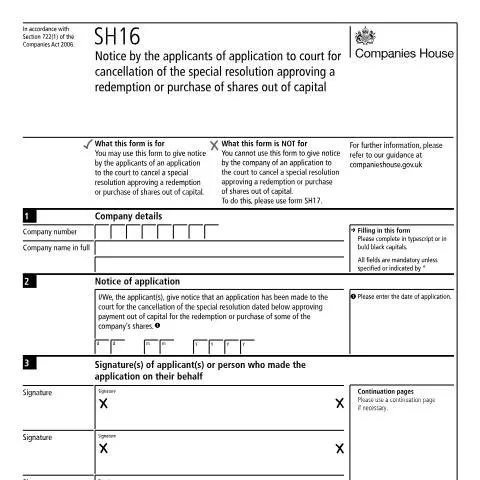
Understanding the Companies House Notice for Court Application to Cancel a Special Resolution (SH16)
The Companies House form SH16 serves a specific legal purpose within the framework of UK company law, particularly under the Companies Act 2006. It provides a formal process for applicants—typically shareholders or directors—to notify the Registrar of Companies of an application to the court to cancel a special resolution that has approved the redemption or purchase of shares out of capital. This guide aims to clarify the context, scope, and procedural aspects of this form, ensuring that relevant parties understand its significance and correct usage.
Context and Legal Framework
Under the Companies Act 2006, companies may pass a special resolution to approve transactions involving the redemption or purchase of shares out of capital. Such resolutions are significant because they involve the company’s assets and can impact its financial stability. If there is a dispute or a need to challenge the validity of such a resolution, the courts can be approached to seek its cancellation.
The form SH16 is used specifically by applicants—often shareholders or other interested parties—who wish to formally notify Companies House of their intention to apply to the court for this cancellation. This process is part of the legal procedures to ensure transparency and proper record-keeping in company transactions involving share capital.
Who Is Responsible for Submitting the Form?
The SH16 form is to be completed and submitted by the applicants—not the company itself. This distinction is crucial: the form is a notice of the applicant’s intention to seek court intervention and cancellation of the resolution. If the company wishes to initiate such a process, or if the application is made by the company, a different form (SH17) should be used.
Applicants must provide detailed company information, including the full company name and registration number, to ensure the correct legal entity is involved. The form also requires signatures from the applicants or their representatives, along with the date of the application.
Key Components and Usage of the SH16 Form
Company Details
- Company Name: The full registered name of the company as recorded on the public register.
- Company Number: The unique identifier assigned by Companies House.
Notice of Application
The core section involves the applicants declaring that an application has been made to the court for the cancellation of a specific special resolution. This includes details such as the date of the resolution and confirmation that the application pertains to the approval of a redemption or purchase of shares out of capital.
Signatures and Date
The form must be signed by the applicant(s) or their authorized representative, with the date of signing clearly indicated. This attestation confirms the accuracy and authenticity of the notice.
Submission and Further Guidance
Applicants can submit the completed SH16 form either by post or via the online upload service available through Companies House, depending on the specific instructions and facilities at the time of submission. It is essential to send the form to the correct address, which can be verified on the official government website.
Additional guidance and detailed instructions are available on the Companies House website. This includes information on alternative formats, contact details for queries, and the legal context of the process. It is recommended that applicants review these resources to ensure compliance and proper submission.
Public Record and Confidentiality
It is important to note that all information provided on the SH16 form will become part of the public record maintained by Companies House. While contact details are optional, including them can facilitate communication if there are questions regarding the submission.
In summary, the SH16 form is a specialized procedural document that plays a vital role in the oversight of company transactions involving share capital. It ensures that applications to challenge or cancel resolutions are properly recorded and accessible to the public, maintaining transparency within UK corporate law.