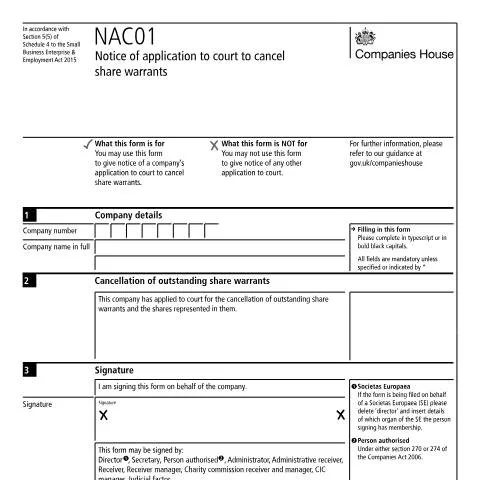
Understanding the NAC01: A Key Notice for Companies Seeking to Cancel Share Warrants
The NAC01 document serves as a crucial component for companies in the UK aiming to formally notify the court of their intention to cancel share warrants. This process is not only significant for the companies directly involved but also plays a vital role in maintaining transparency within the public domain and ensuring proper governance in corporate actions. Understanding how to utilize this notice can save companies from potential pitfalls and ensure compliance with legal requirements.
Deciphering the Purpose of the NAC01 Document
The NAC01 is not just a formality; it is an official notice that must be submitted when a company applies to the court for the cancellation of outstanding share warrants. These warrants represent shares that may have been issued but are no longer required or have become obsolete due to various reasons, such as company restructuring or changes in business strategy.
Importantly, this document is specific to the cancellation of share warrants. It does not serve any other purpose, which is a common misunderstanding. Companies should ensure they do not confuse this with other types of applications, lest they run the risk of submitting incorrect forms, which could result in delays or legal complications.
Who Should File a NAC01 Notice?
The NAC01 notice is pertinent primarily to companies that have issued share warrants in any capacity. This may include:
- Private limited companies
- Public limited companies
- Societas Europaea (SE), specifically if the document is being filed with specific authorizations
It is essential for those who are members of the company’s governing bodies—such as directors, secretaries, or authorized persons—to understand when and how to file this notice. The involvement of these individuals ensures that the application is legitimate and that the proper protocols are followed.
Step-by-Step Process for Filing the NAC01
Navigating the filing of a NAC01 notice involves a clear understanding of the process. Below is a concise step-by-step guide to follow:
- Decide to Cancel Share Warrants: Assess the need for cancellation and ensure it aligns with the company’s strategic goals.
- Gather Necessary Information: Ensure you have the complete company name and company number that matches the information held on the public register.
- Complete the NAC01 Form: Fill out the form in typescript or in bold black capitals. Ensure all mandatory fields are filled accurately.
- Obtain Necessary Signatures: Gather signatures from authorized personnel such as directors or other designated individuals as per the Companies Act 2006.
- File the NAC01 Notice: Submit the form to Companies House, either electronically or via post, depending on your preference and the regulations in place.
- Await Confirmation: After submission, Companies House will process the notice, and you will receive confirmation once the cancellation is approved.
Common Misinterpretations Surrounding the NAC01 Notice
While the NAC01 notice appears straightforward, there are several common misinterpretations and misconceptions that can lead companies astray:
- Assuming It Covers Other Applications: This notice is strictly for share warrants. Other applications require different forms.
- Incomplete Information: Not providing all required details can result in delays. Ensure all fields marked as mandatory are filled correctly.
- Filing Without Proper Authorization: Only authorized individuals may file the NAC01. This can lead to legal challenges if not adhered to.
Interconnections with Other Company Documents
The nature of corporate governance means that the NAC01 is often linked with other documents and filings. For instance:
| Document | Purpose | Relation to NAC01 |
|---|---|---|
| SH01 - Return of Allotment of Shares | Used to notify Companies House of newly issued shares. | Prior to submitting a NAC01, ensure all share allotments are up to date. |
| AR01 - Annual Return | Provides a snapshot of company information at a specific date. | Maintaining accurate records in the AR01 will reflect the changes addressed in the NAC01. |
| Form C - Confirmation Statement | Confirms that the company details are up to date. | This statement may also need adjustments in light of changes from the NAC01. |
Who Benefits from the NAC01 Filing?
The NAC01 notice primarily benefits companies that require a clear and formal method to cancel share warrants. However, the implications extend beyond just the companies directly involved. Potential beneficiaries include:
- Shareholders: They are protected from confusion regarding shares that are no longer valid.
- Potential Investors: Clear records support informed decision-making by prospective stakeholders regarding investment opportunities.
- Regulatory Bodies: Enhances transparency and accountability in the corporate sector.
Importance of Accurate Representation in the NAC01
All information filled in the NAC01 will become part of the public record. Therefore, accuracy is paramount. Inaccuracies can lead to public misinformation, which can have legal ramifications for the company and its directors. Companies should consider:
- Verifying Company Information: Ensure that the name and number match exactly as recorded in Companies House.
- Double-Checking Signatures: The document must be signed by the appropriate authorities to be valid.
- Reviewing Before Submission: A review process can prevent common errors that could lead to rejection of the NAC01.
Practical Insights for Executives and Managers
For company executives and managers, navigating the implications of filing the NAC01 can be quite complex. Here are a few practical insights that may aid in the process:
- Consult with Legal Advisors: Engaging with legal professionals can provide clarity on the obligations and potential consequences related to share warrants.
- Keep a Record of Correspondence: Maintain documentation of all communications with Companies House regarding the filing.
- Stay Updated on Regulatory Changes: Regulatory frameworks evolve, and keeping abreast ensures continued compliance.
Moving Forward: The Future of Share Warrant Management
As the corporate landscape continues to evolve, the approach to managing share warrants will also develop. The NAC01 will remain a pivotal tool in this process, ensuring that companies can adapt to changing circumstances with clarity and compliance. Executives should prioritize:
- Regular Reviews of Share Capital Structure: This ensures that any need for warrants is identified early.
- Training for Authorized Personnel: All individuals involved in filing should be well-versed in the procedures and the importance of the NAC01.
- Real-time Monitoring of Regulatory Updates: Being proactive can mitigate risks associated with non-compliance.
By understanding the intricacies of the NAC01, companies can not only ensure compliance but also foster a culture of transparency and efficiency in their operations. This ultimately leads to enhanced trust and credibility within the corporate framework.
Understanding Share Warrants in the UK
In the UK, share warrants are documents that confer the right to subscribe for shares in a company, essentially giving the holder a claim to shares. They can be issued by companies as a way to raise capital and are typically associated with specific terms and conditions. It's crucial to understand the nature of these warrants before proceeding with an application to cancel them. A share warrant can be seen as a valuable asset, and the implications of cancellation could have significant ramifications for both the company and the warrant holders.
Share warrants are governed by the Companies Act 2006, which sets out the legal framework for their issuance and cancellation. When a company wishes to cancel share warrants, it must do so in compliance with this legislation, ensuring that all procedures are followed meticulously. The company must also provide adequate notice to the warrant holders and the court, explaining the reasons for the cancellation and any potential impacts on the holders.
Reasons for Canceling Share Warrants
There could be various compelling reasons for a company to seek cancellation of share warrants. Understanding these motivations is essential, as it informs the context in which the application is made. Here are several common scenarios:
- Redemption of Debt: A company may wish to cancel share warrants that were originally issued as part of a debt restructuring process. If the company has settled the underlying debt, it might opt to cancel the associated warrants to simplify its capital structure.
- Consolidation of Share Capital: Companies may seek to streamline their share capital for various strategic reasons, including potential mergers, acquisitions, or simply enhancing the share value. Canceling share warrants can be part of a broader strategy to consolidate share ownership.
- Change in Business Strategy: Changes in market conditions or business focus can prompt a company to reassess its commitments to various financial instruments, including share warrants. If the warrants no longer align with the company's strategic objectives, cancellation might be a prudent choice.
- Legal or Compliance Issues: Sometimes, legal challenges or compliance issues may necessitate the cancellation of existing share warrants. The company may face scrutiny from regulatory bodies, making it essential to ensure that all outstanding warrants comply with current legislation.
The Process of Notifying Stakeholders
When a company intends to file an application to cancel share warrants, it is vital to communicate effectively with all stakeholders involved. This transparency helps to mitigate any potential backlash and ensures that all parties are aware of their rights and options. The notification process includes:
- Formal Notice to Warrant Holders: The company must provide a detailed notice to each holder of the share warrants, explaining the reasons for the cancellation and the anticipated timeline. This notice should comply with the company's articles of association and any relevant agreement terms.
- Filing with the Court: Alongside notifying the warrant holders, the company must file the NAC01 form with the appropriate court. This form requires specific details, including the company's information, the purpose of the cancellation, and any supporting documentation.
- Notification to the Registrar: In addition to court notification, the company must inform Companies House of the cancellation. This involves updating the share register and ensuring that all records reflect the current state of share ownership.
- Public Announcement: Depending on the size and impact of the cancellation, making a public announcement may be necessary. This communication can help inform the broader market and other stakeholders about the company's strategic decisions.
Throughout this process, it is vital to maintain compliance with the Data Protection Act 2018 and UK GDPR standards, ensuring that all personal data related to warrant holders is collected, processed, and stored in accordance with legal requirements.