Navigating the ADM20 Form: A Crucial Step in Limitation Claims
When faced with a limitation claim in the Admiralty Court of the High Court of Justice, the submission of the Defendant's Claim in a Limitation Claim (Form ADM20) is not merely a procedural formality; it's a pivotal component that can significantly influence the outcome of your case. Understanding its role, the implications of your submission, and the associated processes is essential for defendants seeking damages.
The Core Purpose of Form ADM20
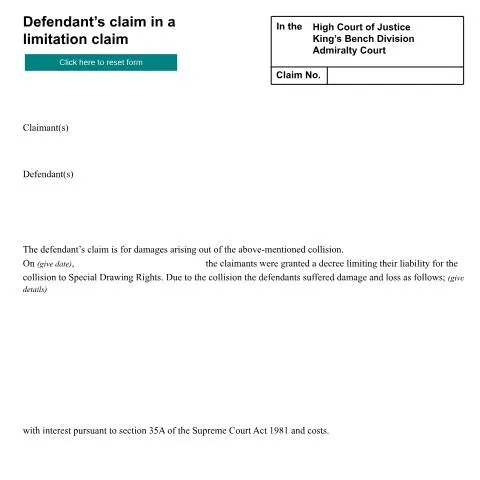
Understanding the strategic role of the ADM20 form is critical. This document serves as the defendant's formal assertion of a claim for damages arising from a collision for which the claimant has sought to limit liability. Upon the court granting this limitation of liability, the defendant may present their case against the claimants.
Completion of the ADM20 is the initiation of a counterclaim, making it vital for defendants to articulate their grievances clearly and comprehensively. The absence of this form, or any errors within it, can lead to the dismissal of the claim, potentially leaving defendants without recourse.
Who Should Submit Form ADM20?
This form is specifically designed for defendants involved in limitation claims, particularly those who have suffered losses or damages as a result of incidents such as maritime collisions. Various profiles of individuals may find themselves needing to fill out this form:
- Individual Defendants: Persons directly involved in the incident, such as ship owners or operators.
- Corporate Entities: Companies or organisations that own vessels involved in the collision.
- Legal Representatives: Solicitors acting on behalf of defendants must ensure accuracy when submitting the form.
Each of these profiles may present unique circumstances or variations in the claims they wish to make, highlighting the need for meticulous attention to detail in the completion of the ADM20.
Chronology of Events: From Incident to Claim Submission
It's important to understand the chronological steps leading up to the submission of Form ADM20, as it is part of a broader legal process:
- Incident Occurs: A maritime collision occurs, leading to claims for damages.
- Claimants Limit Liability: The claimants seek a decree to limit their liability, which the court may grant.
- Decision to Claim: Defendants assess their circumstances and decide to file a counterclaim.
- Complete Form ADM20: Defendants carefully fill out the form, detailing their claim.
- Submit to the Court: The completed form is then filed with the relevant Admiralty Court.
Understanding this timeline helps to clarify the critical nature of the ADM20 form within the overall proceedings, ensuring that defendants do not miss key deadlines or opportunities for their claims.
Completing Form ADM20: Key Sections to Focus On
Filling out Form ADM20 accurately is paramount for the success of your claim. Here are the crucial sections that require attention:
- Claim Details: Clearly outline the nature of the damages and losses incurred due to the collision.
- Date of Incident: Specify the date when the incident took place, as this is crucial for establishing the timeline.
- Interest and Costs: According to Section 35A of the Supreme Court Act 1981, outline any claims for interest and costs associated with your claim.
- Statement of Truth: A declaration that the provided information is accurate, requiring the signature of the defendant or their solicitor.
Each section is designed not only to provide information but also to substantiate the defendant’s position in the proceedings, ensuring that legal grounds for the claim are robust.
The Submission Process: Channels and Requirements
Once Form ADM20 has been completed, it must be submitted correctly to ensure it is acknowledged and acted upon by the court. There are multiple channels for submission:
| Submission Method | Description | Advantages |
|---|---|---|
| Online Submission | Files the form electronically via the HM Courts & Tribunals Service portal. | Faster processing, immediate confirmation. |
| Postal Submission | Mails the completed form to the designated court address. | Useful for those without internet access, provides time-stamped evidence of submission. |
| In-Person Submission | Delivers the form directly to the court clerk at the Admiralty Court. | Opportunity for immediate feedback and clarification of any issues. |
Choosing the right submission method can streamline the process and mitigate delays, which is especially critical given the time-sensitive nature of limitation claims.
What Happens After Submission: The Court's Role
Upon receiving the ADM20 form, the court undertakes a review process to assess the merits of the claim. Here's what to expect:
- Case Assignment: Your claim will be assigned a case number and a judge specializing in maritime law.
- Initial Review: The court will consider the completeness and clarity of the submission, checking for any missing information or required documentation.
- Notification: All parties involved in the claim will be notified of the submission, allowing for any objections or additional claims to be raised.
- Potential Hearings: Depending on the complexity of the claims, the court may schedule hearings for both parties to present their cases.
Understanding this process allows defendants to prepare adequately for any follow-up interactions with the court, ensuring that they remain engaged and responsive throughout the proceedings.
Addressing Rejections, Errors, and Missing Information
Situations may arise where Form ADM20 is rejected or the court identifies errors or missing information. Defendants must be prepared to address these issues promptly:
- Rejection Notices: Upon rejecting the form, the court will provide a notice detailing the reasons for rejection, allowing defendants to rectify these issues.
- Correcting Errors: If errors are identified, defendants should take immediate action to submit a corrected form, ensuring that all details align with the court’s requirements.
- Document Requests: The court may request further documentation or evidence to support the claim, and compliance with these requests is crucial for maintaining the integrity of the claim.
Swiftly addressing any issues ensures that the defendant's claims are not hindered by administrative errors or procedural missteps.
The Aftermath: Following Up on Your Claim
Once the ADM20 form is submitted and processing begins, it is essential to maintain a proactive approach:
- Regular Check-Ins: Engage with the court to check the status of your claim and to clarify any uncertainties that may arise.
- Legal Representation: Consider retaining legal counsel if you have not already; they can provide invaluable support throughout the process.
- Prepare for Court Hearings: If hearings are scheduled, ensure that you are prepared to present your case effectively, supported by all necessary documentation.
Ultimately, the outcome of the limitation claim hinges on the thoroughness of the ADM20 submission as well as the preparedness of the defendant to navigate the subsequent steps.
Understanding the Limitation Periods in Defendant Claims
When involved in a limitation claim, it is crucial for defendants to grasp the specific limitation periods that govern their case. In the UK, the primary statute regulating limitation periods is the Limitation Act 1980. This legislation outlines various time limits within which a claimant must initiate legal proceedings, and similarly, defendants must be aware of these timeframes to safeguard their rights.
Typically, the limitation period for personal injury claims is three years from the date of the incident or when the claimant became aware of the injury. For breach of contract claims, the limitation period is generally six years. However, these periods can differ based on the nature of the claim and the circumstances surrounding it. For instance, claims involving minors or individuals who lack mental capacity may have extended limitation periods.
Defendants must also consider that if a claim is brought after the expiration of the relevant limitation period, they can challenge it on those grounds. This can lead to a dismissal of the claim, provided that the limitation period has indeed lapsed. Therefore, understanding the applicable limitation period not only helps in defending against a claim effectively but also in preparing a strategy for any potential counterclaims that may arise.
Filing the ADM20 Form: Essential Steps and Best Practices
Completing the ADM20 form is a critical step for defendants seeking to counter a claim or bring in additional parties. This form must be filled out accurately to ensure that the defendant’s position is clearly articulated. Here are essential steps and best practices for filing the ADM20:
- Gather Relevant Information: Before starting the ADM20 form, collect all necessary information, including the claim number, details of the claimant, and specific allegations made against you. This will facilitate smoother completion of the form.
- Use Clear Language: When detailing your response, utilize clear and concise language. Avoid jargon unless absolutely necessary, as clarity will improve the understanding of your submission by the court.
- Seek Legal Advice: While it is possible to complete the ADM20 form independently, consulting with a legal professional can provide invaluable insights. They can help refine your arguments and ensure all legal standards are met.
- Double-Check Before Submission: After filling out the form, review it thoroughly. Check for any errors or omissions that could complicate your case. Consider having a peer or a legal advisor review it as well.
Once completed, submit the ADM20 form to the relevant court along with any required fees and supporting documents. Ensure that you keep a copy for your records, as this will serve as proof of your submission.
The Impact of Mediation on Limitation Claims
Mediation has increasingly become a pivotal tool in resolving disputes without resorting to protracted litigation in the UK. For defendants involved in limitation claims, understanding the role of mediation can influence both the strategy and outcome of the claim.
One of the primary advantages of mediation is that it can offer a quicker and more cost-effective resolution compared to traditional court proceedings. It provides both parties with an opportunity to communicate openly and explore potential settlement options. This can be particularly beneficial for defendants who may wish to negotiate a settlement rather than risk the uncertainties of a court judgment.
Moreover, mediation can have implications on limitation periods. Engaging in mediation does not typically stay the limitation period unless explicitly stated. Therefore, defendants must remain vigilant about the expiration of limitation periods while participating in mediation. It is advisable to clarify this with all parties involved and potentially seek an agreement to pause the limitation clock during the mediation process.
In conclusion, while mediation is an alternative dispute resolution method that can lead to effective and amicable solutions, defendants should approach it with a full understanding of its implications on their legal rights and obligations, including the critical aspect of limitation periods.