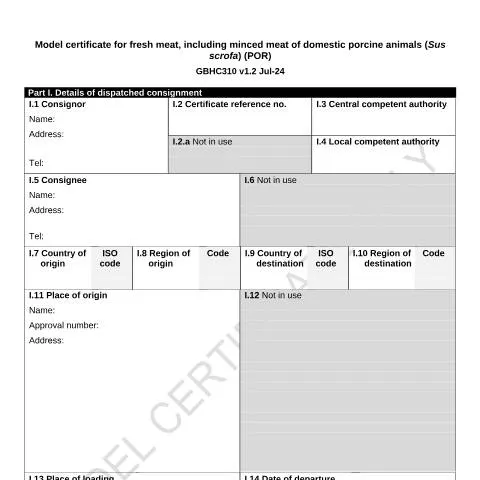
Navigating the GBHC310 Certificate for Porcine Meat Exports to Great Britain
When British exporters seek to dispatch fresh pork or minced pork products to international markets, they encounter a complex web of veterinary certification requirements that can make or break their commercial ventures. The GBHC310 model health certificate stands as the definitive document for fresh meat and minced meat from domestic porcine animals (Sus scrofa), serving as both a passport and guarantee for products crossing borders into Great Britain.
This standardised certificate, managed by the Animal and Plant Health Agency under the Department for Environment, Food & Rural Affairs, represents far more than bureaucratic paperwork. It functions as a comprehensive attestation system that bridges the gap between international food safety standards and British regulatory requirements, ensuring that every consignment of pork meets stringent animal health, welfare, and public health criteria.
The certificate's current iteration, version 1.2 from July 2024, reflects evolving post-Brexit trade relationships and demonstrates how veterinary certification has adapted to new regulatory frameworks. For meat processors, exporters, and veterinary professionals, understanding this document's intricacies becomes essential for maintaining market access and compliance with British import standards.
Decoding the Certificate's Dual Architecture: Commercial Details and Veterinary Attestations
The GBHC310 certificate operates through a two-part structure that separates commercial logistics from veterinary certifications. Part I captures the essential details of the consignment journey, while Part II provides the critical health attestations that determine whether products can legally enter Great Britain.
Commercial Consignment Framework
Part I establishes the commercial foundation through detailed identification of all parties and logistics involved in the meat shipment. The certificate requires comprehensive information about the consignor and consignee, including full contact details and addresses. This section also captures critical logistical elements such as the place of origin with its approval number, means of transport (whether by aeroplane, ship, railway wagon, road vehicle, or other methods), and the designated Border Control Post for entry.
The document demands precise commodity descriptions, including HS codes for customs classification, quantity measurements, and temperature requirements. Products must be clearly identified as ambient, chilled, or frozen, with corresponding packaging details and container identification numbers. This level of detail ensures traceability throughout the supply chain and facilitates efficient border processing.
Veterinary Certification Requirements
Part II transforms the certificate from a commercial document into a veterinary guarantee through three distinct certification domains: Animal Health, Animal Welfare, and Public Health. Each domain contains specific requirements that must be met and certified by an official veterinarian before the certificate gains validity.
The animal health section establishes territorial freedom from specific diseases over defined periods, while animal welfare provisions ensure compliance with British standards for handling and slaughter. Public health certification confirms that production establishments operate under HACCP principles and meet British regulatory requirements.
Disease-Free Territory Attestations: The Foundation of Health Certification
The certificate's most critical component lies in its territory requirements (AH/T103), which establish the disease status of the originating region. These requirements form the bedrock of animal health protection, determining whether meat from specific territories can enter the British market.
The certificate offers two pathways for territorial certification. The first pathway requires the territory to have been free for 12 months from foot-and-mouth disease, rinderpest, African swine fever, classical swine fever, and swine vesicular disease. This represents the gold standard for disease freedom and provides the clearest route to certification.
The alternative pathway accommodates territories with more complex disease histories, allowing for conditional certification where specific diseases have been absent for 12 months, with additional requirements for territories considered free from certain diseases since specified dates. This flexibility recognises that different regions may have varying disease profiles while still maintaining acceptable risk levels.
| Disease Category | Standard Requirement | Alternative Pathway |
|---|---|---|
| Foot-and-mouth disease | 12 months freedom | Conditional freedom with authorisation |
| African swine fever | 12 months freedom | 12 months freedom (mandatory) |
| Classical swine fever | 12 months freedom | Conditional freedom with authorisation |
| Swine vesicular disease | 12 months freedom | Conditional freedom with authorisation |
| Rinderpest | 12 months freedom | 12 months freedom (mandatory) |
Crucially, the certificate prohibits vaccination against these diseases within the territory during the preceding 12 months, and imports of vaccinated domestic animals must also be restricted. This vaccination prohibition reflects the principle that disease freedom through natural resistance provides greater assurance than vaccine-induced protection for international trade purposes.
From Farm to Fork: Establishment and Animal Requirements
Beyond territorial disease status, the certificate establishes detailed requirements for individual holdings, processing establishments, and animals involved in meat production. These requirements create multiple layers of protection that extend from the farm level through to final processing.
Holding-Level Safeguards
The establishment requirements for holdings (AH/E005) create protective zones around farms where animals destined for certified meat production are kept. Animals must come from holdings where no vaccination against the specified diseases has occurred, and within a 10-kilometre radius, no cases or outbreaks of these diseases have occurred during the previous 40 days.
Additional protections address porcine brucellosis, with holdings subject to prohibition if outbreaks have occurred within the previous six weeks. These requirements recognise that disease risks extend beyond the immediate farm environment and that neighbouring areas can influence the safety status of meat products.
Slaughterhouse Standards
Slaughterhouse requirements (AH/E300B) mirror the protective zone concept, requiring that processing establishments operate within disease-free 10-kilometre radii. Where disease cases have occurred, the certificate permits meat preparation only after comprehensive decontamination protocols, including slaughter of all animals present, meat removal, and complete cleaning and disinfection under official veterinary supervision.
These stringent measures reflect the understanding that slaughterhouses represent critical control points where contamination risks are highest, and where comprehensive intervention can break potential disease transmission chains.
Animal Residency and Movement Controls
Individual animal requirements (AH/A001) establish residency criteria that ensure animals have been present in certified territories for sufficient periods to demonstrate freedom from disease exposure. The certificate offers three pathways for meeting residency requirements:
- Lifetime residency: Animals that have remained in the certified territory since birth
- Three-month residency: Animals present in the territory for at least three months before slaughter
- Authorised introductions: Animals introduced from other territories authorised to export meat to Great Britain, or from Great Britain itself
These residency requirements balance practical livestock movement needs with disease prevention objectives, recognising that animals may legitimately move between territories while maintaining traceability and health assurance.
Welfare Standards and Slaughter Protocols
The certificate's animal welfare component (AW/001A) extends British welfare standards to imported products, requiring that animals have been handled in accordance with GB animal welfare requirements before and during slaughter. This provision reflects growing consumer and regulatory emphasis on ethical treatment throughout the meat production chain.
Welfare certification requires official veterinary oversight of slaughter processes, ensuring that animals are handled humanely and that slaughter procedures meet British standards. This requirement creates accountability for welfare practices in exporting countries and provides assurance that imported meat meets the same ethical standards as domestically produced products.
The welfare provisions complement animal health requirements by recognising that stressed or poorly handled animals may be more susceptible to disease and that welfare standards contribute to overall meat quality and safety.
Public Health Assurance Through HACCP Compliance
The certificate's public health component establishes that production establishments must operate under Hazard Analysis and Critical Control Points (HACCP) principles in accordance with British regulations. This requirement extends British food safety management systems to international suppliers, creating consistency in risk management approaches.
HACCP compliance requires establishments to identify potential hazards in their production processes, establish critical control points where these hazards can be managed, and implement monitoring and corrective action procedures. The certificate's requirement for HACCP compliance ensures that meat production facilities maintain systematic approaches to food safety that align with British expectations.
Production requirements (PH/P100B) further specify that products must be produced in accordance with British regulations, creating a comprehensive framework that covers both facility management and specific production practices. This dual approach ensures that both the systems and outcomes of meat production meet British standards.
Official Veterinary Certification and Professional Responsibility
The certificate places significant professional responsibility on the undersigned official veterinarian, who must personally certify compliance with all requirements. This individual certification creates clear accountability and ensures that qualified professionals verify compliance with complex technical requirements.
Official veterinarians must possess detailed knowledge of British regulations and maintain current understanding of evolving requirements. The certificate's declaration that the veterinarian is "aware of the relevant requirements of the GB Regulations" creates a professional standard that extends beyond simple form completion to comprehensive regulatory knowledge.
The veterinary certification process typically involves multiple site visits, document reviews, and verification procedures. Official veterinarians must verify territorial disease status, inspect production facilities, review animal records, and confirm welfare and public health compliance before signing certificates.
Certification Timing and Validity
The certificate requires specific dating for animal slaughter, with provision for either single-date or date-range certification. This timing precision ensures that certified meat corresponds to specific production periods and facilitates traceability in case of subsequent issues.
While the certificate itself does not specify validity periods, practical considerations typically limit certificate life to periods that align with meat shelf-life and shipping timeframes. Certificates generally remain valid for the duration of the specific consignment they cover, rather than providing ongoing authorisation for multiple shipments.
Practical Implementation and Border Control Integration
The GBHC310 certificate integrates with British border control systems through specific entry points designated as Border Control Posts. These facilities possess the expertise and equipment necessary to verify certificate authenticity and conduct physical inspections of consignments when required.
Certificate presentation at borders triggers verification procedures that may include document authentication, temperature monitoring, package inspection, and sampling for laboratory testing. The comprehensive information captured in Part I facilitates efficient processing while providing border officials with the detail necessary for risk-based inspection decisions.
Electronic systems increasingly support certificate processing, allowing for advance notification of consignments and automated risk assessment based on certificate data. However, the fundamental requirement for official veterinary certification and original document presentation remains central to the system's integrity.
For exporters, successful use of the GBHC310 certificate requires coordination between commercial operations, veterinary services, and logistics providers. Early engagement with official veterinarians, careful planning of production schedules, and comprehensive documentation management become essential elements of successful export operations.
The certificate's complexity reflects the sophisticated nature of modern international meat trade, where consumer expectations for safety, welfare, and quality drive increasingly detailed regulatory requirements. Understanding and effectively implementing these requirements becomes a competitive advantage for exporters seeking to maintain and expand their presence in the British market.
Specific Requirements for Different Types of Porcine Products
The model health certificate requirements vary significantly depending on the specific type of porcine product being exported. Fresh pork cuts destined for human consumption require comprehensive veterinary certification confirming the animals were slaughtered in approved establishments under official veterinary supervision. The certificate must detail the specific cuts included, their origin establishment numbers, and confirmation that post-mortem inspection found no evidence of disease.
Processed pork products face additional scrutiny, particularly those involving heat treatment. The health certificate must specify the processing method, core temperature achieved, and duration of treatment. For products like bacon, ham, or sausages, authorities require detailed information about curing agents, preservatives, and any additives used. Establishments producing these items must hold specific approvals for their processing methods, and these approval numbers must feature prominently on the accompanying documentation.
Pork offal requires particularly detailed certification due to higher disease transmission risks. Liver, kidneys, hearts, and other organ meats need individual listing on certificates, with specific confirmation that each organ passed detailed inspection. The veterinary authority must certify that no abnormalities were detected and that the organs originated from carcasses that received full post-mortem examination.
Frozen pork products require additional temperature maintenance records. The health certificate must confirm the freezing process met required standards, typically involving rapid freezing to core temperatures below -18°C. Documentation must include freezing dates, storage temperatures throughout the cold chain, and confirmation that packaging maintains product integrity during transport.
Mechanically separated pork faces the most stringent requirements due to processing methods that could potentially increase contamination risks. Certificates must detail the separation process, confirm the absence of central nervous system tissue, and verify that only approved carcass parts were used in the mechanical separation process.
Laboratory Testing and Sampling Protocols
Model health certificates for porcine meat exports typically require extensive laboratory testing documentation, with specific sampling protocols varying according to destination country requirements. Microbiological testing forms the cornerstone of these requirements, with samples taken at multiple stages of the production process to ensure comprehensive coverage.
Salmonella testing represents a fundamental requirement across most export destinations. The testing protocol typically involves collecting samples from carcasses immediately post-slaughter, from processing equipment, and from final products. Laboratories must follow ISO 6579 methodology, with results confirming absence of Salmonella species in 25-gram samples. The health certificate must reference specific test batch numbers, testing dates, and laboratory accreditation details.
Listeria monocytogenes testing becomes particularly critical for ready-to-eat pork products. Sampling must occur throughout the production environment, including floor drains, equipment surfaces, and product contact areas. The certificate requires confirmation that all environmental samples tested negative, alongside product samples meeting acceptable limits according to EC Regulation 2073/2005 standards.
Chemical residue testing encompasses veterinary drug residues, pesticides, and heavy metals. The testing programme must cover antimicrobials commonly used in pig production, including beta-lactams, tetracyclines, and sulphonamides. Maximum residue limits vary between destination countries, requiring careful attention to specific market requirements. Heavy metal testing focuses on lead, cadmium, and mercury levels, particularly important for organ meats which may concentrate these substances.
Trichinella testing represents a specific requirement for certain pork products, particularly those consumed without cooking. The testing methodology must follow Commission Regulation (EC) No 2075/2005, using artificial digestion methods to detect Trichinella larvae. Each carcass or batch requires individual testing, with certificates confirming negative results before export approval.
Water activity and pH measurements become relevant for processed products, ensuring conditions prevent pathogen growth. The certificate must document these parameters alongside storage conditions and shelf-life determinations based on challenge testing or predictive modelling studies.
Documentation Chain and Traceability Requirements
Comprehensive traceability documentation forms an integral component of porcine meat health certificates, creating an unbroken chain from farm to export. This documentation system must demonstrate complete oversight of animal movements, feed sources, veterinary treatments, and processing stages throughout the production cycle.
Farm-level documentation begins with individual animal identification records, typically involving ear tags linked to central databases. The health certificate must reference holding numbers where animals were born and raised, alongside movement documents showing transfers between holdings. Veterinary treatment records require particular attention, documenting all medications administered, withdrawal periods observed, and confirmation that residue testing verified compliance with maximum limits.
Feed traceability becomes increasingly important following various food safety incidents. Documentation must demonstrate feed sources, including detailed records of feed mill approvals, ingredient specifications, and any additives included. Mycotoxin testing results for feed ingredients may require inclusion, particularly for aflatoxins and ochratoxin A which can transfer into meat products.
Slaughterhouse documentation creates the bridge between live animal records and meat product certification. This includes ante-mortem inspection findings, stunning methods employed, bleeding procedures, and detailed post-mortem examination results. Each carcass must maintain individual identification throughout processing, with clear linkage between live animal records and resulting meat cuts.
Processing establishment records become relevant for value-added products, documenting recipe formulations, cooking temperatures and times, cooling rates, and packaging procedures. Hazard Analysis and Critical Control Points (HACCP) records must demonstrate continuous monitoring of critical control points throughout processing, with corrective actions documented when deviations occur.
Cold chain documentation extends traceability through storage and transport phases. Temperature monitoring records must demonstrate continuous maintenance of required temperatures, with alarm systems documenting any deviations and corrective actions taken. Transport documentation includes vehicle approvals, cleaning and sanitisation records, and temperature logs throughout the journey to export facilities.
Export facility documentation completes the traceability chain, including storage conditions, handling procedures, and loading protocols. Container seals and shipping documentation create the final link in demonstrating product integrity from farm to destination port. Each certificate must cross-reference these various documentation elements, creating a comprehensive picture of product history and safety controls applied throughout the production and distribution chain.