Professional Fishing Certificates: Your Gateway to Commercial Command
Operating commercial fishing vessels in UK waters demands more than seamanship skills and industry knowledge. The Certificate of Competency for Fishing Deck Officers represents the formal qualification that transforms experienced crew members into legally authorised skippers and officers. Whether you're commanding a 12-metre inshore trawler or a 60-metre distant-water vessel, the Maritime and Coastguard Agency requires specific certification levels that match your vessel's size and operating area.
The fishing industry's regulatory framework recognises three distinct classes of certification, each tailored to different vessel categories and operational requirements. From the foundational Class 3 certificate for smaller coastal vessels to the comprehensive Class 1 qualification enabling unlimited operations, these certificates ensure that commercial fishing operations maintain the highest standards of safety and competency at sea.
Understanding the Three-Tier Certification System
The UK's fishing certification structure operates through a carefully graduated system, with each class corresponding to specific vessel limitations and operational boundaries. Class 3 Fishing certificates serve as the entry point for aspiring skippers, typically covering vessels operating in near-coastal waters with restricted tonnage limits. These certificates acknowledge foundational competency whilst ensuring operators understand essential safety protocols and navigation requirements.
Class 2 Fishing certificates represent the intermediate level, expanding operational privileges to larger vessels and extended voyage areas. Holders can command fishing vessels of greater tonnage and operate in more challenging maritime environments, reflecting enhanced training requirements and demonstrated experience levels.
At the apex sits the Class 1 Fishing certificate, the most comprehensive qualification available for commercial fishing operations. This certification enables command of the largest fishing vessels operating in unlimited areas, requiring extensive sea service, comprehensive training, and rigorous examination standards. Class 1 holders often progress to commanding factory ships, distant-water trawlers, and other large-scale commercial fishing operations.
| Certificate Class | Vessel Size Limits | Operating Areas | Career Progression |
|---|---|---|---|
| Class 3 Fishing | Smaller coastal vessels | Near coastal waters | Entry-level command |
| Class 2 Fishing | Medium tonnage vessels | Extended coastal areas | Intermediate command |
| Class 1 Fishing | Large commercial vessels | Unlimited operations | Senior command positions |
Conversion Pathways to Commercial Maritime Certificates
Experienced fishing certificate holders often seek to expand their career opportunities by converting their qualifications to STCW (Standards of Training, Certification and Watchkeeping) certificates, enabling them to work aboard commercial merchant vessels. The Maritime and Coastguard Agency recognises this career transition through specific conversion routes that acknowledge fishing experience whilst ensuring compliance with international maritime standards.
The conversion from Class 1 Fishing to STCW Regulation II/1 Officer of the Watch Unlimited represents one of the most significant career advancement opportunities available to fishing professionals. This pathway recognises the navigational and vessel management skills developed in fishing operations, whilst requiring additional training in commercial shipping practices, cargo operations, and international regulations.
Similarly, both Class 1 and Class 2 fishing certificate holders can pursue conversion to Master Code Vessel certifications, enabling command of commercial vessels under 200 gross tonnes. These conversions acknowledge that fishing operations often involve complex vessel handling, crew management, and navigation challenges that translate effectively to commercial maritime operations.
Additional Training Requirements for Conversions
Converting fishing certificates to commercial maritime qualifications typically requires supplementary training in areas not covered by traditional fishing operations. ECDIS (Electronic Chart Display and Information System) certification becomes mandatory, reflecting the commercial shipping industry's reliance on electronic navigation systems. Additionally, enhanced GMDSS (Global Maritime Distress and Safety System) qualifications ensure compliance with international communication requirements.
Sea Service Requirements and Documentation Standards
The foundation of any fishing certificate application rests upon documented sea service that demonstrates practical competency and progressive responsibility. The Maritime and Coastguard Agency requires detailed evidence of relevant sea service obtained within the last 10 years, with specific duration requirements varying according to the certificate class sought.
Sea service documentation must originate from Sea Service Testimonials issued by skippers, masters, or company directors who can verify the applicant's performance and responsibilities. These testimonials serve as formal attestations of competency, detailing the specific duties performed, vessel characteristics, and operational areas encountered during service periods.
The calculation methodology for sea service follows precise Maritime and Coastguard Agency guidelines, with voyage lengths expressed in calendar months and days. For example, service from 3rd January to 5th March equals 2 months and 3 days, with accumulated odd days converted at 30 days per month. This standardised approach ensures consistent evaluation across all applications.
Vessel Documentation and Operational Areas
Each period of sea service must include comprehensive vessel details, including call signs, port letters, fishing numbers, port of registry, vessel length in metres, and gross tonnage. Operational areas require specific coding, with 'U' indicating Unlimited operations and 'NC' representing Near Coastal Area service. This detailed documentation enables assessors to evaluate the complexity and scope of an applicant's practical experience.
Foreign flag vessel service receives acceptance under equivalent conditions to UK vessel service, provided proper verification procedures can be completed. This recognition acknowledges the international nature of modern fishing operations whilst maintaining documentation standards.
Training Certificates and Professional Development Requirements
Beyond sea service documentation, fishing certificate applications require evidence of completed professional training across multiple specialised areas. The specific training requirements vary significantly between certificate classes, reflecting the increasing complexity and responsibility associated with higher-level qualifications.
Safety training forms the cornerstone of all fishing certificate requirements, with Basic Survival Techniques, Advanced Fire Fighting, and First Aid at Sea representing mandatory qualifications across all levels. These courses address the unique hazards associated with commercial fishing operations, from vessel emergencies to medical incidents occurring far from shore-based assistance.
Navigation and communication training requirements escalate with certificate level, ranging from basic Electronic Navigation Systems (Fishing) for Class 3 applications to comprehensive Navigation Control Course (Fishing) and advanced GMDSS qualifications for Class 1 certificates. This progression ensures that certificate holders possess navigation skills appropriate to their operational responsibilities and vessel complexity.
Medical and Health Certification Requirements
Medical fitness standards for fishing certificate holders reflect the demanding physical environment and remote operational conditions typical of commercial fishing. Valid ENG1 medical certificates or equivalent medical assessments ensure that certificate holders can safely perform their duties under challenging maritime conditions.
Sight test requirements receive particular emphasis, given the critical importance of visual acuity for navigation, vessel handling, and safety watchkeeping. Recent medical certificates demonstrate ongoing fitness for duty, with renewal requirements ensuring continued compliance throughout a certificate holder's career.
Application Processing and Examination Procedures
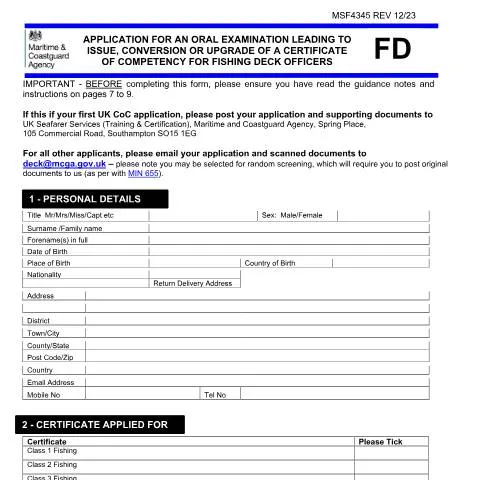
The application process for fishing certificates follows structured procedures designed to ensure thorough evaluation whilst minimising administrative delays. First-time UK Certificate of Competency applicants must submit physical applications to UK Seafarer Services at the Maritime and Coastguard Agency's Southampton offices, enabling detailed document verification and identity confirmation.
Experienced applicants with existing UK certificates can utilise streamlined electronic submission procedures, forwarding applications and scanned documents to the dedicated [email protected] email address. However, random screening procedures may require selected applicants to provide original documentation for verification, maintaining security standards whilst offering processing convenience.
The oral examination component represents the culminating assessment of an applicant's knowledge and competency. These examinations test practical understanding of navigation, vessel handling, safety procedures, and regulatory compliance relevant to the certificate level sought. Examiners evaluate both theoretical knowledge and practical application skills, ensuring certificate holders can effectively manage real-world fishing operations.
Documentation Submission and Verification
Complete applications require extensive supporting documentation, from passport copies and discharge books to training certificates and sea service testimonials. The Maritime and Coastguard Agency's checklist system ensures applicants provide all necessary evidence before examination scheduling, preventing delays and administrative complications.
Two passport-sized photographs accompany each application, reflecting identification requirements and certificate production needs. Original certificates must accompany applications where applicants hold existing UK Certificates of Competency, enabling verification and potential endorsement transfers.
Specialised Qualifications and Advanced Certifications
The evolving nature of commercial fishing operations has prompted the development of specialised qualification pathways that address modern industry requirements. HELM (Human Element Leadership and Management) certifications represent advanced training in crew management, leadership skills, and human factors awareness that complement traditional seamanship qualifications.
HELM Operational Certificates address the day-to-day management challenges facing fishing vessel officers, covering topics from crew motivation to decision-making under pressure. HELM Management Certificates extend these concepts to senior command positions, emphasising strategic thinking, resource management, and organisational leadership skills essential for large-scale fishing operations.
Since January 2017, the Maritime and Coastguard Agency requires documentary evidence of Fire Prevention and Fire Fighting training completion or updates within five years preceding certificate issue. This requirement reflects ongoing professional development expectations and ensures certificate holders maintain current knowledge of evolving safety standards and equipment technologies.
Integration with Scottish Qualifications Authority Standards
Scottish Qualifications Authority (SQA) examinations form integral components of the certification process, particularly for Class 1 and Class 2 applications. These written examinations test theoretical knowledge across navigation, seamanship, safety, and regulatory areas, complementing practical experience with formal academic assessment.
Higher National Certificate (HNC) qualifications provide alternative pathways for some applications, recognising formal education achievements alongside practical sea service. This flexibility acknowledges diverse educational backgrounds whilst maintaining consistent competency standards across all certificate holders.
Certificate Validity and Professional Maintenance
Fishing certificates require ongoing maintenance through continued professional development and periodic updates to remain valid for commercial operations. The five-year renewal cycle for many training components ensures certificate holders maintain current knowledge of evolving safety standards, navigation technologies, and regulatory requirements.
Training certificate validity periods vary according to the specific qualification, with some safety courses requiring updates every three years whilst others maintain five-year validity periods. Medical certificates typically require renewal every two years for commercial fishing operations, reflecting the physical demands and health considerations associated with maritime careers.
The Maritime and Coastguard Agency monitors certificate compliance through various mechanisms, including port state inspections, employer verification requirements, and random audits of training records. Certificate holders must maintain accessible records of all qualifying training and experience to demonstrate ongoing compliance with certification standards.
Professional development opportunities continue throughout a fishing certificate holder's career, with advanced training courses, specialisation programmes, and conversion pathways enabling career progression and skill enhancement. The dynamic nature of modern fishing operations demands continuous learning and adaptation to new technologies, regulations, and industry practices.
Understanding the Different Levels of Fishing Certificates
The UK operates a tiered system of fishing certificates of competency, each designed for specific vessel sizes and operational requirements. Understanding which certificate matches your intended fishing activities is crucial before beginning the application process.
The Boatmaster's Licence represents the entry level for commercial fishing operations. This certificate permits you to operate vessels up to 16.5 metres in length within 60 nautical miles of a safe haven. The licence covers both fishing and passenger operations, making it versatile for those considering mixed maritime activities. You'll need to demonstrate basic navigation skills, understand collision regulations, and show competency in emergency procedures.
For larger commercial operations, the Skipper Limited certificate extends your authority to vessels up to 24 metres, operating within 150 nautical miles of the UK coast. This level requires more advanced navigation knowledge, including celestial navigation principles, advanced weather interpretation, and comprehensive understanding of fishing vessel stability. The assessment includes both written examinations and practical demonstrations aboard suitable training vessels.
The Skipper Unlimited represents the highest level of commercial fishing qualification, permitting command of any size fishing vessel operating anywhere in the world. This certificate requires extensive sea service, typically including time as a mate on large commercial vessels. The syllabus covers advanced ship handling, international regulations, cargo handling specific to fishing operations, and sophisticated navigation techniques including satellite systems and electronic chart plotting.
Fill in your form directly online
No printing: type your details into the boxes of the official form, tick, then download the PDF ready to send.
- 1Type into the form boxes
- 2Tick in one click
- 3Save and download the PDF
Specialist endorsements can be added to these certificates for specific operations. The Personal Survival Techniques (PST) endorsement is mandatory for all commercial fishing operations and covers sea survival, helicopter rescue procedures, and emergency equipment usage. The Fire Prevention and Fire Fighting endorsement becomes essential for larger vessels, whilst Elementary First Aid ensures you can handle medical emergencies during extended fishing trips.
Each certificate level builds upon previous qualifications, creating a clear progression path. However, you cannot skip levels - progression must be sequential, with appropriate sea service accumulated between each stage. The Maritime and Coastguard Agency maintains strict records of sea service, so accurate logbook keeping throughout your fishing career becomes essential for future advancement.
Sea Service Requirements and Documentation
Accumulating the required sea service represents one of the most critical aspects of obtaining a fishing certificate of competency. The Maritime and Coastguard Agency has specific requirements for how this service must be documented, verified, and presented as part of your application.
For a Boatmaster's Licence, you need a minimum of 2 years' sea service, with at least 1 year specifically on fishing vessels. This service must be documented in an approved discharge book or official logbook, countersigned by qualified skippers or harbour masters. The documentation must show not just time served, but also the types of operations undertaken, weather conditions experienced, and specific responsibilities held during each voyage.
Skipper Limited certification requires 3 years of qualifying sea service, with at least 18 months as a qualified crew member on commercial fishing vessels over 12 metres in length. During this period, you must demonstrate progressive responsibility, moving from basic deck duties to navigation assistance and eventually to watch-keeping responsibilities. The MCA scrutinises this progression carefully, looking for evidence of increasing competency rather than merely accumulated time.
The most demanding sea service requirements apply to Skipper Unlimited certification, where 4 years of qualifying service is needed, including at least 12 months as a mate or equivalent officer on vessels over 24 metres. This service must include experience in different fishing methods, various weather conditions, and preferably international waters. The MCA expects to see evidence of command responsibility, crew management experience, and involvement in complex fishing operations.
Acceptable sea service extends beyond purely fishing operations. Time served on merchant vessels, offshore support vessels, or research vessels can contribute to your total, though fishing-specific experience remains paramount. However, recreational sailing or yacht delivery work typically doesn't qualify, regardless of the distances covered or conditions experienced.
Documentation standards are rigorous. Each entry in your discharge book must include vessel details, voyage dates, departure and arrival ports, your role aboard, and the master's signature with their certificate number. Missing signatures, unclear entries, or gaps in your service record can delay your application significantly. The MCA recommends maintaining duplicate records and ensuring all entries are completed before leaving each vessel, as retrospective documentation is often impossible to obtain.
Foreign sea service can contribute to UK requirements, but requires additional verification. You'll need official translations of foreign discharge books, confirmation of the issuing authority's credentials, and sometimes supplementary evidence of the vessel's commercial status during your service period. This process can add several months to your application timeline, so early preparation is essential.
Medical Fitness Standards and Assessment Procedures
Commercial fishing operations demand high levels of physical and mental fitness, reflected in the comprehensive medical standards required for fishing certificates of competency. The Maritime and Coastguard Agency maintains specific medical criteria, administered through approved medical practitioners who understand the unique demands of commercial fishing.
The medical examination must be conducted by an MCA-approved doctor, typically found at designated maritime medical centres in major ports. These practitioners understand the specific physical demands of fishing operations, from handling heavy gear in challenging conditions to maintaining alertness during extended watches. A standard GP examination, while valid for many purposes, will not satisfy MCA requirements for commercial fishing certificates.
Visual standards are particularly stringent for fishing operations. You must demonstrate visual acuity of at least 6/12 in each eye, either unaided or with corrective lenses. Colour vision testing uses the Ishihara plates or similar approved methods, as distinguishing navigation lights and fishing equipment markers is crucial for safe operations. Night vision assessment may be included, particularly for certificates permitting extended offshore operations where dawn and dusk fishing activities are common.
Hearing requirements ensure you can detect engine changes, radio communications, and emergency signals in the noisy environment of a working fishing vessel. The audiometric testing covers both normal conversation frequencies and the higher frequencies used by marine VHF radio systems. Hearing aids may be acceptable if they provide adequate performance and remain functional in the marine environment.
Cardiovascular fitness receives particular attention given the physical demands of fishing operations and the limited medical facilities available at sea. The examination includes blood pressure monitoring, heart rhythm assessment, and evaluation of your fitness for heavy physical work. Any history of heart problems, high blood pressure, or circulation issues requires specialist assessment and may necessitate additional clearance from a cardiologist.
Mental health evaluation forms part of the assessment, recognising the psychological pressures of commercial fishing including extended periods at sea, challenging weather conditions, and the responsibility for crew safety. The examining doctor will discuss your ability to handle stress, work effectively in confined spaces with the same crew for extended periods, and maintain decision-making capability under pressure.
Specific conditions may disqualify or restrict your certification. Diabetes requiring insulin creates particular challenges, though well-controlled cases with specialist oversight may receive limited certification. Epilepsy, even well-controlled, typically prevents certification due to the safety implications of seizures during critical operations. Sleep disorders require careful evaluation, as maintaining proper watch-keeping schedules is fundamental to safe fishing operations.
The medical certificate remains valid for specific periods depending on your age and certificate level. Under 40, renewal is typically required every five years. Between 40 and 65, the interval reduces to two years, whilst over 65 requires annual medical renewal. These examinations must be scheduled well before expiry, as operating without valid medical certification invalidates your fishing certificate and may result in prosecution.
Medical appeals procedures exist for those who feel their assessment was incorrect or who wish to challenge restrictions placed on their certification. The MCA maintains a panel of specialist maritime medical advisers who can review cases and provide second opinions. However, this process can be lengthy, so addressing any medical concerns early in your career is advisable.