The Gateway to Professional Yacht Operations: Understanding Deck Officer Certification
The luxury yacht industry represents one of Britain's most prestigious maritime sectors, with superyachts worth millions requiring highly skilled professionals to navigate safely through international waters. Whether you're commanding a 30-metre charter vessel in the Mediterranean or serving as Officer of the Watch on a 80-metre private yacht, your competency must be formally recognised through the Maritime and Coastguard Agency's rigorous certification process.
The deck yacht certificate of competency stands as the cornerstone qualification for maritime professionals operating commercially and privately operated yachts. This STCW-compliant certification opens doors to career progression whilst ensuring vessels meet international safety standards. Yet the pathway to obtaining this certificate involves navigating complex sea service requirements, professional endorsements, and examination procedures that vary significantly depending on your target qualification level.
Certification Levels and Their Professional Scope
The MCA offers multiple tiers of deck yacht certification, each designed for specific operational contexts and vessel sizes. Understanding these distinctions proves crucial for career planning and regulatory compliance.
Entry-Level Qualifications
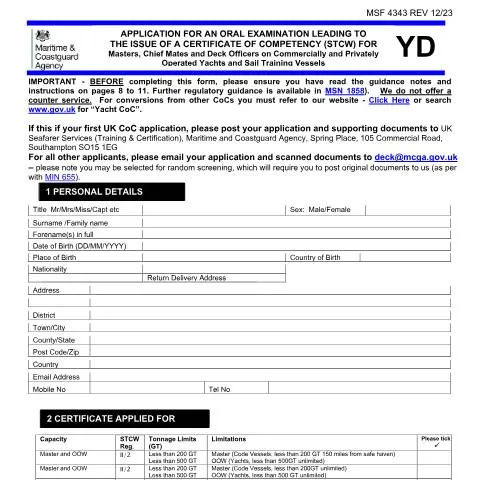
Master and Officer of the Watch (OOW) for vessels under 200 GT represents the foundational certification. This qualification permits command of code vessels under 200 GT within 150 miles of safe haven, plus OOW duties on yachts under 500 GT with unlimited geographical scope. Notably, this entry-level certification requires no sea service testimonials unless converting from an existing merchant navy unlimited OOW certificate.
The unrestricted version of this same qualification removes the 150-mile limitation for code vessel command whilst maintaining the same tonnage restrictions. This subtle but significant difference affects employment opportunities on charter operations requiring extended offshore passages.
Advanced Officer Positions
The OOW Yachts under 3000 GT certification demands substantial sea service commitment—36 months onboard yacht service including minimum 365 days seagoing service on vessels 15 metres or over in load line length. This breaks down into 250 days actual sea service plus 115 days combining actual sea service, standby service, or yard service under specific conditions.
Standby service calculations include particular restrictions: maximum 14 consecutive days counted at one time, with standby periods never exceeding the previous voyage duration. Yard service contributions cap at 90 days continuously or in separate periods, requiring Training Record book completion unless the candidate demonstrates 36 months actual sea service on vessels over 24 metres.
Command Qualifications
| Certificate Type | Tonnage Limit | Sea Service Requirement | Prerequisite Certification |
|---|---|---|---|
| Master Yachts | Under 500 GT | 12 months as Deck Officer, 120 days watchkeeping | OOW STCW Reg. II/1 (Yachts |
| Master Yachts | Under 3000 GT | 24 months as Deck Officer, 240 days watchkeeping | OOW STCW Reg. II/1 (Yachts |
| Chief Mate | Under 3000 GT | Upgrade pathway only | Existing deck certification |
Master qualifications for larger yachts impose additional geographical and vessel size requirements. The 3000 GT Master certification demands service in vessels 15 metres or over in load line length, including 12 months in vessels 24 metres or over, or six months in vessels 500 GT or more.
Professional Endorsement Requirements and Industry Verification
A unique aspect of yacht certification involves mandatory professional verification through recognised maritime organisations. All seafarers employed in the large yacht sector must have their sea service verified by either the Professional Yachting Association or Nautilus International before submitting applications to the MCA.
This verification process serves multiple purposes: ensuring service authenticity, maintaining industry standards, and providing professional networking opportunities. The endorsement requirement reflects the yacht industry's commitment to professionalism whilst acknowledging its distinct operational characteristics compared to merchant shipping.
Documentation Standards
Sea service verification demands meticulous record-keeping. Acceptable documentation includes discharge books, certified logbooks, and certificates of discharge. Foreign flag service receives equal consideration provided proper documentation and verifiability standards are met. The MCA emphasises that all relevant sea service must be listed, requiring continuation sheets when application forms prove insufficient.
Vessel details must specify load line length, gross tonnage, yacht type, and trading area using standardised codes: U for Unlimited, NC for Near Coastal Area. This precision enables accurate assessment of experience relevance to target certification levels.
Application Pathways and Administrative Procedures
The MCA operates distinct application channels depending on applicant status and certification history. First-time UK Certificate of Competency applicants must post applications with supporting documents to UK Seafarer Services in Southampton, whilst existing certificate holders can submit applications electronically to [email protected].
Electronic submission applicants should note potential selection for random screening, requiring original document posting consistent with MIN 655 procedures. This dual-track system balances administrative efficiency with verification security.
Counter Service Limitations
The MCA explicitly states it does not offer counter service for yacht certification applications. This policy reflects the complexity of documentation review and the need for thorough examination scheduling coordination. Applicants must plan accordingly for postal or electronic submission timelines.
Certificate conversions from other qualifications require specific guidance available through the gov.uk "Yacht CoC" search function, acknowledging the varied international certification landscape affecting yacht industry professionals.
Examination Structure and Assessment Criteria
Yacht deck certifications require oral examinations assessing practical knowledge, regulatory understanding, and operational competency. The examination structure varies according to target certification level, with higher qualifications demanding more comprehensive assessment.
Candidates seeking Master Code Vessel endorsements alongside OOW qualifications must pass additional oral examinations. This modular approach allows progressive qualification building whilst ensuring specific competency validation for different operational contexts.
STCW Compliance Framework
All certifications align with International Convention on Standards of Training, Certification and Watchkeeping (STCW) requirements, ensuring international recognition and employment mobility. Regulation II/1 and II/2 standards govern different qualification levels, with specific tonnage limitations and geographical restrictions clearly defined.
The certification framework acknowledges yacht operations' unique characteristics whilst maintaining merchant shipping safety standards. This balance proves crucial for professional credibility and insurance compliance in the luxury yacht sector.
Career Progression Pathways and Strategic Planning
Understanding certification progression enables strategic career development within the yacht industry. Entry-level qualifications provide foundation experience whilst higher certifications unlock command opportunities and salary advancement.
The modular certification structure allows professionals to build qualifications incrementally, gaining practical experience between certification levels. This approach proves particularly valuable given the substantial sea service requirements for advanced qualifications.
Conversion Opportunities
Professionals holding merchant navy qualifications may convert to yacht certifications under specific conditions. The 3-month seagoing service requirement for merchant OOW unlimited conversions acknowledges different operational contexts whilst ensuring yacht-specific competency development.
Conversion pathways reflect the MCA's recognition that yacht operations, whilst sharing fundamental seamanship principles with merchant shipping, involve distinct operational considerations including guest services, charter operations, and luxury vessel maintenance standards.
Regulatory Context and Industry Standards
The yacht certification framework operates within broader maritime regulatory structures whilst addressing industry-specific requirements. MSN 1858 provides detailed regulatory guidance complementing application procedures, ensuring comprehensive understanding of professional obligations.
Form MSF 4343 serves as the primary application instrument, with revision 12/23 reflecting ongoing regulatory updates. Regular form revisions ensure alignment with evolving international standards and industry best practices.
Documentation and Record Management
Certificate holders must maintain comprehensive service records throughout their careers, supporting future applications and demonstrating continuous professional development. The detailed sea service recording requirements establish professional accountability whilst enabling career progression tracking.
Existing certificate holders must submit current certifications with new applications, enabling the MCA to assess qualification progression and ensure appropriate certification pathways. This integrated approach maintains professional standards whilst supporting career advancement within the yacht industry.
Professional Impact and Industry Recognition
Deck yacht certificates carry significant weight within the international yachting community, affecting employment opportunities, salary negotiations, and professional credibility. Charter management companies, private yacht owners, and crew agencies recognise MCA certifications as gold standard qualifications.
The certification's value extends beyond immediate employment benefits, establishing professional networks and continuing education opportunities. Certified professionals often find enhanced access to industry training programmes, professional associations, and career advancement mentoring.
Insurance considerations also favour properly certified crew members, with many yacht insurance policies requiring specific certification levels for coverage validity. This regulatory requirement transforms certification from career enhancement to operational necessity, emphasising the qualification's fundamental importance within professional yacht operations.
The rigorous assessment standards and comprehensive experience requirements ensure certificate holders possess genuine competency rather than merely academic knowledge. This practical focus maintains industry confidence in certified professionals whilst supporting the British maritime sector's international reputation for excellence.
Alternative Pathways and Recognition of Prior Experience
The Maritime and Coastguard Agency recognises that experienced mariners may have acquired relevant competencies through different routes than the standard commercial pathway. Several alternative mechanisms exist for demonstrating equivalent knowledge and practical skills for deck yacht certification.
Commercial to Yacht Conversion Routes
Holders of valid commercial certificates of competency can often convert to equivalent yacht qualifications with reduced assessment requirements. Master Mariner unlimited certificate holders typically qualify for direct conversion to Master Yacht 500GT or above, subject to completing specific yacht-focused modules covering luxury vessel operations, guest safety protocols, and recreational navigation practices.
Chief Mates with appropriate tonnage endorsements may convert to Officer of the Watch Yacht certificates after demonstrating familiarity with yacht-specific equipment and operational procedures. The conversion process requires submission of original commercial certificates alongside evidence of yacht-relevant sea time, which must be verified through official discharge books or employer declarations on company letterhead.
Military and Naval Experience Recognition
Former Royal Navy personnel with appropriate deck qualifications may qualify for accelerated assessment pathways. Navigation officers holding Bridge Watchkeeping Certificates or equivalent naval qualifications can often demonstrate competency equivalence, particularly for electronic navigation systems and collision avoidance procedures common to both military and civilian vessels.
Military experience documentation must include detailed service records showing specific duties, vessel types, and operational areas. The MCA evaluates each application individually, considering factors such as command responsibility, navigation equipment familiarity, and demonstrated decision-making under challenging conditions. Former naval officers should expect additional assessment in commercial maritime law and international regulations specific to civilian yacht operations.
Overseas Qualification Recognition
International certificate holders may qualify for UK yacht certificates through mutual recognition agreements or equivalence assessments. European Economic Area qualifications generally receive favourable consideration under retained recognition provisions, though post-Brexit procedures require individual evaluation of training standards and competency frameworks.
Applicants with qualifications from major maritime nations including Australia, New Zealand, Canada, or Singapore should provide certified translations of certificates alongside detailed curriculum documentation from issuing authorities. The assessment process examines training hour requirements, practical assessment standards, and ongoing professional development obligations to ensure equivalence with UK standards.
Specialised Endorsements and Additional Competencies
Beyond basic deck yacht certificates, several specialised endorsements enhance operational capabilities and may be required for specific vessel types or operational areas. These additional qualifications demonstrate advanced competencies in particular aspects of yacht operations.
Dynamic Positioning Operations
Yachts equipped with dynamic positioning systems require certified operators holding appropriate DP certificates. The International Marine Contractors Association (IMCA) scheme provides recognised standards, with DP Basic, DP Advanced, and DP Expert levels corresponding to different system complexities and operational requirements.
DP training combines theoretical knowledge of positioning principles, equipment operation, and emergency procedures with practical simulator exercises. Training providers must hold MCA approval for DP courses, ensuring compliance with international standards and industry best practices. Certificate holders must maintain competency through regular refresher training and documented operational experience.
High-Speed Craft Operations
Yachts capable of speeds exceeding 30 knots require additional certification under the High Speed Craft Code. Officers must complete specialised training covering high-speed navigation techniques, stability considerations, and emergency response procedures specific to fast vessel operations.
The training addresses unique challenges including reduced reaction times, increased stopping distances, and enhanced weather sensitivity affecting high-speed operations. Practical components include simulator exercises replicating high-speed scenarios and emergency situations requiring rapid decision-making and precise vessel control.
Passenger Yacht Endorsements
Commercial yachts carrying paying passengers require additional endorsements demonstrating competency in passenger safety management, crowd control, and emergency evacuation procedures. The training covers regulatory requirements under the Passenger Yacht Code, including passenger safety briefings, muster procedures, and coordination with emergency services.
Passenger vessel operations training includes practical exercises in emergency scenarios, communication techniques for managing passenger behaviour during incidents, and coordination of abandon ship procedures. Officers must demonstrate competency in managing passenger safety equipment, conducting safety drills, and maintaining accurate passenger manifests and safety records.
Continuing Professional Development and Certificate Maintenance
Maintaining valid deck yacht certificates requires ongoing professional development and regular renewal procedures. The MCA mandates specific training requirements and documented experience to ensure certificate holders maintain current competency levels throughout their careers.
Mandatory Refresher Training Requirements
All deck yacht certificates require renewal every five years, with mandatory refresher training in specific competency areas. Basic Safety Training must be renewed through approved courses covering personal survival techniques, fire prevention and firefighting, elementary first aid, and personal safety and social responsibilities.
Medical care training requires renewal through updated courses reflecting current best practices and regulatory requirements. Advanced medical care certificates demand more frequent renewal, typically every three years, with enhanced training covering emergency medical procedures, pharmaceutical management, and coordination with shoreside medical facilities.
Radar and navigation equipment training must reflect technological advances and regulatory changes. Refresher courses address updates to electronic navigation systems, collision avoidance procedures, and international regulatory amendments affecting yacht operations. The training ensures officers maintain proficiency with evolving technology and current operational procedures.
Continuous Professional Development Documentation
Certificate holders must maintain comprehensive records demonstrating ongoing professional development and operational experience. The MCA requires evidence of continued competency through documented sea service, completed training courses, and professional development activities relevant to yacht operations.
Sea service documentation must specify vessel types, operational areas, and specific duties performed during each engagement. Employers should provide detailed service letters confirming the nature of duties, performance standards achieved, and any additional responsibilities undertaken beyond basic certificate requirements.
Professional development records should include attendance at industry conferences, completion of additional training courses, and participation in professional maritime organisations. The MCA values evidence of commitment to maintaining current knowledge of industry developments, regulatory changes, and technological advances affecting yacht operations.
Career Progression and Advanced Qualifications
Experienced officers may pursue advanced qualifications enabling progression to senior positions aboard larger or more complex vessels. Master Yacht Unlimited certificates require extensive sea service, advanced training, and demonstrated competency in all aspects of yacht operations and management.
The progression pathway typically requires documented experience in increasingly responsible positions, evidence of successful completion of complex voyages, and additional training in areas such as commercial operations, crew management, and regulatory compliance. Senior positions often require specialised knowledge of flag state requirements, port state control procedures, and international yacht regulations.
Advanced certificate holders should consider pursuing additional qualifications in maritime law, business management, or specialised technical areas enhancing their professional capabilities. The yacht industry increasingly values officers combining traditional maritime competencies with modern business skills and international regulatory knowledge.