Unlocking the Seas: The Deck Tug Certificate of Competency Explained
Navigating the waters of the maritime industry requires not just skill, but also formal recognition of competence. The Deck Tug Certificate of Competency (CoC) from the Maritime and Coastguard Agency (MCA) is essential for those who aspire to captain or serve on tugboats. Understanding the nuances of obtaining this certification can significantly impact one's maritime career. This guide delves into the intricacies of the application process, the conditions for eligibility, and the certificate’s value.
Who is Eligible to Obtain the Deck Tug Certificate?
The path to attaining a Deck Tug CoC isn’t a mere formality; it’s anchored in defined eligibility criteria. Here’s a detailed overview of who can apply and what prerequisites are necessary:
Age and Experience Requirements
- Minimum Age: Applicants must be at least 18 years old.
- Sea Service: A requisite number of sea service days is mandatory, which varies based on the capacity they seek. This experience must be documented thoroughly with testimonials.
Types of CoCs
The MCA issues different types of CoCs based on the applicant's experience and the size of the vessels they wish to operate:
- Officer of the Watch (OOW) Tugs: For those with less than 500 GT or less than 3000 GT.
- Master Tugs: For those wishing to operate tugs under similar tonnage limits.
A Step-by-Step Guide to the Application Process
Acquiring the Deck Tug CoC involves systematic steps, ensuring that all necessary documents are in order and submitted correctly. Here’s a detailed breakdown:
Initial Preparation
Before submitting your application, it’s crucial to gather the following:
- Discharge Book or Certificates of Discharge
- Sea service testimonials documenting significant sea time
- Valid Medical Fitness Certificate, attesting to your capabilities to work at sea
- Two recent passport-sized photographs
- Evidence of all necessary STCW (Standards of Training, Certification, and Watchkeeping) training
Submission of Application
Applications can be submitted via two methods depending on the applicant's circumstances:
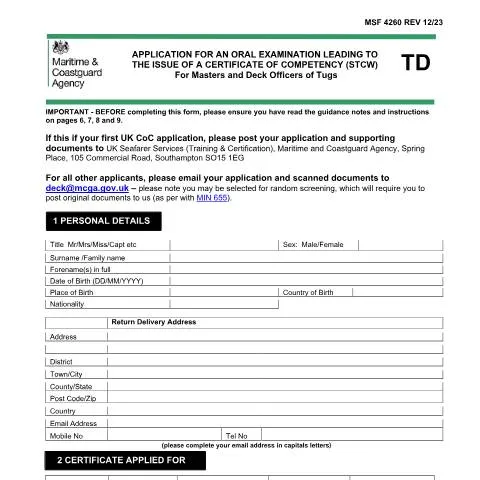
- First-Time Applicants: Must send the complete application and documents via post to the MCA at UK Seafarer Services, Southampton.
- Returning Applicants: Are advised to email their scanned application documents to the designated MCA email for processing.
Post-Submission Process
After submission, applicants may be selected for random screening. In such cases, original documents must be mailed to the MCA. Timeliness and accuracy in documentation can significantly expedite the processing time.
The Legal Weight of the Deck Tug Certificate
The Deck Tug CoC is not merely a piece of paper; it carries considerable legal weight and professional recognition.
What Does the Certificate Entail?
- Official Recognition: It serves as proof of the holder's competency and ability to operate tugboats within specified limits.
- International Validity: The CoC is recognized internationally, allowing the holder to work on vessels registered in other countries, subject to local regulations.
Legal Framework
The issuance of the CoC aligns with regulations set forth under UK law, notably the Merchant Shipping and Fishing Vessels Act and STCW 1978, ensuring that those who hold a CoC have undergone rigorous training and evaluation.
Validity and Renewal of the Deck Tug Certificate
Much like a driving license, the Deck Tug CoC has a limited validity period, necessitating renewal to maintain its active status.
Duration of Validity
Typically, the CoC remains valid for five years from the date of issue. However, holders must ensure that they remain compliant with any further training or refresher courses mandated by the MCA.
Renewal Process
Renewal involves submitting a new application, accompanied by proof of continued sea service and any additional certifications acquired. This process underscores the need for maritime professionals to stay updated with the latest safety and operational standards.
Handling Loss, Errors, and Disputes
Navigating the administrative waters can sometimes lead to challenges such as lost certificates, errors in documentation, or disputes regarding eligibility. Here's how to address these issues effectively.
In Case of Loss
If your Deck Tug CoC is lost or destroyed, it’s imperative to report the loss to the MCA immediately. A formal application for a duplicate certificate must be submitted, detailing the circumstances surrounding the loss.
Correcting Errors
Discrepancies in personal information or sea service records must be rectified promptly. Contacting the MCA directly to submit corrections rather than waiting for the renewal period is advisable, as errors might affect your eligibility.
Challenging Decisions
If an application is rejected, the MCA provides guidelines for appealing the decision. Applicants can present additional evidence or request a review of the decision made, ensuring they have recourse if they believe they meet the eligibility criteria.
Expanding Career Opportunities with Your CoC
Holding a Deck Tug CoC opens numerous doors in the maritime sector. With this certification, individuals are better positioned for various roles, enhancing both career prospects and earning potential.
Career Pathways
- Master of Tugs: Commanding a tugboat, which requires not only leadership skills but also in-depth knowledge of maritime navigation.
- Deck Officer Positions: Assisting in navigation and operations aboard larger vessels that may employ tugs during docking or undocking procedures.
Continuing Professional Development
As part of maintaining validity, continuous professional development through additional courses can be beneficial. Engaging in further training can enhance skills and qualifications, making candidates more appealing to employers.
Conclusion: The Path Ahead
Obtaining a Deck Tug Certificate of Competency is a significant milestone in a maritime career. The process may appear daunting, but with careful planning and a thorough understanding of the requirements, prospective mariners can navigate their way to success. From understanding eligibility criteria to managing lost certificates effectively, this guide serves to equip applicants with the necessary knowledge to thrive in the maritime industry. By committing to professional development and compliance with maritime regulations, certified professionals can ensure a rewarding career at sea.
Understanding the Deck Tug Certificate of Competency: Requirements and Qualifications
The Deck Tug Certificate of Competency is a crucial qualification for individuals seeking to operate tug vessels within UK waters. The Maritime and Coastguard Agency (MCA) is responsible for the regulation and issuance of this certificate. Before applying, it’s important to understand the essential requirements and qualifications needed to be eligible for the certificate.
To qualify for the Deck Tug Certificate, applicants typically need to prove satisfactory sea service experience. This experience should total at least 12 months on vessels that are at least 15 gross tonnage. It's also essential to have completed specific training courses, including basic safety training and the relevant STCW (Standards of Training, Certification, and Watchkeeping) courses. These courses ensure that applicants possess the necessary skills in firefighting, survival at sea, first aid, and other critical areas. Additionally, applicants must pass a medical examination conducted by an MCA-approved doctor to ensure they meet the required health standards.
It is paramount that candidates also have a clear understanding of the operational and safety protocols specific to tug operations, as well as navigational skills suitable for the area where they intend to work. Furthermore, evidence of proficiency in English is important as it is the primary language of communication at sea. The MCA may require proof of a valid English Language Certificate or prior education in the English language.
The Application Process: Step-by-Step Guide
Applying for the Deck Tug Certificate of Competency involves several steps that must be meticulously followed to ensure a smooth process. The following steps outline the application procedure:
- Gather Necessary Documentation: Before starting the application process, collect all required documents, including proof of sea service, training certificates, medical examination reports, and identification documents. Ensure that these documents are up-to-date and properly certified as needed.
- Complete the Application Form: The MCA provides specific application forms for the Deck Tug Certificate. Fill out the appropriate form accurately, ensuring that all sections are completed in clear, legible handwriting. Be mindful of the requirement to sign the declaration at the end of the form.
- Submit Your Application: Once the application form is completed, along with all necessary documentation, submit your application either via post or in person to the MCA’s Maritime Qualifications and Standards team. Ensure that you retain copies of everything submitted for your records.
- Pay the Application Fee: The application for the Deck Tug Certificate incurs a fee, which must be paid at the time of submission. Check the MCA website for current fee amounts and payment methods. Ensure you obtain a receipt for your payment as proof.
- Await Assessment and Notification: After submission, the MCA will assess your application. This process can take several weeks. You will receive notification regarding the outcome of your application via the contact method provided. If approved, you will receive your Deck Tug Certificate by post.
Should any issues arise during the assessment, the MCA may contact you for additional information or clarification. It is crucial for applicants to respond promptly to such requests to avoid delays in certification.
Maintaining Your Deck Tug Certificate: Renewal and Continuing Competence
Once you have obtained the Deck Tug Certificate of Competency, it is essential to understand the requirements for maintaining and renewing your qualification. Like many maritime certifications, the Deck Tug Certificate has a validity period, and maintaining ongoing competency is vital.
The Deck Tug Certificate typically needs to be renewed every five years. To renew your certificate, you must demonstrate continued sea service and undertake refresher training if required. The MCA will provide guidance on what constitutes acceptable sea service, but generally, this requires a minimum number of days worked on tug vessels or similar operations during the validity of your certificate.
Furthermore, ongoing training is critical. Engaging in continual professional development through additional courses or training sessions can enhance your skills and knowledge, which is beneficial both for your career and for safety at sea. The MCA may also encourage or require additional training to stay current with the latest regulations and best practices in marine operations.
It's also advisable to keep abreast of any changes in legislation or procedures that may impact your certification. Regularly checking the MCA website or subscribing to relevant maritime newsletters can be excellent ways to stay informed. Networking with other maritime professionals and attending industry seminars are also effective methods to maintain knowledge and competency.