When Corporate Transparency Meets Practical Reality: Understanding PSC01 Requirements
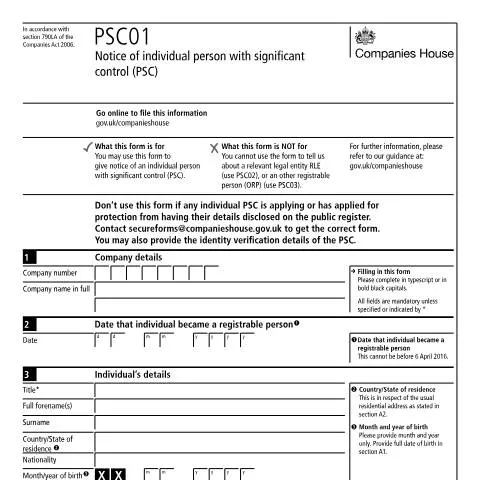
The landscape of corporate transparency in the UK shifted dramatically with the introduction of persons with significant control (PSC) requirements. For companies navigating these waters, the PSC01 form represents a critical checkpoint where legal obligations meet administrative practice. This notice mechanism serves as the formal channel through which companies declare the individuals who exercise meaningful control over their operations, transforming abstract ownership structures into concrete, publicly accessible information.
The PSC01 form specifically addresses individual persons who meet the statutory thresholds for significant control. This distinction proves crucial, as Companies House maintains separate notification pathways for different types of controlling entities. While PSC01 handles natural persons, relevant legal entities require PSC02, and other registrable persons demand PSC03—a tripartite system that reflects the complex reality of modern corporate structures.
Understanding when and how to deploy PSC01 effectively requires grasping both the technical requirements and the practical implications of disclosure. The form doesn't merely collect data; it creates a permanent public record that shapes how the company appears to regulators, creditors, and the wider business community.
Decoding the Thresholds: What Constitutes Significant Control
The PSC01 form operates on precise percentage thresholds that determine when an individual crosses the line from ordinary shareholder to person with significant control. These boundaries aren't arbitrary—they reflect legislative intent to capture meaningful influence while avoiding administrative overload.
Share Ownership Thresholds
The form presents three distinct bands for share ownership, each carrying different implications:
| Threshold Band | Ownership Range | Typical Scenarios |
|---|---|---|
| Tier 1 | More than 25% but not more than 50% | Significant minority stakes, joint venture partners |
| Tier 2 | More than 50% but less than 75% | Controlling majorities with other substantial shareholders |
| Tier 3 | 75% or more | Dominant ownership, closely-held companies |
These bands apply to both direct and indirect holdings. Indirect control often catches companies off-guard, particularly in corporate group structures where an individual might not directly hold shares but exercises control through intermediate entities. The legislation deliberately captures these arrangements to prevent circumvention through complex ownership chains.
Voting Rights and Director Appointment Powers
Beyond share ownership, PSC01 addresses two additional control mechanisms. Voting rights follow identical percentage bands to shareholding, recognising that control can exist even where share ownership and voting power diverge—common in companies with multiple share classes or weighted voting arrangements.
The right to appoint or remove a majority of directors represents a different type of control entirely. This provision operates on a simple yes/no basis rather than percentage bands, acknowledging that director appointment rights can confer effective control regardless of shareholding levels. Such arrangements frequently appear in investment agreements, articles of association, or shareholder agreements.
The Catch-All: Significant Influence or Control
Perhaps most intriguingly, PSC01 includes a residual category for individuals exercising "significant influence or control" without meeting the specific numerical thresholds. This provision only applies when none of the other conditions are satisfied, serving as a safety net to capture unusual control arrangements that might otherwise escape the regime.
This category demands careful judgment calls. It might encompass situations where an individual exercises control through contractual arrangements, holds decisive influence despite modest shareholdings, or benefits from informal but effective control mechanisms. Companies must evaluate these arrangements honestly, as the consequences of under-disclosure can be severe.
Navigating the Identity Verification Landscape
The PSC01 form reflects Companies House's evolving approach to identity verification, incorporating optional but increasingly important verification elements. Section A4 introduces the concept of verified identity, linking PSC notifications to the broader identity verification infrastructure.
When a PSC has completed identity verification with Companies House, they receive an 11-character personal code. Including this code in the PSC01 submission strengthens the notification's credibility and may streamline future interactions with Companies House. However, verification remains optional for PSC01 purposes, unlike certain other Companies House procedures where verification is mandatory.
Name Matching Considerations
The form acknowledges practical realities around name variations. Individuals might use different versions of their name across different contexts—legal names versus preferred names, translated names, or names reflecting cultural naming conventions. PSC01 provides specific categories for these variations:
- Legally changed names where formal name changes have occurred
- Preferred names reflecting common usage rather than legal documentation
- Translation or naming convention differences particularly relevant for international individuals
- Prefer not to say for sensitive circumstances
These options prevent administrative friction while maintaining data integrity, recognising that rigid name matching requirements could create barriers for legitimate notifications.
Address Requirements: Balancing Transparency with Privacy
PSC01's address requirements embody the tension between transparency and privacy that runs throughout the PSC regime. The form distinguishes between service addresses (publicly disclosed) and usual residential addresses (held privately), creating a two-tier disclosure system.
Service Address Strategy
The service address appears on the public register and serves as the official contact point for the PSC. Companies can use various approaches:
- The company's registered office address
- The individual's actual residential address
- A professional service address
- Any other appropriate address where documents can be served
Choosing the company's registered office often provides the simplest solution, centralising correspondence and maintaining consistency across company records. However, this approach may not suit all circumstances, particularly where the PSC prefers direct communication or operates from a different location.
Residential Address Protection
The usual residential address remains confidential, held by Companies House but not disclosed on the public register. This information serves regulatory and law enforcement purposes while protecting individual privacy. However, the form includes important restrictions: residential addresses cannot be PO Box numbers or similar arrangements, ensuring that genuine contact information is available when needed.
Section 790ZF of the Companies Act 2006 provides additional protection for individuals facing serious risk if their residential address becomes available to credit reference agencies. PSCs seeking this protection must apply separately, and the PSC01 form includes special handling procedures for such cases, including alternative postal arrangements.
Timing Considerations and the 2016 Watershed
PSC01 notifications operate within specific temporal constraints that reflect the regime's implementation timeline. The form cannot record PSC status before 6 April 2016, marking the regime's commencement date. This limitation creates practical challenges for companies with long-established ownership structures, requiring careful consideration of when current PSCs actually became registrable persons.
The "date became a registrable person" field demands precision. This might not align with when someone first acquired shares or influence—the relevant date is when they first met the PSC criteria under the current regime. For individuals who held qualifying interests before April 2016, the registrable date becomes 6 April 2016 itself, regardless of their actual acquisition date.
Ongoing Notification Obligations
PSC01 represents just one element in the broader PSC notification ecosystem. Once filed, companies must maintain current PSC information, updating records when circumstances change. This might involve:
- Changes in ownership percentages that cross threshold boundaries
- Alterations to voting rights or director appointment powers
- Address changes for service or residential addresses
- Name changes or other personal details
- Cessation of PSC status
Each change triggers specific notification requirements, with PSC01 serving as the initial foundation upon which subsequent updates build.
Corporate Group Complexities and Indirect Control
PSC01's treatment of indirect control creates particular challenges for corporate groups and complex ownership structures. The legislation deliberately captures control exercised through chains of entities, preventing sophisticated structures from obscuring ultimate beneficial ownership.
Consider a scenario where Individual A owns 100% of Company B, which in turn owns 30% of Company C. Individual A becomes a PSC of Company C through indirect shareholding, triggering PSC01 notification requirements. The form must reflect this indirect relationship, requiring companies to trace ownership chains and calculate cumulative control positions.
Calculation Methodologies
Determining indirect control percentages involves complex calculations, particularly where multiple intermediate entities exist or where control operates through different mechanisms. Companies must aggregate direct and indirect interests, considering:
- Shareholdings through subsidiary companies
- Trust arrangements where individuals are beneficiaries
- Partnership interests that confer corporate control
- Contractual rights that effectively determine company decisions
These calculations require legal and accounting expertise, as the methodology can significantly impact whether PSC thresholds are met and which disclosure bands apply.
Interaction with Protected Disclosure Regimes
The PSC01 form explicitly acknowledges circumstances where standard disclosure might prove inappropriate or dangerous. The form's opening warnings direct users away from PSC01 when individuals have applied for or received protection from public disclosure, requiring alternative submission channels.
Protected disclosure applications typically arise where individuals face genuine security risks from public disclosure of their PSC status. This might include:
- Individuals subject to credible threats or harassment
- Public figures whose safety could be compromised
- Persons involved in sensitive commercial or political activities
- Individuals from jurisdictions where business interests create personal risks
When protection applies, Companies House operates alternative processes that maintain regulatory transparency while safeguarding individual security. The PSC01 form cannot accommodate these arrangements, requiring companies to engage with specialist secure submission procedures.
Timing Coordination
The intersection between PSC01 submissions and protection applications requires careful timing coordination. The form notes that where section 790ZF exemptions are being sought concurrently with PSC01 submission, both documents must be posted together to the alternative Cardiff address. This coordination prevents inadvertent disclosure during processing transitions.
Practical Implementation Strategies
Successfully deploying PSC01 within broader corporate compliance programmes requires systematic approaches that integrate legal requirements with practical business operations. Companies benefit from establishing clear procedures that identify PSC situations, gather necessary information, and maintain ongoing compliance.
Information Gathering Protocols
Effective PSC01 completion begins with comprehensive information gathering. Companies need reliable processes to obtain:
- Complete personal details including full names, nationalities, and birth information
- Accurate address information distinguishing between service and residential addresses
- Detailed ownership analysis covering direct and indirect interests
- Control mechanism documentation including voting rights and director appointment powers
- Timeline verification establishing when PSC status commenced
This information often requires coordination across multiple stakeholders—shareholders, directors, legal advisers, and company secretaries. Establishing clear responsibility chains prevents information gaps that could compromise compliance.
Quality Assurance Measures
Given PSC01's public disclosure implications, robust quality assurance becomes essential. Companies should implement verification procedures that confirm:
- Mathematical accuracy of ownership calculations
- Consistency between PSC01 submissions and internal records
- Compliance with address disclosure preferences
- Appropriate handling of protected information
- Coordination with other Companies House filings
These measures prevent costly corrections and potential regulatory scrutiny arising from inaccurate initial submissions.
Long-term Compliance Considerations
PSC01 submissions create ongoing obligations that extend far beyond initial filing. The public nature of PSC information means that errors, omissions, or inconsistencies can have lasting commercial and regulatory consequences.
Companies must establish monitoring systems that track changes in PSC circumstances, ensuring that the public register remains current and accurate. This monitoring encompasses not only obvious changes like share transfers, but also subtler developments such as corporate reorganisations that might affect indirect control calculations.
The PSC regime represents a fundamental shift in corporate transparency expectations. PSC01 serves as companies' primary tool for engaging with these requirements, but its effective use demands sophisticated understanding of both technical requirements and broader compliance strategies. Success requires treating PSC01 not as an isolated administrative task, but as a cornerstone of modern corporate governance and transparency obligations.
The form's evolution—evidenced by its version 4.0 status—reflects Companies House's commitment to refining these processes based on practical experience. Companies that invest in understanding PSC01's nuances position themselves to navigate not only current requirements but also future developments in the UK's corporate transparency landscape.