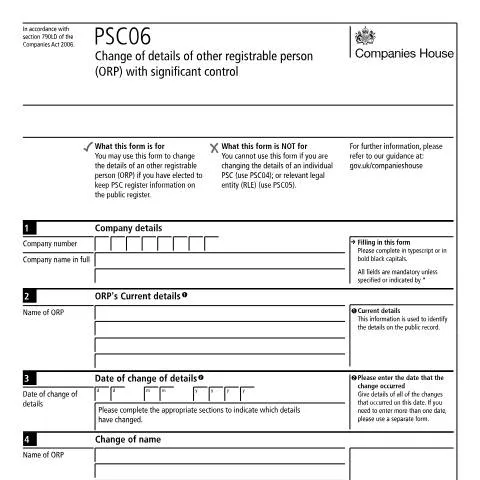
When Corporate Structures Evolve: Tracking Changes Beyond Individual PSCs
Company ownership structures rarely remain static. While most business owners are familiar with reporting changes to individual people with significant control (PSCs), the landscape becomes more intricate when dealing with other registrable persons (ORPs) – entities that don't fit the standard individual PSC category but still wield substantial influence over UK companies. The PSC06 form addresses this specific scenario, providing a structured pathway for companies that have elected to maintain their PSC register information on the public record to update details about these complex controlling entities.
Unlike straightforward individual PSCs, ORPs encompass a diverse range of legal structures: foreign companies not subject to PSC disclosure requirements, government entities, certain partnerships, and other legal arrangements that exercise significant control but fall outside conventional classification. When these entities undergo material changes – whether in their legal form, governing jurisdiction, control mechanisms, or operational structure – Companies House requires precise documentation through this dedicated notification process.
Decoding the ORP Classification: Beyond Traditional Ownership Models
The concept of other registrable persons emerges from the Companies Act 2006's comprehensive approach to beneficial ownership transparency. While individual PSCs and relevant legal entities (RLEs) have their own reporting mechanisms through PSC04 and PSC05 forms respectively, ORPs occupy a distinct regulatory space designed to capture complex ownership arrangements that might otherwise escape disclosure requirements.
Identifying When an Entity Qualifies as an ORP
An entity becomes an ORP when it exercises significant control over a UK company but doesn't fall within the individual PSC or RLE categories. This typically occurs with:
- Foreign corporations from jurisdictions without equivalent PSC disclosure regimes
- Government departments and public sector entities with controlling interests
- Unincorporated associations that don't constitute legal persons under their governing law
- Complex trust arrangements where traditional beneficial ownership concepts become blurred
- International organisations with specific legal immunities or structures
The determination requires careful analysis of both the entity's legal nature under its home jurisdiction and the specific mechanisms through which it exercises control over the UK company. This dual consideration often creates scenarios where seemingly similar entities may be classified differently depending on their precise legal characteristics and control methodologies.
The Threshold Tests for Significant Control
ORPs must meet identical significant control thresholds to individual PSCs, but the application can be more complex due to their organisational nature. The form recognises four primary control mechanisms:
| Control Type | Threshold | ORP-Specific Considerations |
|---|---|---|
| Share ownership | More than 25% | May be held through complex subsidiary structures |
| Voting rights | More than 25% | Could include special voting arrangements or veto rights |
| Director appointment rights | Majority of board | May operate through institutional nomination processes |
| Significant influence | Substantial practical control | Often the most relevant test for governmental or institutional ORPs |
Navigating Complex Control Structures: Firms and Trusts
The PSC06 form acknowledges that ORPs frequently exercise control through intermediate structures, particularly firms that aren't legal persons and trust arrangements. These indirect control mechanisms require specific reporting protocols that reflect the layered nature of modern corporate ownership.
Firm-Mediated Control Arrangements
When an ORP exercises significant influence over a firm that isn't a legal person under its governing law, and that firm's members subsequently control the UK company, the reporting becomes multifaceted. The form requires identification of how the firm's members – acting in their capacity as such – meet the significant control thresholds.
This structure commonly appears with international law firms where partners collectively hold substantial stakes in UK subsidiaries, or professional partnerships governed by foreign law that don't constitute separate legal entities. The key distinction lies in capturing both the ORP's control over the intermediate firm and the firm members' control over the target company.
Trust-Based Control Mechanisms
Trust arrangements present particular complexity, as the form must accommodate the unique legal relationship between trustees, beneficiaries, and the underlying assets. When an ORP exercises significant influence over trust activities, and the trustees subsequently control a UK company, the reporting framework must capture this indirect but substantial control relationship.
The form's structure recognises that trustees act in their capacity as such – a crucial legal distinction that separates their role as trust administrators from any personal interests they might hold. This becomes particularly relevant with institutional trustees or professional trust companies where the individual trustees change regularly but the underlying control structure remains constant.
Procedural Requirements and Timing Considerations
The PSC06 notification process operates within strict temporal frameworks that reflect the dynamic nature of corporate control arrangements. Companies must understand not just what changes to report, but when those changes crystallise for reporting purposes.
The Confirmation Date Principle
A critical aspect of the PSC06 process involves the confirmation date – the point at which the company obtained definitive information about the change. This date may differ significantly from when the underlying change actually occurred, particularly with complex international structures where information flows can be delayed.
The form requires companies to identify three distinct temporal elements:
- The actual change date – when the modification to the ORP's details occurred
- The discovery date – when the company first became aware of the change
- The confirmation date – when the company obtained sufficient detail to complete the notification
This temporal framework acknowledges that companies may not immediately learn of changes to complex controlling entities, particularly those operating across multiple jurisdictions or through intricate legal structures.
Scope Limitations and Form Boundaries
The PSC06 form operates within defined boundaries that companies must respect to ensure compliance. It cannot be used for individual PSC changes (which require PSC04) or relevant legal entity modifications (requiring PSC05). This specificity means companies with mixed PSC populations may need to file multiple forms simultaneously to capture comprehensive changes occurring on the same date.
Additionally, the form only applies to companies that have elected to keep their PSC register information on the public register maintained by Companies House. Companies maintaining their own internal PSC registers follow different notification procedures and timelines.
Legal Form and Jurisdictional Change Scenarios
ORPs frequently undergo fundamental structural changes that affect their legal classification and regulatory treatment. The PSC06 form accommodates these transformations through dedicated sections addressing legal form modifications and governing law changes – scenarios that rarely apply to individual PSCs but commonly affect institutional or corporate controlling entities.
Legal Form Transformations
When an ORP changes its fundamental legal structure – such as a partnership converting to a corporation, or a government department being restructured as a public body – the implications extend beyond simple administrative updates. These changes can affect the entity's legal capacity, liability structure, and regulatory obligations, all of which may influence its relationship with the controlled UK company.
The form requires comprehensive documentation of such changes because they may alter the ORP's ability to exercise control or change the legal mechanisms through which that control operates. A government department that becomes a statutory corporation, for instance, may find its control exercised through different legal pathways even if the practical influence remains unchanged.
Governing Law Modifications
Changes in governing law represent particularly complex scenarios that can fundamentally alter an ORP's legal character. This might occur when an entity relocates its legal seat to a different jurisdiction, or when legislative changes in its home jurisdiction modify the legal framework under which it operates.
Such modifications require careful analysis because they may affect whether the entity continues to qualify as an ORP or whether it should be reclassified under different PSC categories. The form's structure allows companies to document these transitions while ensuring continuity in the beneficial ownership disclosure chain.
Authentication and Corporate Responsibility Framework
The PSC06 submission process operates within a robust authentication framework that reflects the serious regulatory implications of PSC disclosure. The form may only be authenticated by specific corporate officers or authorised individuals, ensuring that submissions carry appropriate corporate authority and accountability.
Authorised Signatories and Their Responsibilities
The range of permitted authenticators extends beyond traditional company officers to include various categories of corporate representatives and external professionals. Directors, company secretaries, and persons authorised under sections 270 or 274 of the Companies Act 2006 represent the standard authentication options, but the framework also accommodates insolvency practitioners, charity receivers, and other specialist roles that may assume corporate responsibilities in particular circumstances.
For Societas Europaea structures, the authentication requirements acknowledge the different corporate governance frameworks by allowing appropriate organ members to authenticate submissions, recognising that the traditional UK concept of directors may not directly translate to continental European corporate structures.
The Confirmation Requirement
A crucial procedural safeguard requires that companies obtain confirmation from the relevant ORP before submitting changes to their details. This requirement ensures that notifications are based on accurate, up-to-date information and helps prevent unauthorised or incorrect submissions that could mislead the public register.
The confirmation process becomes particularly important with international ORPs where communication may be complex or time-consuming. Companies must balance their obligation to submit timely notifications with their duty to ensure accuracy, often requiring proactive engagement with controlling entities to maintain current information.
Integration with Broader PSC Compliance Obligations
The PSC06 form operates as part of a comprehensive beneficial ownership disclosure regime that extends far beyond simple form submission. Companies must understand how ORP notifications integrate with their broader PSC compliance obligations, including ongoing monitoring duties and the maintenance of accurate records.
The election to keep PSC information on the public register – a prerequisite for using PSC06 – carries ongoing obligations that affect how companies manage their beneficial ownership compliance. This election cannot be easily reversed and commits companies to a specific disclosure pathway that influences their administrative processes and regulatory relationship with Companies House.
Regular review of ORP details becomes essential, particularly for companies with international or institutionally complex ownership structures. The form's framework assumes that companies maintain active monitoring of their controlling entities and can respond promptly to changes that affect the accuracy of public register information.
Understanding the PSC06 process requires appreciation of its position within the broader corporate transparency framework. While the form addresses specific technical requirements for ORP change notifications, its effective use depends on companies developing comprehensive beneficial ownership compliance systems that can identify, evaluate, and report changes across their entire PSC population, regardless of classification complexity.
Timing Considerations and Strategic Planning for PSC06 Submissions
The timing of your PSC06 submission can significantly impact both compliance obligations and strategic business considerations. Understanding when changes must be reported versus when they may be reported creates opportunities for better corporate governance and regulatory alignment.
Companies House requires PSC06 submissions within 14 days of the company becoming aware of the change, not necessarily when the change occurred. This distinction proves crucial for complex ownership structures where information flows may involve multiple intermediaries. For instance, if a trust beneficiary's details change but the trustee only learns of this three weeks later, the 14-day clock starts ticking from the trustee's knowledge, not the actual change date.
However, this timeline can create complications in practice. Consider scenarios where ownership changes occur close to the company's confirmation statement deadline. If you submit PSC06 just days before the confirmation statement is due, you may need to file an updated CS01 to reflect the new information, potentially creating duplicate administrative burden and fees.
Strategic timing becomes particularly relevant during corporate restructuring or acquisition processes. Companies undergoing due diligence often prefer to consolidate PSC changes rather than filing multiple PSC06 forms in quick succession. While this approach must still comply with the 14-day rule for each individual change, careful coordination can minimise administrative complexity.
The interaction between PSC06 timing and other regulatory obligations deserves attention. HMRC's beneficial ownership requirements under anti-money laundering regulations operate on different timelines, and maintaining consistency across these parallel obligations requires careful diary management. Companies subject to both regimes often establish internal protocols ensuring PSC changes trigger reviews of all relevant compliance calendars.
For companies with international ownership structures, time zone differences can complicate the 14-day calculation. When a change occurs in a different jurisdiction, companies must establish clear procedures for information transmission to ensure UK compliance deadlines are met consistently.
Late filing carries a £100 penalty, but more significantly, it can trigger enhanced scrutiny from Companies House, particularly if patterns of late submission emerge. Companies with good compliance records may receive more lenient treatment for isolated delays, whilst those with poor filing histories face increased regulatory attention.
Complex Ownership Scenarios and PSC06 Applications
Real-world ownership structures often present intricate scenarios that challenge straightforward PSC06 application. Understanding how the form applies across various complex arrangements ensures accurate compliance and avoids regulatory complications.
Trust arrangements frequently generate PSC06 requirements, but the specific circumstances determine which changes trigger filing obligations. When trust beneficiaries change, the impact on PSC status depends on whether the beneficiaries held significant control rights. For discretionary trusts, changes in the class of potential beneficiaries may not immediately affect PSC registration, but amendments to distribution criteria or trustee powers often do.
Partnership structures involving corporate partners create layered PSC obligations. When a partnership holds shares in a company, changes to the partnership's composition may cascade into PSC06 requirements for the underlying company. This becomes particularly complex with limited liability partnerships (LLPs) where member changes can alter the partnership's own PSC profile, subsequently affecting companies where the LLP has interests.
Employee benefit trusts (EBTs) and employee share schemes present unique PSC06 considerations. When share options vest or employee shareholdings cross percentage thresholds, PSC status may change. Companies operating such schemes must monitor both individual employee holdings and collective employee trust positions, as both can trigger PSC06 requirements under different circumstances.
Private equity and venture capital structures often involve multiple layers of holding companies, management companies, and investor vehicles. Changes at any level may require PSC06 submissions if they affect the ultimate control position. For instance, when a management company's directors change, this might alter who exercises significant control over portfolio companies, necessitating PSC06 submissions across multiple entities.
Family investment companies and family trusts create particularly nuanced scenarios. When family members' roles change – such as children reaching majority, marriage affecting beneficial ownership, or family members joining or leaving family councils – the PSC implications can be far-reaching. These changes often occur gradually and may not immediately trigger obvious PSC06 requirements, yet careful analysis frequently reveals reportable changes.
Cross-border ownership adds another layer of complexity. When foreign entities undergo restructuring, mergers, or regulatory changes in their home jurisdictions, UK subsidiaries must assess whether these changes affect PSC status. Different countries' corporate law concepts may not translate directly into UK PSC requirements, requiring careful legal analysis.
Dormant companies with PSCs present interesting edge cases. Even if the company conducts no business, changes to PSC details still require PSC06 submission. This catches many directors off-guard, particularly in group structures where holding companies may be dormant but still have active PSCs whose circumstances change.
Integration with Broader Corporate Governance and Compliance Frameworks
PSC06 submissions form part of a comprehensive corporate governance framework that extends well beyond simple Companies House compliance. Understanding these broader connections helps companies develop integrated approaches to beneficial ownership transparency and regulatory reporting.
The relationship between PSC registers and anti-money laundering (AML) obligations creates overlapping but distinct compliance requirements. While Companies House PSC information becomes publicly available, AML regulations require companies to maintain more detailed beneficial ownership information for their own records. PSC06 changes often trigger corresponding updates to internal AML records, but the reverse is not always true – internal AML record changes may not always require PSC06 submissions.
Financial services companies face additional complexity through Financial Conduct Authority (FCA) requirements regarding controllers and close links. Changes that trigger PSC06 submissions may simultaneously require FCA notifications under different timescales and thresholds. Firms must coordinate these obligations to avoid regulatory conflicts or gaps.
Listed companies subject to Disclosure and Transparency Rules (DTR) must consider how PSC changes interact with substantial shareholding notifications. While DTR and PSC regimes serve different purposes, changes that trigger PSC06 requirements may also require market notifications under different rules and timescales.
Tax considerations interweave with PSC06 obligations in several ways. Changes in control or ownership may trigger capital gains tax events, stamp duty obligations, or corporation tax group relief implications. Companies developing integrated compliance procedures often coordinate PSC06 submissions with tax planning to ensure all implications are considered simultaneously.
Data protection obligations under UK GDPR add another compliance layer. PSC06 submissions involve processing personal data of individuals with significant control, requiring appropriate legal bases and privacy protections. Companies must balance transparency obligations with data subjects' rights, particularly regarding data accuracy and retention periods.
Corporate secretarial best practices increasingly integrate PSC maintenance with broader governance activities. Annual governance reviews, director and secretary changes, and major corporate transactions all present opportunities to review and update PSC information proactively rather than reactively.
Risk management frameworks should incorporate PSC compliance as both a regulatory risk and a reputational risk. Companies with poor PSC compliance records may face increased scrutiny in other regulatory contexts, whilst those maintaining excellent standards often benefit from regulatory confidence in other areas.
Internal audit functions increasingly include PSC compliance in their review cycles. This involves not just checking form submissions but evaluating the underlying processes for identifying PSC changes, the accuracy of internal records, and the effectiveness of procedures for meeting filing deadlines.
Board reporting on PSC matters varies significantly between companies, but best practice suggests regular updates on PSC compliance status, particularly where ownership structures are complex or changing. This helps ensure board awareness of beneficial ownership transparency obligations and supports strategic decision-making around corporate structure changes.
The integration of PSC06 processes with digital transformation initiatives presents opportunities for improved compliance efficiency. Companies implementing new corporate secretarial systems often redesign their PSC monitoring processes simultaneously, creating automated alerts and streamlined filing procedures that reduce compliance burden whilst improving accuracy.