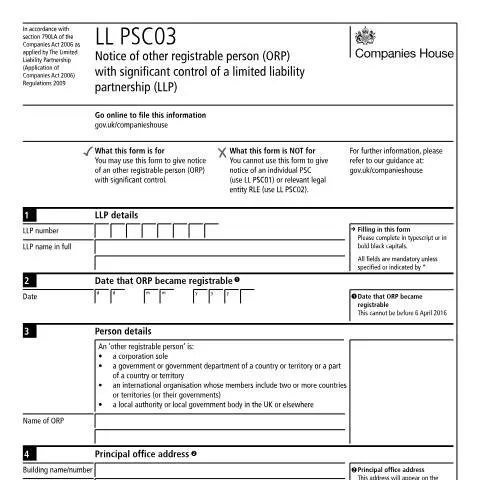
A Deep Dive into the LL PSC03 Document: Unpacking the Notice of Other Registrable Persons
In the complex world of business registration within the UK, understanding the intricacies of the documentation process is crucial. One such document is the LL PSC03, which serves a specific purpose in the realm of Limited Liability Partnerships (LLPs). This article aims to elucidate the contents of the LL PSC03 form, its essential requirements, and its significance in the broader context of Companies House regulations.The Essence of the LL PSC03 Document
The LL PSC03 document is not merely a form; it's a formal notice that provides critical details about an Other Registrable Person (ORP) who has significant control over an LLP. But what does this really mean? The term “significant control” pertains to a variety of rights and powers held by individuals or entities, such as the ability to influence or control the management and policies of the LLP. Here are the key components this document encompasses:- Identification of the ORP: The document requires specific details about the ORP, such as their name, address, and the date they became registrable.
- Nature of Control: A critical section of the document outlines how the ORP exerts significant control, including ownership rights and voting powers.
- Legal Framework: It operates within the guidelines set by the Companies Act 2006 and the Limited Liability Partnership Regulations, solidifying its legality and acceptance.
Who Falls Under the Umbrella of Other Registrable Persons?
Understanding who qualifies as an ORP is essential for anyone involved with an LLP. The definition encompasses a range of entities which include:- Corporation Sole: A unique entity consisting of a single member.
- Government Departments: Any governmental body from the UK or other territories can be classified as an ORP.
- International Organizations: Entities that include members from multiple countries.
- Local Authorities: Any local government body, either in the UK or abroad, fits this category.
The Limits of the LL PSC03 Document
While the LL PSC03 is a vital instrument for reporting significant control, it is important to recognize its limitations. This document is specifically tailored for ORPs, and it cannot be employed to notify Companies House of:- Individuals classified as Persons with Significant Control (PSCs) – for this purpose, one would need to use the LL PSC01.
- Relevant Legal Entities (RLEs) – for these entities, the LL PSC02 is applicable.
Navigating the Intersections: LL PSC03 and Other Key Documents
It’s essential to view the LL PSC03 in conjunction with other forms integral to LLP governance. Here’s how it interrelates:| Document | Purpose |
|---|---|
| LL PSC01 | Notifying Companies House of individual PSCs. |
| LL PSC02 | Reporting relevant legal entities with significant control. |
| LL LPC02 | Providing details about the LLP itself, including the registration and management. |
Common Procedural Queries Regarding the LL PSC03
When it comes to completing the LL PSC03, those involved often have several questions. Here’s a breakdown of common queries that arise:- What details are mandatory? Every field must be completed, unless otherwise indicated. This includes comprehensive addresses and precise control details.
- Is there a specific format for submission? Yes, the document must be filled out in typescript or bold black capitals to ensure clarity.
- How is authentication handled? The document must be authenticated by a designated member or judicial factor, with a typed name sufficing in lieu of a signature.
Step-by-Step Exploitation of the LL PSC03 Document
Using the LL PSC03 effectively entails a clear understanding of each step involved in its preparation and submission. Here is a comprehensive guide:- Gather Required Information: Compile all necessary details about the ORP, including their identification and control information.
- Complete the Document: Fill out the LL PSC03 using the specified format, ensuring all fields are correctly populated.
- Confirm Nature of Control: Carefully indicate how the ORP exercises significant control, selecting from the specified categories.
- Authentication: Ensure the document is authenticated by a designated member to validate the submission.
- Submit to Companies House: File the completed document electronically via the Companies House portal.
Situational Awareness: When is the LL PSC03 Crucial?
Certain circumstances make the LL PSC03 particularly necessary. Understanding these situations will help businesses apply the document correctly:- Change of Control: Any time there’s a shift in control within the LLP, an update through the LL PSC03 is required.
- New Registrable Persons: If a new ORP meets the criteria for significant control, the document must be submitted to report this change.
- Compliance Audits: During a compliance review or audit, having the LL PSC03 on file can provide clarity regarding the current management structure.
Final Thoughts on the LL PSC03
The LL PSC03 is more than just a regulatory requirement; it’s a crucial document that provides transparency in the governance of Limited Liability Partnerships in the UK. Understanding its components, limitations, and procedural steps is vital for any business owner or manager navigating this framework. By approaching the task with diligence and awareness of the interconnected documentation, stakeholders can ensure they fulfil their obligations while maintaining an effective operational structure. In this intricate landscape of business compliance, the LL PSC03 stands out as a significant element that supports transparency and accountability. Keeping abreast of updates and changes in legislation related to this notice can further enhance the operational integrity of LLPs.Understanding Significant Control in Limited Liability Partnerships
In the context of Limited Liability Partnerships (LLPs) in the UK, the concept of 'significant control' is crucial for maintaining transparency and ensuring compliance with the legal framework set out by the Companies Act 2006. An LLP is required to keep a register of people with significant control (PSC) to provide a clear record of who holds the power and influence over the entity. This includes not only those who directly own shares but also those who have a right to appoint or remove the majority of the management. Understanding who qualifies as a PSC can be complex, especially in partnerships where control may be shared or diluted.
According to the regulations, a person with significant control is someone who meets one or more of the following conditions: they hold more than 25% of the voting rights; they have the right to appoint or remove the majority of the board; or they have significant influence or control over the LLP, even if they do not meet the criteria set out above. This definition can extend to corporate entities, meaning that even companies themselves can qualify as PSCs if they meet these thresholds.
It’s important to regularly review your PSC register, particularly after significant changes in ownership or management. Failure to accurately reflect the current state of control within your LLP can lead to administrative penalties or even criminal charges against responsible individuals. Therefore, it is prudent to conduct annual audits of your PSC register as part of your compliance obligations.
Filing the PSC03 Form: Step-by-Step Guide
Completing the PSC03 form for notifying Companies House about changes in your LLP’s significant control is a straightforward process, but it requires careful attention to detail to avoid mistakes that could delay processing. Here's a step-by-step overview to ensure you follow all necessary procedures:
- Gather Necessary Information: Before you begin filling out the PSC03 form, collect all relevant details regarding the individual or entity you are notifying as an additional PSC. This includes their full name, date of birth, nationality, residential address, and their unique identification number (if applicable).
- Download the PSC03 Form: The form can be obtained from Companies House’s official website. Ensure you have the latest version of the form to comply with the current regulations.
- Complete the Form: Fill the PSC03 form accurately, ensuring that all sections are completed. Pay special attention to the sections detailing the nature of control held by the new PSC. You may need to specify whether the control is through direct ownership, indirect ownership, or other influence.
- Review for Accuracy: Once the form is filled out, review it thoroughly to confirm that all information is correct and up-to-date. Double-check names, addresses, and identification numbers to prevent any errors that could lead to rejection of the form.
- Submit the Form: You can submit the completed PSC03 form to Companies House online via their electronic filing system, or by post. If you are sending it by post, consider using a signed-for service to track the submission. Keep a copy of the completed form for your records.
- Await Confirmation: After submission, Companies House will process your form and update the public register accordingly. They will send you a confirmation once the changes have been recorded. If there are any issues, they will notify you directly.
By following these steps, you ensure that your LLP remains compliant with the legal requirements regarding significant control, thus maintaining your business's integrity and accountability.
Common Challenges and How to Overcome Them
While notifying Companies House about changes in significant control may seem straightforward, several challenges can arise during the process. Here are some common obstacles and practical solutions to help you navigate them effectively:
- Inaccurate Information: One of the most frequent issues encountered is the provision of incorrect information, which can lead to delays. To address this, implement a robust internal process to verify all details before submission. Establish a checklist of required documents and information to ensure nothing is overlooked.
- Failure to Notify Timely: There is a statutory requirement to notify Companies House of any changes in significant control within 14 days. To avoid missing this deadline, set a reminder system for your team to review the PSC register regularly, especially after any significant changes in partnership or shareholding.
- Lack of Awareness Among Partners: Sometimes partners may not fully understand the implications of significant control or their obligations. Conduct training sessions to educate all members about the importance of maintaining an accurate PSC register and the potential legal repercussions of non-compliance.
- Changes in Ownership Structures: If your LLP experiences frequent changes in ownership, keeping track of who qualifies as a PSC can be challenging. Implement a system for documenting changes immediately as they occur, including any agreements or alterations in ownership stakes that might affect control.
- Legal Disputes: Disputes can arise within partnerships over who qualifies as a PSC, leading to potential complications. It is advisable to consult with a legal expert to clarify the rights and obligations of each partner, particularly if there is any uncertainty. Regularly updating your partnership agreement can also help to mitigate conflicts regarding control.
By anticipating these challenges and proactively addressing them, you can navigate the complexities of managing significant control in your LLP and ensure compliance with the relevant legislation.