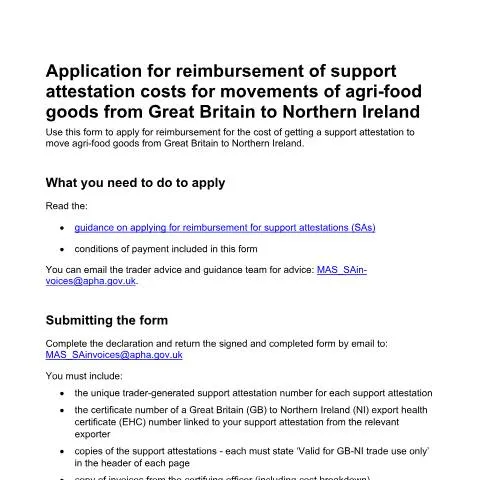
Navigating the Support Attestation Costs Reimbursement Application
As the landscape of trade between Great Britain and Northern Ireland evolves, the importance of understanding the Support Attestation Costs Reimbursement Application becomes paramount for businesses engaged in the movement of agri-food goods. This document is an essential tool for traders seeking financial relief related to costs incurred for support attestations required for compliance with export health regulations. It's not merely a piece of paper; it represents a critical step towards ensuring your goods can travel smoothly across borders.
Understanding the Support Attestation: Purpose and Implications
The Support Attestation (SA) serves as a formal declaration that certifies the compliance of agri-food products with specific health and safety standards established by the governing bodies. This attestation is crucial when transporting goods from Great Britain to Northern Ireland, especially in light of post-Brexit regulations. It assures that the products meet the necessary requirements to prevent the spread of diseases and pests, thereby safeguarding public health and the agricultural industry.
For businesses, the SA not only facilitates the movement of goods but also serves as a legal document that can be required by various authorities during inspections. The validity of the attestation, therefore, has significant implications on the ability of the trader to conduct business efficiently across the UK’s borders.
Who is Eligible to Apply for Reimbursement?
Eligibility to apply for reimbursement under the Movement Assistance Scheme (MAS) is primarily focused on traders who have incurred costs specifically for obtaining support attestations linked to export health certificates (EHCs). To qualify for reimbursement, you must meet the following criteria:
- Your support attestation must be dated on or after 27 September 2021.
- The products must be destined for Northern Ireland as per the relevant EHC.
- The types of products eligible include:
- Live animals and animal products
- Plants and plant products
- High-risk food and feed of non-animal origin (HRFNAO)
- Organic products
Steps to Effectively Apply for Reimbursement
The application process for the reimbursement of support attestation costs involves several crucial steps that traders need to meticulously adhere to. Below are the specific steps that ensure a smooth application experience:
- Gather necessary documentation including:
- The unique trader-generated support attestation number for each attestation.
- The corresponding EHC certificate number.
- Copies of the support attestations indicating “Valid for GB-NI trade use only”.
- Invoices from the certifying officer detailing the costs.
- Convert all documents into PDF format to ensure compatibility when submitting via email.
- Complete the application form and make sure to include all required details accurately.
- Email the completed application to [email protected].
Understanding Payment Conditions
The reimbursement program is governed by specific payment conditions under the Movement Assistance Scheme. Here are key points to consider:
| Condition | Details |
|---|---|
| Max Reimbursement Amount | £150 per attestation |
| Application Submission Deadline | 90 days from the date of the attestation for attestations dated on or after 1 June 2022; for earlier attestations, application must be submitted by 31 August 2022. |
| Invoice Requirements | Submission of invoices should be made only after receiving approval from APHA. Each invoice must include a valid purchase order (PO) number. |
| Compliance and Inspection Rights | Defra and APHA reserve the right to inspect records for a period of six years to verify claims. |
What to Do in Case of Issues: Lost Documents and Errors
Document integrity is paramount in the application process. However, mistakes and lost documents can happen. Here’s what to do if you face such issues:
Lost Support Attestation
If you lose your support attestation, it is critical to act swiftly. Contact the certifying authority immediately to request a duplicate. Ensure you have all relevant information at hand, such as the original issuance date and any reference numbers.
Discrepancies in Submitted Information
In instances where a mistake is identified in the application, it’s essential to notify APHA as soon as possible. Corrections should be made through a formal communication channel, ideally via the same email used for submission. Clearly outline the discrepancies and provide supporting documentation for the corrections.
Utilization of the Support Attestation: Practical Implications for Traders
The reach of a support attestation extends beyond just fulfilling a regulatory requirement. Its implications are practical and can significantly affect a trader's operations:
- Market Access: A valid SA allows for smoother access to the Northern Ireland market, crucial for businesses that depend on timely deliveries.
- Compliance Assurance: It enhances confidence among traders and buyers alike regarding product safety and compliance with health regulations.
- Financial Planning: Understanding the costs associated with obtaining SAs helps businesses budget effectively, anticipating reimbursement timelines and amounts.
Legal Validity and the Scope of the Attestation
The legal standing of the support attestation is significant. It acts as a legal document that represents the certification of goods being compliant with health and safety standards. As such, every trader must ensure:
- The SA is obtained from a recognised certifying officer.
- It accurately reflects the products it represents without omissions.
- It is submitted for reimbursement in accordance with the conditions laid out by APHA.
Failure to adhere to these requirements can lead to potential legal challenges, fines, or rejection of goods at ports, making it imperative to maintain high standards of diligence.
Final Thoughts: Beyond the Application
Successfully navigating the Support Attestation Costs Reimbursement Application is about more than just completing forms. It's a strategic part of doing business in a changing regulatory environment. Traders must remain informed and proactive in managing their compliance obligations while leveraging available support programs effectively. The reimbursement process may seem daunting, but with careful attention to detail and an understanding of the underlying conditions, businesses can enhance their operational efficiency and safeguard their interests in the Northern Ireland market.
Understanding the Eligibility Criteria for Cost Reimbursement Applications
When applying for reimbursement of costs related to support attestations in the UK, it’s crucial to understand the eligibility criteria set forth by the relevant authorities. Generally, these applications fall under various support schemes, which might include provisions for educational, medical, or vocational support. Each scheme has its specific eligibility requirements that applicants must meet to qualify for reimbursement.
For instance, in the context of educational support, the applicant must usually demonstrate that the costs incurred are directly related to their educational needs. This might encompass specific courses, assessments, or necessary materials that are essential for their learning. The Department for Education (DfE) outlines these criteria, and applicants should carefully review the requirements pertinent to their situation.
Individuals receiving support from agencies such as the Department for Work and Pensions (DWP) may also be entitled to claim for costs associated with necessary support assessments. This includes costs incurred for medical examinations, counselling, or training that is essential for their job-seeking efforts. It is essential to document all expenses comprehensively, ensuring that the application clearly delineates how each cost is linked to the required support.
Furthermore, certain categories of individuals, such as those receiving Universal Credit, may benefit from additional allowances to cover specific support costs. Each case is assessed individually, so it is recommended that applicants provide thorough justification for their claims, alongside any supporting documentation from professionals or relevant authorities.
Step-by-Step Guide to Submitting a Cost Reimbursement Application
Submitting a reimbursement application for support attestations can appear daunting, but breaking it down into manageable steps can streamline the process. Here’s a comprehensive guide to assist applicants in ensuring their submissions are completed correctly and efficiently.
- Gather Necessary Documentation: Before submitting your application, compile all necessary documents. This includes receipts, invoices, and any relevant letters or assessments that substantiate your claims. Make sure that all documents are clear, legible, and directly correlate with the costs you intend to claim.
- Complete the Application Form: Depending on the specific support scheme under which you are applying, you will need to fill out the corresponding application form. For educational costs, this might be an application under the Student Finance scheme, while for health-related costs, you may need to refer to specific forms provided by the NHS or local health authority. Ensure that all sections of the form are filled out accurately and completely.
- Submit on Time: Be mindful of any deadlines for submitting your application. Different schemes may have varying submission timelines, and many reimbursements are contingent upon timely applications. It is advisable to double-check the dates and plan ahead to avoid any last-minute rush.
- Track Your Application: After submission, keep a record of your application including any reference numbers and correspondence with the authority. Many agencies allow you to track the status of your application online or via direct contact.
- Respond to Queries Promptly: Occasionally, the processing authority may require additional information to support your application. Be prepared to respond promptly to any queries or requests for documentation to avoid delays in the reimbursement process.
- Familiarise Yourself with Appeal Procedures: In the event that your application is denied, it’s important to understand the appeal process. Each authority will have a specific procedure for challenging a decision. Make sure you adhere to the required timelines and submit any appeals in a formal manner.
Common Pitfalls to Avoid When Applying for Cost Reimbursement
While navigating the cost reimbursement application process for support attestations, applicants may encounter several common pitfalls that could hinder their chances of success. Awareness of these pitfalls enables individuals to prepare adequately and avoid unnecessary complications.
1. Incomplete Documentation: One of the most frequent reasons for application denial is the lack of complete documentation. Ensure all receipts, invoices, and supporting letters are included and match the costs being claimed. Incomplete information can lead to delays or outright refusals.
2. Misunderstanding Eligibility Requirements: Applicants must thoroughly read and understand the eligibility requirements established by the relevant authority. Misinterpreting these can lead to claims that do not meet the necessary criteria, resulting in rejection. Seek clarification from the authority if the guidelines are unclear.
3. Submitting Late: Many reimbursement schemes have strict timelines. Missing a deadline can disqualify an applicant. Calendar reminders and early submissions can mitigate this risk.
4. Failure to Maintain Records: Keeping comprehensive and organised records is vital throughout the application process. This includes noting down all interactions with the authorities and maintaining copies of submitted documents. Such records may be invaluable if there is a need for follow-up or appeal.
5. Ignoring Feedback: If an application is returned with feedback or requests for additional information, it’s crucial to address these promptly. Ignoring such correspondence can lead to further complications or denial of the claim.
By being mindful of these common pitfalls and preparing accordingly, applicants can enhance their chances of a successful cost reimbursement application.