When Patent Applications Face the Brink: Understanding the Reinstatement Process
The moment a patent application lapses through missed deadlines represents one of the most stressful scenarios for inventors and their representatives. Whether it's a failure to respond to an examination report, missed renewal fees, or overlooked formality requirements, the termination of a patent application can feel catastrophic. However, the UK intellectual property system recognises that circumstances beyond an applicant's control can lead to such failures, which is precisely why Patents Form 14 exists as a crucial lifeline.
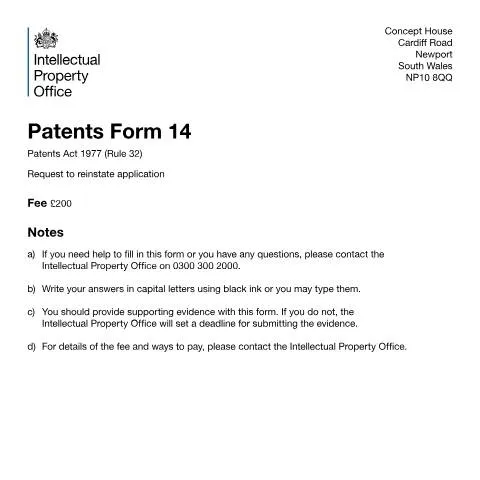
This reinstatement mechanism serves as more than just an administrative correction tool—it represents a fundamental recognition that innovation deserves protection even when procedural mishaps occur. The form operates under Rule 32 of the Patents Act 1977, establishing a formal pathway for applicants to resurrect terminated applications, provided they can demonstrate valid reasons for their initial failure to comply.
The Anatomy of Application Failure: What Triggers the Need for Reinstatement
Patent applications don't simply disappear overnight. The termination process typically follows a cascade of missed opportunities, each with its own implications for potential reinstatement. Understanding these trigger points proves essential for crafting a compelling reinstatement request.
Examination-related failures constitute the most common cause of application termination. When the Intellectual Property Office issues an examination report highlighting deficiencies in the application, applicants receive a specific deadline—usually four months—to respond adequately. Failure to address substantive objections or formal requirements within this timeframe results in automatic termination.
Fee-related terminations present another significant category. Patent applications require various fees throughout their lifecycle, from search fees to examination fees and annual renewal fees. Missing any of these payments by the specified deadline, including any available grace periods, triggers termination proceedings.
Formality requirements represent a third major area where applications falter. These might include failures to file required translations, provide necessary declarations, or submit amended claims in the correct format. While seemingly minor, such oversights carry the same terminal consequences as more substantial failures.
The Critical Window: Time Limits for Reinstatement
The Patents Act 1977 establishes strict time limits for reinstatement requests. Generally, applicants must submit their reinstatement request within twelve months from the date when the application was terminated. This deadline is absolute—missing it eliminates any possibility of revival, regardless of the circumstances.
However, the clock starts ticking from the actual termination date, not from when the applicant becomes aware of the termination. This distinction proves crucial, particularly for applicants who may not immediately realise their application has lapsed.
Constructing Your Case: The Art of Justifying Reinstatement
Section 4 of Patents Form 14 requires applicants to explain why they failed to meet the original legal requirement. This explanation forms the heart of the reinstatement request and demands careful consideration. The Intellectual Property Office doesn't operate with a checklist of acceptable excuses; instead, each case receives individual assessment based on its particular circumstances.
Acceptable justifications typically fall into several categories. Serious illness affecting the applicant or their representative often provides grounds for reinstatement, particularly when supported by medical evidence. Postal delays, while less reliable as standalone justifications, may succeed when combined with other factors and supported by postal service documentation.
Technical failures can also justify reinstatement. Computer system crashes, email delivery failures, or problems with online filing systems may provide valid grounds, especially when the applicant can demonstrate they took reasonable steps to meet the deadline through alternative means.
Administrative errors within patent attorney firms or corporate intellectual property departments frequently trigger reinstatement requests. While the law generally holds applicants responsible for their representatives' actions, genuine system failures or extraordinary circumstances within the representative's organisation may provide acceptable justification.
The Supporting Evidence Imperative
Form 14's notes explicitly state that supporting evidence should accompany the reinstatement request. Without such evidence, the IPO will set a deadline for its submission, potentially delaying the entire process. The nature of required evidence varies significantly based on the claimed circumstances.
| Circumstance | Typical Supporting Evidence | Additional Considerations |
|---|---|---|
| Medical emergency | Medical certificates, hospital records | Evidence must cover the relevant deadline period |
| Postal failure | Proof of posting, delivery confirmations | Must demonstrate reasonable reliance on postal service |
| Technical system failure | Error logs, IT support records | Should show attempts to resolve issues promptly |
| Representative error | Internal communications, system records | Must demonstrate extraordinary circumstances |
Financial Implications and Fee Structure
The £200 reinstatement fee represents more than just an administrative charge—it reflects the substantial work involved in reviving a terminated application. This fee applies regardless of the application's complexity or the reason for termination, creating a flat-rate system that treats all reinstatement requests equally from a financial perspective.
Payment methods mirror those available for other IPO fees, offering flexibility to accommodate different organisational preferences. The online payment system through the IPO's secure website provides the fastest processing route, generating a 10-character reference code that must be recorded on the form as proof of payment.
For organisations maintaining IPO deposit accounts, direct deduction offers convenience and immediate processing. This method proves particularly valuable for patent attorneys and corporate intellectual property departments handling multiple applications simultaneously.
Traditional payment methods remain available but carry processing implications. Cheques require additional handling time, while bank transfers need careful attention to reference details to ensure proper allocation of funds to the correct application.
Hidden Costs Beyond the Form Fee
The £200 reinstatement fee represents only the beginning of potential costs. Successful reinstatement typically requires addressing the original compliance failure that caused termination. This might involve additional examination fees, renewal fees that accumulated during the lapsed period, or professional fees for preparing complex responses to outstanding objections.
Patent attorneys' fees for preparing reinstatement requests can vary significantly based on the complexity of justification required and the amount of supporting evidence needed. Simple cases might require minimal additional work, while complex situations involving multiple missed deadlines or substantial evidence gathering can generate considerable professional charges.
Procedural Navigation: From Submission to Decision
The reinstatement process follows a structured pathway that begins with form submission but extends well beyond initial filing. Understanding each stage helps applicants manage expectations and prepare for potential additional requirements.
Electronic submission via email to [email protected] represents the preferred route, offering faster processing and immediate delivery confirmation. The IPO's systems automatically generate acknowledgment receipts, providing applicants with confidence that their submission reached its destination.
Paper submissions to Concept House in Newport face inherently longer processing times. The physical handling, scanning, and data entry requirements add several days to the initial processing phase, potentially proving crucial when working near deadline limits.
The Examination Phase
Once received, reinstatement requests undergo examination by IPO personnel familiar with the specific circumstances that justify application revival. This examination involves several key assessments:
- Timeliness verification: Confirming the request falls within the twelve-month deadline from termination
- Justification evaluation: Assessing whether the provided explanation meets the legal standards for reinstatement
- Evidence sufficiency: Determining whether supporting documentation adequately supports the claimed circumstances
- Procedural compliance: Ensuring all form requirements and fees have been properly addressed
The examination process typically takes several weeks, though complex cases requiring additional evidence or clarification may extend significantly longer. During this period, the IPO may request additional information or documentation to support the reinstatement request.
Strategic Considerations for Different Applicant Categories
Individual inventors face unique challenges when preparing reinstatement requests. Without the administrative infrastructure of larger organisations, they often struggle with deadline management and may lack sophisticated document retention systems. However, their circumstances frequently provide more compelling personal justifications for missed deadlines.
For individual applicants, the key lies in honest, detailed explanations supported by whatever evidence remains available. Medical emergencies, family crises, or genuine misunderstandings of procedural requirements often receive sympathetic consideration when properly documented.
Corporate applicants operate under different expectations. The IPO generally assumes that companies, particularly those with established intellectual property portfolios, maintain professional systems for deadline management. Consequently, corporate reinstatement requests require more substantial justification, typically involving extraordinary circumstances that overwhelmed normal procedural safeguards.
Patent attorney firms submitting reinstatement requests on behalf of clients face the additional challenge of potentially accepting responsibility for procedural failures. These situations require careful analysis of professional indemnity implications alongside the substantive reinstatement arguments.
International Applicants and Cross-Border Complications
Foreign applicants often encounter additional complexity in reinstatement scenarios. Time zone differences, international postal delays, and varying legal systems can create genuine obstacles to deadline compliance. The IPO recognises these challenges but requires clear evidence of their impact on the specific missed deadline.
Currency conversion issues, international banking delays, and communication barriers may provide valid justification for fee-related failures. However, such circumstances require detailed documentation to demonstrate their direct connection to the compliance failure.
Beyond Reinstatement: Addressing the Underlying Issues
Successful reinstatement merely returns the application to its pre-termination status—it doesn't resolve the original compliance failure that triggered termination. This reality demands immediate attention to outstanding requirements once reinstatement is granted.
Applications reinstated following examination failures must promptly address the substantive objections raised in the original examination report. The IPO typically provides a fresh deadline for response, but this period is often shorter than the standard four months initially allowed.
Fee-related reinstatements require immediate payment of outstanding amounts, often including accumulated renewal fees for the period during which the application was terminated. These financial obligations can create significant unexpected costs, particularly for applications that remained lapsed for extended periods.
Managing Expectations and Alternative Strategies
Not all reinstatement requests succeed, and applicants should prepare for potential refusal. When reinstatement appears unlikely or impossible due to deadline constraints, alternative strategies may preserve some value from the original application.
Divisional applications, where permissible, might allow extraction of valuable subject matter from terminated parent applications. Continuation applications under international filing systems could provide alternative protection routes, particularly for applicants maintaining parallel applications in multiple jurisdictions.
The reinstatement process, while offering genuine hope for terminated applications, demands realistic assessment of both prospects and alternatives. Success requires not just completing Patents Form 14 correctly, but understanding its place within the broader strategic landscape of intellectual property protection.
Specific Reinstatement Procedures by Application Type
The reinstatement process varies considerably depending on the type of application and the administering body. Each government department maintains distinct procedures, timescales, and requirements that reflect the specific nature of their services.
Immigration and Visa Applications
UK Visas and Immigration (UKVI) operates perhaps the most complex reinstatement framework, given the high stakes involved. When a visa application lapses due to failure to attend a biometric appointment or provide requested documents, applicants typically receive a withdrawal notification. The reinstatement window is generally 28 days from the date of withdrawal, though this can vary by visa category.
For Skilled Worker visas, reinstatement requires demonstrating that the original Certificate of Sponsorship remains valid and that the sponsor continues to support the application. Student visa reinstatements demand proof of continued course availability and Confirmation of Acceptance for Studies (CAS) validity. Settlement applications carry stricter requirements, often necessitating updated financial evidence and English language certificates if the originals have expired during the lapse period.
Priority and super priority services are typically unavailable for reinstated applications, regardless of the original service level purchased. Applicants should expect standard processing timeframes to apply from the reinstatement date, not the original submission date.
Driving Licence and Vehicle-Related Applications
DVLA reinstatement procedures differ markedly between licence applications and vehicle registrations. Provisional licence applications that expire due to incomplete medical declarations can usually be reinstated within six months, provided the medical condition hasn't materially changed. Full licence applications withdrawn due to failed theory or practical tests require fresh applications rather than reinstatement.
Vehicle registration applications present unique challenges, particularly for imported vehicles. If customs clearance documents expire during the application process, reinstatement may require updated C&E 386 forms and fresh vehicle inspections. Historic vehicle applications are particularly vulnerable to documentation expiry, as age-related evidence can become outdated quickly.
Personalised number plate applications follow a 12-month retention period after withdrawal. Beyond this timeframe, the desired combination returns to general availability, and applicants must submit entirely new applications with no guarantee of securing the same registration.
Benefits and Tax Credit Applications
Department for Work and Pensions (DWP) reinstatement procedures prioritise continuity of support, recognising that gaps in benefits can cause significant hardship. Universal Credit applications withdrawn due to incomplete Work Capability Assessments can typically be reinstated within one month, preserving the original assessment date if medical evidence remains current.
Personal Independence Payment (PIP) applications require particular attention to assessment validity periods. Medical evidence older than two years at the time of reinstatement usually necessitates fresh assessments, potentially extending the overall processing time significantly. Attendance Allowance applications for claimants over state pension age benefit from more flexible evidence requirements, often accepting GP records spanning longer periods.
Child Benefit applications can be reinstated retrospectively in some circumstances, particularly where delays resulted from missing National Insurance numbers for newborn children. However, backdating is subject to strict time limits and evidence requirements.
Fill in your form directly online
No printing: type your details into the boxes of the official form, tick, then download the PDF ready to send.
- 1Type into the form boxes
- 2Tick in one click
- 3Save and download the PDF
Common Pitfalls and Strategic Considerations
Understanding frequent reinstatement errors can significantly improve success rates and prevent further delays. Many applicants underestimate the importance of addressing the root cause of the original withdrawal, leading to repeated failures even after successful reinstatement.
Documentation and Evidence Management
One of the most critical aspects involves maintaining current, valid documentation throughout the reinstatement process. Many applications fail because supporting documents have expired during the lapse period. Bank statements must typically cover periods immediately preceding the reinstatement request, not the original application date. Similarly, medical certificates, employer letters, and educational transcripts may require updating to reflect current circumstances.
Translation requirements can catch applicants off-guard, particularly if original certified translations have been returned or lost. The Home Office maintains a list of approved translators, but securing appointments can take several weeks. Planning for these requirements early in the reinstatement process prevents unnecessary delays.
Digital document management becomes crucial when dealing with multiple government portals. Each system may have different file size limits, accepted formats, and naming conventions. Maintaining organised digital folders with clearly labelled documents speeds up the reinstatement process and reduces the risk of uploading incorrect versions.
Timing and Strategic Planning
Successful reinstatement often depends on understanding optimal timing windows. Submitting reinstatement requests immediately before Christmas or during peak summer holiday periods typically results in longer processing times due to reduced staffing levels. Conversely, early autumn often provides the most favourable processing conditions across most government departments.
For applications involving third-party verification, such as employer sponsorship or educational institution confirmation, coordinating timing becomes essential. Sponsors may have their own internal approval processes that can take several weeks, particularly in large organisations with complex compliance procedures.
Multiple application scenarios require careful sequencing. For instance, applicants seeking both work authorisation and family reunification should typically prioritise the primary applicant's case, as derivative applications often cannot proceed until the main application concludes successfully.
Cost Implications and Financial Planning
Reinstatement rarely comes without financial implications beyond the obvious administrative fees. Extended stays in the UK while awaiting reinstatement decisions can substantially increase accommodation and living costs, particularly for applicants whose original timelines assumed quicker processing.
Healthcare surcharge considerations become complex for reinstated visa applications. If the original application included NHS surcharge payments, these typically remain valid only if reinstatement occurs within specific timeframes. Late reinstatements may require fresh surcharge payments, effectively doubling this significant cost component.
Legal representation costs can escalate quickly if reinstatement attempts fail repeatedly. Understanding when professional assistance becomes cost-effective versus continuing with self-representation requires honest assessment of case complexity and personal capability.
Appeals, Reviews, and Alternative Remedies
When reinstatement requests are refused or when the original decision leading to withdrawal was incorrect, various review mechanisms exist across different government departments. Understanding these options and their relative merits is crucial for determining the most appropriate course of action.
Administrative Review Processes
Many government departments offer administrative review as a first-tier challenge mechanism. These reviews examine whether the original decision was made correctly according to published policies and procedures, rather than reconsidering the merits of the underlying application.
UKVI administrative reviews must typically be requested within 14 days of the original decision for in-country applications, or 28 days for out-of-country applications. The review fee is substantial but is refunded if the review succeeds. Administrative reviews cannot introduce new evidence or arguments not present in the original application, limiting their effectiveness in cases where circumstances have genuinely changed.
HMRC internal reviews follow a different model, typically allowing 30 days for review requests and not charging fees. These reviews can consider new information if it relates to circumstances existing at the time of the original decision but not previously disclosed. Tax credit and benefit reviews through DWP operate under yet another framework, often incorporating mandatory reconsideration as a prerequisite for tribunal proceedings.
Tribunal and Judicial Review Options
First-tier Tribunals handle appeals from various government decisions, including immigration, benefits, and tax matters. Each tribunal division operates under distinct rules and procedures, making generic advice difficult. Immigration and Asylum Chamber appeals must typically be lodged within strict time limits and require payment of substantial fees unless fee remission applies.
Social Entitlement Chamber tribunals, covering benefits and tax credits, generally operate on a free-to-user basis and maintain more flexible approaches to evidence submission. These tribunals can consider circumstances up to the date of hearing, making them potentially more suitable than reinstatement for cases where circumstances have genuinely improved.
Upper Tribunal appeals are available on points of law only, requiring permission either from the First-tier Tribunal or directly from the Upper Tribunal. The complexity of legal argumentation typically necessitates professional representation, significantly increasing costs.
Judicial review represents the final tier for challenging government decisions on grounds of illegality, irrationality, or procedural impropriety. The high costs, strict time limits, and requirement for legal representation make judicial review appropriate only for cases involving significant legal principles or systemic administrative failures.
Parliamentary and Ombudsman Interventions
When standard administrative channels fail to provide satisfactory resolution, parliamentary intervention through constituency MPs can prove effective, particularly for cases involving clear administrative error or unreasonable delay. MPs can make direct representations to government departments and often receive more detailed responses than individual applicants.
The Parliamentary and Health Service Ombudsman investigates complaints about government departments and NHS bodies when internal complaints procedures have been exhausted. Ombudsman investigations are free but can take many months to complete. They focus on administrative failings rather than policy disagreements, making them suitable for cases involving procedural errors in the reinstatement process.
Sector-specific ombudsmen exist for certain areas, such as the Housing Ombudsman for housing-related applications and the Financial Ombudsman Service for certain financial services complaints. Understanding which ombudsman has jurisdiction prevents wasted time pursuing complaints through inappropriate channels.
Local Government and Social Care Ombudsman handles complaints about local authority services, including housing benefit, council tax support, and social care applications. These investigations can result in compensation awards for injustice caused by maladministration, providing remedies beyond simple reinstatement of the original application.