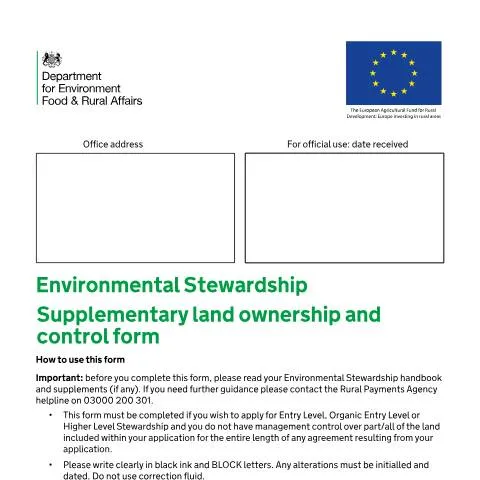
Navigating the Supplementary Land Ownership and Control Form: Essential Insights
When embarking on the journey towards Environmental Stewardship in the UK, understanding the Supplementary Land Ownership and Control form is crucial. This document serves as a vital component for those applying for Entry Level, Organic Entry Level, or Higher Level Stewardship, particularly when applicants do not hold the management control over the land specified in their application. Missteps in this process can lead to complications down the line, making it imperative to approach this form with precision and care.
Understanding Your Obligations: Who Needs This Form?
This form is necessary for any applicant who lacks full management control over their land throughout the duration of the stewardship agreement. To ensure clarity, let’s break down the circumstances under which this form is required:
- Ownership Scenarios: If you are applying for stewardship but are not the sole owner, you need to fill out this form to designate responsibilities.
- Application Types: It is especially relevant for those applying in the context of environmental management, including biodiversity and land conservation activities.
- Counter-signing Requirement: If you’re not managing the land directly, an individual who can take over these responsibilities must co-sign your application and complete the necessary sections on this form.
Identifying Your Role in the Application Process
The form distinguishes between two main roles within the application process:
- Primary Applicant: The individual or entity applying for stewardship.
- Counter-signing Applicant: An individual who agrees to take responsibility for the management of the land if required.
Understanding these roles will assist you in gathering the correct information and identifying who needs to participate in the completion of the form.
Breaking Down the Form: Section by Section
The Supplementary Land Ownership and Control form is structured to gather specific information from both the applicant and the counter-signing individual. Below, we delve into each section, highlighting possible pitfalls and essential details to ensure successful completion.
Section 1: Applicant Details
In this section, applicants are required to provide personal and business information, including:
- Application Reference Number: A unique identifier linked to your application.
- Name and Contact Information: Ensure that all spelling is correct and that the email address is valid as this will be your primary communication channel.
Important note: If submitting the form by email, it’s recommended to use a professional email account to avoid delivery issues.
Section 2: Counter-signing Applicant Details
This segment requires the completion of similar details for the counter-signing applicant. Key points include:
- Authorisation Confirmation: If an agent submits the form, they must confirm their authority to do so through an authorisation form attached to the submission.
- Contact Information: Ensure that every detail matches the records held by the Rural Payments Agency (RPA).
Declarations and Undertakings: Sections 3 and 4
These sections require important declarations regarding the truthfulness of the information provided and the responsibilities relating to land management. Here’s what to keep in mind:
- Age Requirement: Applicants must declare their age (over 18 years).
- Responsibility Declaration: This is a legally binding statement. Make sure to review the information provided carefully before signing.
Each individual must tick all applicable boxes accurately, as incorrect ticks could invalidate the application.
Key Documentation: What to Prepare
Alongside the form, there are several pieces of documentation and information that applicants should prepare to enhance the robustness of their application:
- Land Maps: Clear maps indicating the parcels of land in question, which may need to be attached to the form.
- Written Authorisation: If an agent is completing the form, their authorisation must be included.
- Proof of Identity: This could include documentation validating the identity of both the primary and counter-signing applicants.
Tips for Preparing Your Documentation
- Organise Early: Start gathering required documents as soon as you decide to apply to avoid delays.
- Verify Information: Double-check that all names, addresses, and contact details are accurate and consistent across documents.
- Keep Copies: Always retain copies of submitted forms and documents for your records.
Submission Channels: How to Send Your Form
Understanding how to submit your completed Supplementary Land Ownership and Control form can influence the speed and efficiency of your application process:
- Email Submission: The preferred method is to email the completed form to [email protected]. This route is typically faster.
- Postal Submission: Alternatively, you can post your application to your local Rural Payments office. Ensure to check the correct address online to avoid misdelivery.
- In-Person Submission: If necessary, you can also drop your documents at your local office, although this may require prior appointment.
Comparing Submission Methods
| Submission Method | Pros | Cons |
|---|---|---|
| Fast, immediate confirmation, easier tracking | Requires internet access, potential for technical issues | |
| Postal | Physical record of submission, no tech issues | Slower, possible loss in transit |
| In-Person | Direct receipt confirmation, opportunity for immediate questions | Time-consuming, may require prior booking |
Tracking Your Application: After Submission
Once you’ve submitted your form, knowing how to monitor the progress of your application can alleviate anxiety and ensure that you remain informed:
- Confirmation of Receipt: If submitted via email, watch for an automated reply confirming receipt. For postal submissions, you might consider using recorded delivery.
- Follow-up Contact: If you haven’t heard back within a specified timeframe (usually around six weeks), it’s advisable to contact the Rural Payments Agency for an update on your application’s status.
- Documentation Retention: Keep all copies of your submitted documentation in a safe place for reference in future communications.
What Happens in Cases of Refusal or Errors?
In the unfortunate event that your application is refused or if there are errors identified, immediate action is necessary:
- Review Feedback: Carefully examine any reasons provided for the refusal. Understanding the rationale is critical for addressing issues.
- Rectification Opportunities: You may have the chance to amend your application within a certain timeframe. Take full advantage of this to ensure your application meets all requirements.
- Appeal Process: If you believe the refusal was unjustified, you may have the right to appeal. Contact the Rural Payments Agency for detailed instructions on how to proceed.
The Greater Context: Environmental Stewardship and Its Importance
Completing the Supplementary Land Ownership and Control form is just one step in a larger framework aimed at promoting sustainable farming and land management practices in the UK. The Environmental Stewardship programme represents a commitment to enhancing biodiversity, improving the landscape, and ensuring that agricultural practices align with environmental sustainability goals.
By participating in this programme, applicants not only contribute to the preservation of the countryside but also become part of a broader movement towards responsible land management. Understanding the specific requirements and implications of the Supplementary Land Ownership and Control form is fundamental to achieving these ends.
Future Considerations: Staying Informed
As regulations and stewardship opportunities evolve, remaining updated on changes in requirements or best practices is essential. Regularly consulting resources provided by the Rural Payments Agency and attending informational workshops can provide invaluable guidance as you navigate the complexities of land stewardship.
Understanding Environmental Stewardship Schemes
Environmental stewardship schemes in the UK are designed to help landowners manage their land in a way that benefits the environment. These schemes not only enhance biodiversity but also promote sustainable practices that can lead to improved land productivity over time. The main types of schemes available include the Countryside Stewardship Scheme, which is operated by the Rural Payments Agency (RPA), and the Environmental Stewardship Scheme, which was previously in operation but has now been largely succeeded by the Countryside Stewardship Scheme.
Through these schemes, landowners can receive financial support to implement various conservation practices, such as planting native trees, restoring wetlands, and creating habitats for wildlife. It is essential for landowners to conduct thorough research to determine which scheme is most suitable for their circumstances, as eligibility and requirements can vary significantly. For example, the Countryside Stewardship Scheme may require landowners to submit an application that includes a detailed management plan, outlining how they intend to carry out environmental improvements on their land.
Eligibility and Application Process for Environmental Stewardship
Eligibility for environmental stewardship schemes typically depends on several factors, including the type of land you own, its location, and the current management practices in place. For instance, to qualify for the Countryside Stewardship Scheme, applicants must have at least 5 hectares of land that is eligible for Environmental Land Management (ELM) payments.
The application process involves several stages. First, landowners need to register on the Rural Payments service, where they can create an account and provide the necessary information regarding their land. After registering, they can access the application forms for the stewardship scheme they wish to apply for. It’s worth noting that applications are usually time-sensitive, with specific windows for submission depending on the scheme. For example, the closing date for most applications for the Countryside Stewardship Scheme is usually in early March each year.
Once the application is submitted, it will be assessed based on various criteria, including the expected environmental benefits and the feasibility of the proposed activities. Successful applicants will receive a contract that details the terms and conditions of the payment for the stewardship activities they will undertake.
Monitoring and Compliance in Environmental Stewardship
Once enrolled in an environmental stewardship scheme, compliance with the agreed contract terms is crucial. The RPA conducts regular inspections to ensure that landowners adhere to the management practices outlined in their plans. Non-compliance can lead to financial penalties or total withdrawal from the scheme.
It is important for landowners to maintain detailed records of their stewardship activities, including any environmental assessments carried out and the implementation of conservation measures. Additionally, ongoing engagement with local conservation groups can provide valuable support and resources to help ensure compliance and success in environmental stewardship initiatives.
Moreover, landowners are encouraged to share their experiences and outcomes with other participants, as this can foster community learning and improvement of stewardship practices. Successful case studies can often inspire others to engage in similar environmental stewardship efforts, leading to enhanced community resilience and biodiversity across the region.