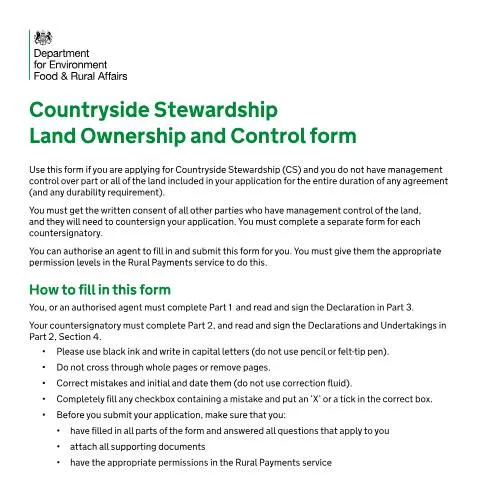
Navigating Joint Land Agreements in Countryside Stewardship Schemes
When multiple parties hold interests in the same piece of agricultural or rural land, securing environmental funding through Countryside Stewardship becomes significantly more complex. The Land Ownership and Control form (CS02) emerges as a critical bridge between competing land interests and conservation objectives, ensuring that all stakeholders with management control formally consent to proposed environmental works.
This document serves as the legal foundation for situations where the primary applicant lacks complete management authority over their intended scheme area. Whether dealing with tenant farmers seeking to implement hedge restoration on rented ground, landowners whose tenants retain certain environmental rights, or complex partnership arrangements, the CS02 form transforms potential legal conflicts into structured agreements that satisfy both the Rural Payments Agency and all parties involved.
Decoding Management Control: When Multiple Signatures Become Essential
The concept of management control extends far beyond simple ownership, encompassing any legal authority to make decisions about land use, environmental practices, or agricultural operations. Understanding who truly controls what aspects of land management determines whether this form becomes necessary for your Countryside Stewardship application.
Tenant Farming Scenarios
Agricultural tenancies create the most common situations requiring CS02 completion. A tenant farmer seeking to establish wildflower margins or restore traditional boundaries must secure their landlord's written consent, particularly where agreements extend beyond the tenancy term or involve permanent landscape alterations. The form captures these relationships through specific sections addressing tenancy start and end dates, ensuring the Rural Payments Agency understands the temporal limitations of management authority.
Conversely, landowners applying for schemes on tenanted ground face their own complexities. Where tenants hold environmental management obligations within their lease agreements, the CS02 form includes specific provisions preventing double-funding scenarios. Question 6(b) requires tenants to declare existing environmental obligations, with applicants confirming they're not seeking funding for activities already covered by tenancy arrangements.
Partnership and Corporate Structures
Business partnerships, family farming companies, and agricultural cooperatives often involve multiple decision-makers with varying degrees of management authority. The CS02 form accommodates these structures by allowing separate completion for each countersignatory, ensuring comprehensive coverage of all management interests. This proves particularly valuable where partnership agreements delegate specific environmental responsibilities to individual partners or where corporate governance requires multiple authorisations for long-term land use commitments.
Rights of Way and Easements
Less obvious management control issues arise from historical rights, easements, and restrictive covenants affecting land use. While the form doesn't explicitly address these situations, they may trigger CS02 requirements where third parties retain sufficient control over proposed scheme areas to influence environmental outcomes.
Dissecting the Three-Part Structure: A Section-by-Section Analysis
The CS02 form's tripartite structure reflects the complex relationships it aims to document, with each section serving distinct legal and administrative functions within the broader Countryside Stewardship framework.
Part 1: Establishing Primary Applicant Authority
Part 1 captures essential details about the primary applicant or agreement holder, establishing their identity and contact preferences for ongoing scheme administration. The inclusion of Single Business Identifier and application reference numbers enables the Rural Payments Agency to link this consent form with existing applications and business registrations.
The agent authorisation questions in Section 2 prove particularly significant, as they determine whether agricultural consultants, land agents, or farming advisers can legally complete and submit forms on behalf of applicants. The requirement for appropriate permissions within the Rural Payments service reflects enhanced digital security measures, ensuring only properly authorised representatives can access sensitive business information.
Part 2: Capturing Countersignatory Complexities
Part 2 demonstrates the form's sophisticated approach to documenting secondary interests in scheme land. Section 1's focus on tenancy details, including County Parish Holding numbers, enables precise identification of affected parcels within larger agricultural units.
The countersignatory details section mirrors Part 1's structure while adding crucial questions about tenant obligations and environmental management responsibilities. This dual approach prevents conflicts between existing tenancy arrangements and new Countryside Stewardship commitments, protecting both applicants and the Rural Payments Agency from future disputes.
| Question | Purpose | Implications if 'Yes' |
|---|---|---|
| 6(a) Are you a tenant? | Establishes countersignatory's legal status | Triggers additional environmental obligation checks |
| 6(b) Environmental obligations in tenancy? | Identifies existing commitments | Requires confirmation of no double-funding |
| 7 Countersigning for all land? | Defines scope of consent | Requires detailed parcel identification if partial |
Ordnance Survey References and Parcel Identification
Question 7's requirement for Ordnance Survey map sheet references and National Grid numbers reflects the precision needed for environmental scheme administration. These technical identifiers enable field officers to locate specific parcels during inspections and ensure scheme payments align with actual environmental work completed.
Agent Authorisation Protocols Within Rural Payments Service
The form's repeated emphasis on Rural Payments service permissions reflects fundamental changes in how agricultural agents operate within government systems. Traditional paper-based agent authorisations no longer suffice for CS02 submissions, requiring digital permission management through official government platforms.
Permission Levels and Their Implications
The Rural Payments service operates multiple permission tiers, from basic enquiry access to full application submission rights. For CS02 completion, agents require sufficient permissions to view sensitive business information, access existing applications, and submit new documentation on behalf of clients. These permissions must be established separately for each party involved – both primary applicants and countersignatories.
Agents representing multiple parties within a single CS02 submission face particular complexities, potentially requiring separate permission sets for different roles within the same transaction. This administrative burden reflects enhanced data protection requirements under UK GDPR, ensuring personal and business information remains secure throughout the application process.
Digital Transition Challenges
Many established agent relationships predate current digital systems, creating potential barriers for CS02 completion where historical paper authorisations no longer provide sufficient access. The form's guidance explicitly states that previous paper authorisations don't automatically transfer to digital permissions, requiring proactive permission management before form completion can commence.
Submission Pathways and Processing Expectations
The CS02 form offers dual submission routes – electronic and postal – each with distinct advantages and processing implications for Countryside Stewardship applications.
Electronic Submission via Rural Payments Agency
Email submission to [email protected] provides the fastest processing route, enabling immediate acknowledgment and rapid integration with existing application files. However, electronic submission requires careful attention to document formatting, file sizes, and digital signature validity to prevent processing delays.
The Rural Payments Agency's electronic systems automatically cross-reference CS02 submissions with existing applications using Single Business Identifiers and application reference numbers. This automated matching reduces manual processing time while flagging potential discrepancies requiring human intervention.
Postal Processing Through Worksop Operations
Traditional postal submission to the Rural Payments Agency's Worksop facility (PO Box 324, Worksop, S95 1DF) remains available for applicants preferring paper-based processes or lacking reliable digital access. Postal submissions typically require longer processing times but provide physical documentation trails valuable for complex applications involving multiple parties.
The form's emphasis on retaining copies reflects the importance of maintaining independent records throughout scheme duration, particularly where agreements extend beyond initial application periods or involve ongoing monitoring requirements.
Timing Considerations Within Countryside Stewardship Cycles
CS02 form completion sits within broader Countryside Stewardship application timelines, creating cascading effects on scheme commencement and payment schedules when consent processes extend beyond expected durations.
Application Window Pressures
Countryside Stewardship applications operate within specific annual windows, typically closing in late summer for following year scheme commencement. CS02 requirements can significantly extend application preparation time, particularly where multiple countersignatories require extensive consultation or where complex tenancy arrangements need legal clarification before consent provision.
Successful applicants often begin CS02 processes months before main application submission, allowing sufficient time for stakeholder engagement and potential renegotiation of management arrangements. This forward planning proves particularly valuable where proposed schemes affect traditional farming operations or require modifications to existing land use patterns.
Agreement Duration Implications
Most Countryside Stewardship agreements extend five years beyond commencement, with some options requiring additional durability periods extending total commitments to eight or ten years. CS02 declarations must cover these entire periods, creating particular challenges where existing tenancy arrangements terminate before scheme completion.
The form addresses these temporal mismatches through careful dating requirements and explicit acknowledgment of agreement durations by all parties. Countersignatories effectively commit to honouring scheme requirements throughout their period of management control, even where their own interests in the land may change during scheme operation.
Complex Scenarios: Multi-Party Arrangements and Partial Consents
Real-world land arrangements often involve more than two parties, creating situations where single CS02 forms prove insufficient for comprehensive consent documentation.
Sequential Consent Requirements
Where land parcels involve multiple management interests – such as tenant farmers operating under head leases from landlords who themselves hold land under superior arrangements – separate CS02 forms become necessary for each consent layer. The Rural Payments Agency requires complete consent chains, ensuring no management authority remains unaddressed within scheme areas.
These sequential arrangements create administrative complexity but provide comprehensive protection against future disputes. Each form captures specific relationships and responsibilities, enabling targeted enforcement where scheme obligations aren't met by particular parties.
Partial Parcel Consent
Question 7's provision for partial land consent enables sophisticated scheme design where management control varies across application areas. Countersignatories can limit their consent to specific parcels while excluding others, allowing applicants to proceed with partial schemes rather than abandoning entire applications due to consent difficulties on marginal areas.
This flexibility proves particularly valuable for large applications spanning multiple farms or management units, where universal consent might prove impossible but significant environmental benefits remain achievable through partial implementation.
Post-Submission Monitoring and Compliance Responsibilities
CS02 completion marks the beginning rather than end of multi-party obligations within Countryside Stewardship schemes, establishing ongoing responsibilities for monitoring, reporting, and compliance management throughout agreement duration.
Joint and Several Liability
While primary applicants retain ultimate responsibility for scheme compliance, countersignatories accept specific obligations through their CS02 declarations. These commitments include understanding scheme requirements, facilitating access for inspections, and maintaining environmental standards on land under their management control.
The form's declaration structure creates legally binding obligations extending beyond simple consent provision. Countersignatories effectively become scheme stakeholders with ongoing responsibilities rather than passive consent providers, ensuring environmental objectives receive active support from all management parties.
Communication and Coordination Requirements
Multi-party schemes require enhanced communication protocols to ensure all stakeholders remain informed of scheme developments, inspection schedules, and compliance requirements. The CS02 form establishes contact details enabling the Rural Payments Agency to communicate directly with all parties, reducing reliance on primary applicants for information cascade.
This direct communication capability proves particularly valuable during scheme inspections or compliance investigations, where independent verification from multiple parties may be required to establish factual positions regarding environmental work completion or maintenance standards.
Advanced Land Management Considerations and Eligibility Criteria
Countryside Stewardship applications require meticulous attention to land management history and current agricultural practices. Natural England evaluates applications based on environmental priority areas, existing conservation value, and potential for improvement. Applicants must demonstrate understanding of their land's baseline environmental condition through detailed habitat assessments.
Eligibility extends beyond simple land ownership to include various forms of land control arrangements. Tenant farmers can apply provided they hold agreements extending beyond the proposed scheme duration. Partnership arrangements between landowners and occupiers require clear documentation of responsibilities and benefit-sharing arrangements. Common land presents particular complexities, requiring consent from all commoners and detailed grazing management plans.
Agricultural land classification significantly influences application success rates. Grade 1 and 2 agricultural land faces stricter scrutiny for conversion to environmental habitats, whilst Grade 4 and 5 land typically receives preferential treatment for habitat creation schemes. Applicants must provide soil classification reports and justify any proposed changes to high-quality agricultural land use.
Environmental designations create both opportunities and constraints within Countryside Stewardship applications. Sites of Special Scientific Interest (SSSI) often attract higher payment rates but require consent from Natural England for any management changes. Areas of Outstanding Natural Beauty (AONB) and National Parks receive priority consideration but must align with landscape character assessments and local planning policies.
Cross-compliance requirements from the Basic Payment Scheme continue to apply during Countryside Stewardship agreements. Participants must maintain Good Agricultural and Environmental Condition (GAEC) standards and comply with Statutory Management Requirements (SMR). Breaches can result in penalties affecting both schemes, making comprehensive understanding of regulatory requirements essential.
Organic farming systems require specific consideration within Countryside Stewardship applications. Certified organic land may be ineligible for certain options involving synthetic inputs, whilst conversion to organic production can attract additional support through complementary schemes. Applicants must coordinate with organic certification bodies to ensure compatibility between environmental management and organic standards.
Payment Structures and Financial Planning Implications
Countryside Stewardship operates through a complex matrix of payment rates varying by geographic location, habitat type, and management intensity. Higher Level Stewardship options command premium rates but require more intensive management and monitoring commitments. Capital grants for infrastructure improvements can reach substantial amounts but require detailed cost estimates and competitive tendering processes.
Payment timing follows a structured annual cycle, with initial payments typically received 12-18 months after agreement commencement. This delay necessitates careful cash flow planning, particularly for capital-intensive options requiring upfront investment. Natural England provides advance payment options in exceptional circumstances, subject to bank guarantee requirements.
Tax implications vary significantly depending on the nature of Countryside Stewardship activities. Revenue payments for ongoing management typically qualify as trading income subject to income tax and National Insurance contributions. Capital grants for permanent improvements may qualify for capital allowances or attract Capital Gains Tax implications when land is subsequently disposed of.
VAT treatment of Countryside Stewardship payments depends on the applicant's registration status and the specific nature of activities undertaken. Agricultural businesses below the VAT threshold must consider whether Countryside Stewardship income pushes them above registration limits. Registered businesses must determine appropriate VAT treatment for different payment categories, with some qualifying for zero-rating and others standard-rated.
Financial planning must account for potential payment reductions or clawback provisions. Partial compliance with agreement terms results in proportionate payment reductions, whilst serious breaches can trigger full clawback of payments received. Force majeure provisions provide limited protection for circumstances beyond applicant control, but require prompt notification and detailed documentation.
State aid regulations, despite Brexit, continue to influence Countryside Stewardship payment structures through retained EU law principles. Payments must not exceed additional costs and income foregone from environmental management, with detailed cost-benefit analyses required for higher-value options. Business expansion during agreement periods may trigger retrospective payment adjustments if aid intensity limits are exceeded.
Monitoring, Compliance and Agreement Modifications
Countryside Stewardship agreements establish rigorous monitoring frameworks requiring detailed record-keeping throughout the agreement term. Participants must maintain management diaries documenting all activities, inputs, and outcomes relevant to scheme objectives. Photographic records at designated monitoring points provide visual evidence of habitat condition and management effectiveness.
Natural England conducts regular inspections using risk-based assessment criteria, with higher-risk agreements subject to annual visits whilst lower-risk sites receive less frequent monitoring. Remote sensing technology increasingly supplements ground-based inspections, particularly for monitoring grassland management and crop establishment. Participants receive advance notice of formal inspections but may face unannounced compliance checks.
Non-compliance penalties operate on a graduated scale reflecting the severity and duration of breaches. Administrative errors attracting warnings for first-time minor breaches, whilst deliberate non-compliance can result in immediate agreement termination and full payment recovery. Appeals processes allow challenged decisions to be reviewed by independent panels, though interim payment suspensions often apply pending resolution.
Agreement modifications accommodate changing circumstances through formal variation procedures. Land use changes, ownership transfers, and environmental condition alterations may necessitate option amendments or geographic boundary adjustments. Natural England assesses modification requests against original scheme objectives, potentially requiring additional environmental assessments or public consultation processes.
Succession planning requires careful consideration of agreement transferability provisions. Family farm transfers can typically continue existing agreements with appropriate documentation, whilst commercial sales may require novation agreements with new landowners. Agreement terms explicitly address circumstances where land control changes, including tenant farming arrangements and partnership dissolutions.
Force majeure provisions recognise circumstances beyond participant control affecting agreement compliance. Extreme weather events, disease outbreaks, and regulatory changes may qualify for temporary compliance suspension or permanent agreement modification. Claims require detailed documentation and independent verification, with Natural England retaining discretionary powers over acceptance and remedy terms.
Data protection obligations under UK GDPR require participants to understand how personal and business information is collected, processed, and shared throughout the agreement lifecycle. Natural England's privacy notices detail data retention periods, third-party sharing arrangements, and individual rights regarding personal data processing. Cross-government data sharing enables verification against other agricultural support schemes and regulatory databases.