When Environmental Rules Meet Agricultural Reality: The MTA Form's Critical Role
Agricultural land management in England operates within a complex web of environmental agreements that can suddenly collide with unpredictable farming realities. A late-season weed outbreak threatens your carefully managed grassland option. Extreme weather forces urgent drainage work on land under Environmental Stewardship. Livestock welfare demands immediate action that conflicts with your Countryside Stewardship prescriptions.
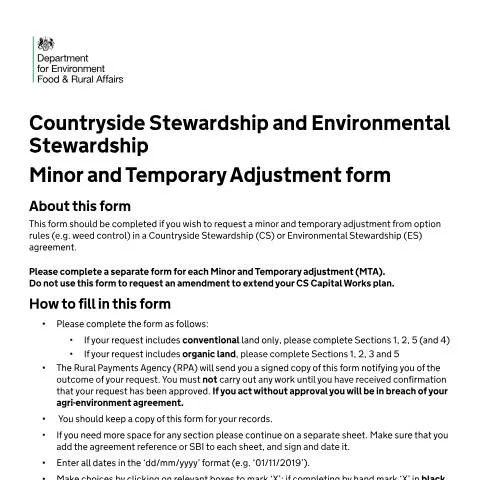
The Minor and Temporary Adjustment (MTA) form serves as the essential safety valve between rigid environmental commitments and agricultural pragmatism. Administered by the Rural Payments Agency (RPA) under the Department for Environment, Food & Rural Affairs, this form enables farmers and land managers to request temporary deviations from their agri-environment agreement rules without triggering costly breaches.
This mechanism applies to both Countryside Stewardship (CS) and Environmental Stewardship (ES) agreements, recognising that sustainable land management sometimes requires tactical flexibility. The form carries significant weight: acting without prior approval can result in agreement penalties, payment reductions, or complete scheme termination.
Navigating the Dual-Track System: CS and ES Distinctions
The MTA form operates across two distinct agri-environment schemes, each with specific nuances that affect how adjustments are processed and approved.
Countryside Stewardship Framework
Countryside Stewardship represents the current generation of environmental land management, offering Mid-Tier and Higher-Tier options. CS agreements typically run for five years and include detailed prescriptions for land management, from grassland inputs to hedge cutting windows. The MTA process for CS agreements tends to be more streamlined, reflecting the scheme's more recent design and digital infrastructure.
CS participants must provide their Single Business Identifier (SBI) number and specific agreement reference. The form requires precise identification of affected parcels using the standard format (e.g., SZ1234 5678) and corresponding option codes such as GS2 for permanent grassland with very low inputs.
Environmental Stewardship Legacy
Environmental Stewardship, while no longer accepting new entrants, continues to govern thousands of existing agreements until their natural expiry. ES agreements operate under Higher Level Stewardship provisions and often involve more complex management prescriptions developed in earlier policy contexts.
ES participants face additional bureaucratic layers, particularly regarding agent authorisation. Unlike CS agreements, ES requires specific agent authorisation forms for representatives with limited Rural Payments system permissions, adding complexity to the adjustment process.
Decoding the MTA Categories: When Flexibility Becomes Necessary
The form categorises adjustment requests into nine distinct types, each reflecting common scenarios where environmental prescriptions conflict with practical farm management needs.
| MTA Category | Typical Scenarios | Key Considerations |
|---|---|---|
| Weed Control | Invasive species outbreaks, thistle infestations, ragwort control | Most common MTA type; often time-critical |
| Field Operations | Emergency cultivation, reseeding after weather damage | Requires detailed justification of unforeseen circumstances |
| Drainage and Water Levels | Flood damage repair, blocked ditches, water management | May require Natural England consultation |
| Stocking/Supplementary Feeding | Animal welfare emergencies, grazing adjustments | Often seasonal and weather-dependent |
| Meadow or Pasture Management | Cutting date adjustments, grazing modifications | Balance between environmental and agricultural objectives |
Each category demands specific evidence that the situation was unforeseen and that alternatives within existing agreement terms have been genuinely considered. The RPA scrutinises these justifications carefully, as the MTA mechanism must not become a routine workaround for poor planning.
The "Other" Category Challenge
When circumstances don't fit standard categories, applicants must select "Other" and provide detailed explanations. This route typically faces longer processing times as RPA officers assess novel situations against scheme objectives. Common "Other" requests include infrastructure repairs, boundary modifications, or emergency access requirements.
Critical Compliance Points: SSSI and Organic Land Complications
Certain land designations trigger additional procedural requirements that can significantly complicate MTA requests and extend approval timelines.
Sites of Special Scientific Interest (SSSI) and Natura 2000
Land within or bordering SSSI or Natura 2000 sites (Special Areas of Conservation, Special Protection Areas, or Ramsar wetlands) requires dual approval. The MTA form specifically flags these designations because applicants must separately contact Natural England for consent and provide formal notice of planned activities.
This parallel process can create timing challenges. Natural England consent may take several weeks, while agricultural situations often demand immediate action. The form explicitly warns that RPA approval alone is insufficient for designated sites – proceeding without Natural England consent constitutes a separate regulatory breach.
Organic Certification Considerations
Organic land parcels face additional complexity as any adjustments must comply with both agri-environment rules and organic certification standards. The form requires specific identification of organic parcels because certain MTAs might jeopardise organic status, particularly those involving fertiliser use, weed control methods, or stocking modifications.
Organic farmers must often coordinate between the RPA, their organic certification body, and potentially Natural England, creating a three-way approval process that demands careful sequencing and documentation.
The Permission Architecture: Agent Authorisation and Digital Access
The MTA process reflects the broader complexity of Rural Payments Agency digital systems, where different permission levels determine who can submit adjustment requests and under what circumstances.
Direct Holder Submissions
Agreement holders with direct access to Rural Payments systems can submit MTA requests using their Government Gateway credentials. This straightforward route requires 'Full Business' permissions and allows direct communication with RPA processing teams.
Agent Complexity Matrix
Agricultural agents and partnership representatives face a more intricate permission structure that varies between CS and ES agreements:
Countryside Stewardship agents require 'Full Business', 'Make Legal Changes', or 'Amend' permissions for the relevant business. These permissions align with the scheme's integrated design and digital-first approach.
Environmental Stewardship agents navigate more complex requirements reflecting the scheme's older architecture. Agents with 'View' or 'Amend' permissions must complete additional ES agent authorisation forms specifically authorising them as Agreement Management Agents.
This dual-layer authorisation for ES creates practical challenges. Many agricultural consultants discover permission gaps only when attempting urgent MTA submissions, potentially delaying critical adjustments during time-sensitive agricultural operations.
Strategic Timing and the Approval Process Timeline
Understanding MTA timing requirements proves crucial for maintaining compliance while addressing urgent agricultural needs. The process operates under strict sequencing rules that can catch unprepared applicants.
The Pre-Approval Imperative
The form's most critical warning appears in bold: "You must not carry out any work until you have received confirmation that your request has been approved." This absolute prohibition means that even obviously necessary work – such as controlling invasive weeds or repairing flood damage – cannot commence until formal approval arrives.
Breaching this rule triggers immediate agreement violations with potential consequences including:
- Payment reductions calculated on affected parcel areas
- Penalty charges applied to the entire agreement
- Formal warnings that affect future scheme applications
- In serious cases, agreement termination with recovery of previous payments
Processing Expectations and Communication
The RPA commits to sending signed copies of completed forms notifying applicants of outcomes. Email submissions to [email protected] typically receive faster processing than postal submissions to the Worksop office, particularly during peak seasons.
Email subject lines must include 'Adjustment request' plus either 'Environmental Stewardship'/'ES' or 'Countryside Stewardship'/'CS' to ensure proper routing within RPA systems. Incorrect subject formatting can delay processing as forms require manual re-routing.
Seasonal Pressure Points
MTA processing faces predictable seasonal bottlenecks. Spring weed control requests, summer drought responses, and autumn cultivation adjustments create processing peaks that can extend approval times. Experienced farmers often submit requests earlier in anticipation cycles, though the "unforeseen circumstances" requirement limits this strategy.
Documentation Requirements and Mapping Precision
Successful MTA applications depend heavily on precise documentation that enables RPA officers to understand exact locations, proposed activities, and justifications without additional queries.
Mapping Standards and Parcel Identification
Every MTA submission must include mapping showing parcel references and specific locations within affected parcels. Generic whole-parcel maps prove insufficient – the RPA requires precise identification of adjustment areas within larger parcels.
Parcel numbering follows the standard Rural Land Registry format (e.g., SZ1234 5678), and applicants must correctly match option codes to option titles. Common errors include using outdated option codes from previous agreement versions or mismatching codes between CS and ES systems.
Justification Documentation Strategy
Section 7 demands comprehensive justification addressing three specific elements:
- Why the adjustment is required – demonstrating genuine necessity rather than convenience
- Exact proposed course of action – specific activities, timing, and methods
- Unforeseen nature and alternative consideration – proving circumstances couldn't be anticipated and explaining why agreement-compliant alternatives won't suffice
Weak justifications represent the primary cause of MTA rejections. Successful applications typically provide detailed chronologies of events leading to the request, specific environmental or agricultural risks that necessitate action, and evidence of alternative approaches that proved inadequate.
Post-Submission Outcomes and Record-Keeping Obligations
MTA processing concludes with formal notification, but applicants face ongoing obligations that extend beyond initial approval or rejection decisions.
Approval Implementation Requirements
Approved MTAs come with specific conditions that may differ from initial requests. The RPA commonly approves partial requests, modified timescales, or alternative approaches that achieve similar outcomes while better protecting environmental objectives.
Approved adjustments must be implemented exactly as specified in RPA confirmation letters. Variations from approved methods, even minor ones, can trigger compliance investigations during subsequent inspections.
Rejection Responses and Appeals
Rejected MTAs require careful analysis of RPA reasoning before considering resubmission or appeal options. Common rejection grounds include insufficient justification, available alternatives within existing agreement terms, or conflicts with underlying environmental objectives.
Resubmissions must address specific rejection reasons rather than simply restating original arguments. The RPA maintains rejection records that influence assessment of subsequent requests from the same applicants.
Record Maintenance and Inspection Preparation
The form explicitly requires applicants to "keep a copy of this form for your records." These records prove essential during compliance inspections, where inspectors verify that any observed deviations from standard management correspond to approved MTAs.
Comprehensive MTA records should include original applications, RPA approval letters, photographic evidence of implemented adjustments, and documentation of completion dates. This documentation package demonstrates proactive compliance management and can prevent penalty assessments during routine inspections.
The MTA system ultimately balances environmental protection with agricultural reality, providing essential flexibility within otherwise rigid agreement structures. Success depends on understanding both the procedural requirements and the underlying policy objectives that guide RPA decision-making in this critical area of agri-environment management.
MTA Processing Timeline and Decision Framework
Understanding the MTA processing timeline helps you plan your stewardship activities effectively and avoid potential complications. Natural England typically processes straightforward MTA applications within 8 to 12 weeks from receipt of a complete application, though complex cases involving multiple parcels or significant habitat changes may take considerably longer.
The decision framework follows a structured assessment process. Natural England first conducts a desktop review using aerial imagery, environmental data layers, and your submitted evidence. Applications involving designated sites (SSSIs, SACs, SPAs) automatically trigger enhanced scrutiny and may require consultation with specialist ecological advisers.
Your application enters one of three processing tracks depending on complexity. Fast-track processing applies to minor boundary corrections under 0.1 hectares with no environmental sensitivity concerns. These typically receive decisions within 4-6 weeks. Standard processing covers most MTA requests involving habitat changes, access modifications, or parcel adjustments between 0.1-2 hectares. Complex case processing handles applications affecting priority habitats, archaeological features, or multiple agreement parcels simultaneously.
During assessment, Natural England may request additional information or propose alternative solutions. Common requests include updated maps showing precise boundary changes, photographic evidence of current land conditions, or confirmation of consultation with relevant statutory bodies. Responding promptly to these requests prevents delays—Natural England allows 28 days for responses before potentially refusing applications.
The decision notice clearly states whether your MTA is approved, approved with conditions, or refused. Approved MTAs include updated prescription requirements and any revised payment calculations. Conditional approvals might specify timing restrictions (avoiding bird nesting seasons) or require additional management measures. Refusals explain the grounds for rejection and outline appeal procedures if you disagree with the decision.
Financial Implications and Payment Adjustments
MTAs can significantly affect your stewardship payments, both positively and negatively, depending on the nature and scale of changes requested. Understanding these financial implications helps you make informed decisions about whether to proceed with an MTA application.
Payment adjustments operate on a pro-rata basis calculated from the date Natural England approves your MTA. If you're adding higher-value options (such as converting improved grassland to species-rich meadows), payments increase accordingly. Conversely, removing land from prescriptions or switching to lower-value options reduces future payments. Natural England recalculates your annual payment statement to reflect these changes.
For Countryside Stewardship agreements, payment rates vary significantly between options. Capital grants for infrastructure improvements (fencing, gates, water systems) may require repayment if you remove associated land parcels within the clawback period—typically 5 years for most capital items, 10 years for major infrastructure like farm tracks or storage facilities.
Environmental Stewardship agreements under legacy schemes follow different rules. Higher Level Stewardship agreements often include complex payment mechanisms tied to specific management outcomes. MTAs affecting these agreements may trigger reviews of your entire payment package, potentially affecting prescriptions beyond those directly mentioned in your application.
Overpayments resulting from retrospective MTAs must be repaid to Natural England. This commonly occurs when you've been claiming for land subsequently found to be ineligible or when management failures are identified during MTA assessment. Natural England typically recovers overpayments through reduced future payments rather than demanding immediate repayment, though serious compliance failures may result in recovery action.
Consider the opportunity cost of MTA applications carefully. Removing productive agricultural land from stewardship to accommodate development might seem financially attractive, but you'll lose future stewardship payments and may face difficulties re-entering schemes later. Natural England prioritises applications from existing participants, but this doesn't guarantee acceptance if your circumstances change significantly.
Common Pitfalls and How to Avoid Them
MTA applications frequently encounter preventable problems that delay processing or result in refusal. Learning from common mistakes helps you submit stronger applications and avoid frustrating setbacks.
Inadequate mapping represents the most frequent cause of MTA delays. Your submitted maps must show precise boundaries using Ordnance Survey references, clearly distinguish between existing and proposed land parcels, and accurately reflect current land use. Hand-drawn sketches or approximate boundaries cause confusion and processing delays. Use the Rural Land Register or Rural Payments Agency mapping tools to ensure accuracy, and consider engaging a rural surveyor for complex boundary changes.
Many applicants underestimate the environmental sensitivity of their proposed changes. Natural England maintains detailed environmental data layers showing designated sites, priority habitats, archaeological features, and flood risk areas. Changes affecting these sensitive areas require specialist assessment and often face refusal unless compelling justification is provided. Research your land's environmental designations thoroughly before submitting MTA applications.
Timing mistakes frequently derail otherwise acceptable applications. Submitting MTAs close to scheme deadlines leaves insufficient time for proper assessment, while retrospective applications for changes already implemented may face automatic refusal. Plan MTA submissions at least 6 months before you need approval, allowing time for Natural England's assessment and any necessary revisions.
Incomplete consultation represents another common pitfall. MTAs affecting public rights of way require consultation with highway authorities, while changes near watercourses need Environment Agency input. Archaeological features trigger Historic England consultation requirements. Failing to identify and complete necessary consultations before submitting your MTA causes significant delays and may result in refusal.
Unrealistic expectations about what MTAs can achieve lead to disappointment and wasted effort. MTAs cannot retrospectively approve breaches of agreement conditions, convert between fundamentally different scheme types, or override statutory environmental protections. They provide flexibility within existing frameworks rather than complete freedom to redesign your stewardship package.
Poor record-keeping compounds MTA problems. Natural England may request historical information about your land management, previous applications, or compliance history. Maintaining comprehensive records of all stewardship-related activities, correspondence, and decisions helps you respond quickly to information requests and demonstrates your commitment to proper scheme administration.