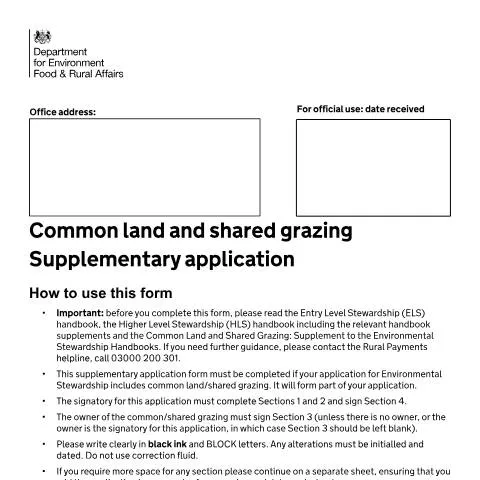
Navigating the Complexities of the Shared Grazing and Common Land Supplementary Application
The interplay of agriculture and environmental stewardship in the UK has led to the establishment of various support systems aimed at sustaining rural landscapes. One such mechanism is the Shared Grazing and Common Land Supplementary Application. This form is crucial for landowners and applicants engaging in Environmental Stewardship schemes under the auspices of the Rural Payments Agency (RPA), a body within the Department for Environment, Food & Rural Affairs (DEFRA). This discussion will dissect the form's significance, its procedural intricacies, and its implications for those involved.
Understanding the Historical Context and Regulatory Framework
The evolution of common land usage and shared grazing systems in the UK is deeply rooted in agricultural practices that date back centuries. Common land, where multiple individuals have rights to graze livestock, has been governed by regulations that aim to balance agricultural productivity with environmental conservation.
Post-2000, the UK has seen heightened awareness regarding sustainability, leading to the implementation of Environmental Stewardship (ES) schemes. These initiatives are designed to incentivize farmers and land managers to adopt environmentally friendly practices. The Entry Level Stewardship (ELS) and Higher Level Stewardship (HLS) are two components of these schemes that require applicants to submit the Supplementary Application for any lands designated as common or shared grazing.
Legislative Underpinnings
Key legislative frameworks include the Environmental Protection Act 1990 and the Countryside and Rights of Way Act 2000, both of which establish guidelines for managing public access and environmental protection. Additionally, the Data Protection Act 2018 and UK GDPR ensures that personal information provided in the application is handled appropriately.
Channels for Submission: Online vs. Paper Applications
Completing the Shared Grazing and Common Land Supplementary Application requires familiarity with various submission methods. Each channel presents distinct advantages and potential drawbacks.
Online Submission
Submitting your application online through the Rural Payments Agency portal is generally faster and more efficient. Applicants can simply fill out the form digitally, ensuring that any typographical errors are easily corrected before submission. Furthermore, the online system often allows for real-time tracking of the application’s progress, providing users with immediate updates.
Paper Submission
For those preferring traditional methods, paper applications can be filled out and mailed to the local Rural Payments office. However, this method entails longer processing times and potential delays due to postal issues. It’s essential to retain a copy of the completed form for personal records, as a safeguard against any disputes or lost documents.
Sequential Breakdown of the Application Process
The journey from initiating the application to receiving a decision involves several well-defined stages.
Step 1: Preparing the Application
- Review the relevant handbooks such as the ELS and HLS manuals, ensuring comprehensive understanding of required practices.
- Gather necessary documentation, including land ownership details and any prior agreements affecting grazing rights.
Step 2: Completing the Form
When filling out the form, applicants must provide clear and precise information. Sections demand details about the applicant, the common land, and declarations from owners if applicable. Important sections include:
- Section 1: Personal details of the applicant.
- Section 2: Specifics about the common/shared grazing land.
- Section 4: Declarations ensuring compliance with Environmental Stewardship requirements.
Step 3: Submission
Once the form is filled, it must be submitted either electronically or via postal service. Ensure to include any necessary authorisation letters if an agent is submitting on behalf of an applicant.
Step 4: Awaiting Processing
After submission, applications are processed by the RPA. During this time, applicants are encouraged to monitor their application status through the RPA’s tracking system, should they opt for online submission.
Understanding the Timeline: Key Dates and Expectations
Timeliness is vital in the application process, particularly regarding the Environmental Stewardship scheme's annual cycles.
Application Periods
The application for the Shared Grazing and Common Land Supplemental Application typically aligns with specific deadlines set forth by the RPA. Applicants must ensure they submit their forms before these deadlines to avoid any penalties or disqualification from funding opportunities.
Post-Submission: What Happens Next?
Once submitted, applicants will receive confirmation from the RPA acknowledging receipt of their application. Following this, the processing phase can take several weeks, during which the RPA may contact applicants for clarification or additional information regarding their submissions. It's crucial to remain responsive to any such requests to avoid delays in decision-making.
Implications of Application: Rights, Obligations, and Possible Consequences
Submitting the Shared Grazing and Common Land Supplemental Application opens up various opportunities while imposing certain obligations on applicants.
Rights Granted
- Eligibility for financial support under Environmental Stewardship, which can significantly enhance the sustainability of common land practices.
- Access to technical advice and guidance from DEFRA and Natural England regarding best practices for land management.
Obligations to Fulfill
Applicants are expected to adhere strictly to the practices outlined in their applications. Non-compliance can result in penalties, including potential forfeiture of funds and eligibility for future applications.
Consequences of Non-Submission or Errors
Failure to submit the application by the required deadlines, or submitting incomplete or inaccurate forms, can lead to disqualification from funding, with lasting impacts on land management and sustainability efforts.
Distinguishing the Supplementary Application from Other Forms
It’s easy to confuse the Shared Grazing and Common Land Supplementary Application with other similar forms related to rural payments and land stewardship. Understanding these distinctions is essential for ensuring compliance and securing the right support.
Key Differences
| Form | Purpose | Applicable Scenarios |
|---|---|---|
| Shared Grazing and Common Land Supplementary Application | Specifically for applications involving common/shared grazing areas. | Landowners applying for ELS or HLS involving common land. |
| Single Application Form | General application for direct payments. | Farmers seeking basic payment support. |
| Basic Payment Scheme (BPS) Application | Related to direct payments based on land size. | Farmers with eligible land for BPS. |
Understanding these distinctions not only aids in avoiding administrative errors but also ensures that applicants receive the appropriate support tailored to their specific circumstances.
Final Thoughts on the Application Process
Engaging with the Shared Grazing and Common Land Supplementary Application is not merely a bureaucratic exercise; it is a vital component in supporting environmental sustainability and agricultural viability in the UK. As applicants navigate this process, they must remain vigilant, keeping abreast of regulatory updates and deadlines. Leveraging available resources, such as the Rural Payments helpline, can enhance the likelihood of a successful application outcome.
Understanding Shared Grazing Rights on Common Land
Shared grazing rights on common land can be a complex issue, especially for those new to land management and agricultural practices in the UK. Common land refers to areas where a community has rights to graze livestock, collect firewood, and engage in other traditional practices. The rights to these lands often derive from historical agreements and can differ significantly from one area to another. Understanding who holds these rights and how they can be exercised is crucial for effective environmental stewardship.
Typically, shared grazing rights are established under various Acts of Parliament, such as the Commons Act 2006, which aims to clarify the rights of commoners and the responsibilities of landowners. It is essential for anyone engaged in shared grazing to be aware of their legal position and the implications for land management. For example, common land is often subject to regulations that aim to preserve its natural beauty and biodiversity, which can be at odds with intensive grazing practices.
Additionally, commoners are encouraged to engage in discussions with local councils and environmental organizations to develop sustainable grazing practices that benefit both the land and the community. This collaboration can lead to agreements on rotational grazing, which can enhance soil health and biodiversity, thus fulfilling environmental stewardship objectives while allowing commoners to make effective use of their grazing rights.
Environmental Impact Assessments in Grazing Management
Conducting Environmental Impact Assessments (EIAs) is an essential practice for those managing shared grazing on common land. An EIA helps to evaluate the potential effects of proposed grazing practices on the environment. In the UK, while not always mandatory for grazing activities, there are circumstances where they become crucial, particularly for large-scale operations or when significant environmental impacts are anticipated.
When preparing an EIA, land managers should consider factors such as soil erosion, biodiversity loss, and water quality. For example, overgrazing can lead to soil compaction, adversely affecting water retention and increasing runoff, which may contribute to local flooding and sedimentation in waterways. By assessing these risks, land managers can make informed decisions that align with environmental stewardship goals.
In addition to EIAs, landowners should consider using tools like the Countryside Stewardship scheme, administered by Natural England, which supports environmentally sustainable practices. This scheme encourages grazing practices that enhance habitats for various species and promote soil health. Land managers can receive financial support for implementing these sustainable practices, creating a win-win scenario for both the environment and the agricultural community.
Integrating Modern Technology in Common Land Management
The integration of modern technology into common land management and shared grazing practices is quickly gaining traction among landowners and farmers in the UK. Tools such as GIS (Geographic Information Systems) and precision farming technology are providing more efficient ways to monitor land use and manage resources effectively.
For instance, using GIS technology allows land managers to map common land accurately, identifying areas of high biodiversity, soil erosion risks, and grazing patterns. This data can facilitate informed decision-making, ensuring that grazing practices do not exceed the land's ecological limits. Moreover, with the advent of drones, monitoring the health of common land has become more accessible. Drones can capture high-resolution images, enabling land managers to spot issues like overgrazing or habitat degradation early on.
Another aspect of technology integration is the use of mobile apps designed for farmers and land managers. These apps can assist in recording livestock movements, monitoring pasture health, and scheduling grazing rotations. The ability to track these metrics in real time can empower users to adopt adaptive management strategies that respond to changing environmental conditions, ultimately fostering a more sustainable approach to land use.
It is important to note, however, that while technology can improve management practices, it should be complemented by traditional knowledge and community engagement. Local insights and experience are invaluable in developing a holistic approach to common land management, ensuring that both modern techniques and traditional practices are utilized for optimal outcomes.