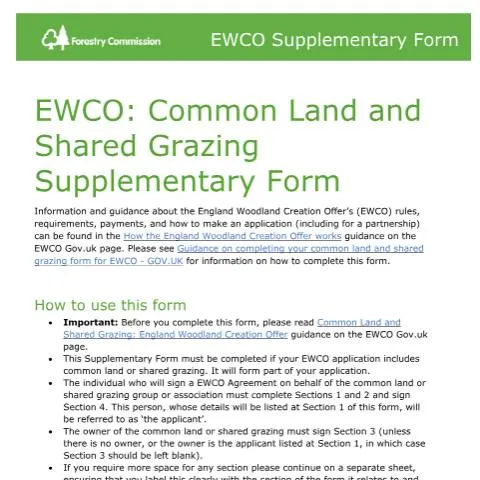
Navigating the England Woodland Creation Offer: Common Land and Shared Grazing Supplementary Form
Engaging with the forestry initiatives in England can be a significant step towards promoting sustainable land use and enhancing biodiversity. The Common Land and Shared Grazing Supplementary Form, part of the England Woodland Creation Offer (EWCO), serves as a conduit for landowners and groups who wish to integrate woodland creation into their common land or shared grazing schemes. Understanding this form is crucial for ensuring compliance with the EWCO guidelines and maximizing the benefits of the program.
Identifying Applicants and Their Responsibilities
The EWCO Supplementary Form is specifically designed for individuals representing common land or shared grazing groups. The person who will sign the EWCO Agreement must fill out this document. This individual is referred to as the applicant and must ensure that all sections are accurately completed and submitted alongside the main application.
Who Qualifies as an Applicant?
- Individuals or representatives of associations: Those who can legally represent a group of landowners or stakeholders.
- Landowners: If the owner of the common land is also the lead applicant, they must still complete the necessary sections of this form.
- Authorised agents: In cases where an agent is completing the form on behalf of the owner, they must have appropriate authorization documented.
Understanding the Role of Common Land and Shared Grazing
Common land and shared grazing areas have specific definitions under UK law. Common land refers to land where a limited number of people have the right to graze livestock, gather firewood, or carry out other activities. Shared grazing typically involves multiple landowners collectively managing a grazing area. The EWCO aims to enhance these areas by encouraging woodland creation, which can improve biodiversity, combat climate change, and provide additional income through grants.
Common Misconceptions
Many applicants may confuse this supplementary form with other forestry-related applications. The key difference lies in its specific focus on common land and shared grazing. Applications unrelated to these categories will require different forms and processes. It is crucial to consult the How the England Woodland Creation Offer Works guidance on the official government website for clarity on application requirements.
Step-By-Step Guide to Completing the Supplementary Form
Completing the EWCO Supplementary Form requires attention to detail. Each section is crafted to gather specific information that is pivotal for the success of the application. Below is a breakdown of the form's sections, detailing what is required from applicants.
Section 1: Applicant Authorisation
- Confirm that a letter authorising the applicant to sign on behalf of the group is attached.
- Ensure that this section is completed before advancing to the next parts of the form.
Section 2: Details of Common Land or Shared Grazing
This section collects essential data about the land in question:
- Provide the name of the common land or grazing area.
- List the Common Land Register Unit Number(s) if applicable.
- Indicate if the application pertains to the whole common or part-commons, with a clear acknowledgment of the requirements specified in the guidance.
Section 3: Declarations by Owners
Here, the landowner or their agent must declare their awareness and consent regarding the obligations related to the EWCO:
- Make sure that if the owner is unavailable, the agent has sufficient authorisation to make declarations on their behalf.
- Be aware that this section is crucial for validating the application and ensuring compliance with the EWCO requirements.
Best Practices for Submission
Once the form has been filled out, applicants have multiple options for submission. Each method carries specific considerations that may impact processing times and response outcomes.
Electronic Submission vs. Paper Forms
| Method | Advantages | Considerations |
|---|---|---|
| Electronic Submission | Faster processing times, instant confirmation of receipt. | Requires digital signatures for certain sections. |
| Paper Submission | Ability to include additional documentation easily. | Longer processing times, potential for postal delays. |
Regardless of the method chosen, applicants should always keep a copy of the submitted form and any accompanying materials for their records. This serves as a safeguard should any inquiries or issues arise post-submission.
Tackling Potential Pitfalls
Filling out forms can be daunting, especially when dealing with regulations surrounding land use. Applicants should be mindful of common pitfalls that can lead to delays or rejections.
Addressing Missing Information
- All relevant sections must be completed; leaving blanks can lead to automatic disqualification.
- If additional space is needed for any section, it’s crucial to clearly label any supplementary sheets with their corresponding section numbers.
Handling Refusals and Errors
If an application is refused or if there are discrepancies in the submitted form, applicants have recourse:
- Study the refusal letter closely to understand the reasons behind it.
- Check the guidance provided on the EWCO page for advice on how to rectify common issues.
- Consider appealing the decision if you believe that the refusal was unjustified. Guidance on appeals will be available through the Forestry Commission.
Following Up: What Comes Next?
After submission, applicants may wonder about the next steps. The EWCO team will review the application based on the information provided in conjunction with the guidelines. Here’s what to expect:
Review Process
- The Forestry Commission will assess the application, focusing on the accuracy of details and compliance with the prescribed requirements.
- Communication will typically be via email or post, confirming whether the application has been successful or if further information is needed.
Post-Application Support
Once an application is approved, the applicant will enter into an agreement with the Forestry Commission. This document will outline the responsibilities of both parties and the specific actions required to comply with the EWCO. Continuous communication with the Forestry Commission is encouraged to ensure smooth implementation of the agreed-upon activities.
Understanding Data Protection and Privacy Issues
As with any formal application, data protection is paramount. The Data Protection Act 2018 and UK GDPR provide regulations on how personal data is handled. Applicants must be aware of how their information will be processed and shared.
Key Considerations for Applicants
- Ensure that you have read the Personal Information Charter on the Forestry Commission's website to understand data handling practices.
- Inform any third parties involved about how their information may be used as part of the application process.
Being informed and prepared is essential for a successful application under the England Woodland Creation Offer. By understanding the intricacies of the Common Land and Shared Grazing Supplementary Form, applicants can effectively navigate the process and contribute to the sustainability of England's woodlands and grazing territories.
Understanding Common Land and Its Historical Context
Common land in England has a rich historical significance, serving as a communal resource for rural communities. These lands, often comprised of meadows, heathlands, and pastures, have allowed local populations to graze livestock, collect firewood, and harvest other natural resources. Under the Enclosure Acts, which began in the 18th century, many common lands were privatized, leading to significant social and economic shifts. Today, the concept of common land still exists, often governed by specific laws and regulations, and plays a crucial role in the contemporary landscape, particularly for environmental conservation and agriculture.
In the context of the England Woodland Creation Offer, understanding these historical roots is essential. The initiative aims not only to promote tree planting and biodiversity but also to consider the rights and traditions of common land users. Those who have historically grazed their livestock on common land may find that their practices intersect with new woodland creation initiatives, creating a potential for co-management strategies that balance conservation and traditional land use.
The Role of Local Authorities and Stakeholders in Woodland Creation
Local authorities play a pivotal role in the implementation of the England Woodland Creation Offer. They are tasked with assessing applications, ensuring compliance with local planning regulations, and facilitating community engagement throughout the process. This includes gathering feedback from stakeholders such as farmers, environmental groups, and community organizations, which is vital for the project's success.
Collaboration among various stakeholders enhances the effectiveness of woodland creation initiatives. Farming groups may offer insights into sustainable grazing practices that could coexist with new woodlands. Environmental NGOs can provide expertise in biodiversity management, while local councils can ensure that the interests of the community are adequately represented. This multi-faceted approach not only fosters cooperation but also helps mitigate potential conflicts between traditional land use and new environmental goals.
Challenges and Opportunities in Balancing Grazing and Woodland Expansion
While the England Woodland Creation Offer presents exciting opportunities for environmental restoration and carbon sequestration, it does not come without challenges. One major hurdle is the potential conflict between woodland expansion and traditional grazing practices. Grazing livestock on common land has long been a sustainable practice, but the introduction of woodlands may limit available grazing areas.
To address this, landowners and commoners can explore innovative approaches that allow for shared spaces. Agroforestry, for example, combines agriculture and forestry, enabling livestock to graze among trees, which can enhance the ecosystem while supporting economic viability for farmers. By fostering dialogue between woodland creators and common land users, it may be possible to design land-use strategies that benefit both parties.
Furthermore, funding provided through the England Woodland Creation Offer can be used to facilitate research and development into sustainable grazing practices and woodland management techniques. This collaboration can lead to best practices that not only address land use conflicts but also enhance biodiversity and resilience against climate change.