Understanding the Runoff and Soil Erosion Risk Assessment in Countryside Stewardship
The Runoff and Soil Erosion Risk Assessment form plays a crucial role for farmers and land managers participating in the Countryside Stewardship scheme. This document is not merely bureaucratic; it serves as a vital tool to assess potential environmental impacts stemming from agricultural practices. In the context of the UK’s commitment to sustainable land use, understanding how to navigate this document can aid in protecting natural resources and enhance biodiversity.
Key Stakeholders: Who Needs to Engage with This Assessment?
This assessment primarily targets farmers and landowners who are part of the Countryside Stewardship initiative, aimed at promoting environmentally beneficial farming practices. The following profiles are most relevant:
- Farmers managing land that may be at risk of runoff or soil erosion.
- Landowners looking to participate in conservation efforts through stewardship options.
- Environmental consultants assisting land managers in completing the assessment accurately.
Each of these stakeholders has a vested interest in ensuring that their land management practices do not lead to environmental degradation. Additionally, those involved in land use planning or environmental policy may also benefit from understanding this form and its implications.
The Regulatory Framework Behind the Risk Assessment
This document operates within a broader legislative context, framed by the Department for Environment, Food & Rural Affairs (DEFRA) and its associated bodies such as Natural England and the Forestry Commission. The assessment is informed by principles of the Environmental Protection Act and aligns with the UK’s ambitions for sustainable agriculture.
The legislative underpinnings dictate how land should be managed to prevent soil erosion and runoff. For instance, the Data Protection Act 2018 ensures that personal data shared during the assessment process remains secure, thus protecting the confidentiality of landowners.
Step-by-Step Breakdown of the Assessment Process
Completing the runoff and soil erosion risk assessment involves systematic evaluation across several parameters. Here’s how you can approach filling in this crucial document:
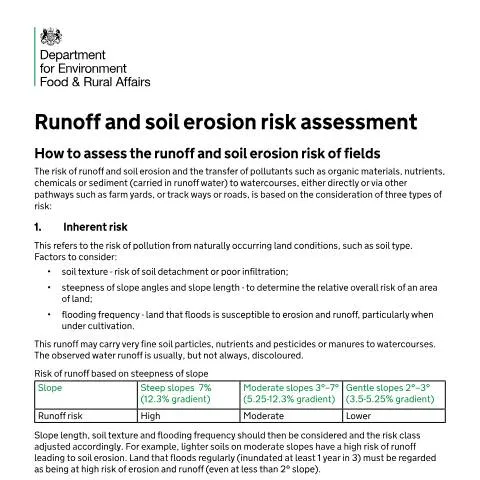
- Identifying Inherent Risk: Assess factors such as soil texture, slope steepness, and flooding frequency on your land. This initial screening helps determine the baseline risk of runoff.
- Evaluating Proximity to Water Bodies: Determine how close your fields are to rivers, ditches, or other watercourses, which can influence the risk of pollution transfer.
- Assessing Managed Risk: Review past runoff or ponding incidents in your fields. Your management practices and history should align with the historical context of the land to inform your risk status.
Factors Influencing Inherent Risk
Inherent risk is determined by a combination of land characteristics:
- Soil Texture: Lighter soils might have a higher detachment risk.
- Slope Assessment: Steeper gradients (over 7%) increase runoff risk significantly.
- Flood History: Regularly flooded areas must be assessed with higher caution.
Connection to Water Bodies
Understanding how your fields connect to water bodies is critical:
- Adjacent fields pose a higher risk while those with at least one intervening field may have moderate risk.
- Distant fields from watercourses generally indicate lower pollution risk.
Filling Out the Risk Assessment Form
Once you've assessed the risks, it’s time to document your findings. The form includes several sections where you must record the results of your risk evaluations. For each field parcel, you will indicate:
| Field Parcel | Inherent Risk | Connection to Waterbody | Managed Risk | Overall Risk |
|---|---|---|---|---|
| AB12345678 | Moderate | Little or no connection | Lower | Low |
| AB23456789 | High | Adjacent | Moderate | Moderate/High |
If you require additional space for recording, a separate continuation sheet is available.
What to Expect After Submission
Once you have submitted the runoff and soil erosion risk assessment, it is vital to know the potential next steps:
- Review Process: Your assessment will be reviewed by the relevant environmental authorities, who may contact you for clarification or additional information.
- Approval Notification: If your assessment meets the necessary criteria, you will receive confirmation that your stewardship application can proceed.
- Addressing Issues: In the case of queries or discrepancies, you may need to adjust your risk assessments or provide further documentation.
Dealing with Rejection or Queries
If your assessment is rejected or if you encounter questions from the reviewing body, consider the following steps:
- Request Feedback: Seek specific reasons for any rejection to address the concerns directly.
- Amend Your Assessments: If necessary, revise the risk assessments based on feedback and resubmit.
- Consult Colleagues: Engaging with fellow farmers or environmental consultants can provide valuable insights into improving your submission.
Special Considerations and Exceptions
For certain land managers, special considerations apply:
- Non-residents: If you manage land from outside the UK, ensure you understand the legal framework governing your operations.
- Complex Sites: Fields with unique features or historical agricultural practices may require tailored strategies for risk assessment.
- Emergency Planning: In times of extreme weather or unexpected events, a rapid risk assessment may be necessary to mitigate environmental harm.
Interplay with Larger Environmental Initiatives
The runoff and soil erosion risk assessment does not exist in isolation; it is part of a wider framework designed to promote sustainable agricultural practices. This form can influence eligibility for various Countryside Stewardship options aimed at enhancing environmental resilience. Land categorized as high risk may be prioritized for funding under conservation schemes, while those that do not demonstrate adequate risk management may find themselves ineligible for certain benefits.
In closing, navigating the complexities of the Runoff and Soil Erosion Risk Assessment requires diligence, attention to detail, and a proactive approach to managing land responsibly. For those involved in agricultural practices, this document not only safeguards the environment but also opens doors to valuable stewardship opportunities.
Understanding the Impacts of Soil Erosion on Agriculture
Soil erosion significantly affects agricultural productivity in the UK, particularly in vulnerable regions. Erosion can lead to the loss of topsoil, which is essential for crop growth. The main drivers of soil erosion include rainfall, wind, and human activities such as farming practices and land use changes. Therefore, understanding these impacts is crucial for farmers looking to engage in sustainable practices under the Countryside Stewardship scheme.
In regions where soil erosion is a concern, farmers might need to consider implementing contour farming, cover cropping, or reduced tillage techniques. These practices help to maintain soil structure, enhance moisture retention, and reduce runoff. When assessing soil erosion risk, it's essential to evaluate factors such as slope steepness, soil type, and rainfall patterns, which can all contribute to varying levels of erosion risk.
As part of the Countryside Stewardship scheme, land managers can receive guidance and financial incentives to adopt these sustainable practices. This not only aids in protecting the environment but also enhances the resilience of agricultural systems against the adverse effects of climate change. The practical application of these methods can lead to long-term benefits for both the land and those who depend on it for their livelihoods.
Evaluating the Effectiveness of Countryside Stewardship in Mitigating Soil Erosion
Assessing the effectiveness of Countryside Stewardship in addressing soil erosion involves monitoring changes in soil health, biodiversity, and water quality over time. Farmers enrolled in the scheme often implement conservation practices that are designed to reduce runoff and promote soil retention. Evaluating these practices can be done through a combination of field observations, soil sampling, and water testing.
One approach to evaluate the success of these stewardship practices is the establishment of 'control' and 'treatment' plots within a farm. Farmers can apply different conservation techniques on these plots and monitor the results over a set period. This method allows them to gather empirical data regarding which strategies yield the best results in terms of soil retention and reduced erosion.
The outcomes from these evaluations are not only beneficial for individual farmers but can provide valuable insights for policymakers and environmental agencies. By sharing successful strategies and techniques within local farming communities, the Countryside Stewardship scheme can create a collaborative effort to combat soil erosion across the UK.
Future Trends in Runoff and Soil Erosion Management
Looking ahead, the management of runoff and soil erosion will likely evolve with advancements in technology and changes in environmental policies. Precision agriculture, which utilizes data-driven techniques and automation, can significantly enhance the way farmers assess and manage soil erosion risks. Technologies such as drones and satellite imagery can provide real-time data on land use and soil conditions, enabling farmers to make informed decisions about erosion control measures.
Additionally, the integration of environmental data analytics can help to predict erosion risks based on weather patterns and soil characteristics. As data becomes more accessible and affordable, even smaller farms can adopt these technologies, improving their ability to manage soil erosion effectively.
Furthermore, collaborative initiatives between government agencies, agricultural organizations, and research institutions can facilitate the development of innovative solutions tailored to specific regional challenges. This collaborative approach can lead to the formulation of best practices and policies that enhance the resilience of agricultural soils against erosion while also promoting sustainable land management practices across the UK.